WhatsApp
 Eric.wang@ltzzc.com
 0086-379-69950051

Какие поворотные подшипники следует использовать в горнодобывающем оборудовании?
As critical components enabling rotational movement, supporting combined loads, and ensuring structural stability in heavy machinery, slewing bearings are widely utilized in excavators, mining cranes, bucket-wheel excavators, stacker-reclaimers, drilling rigs, and large-scale conveying equipment.
When procuring new machinery or sourcing replacement parts, many clients frequently pose the same question:
Какие поворотные подшипники следует использовать в горнодобывающем оборудовании?
The answer is not limited to a single specific model; rather, it requires a comprehensive assessment based on the equipment type, load requirements, installation space, operating frequency, environmental conditions, and maintenance protocols.
Как специализированный производительповоротные подшипники, LTZC has long provided the global mining industry with highly reliable bearing solutions. Drawing from the perspective of practical application, this article offers a detailed analysis of the slewing bearing types commonly used in mining equipment, tailored solutions for various machinery, scientific selection methodologies, and answers to frequently asked questions.
I. Which Slewing Bearings Are Typically Used in Mining Equipment?
1. Single-Row Four-Point Contact Ball Slewing Bearings
Оноднорядный четырехточечный шариковый поворотный подшипникstructure is the most widely applied type of slewing bearing in mining equipment. Its design features a single row of rolling balls that form a four-point contact structure with the raceway, enabling it to simultaneously withstand axial forces, radial forces, and overturning moments. Common applications include: small to medium-sized excavators, light-duty mining loaders, small rotating platforms, and auxiliary hoisting equipment.
Advantages of Single-Row Four-Point Contact Ball Slewing Bearings:
① Compact Structure; Saves Installation Space
For machinery with compact structural designs or limited platform space, this type of bearing offers high load-bearing capacity within a confined area.
② Effective Cost Control
Compared to roller-type structures, ball-type slewing bearings have more reasonable manufacturing costs, making them suitable for bulk purchasing and configuration in mid-range equipment.
③ Low Rotational Resistance
Steel balls have a lower rolling friction coefficient, resulting in lighter rotation and a reduced load on the drive system.
④ Easy Installation and Maintenance
Lightweight slewing bearings are better suited for rapid on-site replacement and routine maintenance.
LTZC Recommendation:
If a client's equipment primarily operates under moderate loads and standard working conditions, LTZC recommends prioritizing the four-point contact ball structure, as it offers an optimal balance between cost and performance.
2. Double-Row Ball Slewing Bearings
Ондвухрядный шариковый поворотный подшипник structure distributes the load across two rows of steel balls—an upper row and a lower row—thereby significantly enhancing axial load capacity and operational stability. Compared to single-row ball slewing bearings, double-row ball slewing bearings offer higher load-bearing capacity and superior stability.
Applications of Double-Row Ball Slewing Bearings:
Medium to large-sized stackers
Port ore ship loaders
Medium to large-sized mining rotary equipment
High-stability operating platforms
Advantages of Double-Row Ball Slewing Bearings:
① Higher Load-Bearing Capacity than Single-Row Structures: With two rows of steel balls sharing the load, the bearing is capable of supporting significantly larger vertical loads.
② Smoother Operation: Ideal for working conditions where equipment requires continuous, low-speed, and smooth rotation—such as the rotating platforms of stacker-reclaimers. ③ Superior Resistance to Eccentric Loads: The double-row ball structure offers greater stability when the equipment load is unevenly distributed.
④ Extended Service Life: Under conditions of long-term continuous operation, the rate of wear is significantly lower.
3. Three-Row Roller Slewing Bearings
Он three-row cylindrical roller slewing bearing is the most representative type of bearing for heavy-duty mining equipment, distinguished by its exceptionally high load-carrying capacity. It is also the most commonly used bearing type in large-scale mining machinery, enabling equipment to operate stably under extreme load conditions.
Applications of Three-Row Roller Slewing Bearings:
Ultra-large mining excavators
Crawler cranes
Bucket-wheel excavators
Ultra-large stacker-reclaimers
Heavy-duty port machinery
Advantages of Three-Row Roller Slewing Bearings:
① Extremely High Load-Carrying Capacity: The three rows of rollers independently bear axial forces, radial forces, and overturning moments; by performing their specific functions, they distribute loads with far greater efficiency than ball-type structures.
② Particularly Suitable for Impact Load Conditions: Mining equipment frequently encounters impact loads—such as those arising from excavation, hoisting, or collisions—and the roller-based structure offers superior stability in such scenarios.
③ Long Service Life: With proper lubrication and maintenance, the service life is significantly longer than that of standard bearing structures.
④ High Safety Factor: Ideal for high-value equipment and critical operational positions, thereby minimizing the risk of downtime.
LTZC Recommendation:
For large-scale mining clients prioritizing long-term operational stability, it is recommended to directly opt for the three-row roller structure or to consult directly with LTZC technical engineers for a customized design solution.
4. Cross-Roller Slewing Bearings
Вcross-roller slewing bearings, the rollers are arranged in a crisscross pattern at 90-degree angles within the raceway, establishing linear contact with the raceway. This design is characterized by high rigidity and high precision.
Applications of Cross-Roller Slewing Bearings:
Precision drilling equipment
Automated mining machinery
Intelligent rotary positioning platforms
Advantages of Cross-Roller Slewing Bearings:
① High Rotational Precision: Ideal for applications requiring high-precision positioning, such as drilling operations.
② High Rigidity: Exhibits minimal structural deformation and maintains high stability even under load.
③ Low Starting Torque: Suitable for equipment that undergoes frequent start-and-stop cycles.
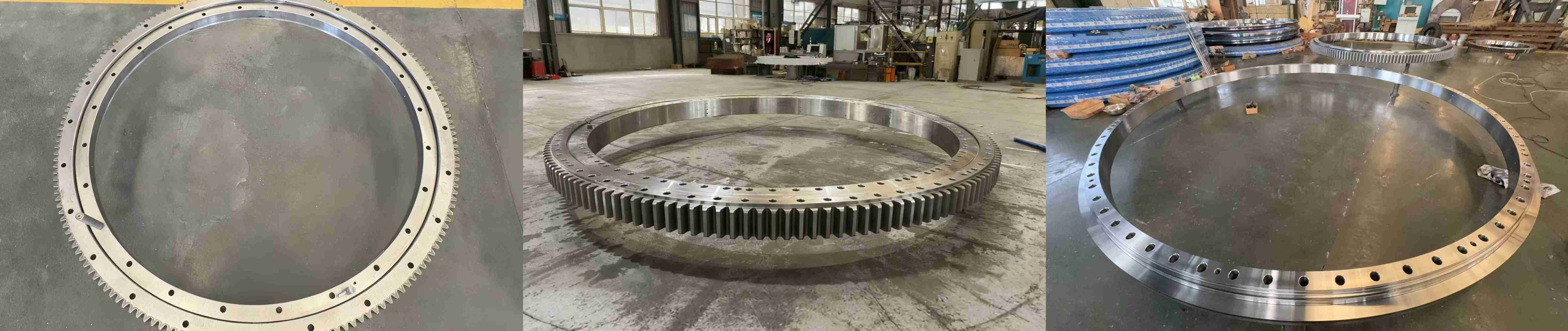
II. How to Select the Appropriate Slewing Bearings Based on Equipment Requirements?
Mining operations involve a wide variety of heavy machinery; therefore, selecting the appropriate slewing bearings requires looking beyond mere dimensions to consider the overall operating conditions.
1. Selection Based on Load
Key parameters to verify include: Axial Load (Fa), Radial Load (Fr), and Tilting Moment (M). For medium loads, a four-point contact ball bearing is recommended; for heavy loads, a double-row ball bearing is suitable; and for ultra-heavy loads, a triple-row roller bearing is the preferred choice.
2. Selection Based on Equipment Speed
Mining equipment typically operates at low speeds, though it often undergoes frequent start-and-stop cycles. Generally, low-speed, heavy-load applications require slewing bearings with a roller-type structure, while medium-speed, light-load applications are better suited for slewing bearings with a ball-type structure.
3. Selection Based on Environmental Conditions
Heavy-duty mining equipment must withstand complex operating environments characterized by high dust levels, significant temperature fluctuations, severe corrosion, and strong impact forces. These conditions place rigorous demands on the performance of the bearings, as well as their lubrication and sealing systems.
LTZC Mining Bearing Recommendations:
Enhanced sealing structures
Anti-corrosion surface coatings
High-performance lubricants
Regular maintenance programs
4. Selection Based on Installation Space
When the available design space within the equipment is limited, a thin-section four-point contact ball bearing is the more appropriate choice; conversely, when space is ample and the load is heavy, a triple-row roller bearing is recommended.
III. Mining Equipment Bearings FAQ
Q1: Which slewing bearings are best for mining equipment?
For heavy-duty mining equipment, three-row roller slewing bearings are recommended; for medium-sized equipment, a four-point contact ball structure is a suitable option.
Q2: How long does an excavator slewing bearing last?
With proper maintenance, a high-quality excavator slewing bearing can last 5 to 10 years, depending specifically on the operating conditions.
Q3: What is the best mining bearing for harsh environments?
Mining bearings featuring enhanced sealing, anti-corrosion coatings, and heat-treated raceways are best suited for harsh environments.
Q4: How do I choose a slewing ring for a crane?
Selection should be based on calculations involving the lifting capacity, working radius, overturning moment, and installation dimensions.
Q5: Can LTZC customize slewing bearings?
Yes, LTZC offers comprehensive customization options covering dimensions, gear profiles, materials, sealing systems, mounting hole patterns, and more.