WhatsApp
 jessica.chai@ltzzc.com
 0086-379-69950051

Dual-Worm Slewing Drives: When Do They Improve Stability?
As a slewing bearing engineer, one of the most common questions I receive from OEM design teams concerns drive architecture. Specifically, they ask: when is the added complexity and cost of a dual-worm system justified over a standard single-worm design? The answer depends entirely on the operational demands of the application, particularly the need to manage high tilting moment loads, frequent load reversals, and the requirement for near-zero backlash. While a single-worm configuration is sufficient for many applications, a dual-worm setup provides specific performance advantages that are indispensable for others.
Understanding this distinction is key to specifying a drive that ensures both performance and long-term reliability. Misapplication can lead to premature wear, positioning inaccuracies, or even catastrophic failure. This guide breaks down the functional differences and provides a framework for deciding which architecture best suits your equipment. At LTZC, we manufacture a range of Slewing Drives and have seen firsthand how the right selection impacts system stability, especially in heavy-duty machinery.
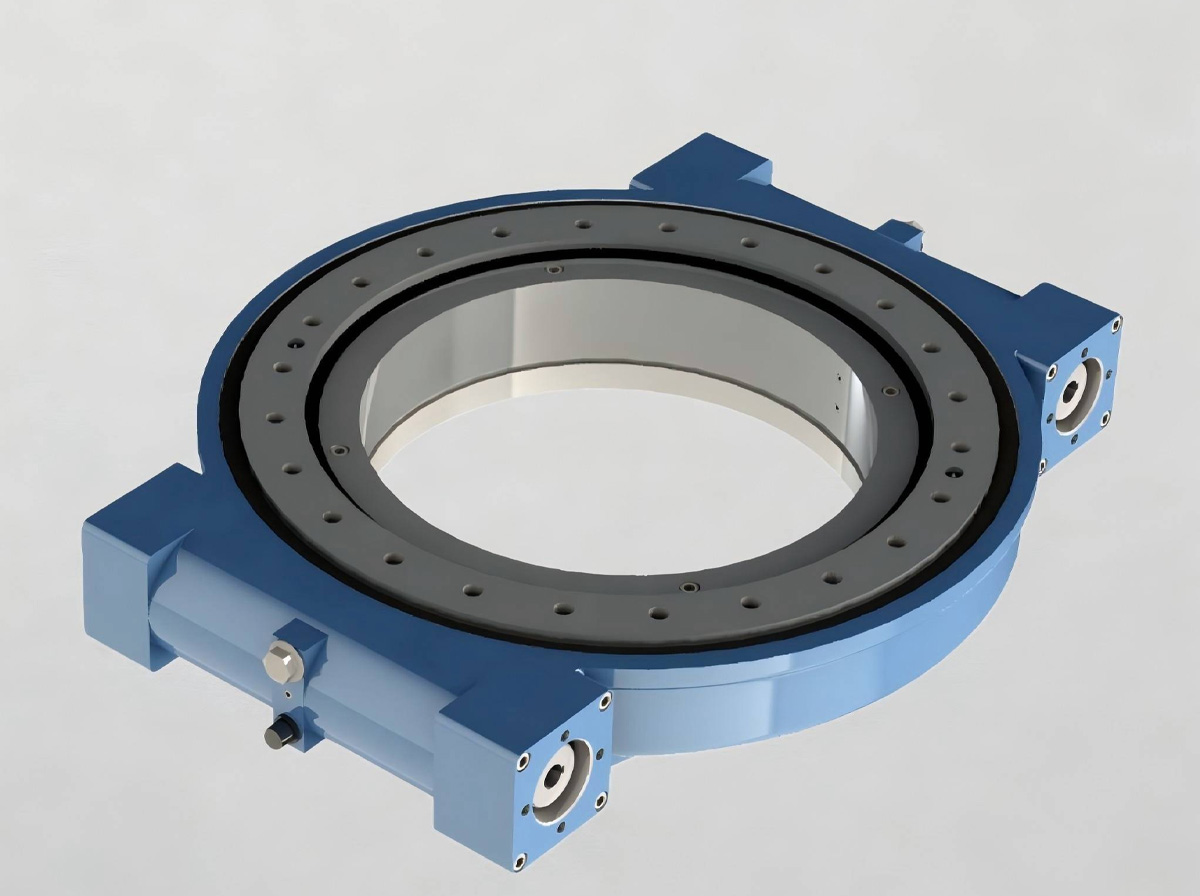
The Core Mechanics of Single-Worm vs. Dual-Worm Slewing Drives
The primary difference between these two architectures lies in how rotational force is transferred to the main slewing ring gear. A single-worm drive uses one worm shaft to engage the gear, while a dual-worm drive uses two, typically positioned opposite each other. This seemingly simple change has significant implications for load distribution, backlash, and overall system rigidity.
Here is a direct comparison of their key operational characteristics:
| Characteristic | Single-Worm Slewing Drive | Dual-Worm Slewing Drive |
|---|---|---|
| Torque Sharing | A single contact point bears the entire load, concentrating stress on one section of the worm and gear. | The load is distributed across two contact points, effectively doubling the tooth engagement area. This reduces stress on individual gear teeth and allows for higher output torque. |
| Backlash Control | Backlash is inherent and can increase with wear. While it can be minimized through precise manufacturing, it cannot be eliminated mechanically post-assembly. | One worm can be adjusted against the other, allowing for the precise mechanical elimination of backlash. This provides superior positional accuracy and is critical for applications requiring high precision. |
| Response to Wind Reversal | Sudden changes in load direction (e.g., wind gusts on a solar panel) can cause the gear to "chatter" within the backlash gap, leading to shock loads and wear. | With zero backlash, the gear is constantly engaged by both worms. This preloaded state prevents movement during load reversals, resulting in a much stiffer, more stable system that resists shock. |
| Synchronization Requirements | Not applicable, as there is only one input. | Requires precise synchronization between the two worm shafts (if independently driven) to ensure they share the load evenly. Improper synchronization can lead to binding and premature failure. Often, they are driven by a single motor with a split gearbox. |
| Complexity & Cost | Simpler design, fewer components, lower initial cost, and simpler maintenance. | More complex, requires more components (second worm, potentially more complex housing/gearing), leading to a higher initial cost and more involved maintenance procedures. |
Key Applications Where Dual-Worm Drives Excel
The theoretical benefits of a dual-worm drive translate into clear advantages in specific real-world applications. These are typically environments where precision and stability under variable, high-magnitude loads are non-negotiable.
Large-Scale Solar Trackers
For utility-scale solar farms, single-axis trackers can span hundreds of meters. The large surface area of the panel arrays acts like a sail, subjecting the drive system to immense and constantly shifting wind loads. A dual-worm drive provides the stiffness needed to prevent the panels from oscillating or "galloping" in the wind. This stability protects the structure from mechanical fatigue and ensures the panels maintain their optimal angle to the sun, maximizing energy production. The ability to eliminate backlash is key to resisting these micro-movements caused by wind gusts.
Aerial Work Platforms (AWPs) and Mobile Cranes
Safety and precision are paramount in AWPs. The boom's movement must be smooth and completely predictable, with no "slop" or "judder" when starting or stopping rotation. A dual-worm slew drive provides this level of positional control by eliminating backlash. It also distributes the high tilting moment loads generated by a fully extended boom with personnel and equipment in the basket. This enhanced load capacity and rigidity ensure stable operation, which is a critical safety factor when working at height. Our experience producing large-diameter bearings, such as the recent 10.87-meter slewing ring for 2,000-ton lifting equipment, gives us deep insight into the forces these drives must withstand in Construction & Heavy Machinery.
Satellite and Radar Antennas
In communication and defense applications, tracking antennas must be pointed with extreme accuracy. Any backlash in the drive system translates to a pointing error that can be significant over long distances. Dual-worm drives offer the near-zero backlash required for precise, repeatable positioning. The continuous engagement of the gear teeth ensures that the antenna remains locked on its target without drifting, even when subjected to external forces like wind.
Material Selection and Manufacturing Precision for High-Stability Drives
The performance of any slewing drive, whether single or dual-worm, is fundamentally tied to the quality of its materials and the precision of its manufacturing. A superior design executed with substandard materials or loose tolerances will fail to deliver the expected stability and longevity. As an ISO 9001:2015 certified manufacturer, we adhere to strict quality management standards from raw material sourcing to final assembly.
The choice of material is dictated by the load, environment, and performance requirements of the application. Here are some of the specialized materials we use for high-load drive components:
42CrMo: This alloy steel offers an excellent balance of strength, hardness, and wear resistance after heat treatment. It is a common choice for the worm shaft and the slewing ring gear in heavy-duty drives that must bear significant loads.
GCr15 / SUJ2: These high-carbon chromium bearing steels provide exceptional hardness and wear resistance, making them ideal for the rolling elements and raceways within the core slewing bearing.
CuSn6: This bronze alloy is often used for the worm wheel in certain configurations due to its good wear resistance and low-friction properties when paired with a steel worm.
Precision manufacturing is equally important. For a dual-worm drive to function correctly, the housing must be machined with high accuracy to ensure the two worms are positioned perfectly. Any misalignment will prevent proper load sharing and can cause binding. Our advanced production capabilities ensure the high precision and consistent quality necessary for these demanding assemblies.
A Decision Checklist: Is a Dual-Worm Slewing Drive Right for Your Project?
Use these questions to determine if the performance benefits of a dual-worm drive justify the investment for your specific design. If you answer "yes" to several of these, a dual-worm configuration is likely the appropriate choice.
Does your application require near-zero backlash for positional accuracy? (e.g., robotics, antenna pointing, precision indexing tables)
Will the equipment be subjected to frequent and rapid load reversals? (e.g., high wind loads on a solar tracker or crane boom)
Is the tilting moment load exceptionally high relative to the drive's size? (e.g., long-reach AWPs, cantilevered structures)
Is smooth, judder-free rotation under load a critical performance or safety requirement?
Does the drive need to hold a precise position without creep or drift under a constant, off-center load?
Is the higher initial cost acceptable to achieve a significant improvement in system stiffness and stability?
Answering these questions honestly will guide you toward the most effective and economical solution. For example, while a dual-worm drive offers superior performance for a large solar tracker, it would be over-engineered and unnecessarily expensive for a small, slow-moving industrial turntable operating indoors.
After-Sales Support: Ensuring Long-Term Stability and Performance
Selecting the right drive is only the first step. Proper installation, commissioning, and maintenance are essential for achieving and maintaining long-term operational stability. A poorly installed drive, regardless of its design quality, will not perform as expected. This is why we provide full after-sales support to our clients.
Our support services are designed to ensure your equipment operates reliably for its entire service life. This includes:
Installation & Commissioning Guidance: Our engineers provide expert advice on proper mounting procedures, bolt torque sequences, and initial backlash adjustments to ensure the drive is set up for optimal performance from day one. Proper bearing installation is fundamental.
Preventive Maintenance Training: We train your teams on correct lubrication schedules, inspection techniques, and signs of potential wear, helping you prevent unexpected downtime.
Fault Diagnosis & On-Site Support: If an issue arises, we respond quickly. Our policy is to reply to quality objections within 24 hours, with on-site service available within 48 hours in China to analyze the problem and implement a solution.
This commitment to partnership ensures that the stability designed into our slewing drives is realized in your final application.
If you are evaluating drive architectures for a high-load or high-precision application, our engineering team can help. Submit your technical specifications and operating conditions, and we can provide a detailed analysis and recommendation for a customized drive solution.