WhatsApp
 jessica.chai@ltzzc.com
 0086-379-69950051

How to Properly Evaluate a Slewing Ring Bearing Manufacturer RFQ
As a sourcing manager, you receive multiple quotations for a critical slewing ring. The unit prices are close, but one is slightly lower. Choosing the cheapest option seems logical, but it's often the single biggest mistake a buyer can make. A low initial price can conceal significant long-term expenses that inflate your total cost of ownership (TCO) and introduce operational risk. The key is to look beyond the per-unit figure and evaluate the full scope of what a potential precision slewing bearing partner offers.
In my 10 years as a slewing bearing engineer, I've seen firsthand how an incomplete RFQ analysis leads to costly downtime, premature failures, and emergency replacements. A truly competitive quote from a qualified slewing ring bearing manufacturer accounts for material integrity, proven manufacturing scale, and dedicated post-sales support—factors that protect your investment for years to come.
Beyond the Unit Price: A 5-Year Total Cost Model
The unit price is just the starting point. To accurately compare suppliers, you must project costs over the expected service life of the bearing. A five-year model exposes the hidden expenses that separate a low-cost supplier from a high-value partner. Before awarding a contract, break down each quotation into these distinct cost categories.
This framework helps you move from a simple price comparison to a strategic value assessment. A supplier with no minimum order quantity (MOQ), like LTZC, can significantly reduce your inventory holding costs, while one with proven large-scale production reduces the risk of costly project delays.
| Cost Category | Description & Key Questions to Ask | Potential Financial Impact |
|---|---|---|
| Unit Price | The quoted price per bearing. This is a confirmed cost but often represents only a fraction of the total investment. | Direct, immediate cost. |
| Tooling & NRE Costs | One-time costs for custom molds, fixtures, or engineering for a non-standard design. Is this cost amortized or a separate line item? | Can add 5-20% to the initial project cost. A supplier with flexible capabilities may have lower NRE. |
| Testing & Certification | Costs for material analysis, dimensional reports, NDT, and third-party certifications (e.g., ABS, CCS). Are these included or extra? | Failure to secure proper certification can halt projects and lead to non-compliance penalties. |
| Freight, Duties & Packaging | Estimated costs for international shipping, import tariffs, and specialized crating for large or sensitive bearings. Does the packaging protect against corrosion and impact? | Can fluctuate significantly. Poor packaging can lead to damaged goods and costly claims. |
| Replacement & Downtime Risk | The estimated cost of premature failure. This includes the price of a new bearing, labor for replacement, and lost operational revenue during downtime. A supplier's quality record directly impacts this risk. | This is the highest potential cost, often exceeding the initial purchase price by 10x or more. |
Matching Material Specifications to Your Application and Budget
The material selected for your slewing ring is a primary driver of both its performance and its price. A manufacturer offering a limited range of materials may force you into a solution that is either over-engineered and expensive or under-engineered and prone to failure. A capable partner will guide you to the optimal material based on load, environment, and operational life requirements.
Our engineering team regularly consults with clients to specify materials for their unique working conditions, ensuring they don't pay for properties they don't need. Below is a comparison of common materials used in our ISO 9001:2015 certified facility.
- GCr15 / SUJ2: This is the workhorse for many standard ball and roller bearings. It offers excellent hardness and wear resistance for high-load applications where corrosion is not the primary concern. Its cost-effectiveness makes it a default choice for general industrial machinery.
- AISI 440C: When your equipment operates in marine, food processing, or other corrosive environments, the chromium content in 440C stainless steel provides necessary corrosion and oxidation resistance. It carries a price premium but prevents premature failure from rust.
- 42CrMo / 20CrMo: For heavy-duty applications like cranes, excavators, and mining equipment, these alloy steels are through-hardened or case-hardened to achieve superior strength and toughness, handling shock loads that would fracture standard bearing steel. This is essential for a Large Slewing Bearing.
- Ti-6Al-4V: In aerospace and other high-performance sectors, this titanium alloy is specified for its exceptional strength-to-weight ratio and high-temperature resistance. It is a premium material for applications where every kilogram matters.
Assessing a Manufacturer’s Proven Capability and Quality Systems
Any supplier can claim to produce high-quality bearings. A reliable slewing ring bearing manufacturer provides verifiable proof. When evaluating potential partners, your due diligence should extend beyond their website to their documented quality management systems and, most importantly, their track record with real-world, large-scale projects.
Look for concrete evidence of their capabilities. For instance, our quality system is not only certified to ISO9001:2015 but also to ISO14001:2015 and ISO45001:2018, with approvals from classification societies like ABS and CCS. This demonstrates a commitment to quality, safety, and environmental standards.
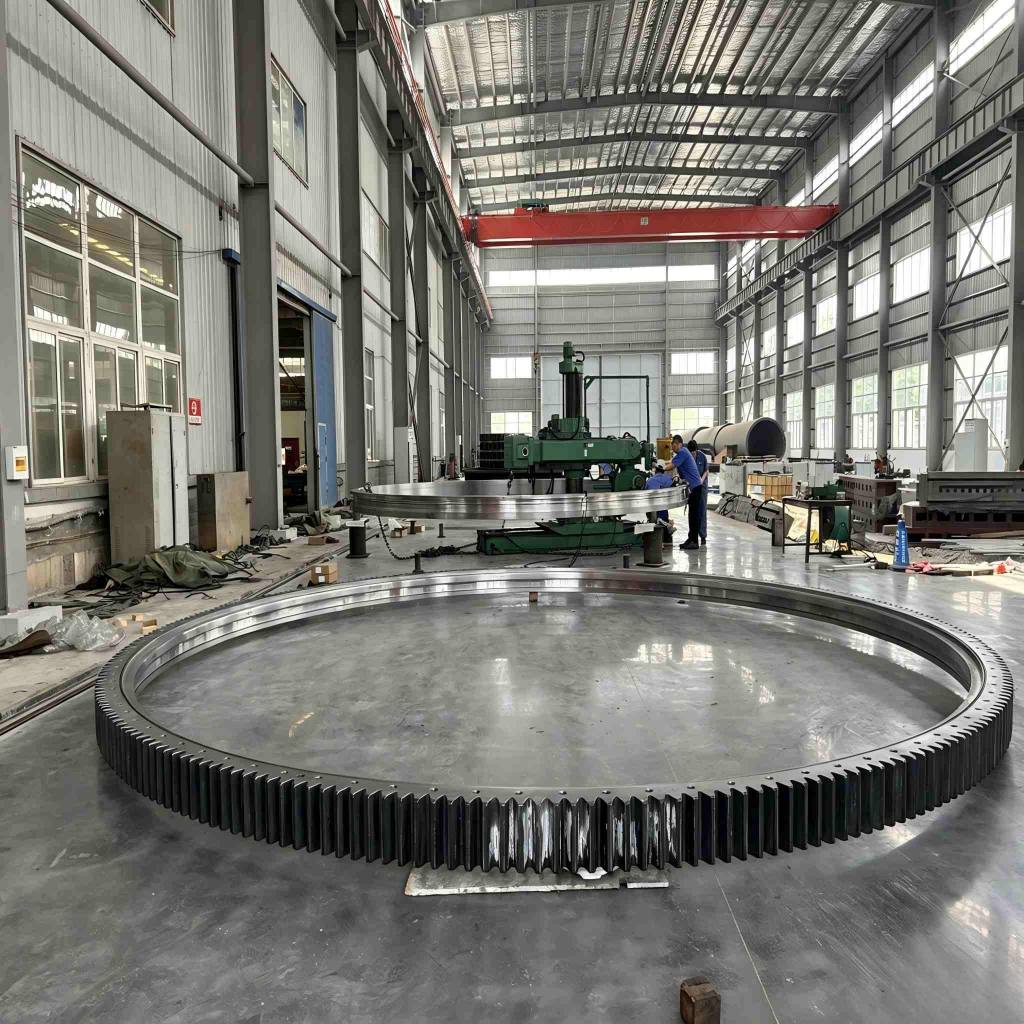
However, the ultimate proof is in the execution. In 2024, LTZC set a new company record by delivering a 10.87-meter outer diameter integral three-row roller slewing ring for 2,000-ton lifting equipment. We also recently produced an 8.445-meter OD integrated bearing for a major crane industry client in South Korea. These are not theoretical capabilities; they are successfully delivered projects. Other examples include:
- 8-meter high-precision segmented gear rings for Wuhan Heavy Industry's national friction stir welding project.
- Complete sets of shield machine main drive ring rolls for CRCC.
- The 3-meter turntable bearing supporting the main torch for the World Military Olympic Games opening ceremony.
When a manufacturer can point to specific, complex projects of this scale, it provides a high degree of confidence that they can manage the technical and logistical challenges of your order.
The Hidden Value of Comprehensive After-Sales Support
The transaction doesn't end upon delivery. The long-term performance of your equipment depends on proper installation, maintenance, and troubleshooting. A supplier who disappears after shipping leaves you exposed to significant operational risks. The cost of a single day of unplanned downtime on heavy machinery can easily surpass the entire cost of the bearing itself.
True partners invest in your long-term success. Evaluate a manufacturer's post-sales support infrastructure. Do they offer the following?
- Installation & Commissioning Guidance: Incorrect installation is a leading cause of premature bearing failure. On-site or remote guidance from an experienced engineer ensures proper mounting, preloading, and lubrication from day one. Proper bearing installation is critical.
- Preventive Maintenance Training: Training your team on correct lubrication schedules, bolt torque checks, and seal inspection can dramatically extend the bearing's service life and prevent catastrophic failures.
- Fault Diagnosis & On-Site Support: When an issue arises, you need fast and effective support. At LTZC, we commit to responding to quality objections within 24 hours and can dispatch on-site service within 48 hours in China. This level of responsiveness is a crucial part of the value proposition.
This support system is an insurance policy against extended downtime. It should be a significant factor in your TCO calculation and supplier selection process, especially for critical, high-load equipment.
Choosing the right slewing ring bearing manufacturer requires a shift in perspective—from chasing the lowest unit price to investing in the lowest total cost of ownership. By analyzing material science, verifiable manufacturing history, and the depth of after-sales support, you can forge a partnership that delivers reliability and value long after the initial invoice is paid.
If you require a quotation that reflects true long-term value, submit your technical drawings and operating conditions to our engineering team for a comprehensive analysis.