WhatsApp
 jessica.chai@ltzzc.com
 0086-379-69950051

Choosing the Right Crane Slewing Bearing Reduces Fleet Downtime
A cracked raceway at month 18 is the kind of surprise no fleet manager wants. By the time a crane operator reports grinding noise or play in the slew ring, the machine is already parked, and every day it sits idle costs far more than the bearing itself. Before you place an RFQ for a replacement crane slewing bearing, you need to know whether the lowest quote actually protects your uptime, or just shifts the cost further down the schedule. This article walks through the real cost drivers, the bearing types that match different duty cycles, and the questions to ask a supplier before you commit.
Why Crane Downtime Usually Starts at the Bearing
Slewing bearings carry axial load, radial load, and tilting moment simultaneously, which is a demanding combination compared to a standard ball bearing. When a bearing is undersized, poorly hardened, or mismatched to the gear ring pitch, wear accelerates long before the rated fatigue life is reached. The failure rarely looks dramatic at first. It shows up as increased backlash, uneven rotation torque, or lubricant that turns dark and gritty within a few months.
Common sourcing mistakes that lead to premature failure include:
Selecting a bearing by bolt pattern alone, without checking load rating against actual crane duty class.
Accepting a gear ring module that does not exactly match the existing slewing ring gear, causing uneven tooth loading.
Skipping hardness and tolerance data in the quote, so there is no way to verify raceway quality before shipment.
Choosing a shorter lead time over a documented quality process, then absorbing a field failure six months later.
Ignoring seal design for the crane's operating environment, which lets in moisture or dust on outdoor sites.
None of these mistakes show up on the invoice. They show up on the maintenance log, usually at the worst possible time in a project schedule.
Five-Year Ownership Cost Model for a Crane Slewing Bearing
Price-per-unit is the only number most buyers compare at RFQ stage. But a slewing bearing is a structural component that typically stays in service for years, so the purchase price is only one line in a larger cost picture. Below is a cost model built around two sourcing paths: a lower-upfront-price bearing and an engineered, application-matched bearing. Some figures are confirmed facts from standard industry practice (labor hours, crane downtime patterns); others are reasonable estimates and are marked as such. Treat the estimated figures as planning ranges, not guarantees.
| Cost Factor | Lower-Price Bearing | Engineered/Matched Bearing | Status |
|---|---|---|---|
| Unit purchase price | Lower, often 15-30% below engineered quote | Higher upfront | Confirmed (typical market spread) |
| Expected service life before replacement | Shorter, higher variance | Longer, more consistent | Estimated (depends on load/duty) |
| Replacement labor (rigging, removal, reinstall) | Repeated sooner | Deferred further out | Estimated |
| Crane downtime per replacement event | Full cycle, same as right-hand column | Full cycle, same as left-hand column | Confirmed (labor hours are similar regardless of brand) |
| Lead-time risk for urgent replacement | Variable; depends on supplier stock and 30-90 day production cycles | Same lead-time range, but fewer urgent orders over 5 years | Confirmed (LTZC standard lead time is 30-90 days) |
| Unknown / site-specific factors | Environmental exposure, duty cycle severity, lubrication discipline | Same unknowns apply | Unknown — must be assessed per project |
The practical takeaway: if your crane runs light duty indoors with a strict lubrication schedule, a lower-price bearing may reach its rated life without issue. If your crane runs continuous outdoor duty, heavy tilting moment, or a project where a breakdown halts a whole site, the engineered option usually wins on five-year cost, because downtime and labor repeat with every premature failure. This model doesn't apply if you're replacing a bearing on equipment nearing retirement, where a lower-cost bridge solution can make sense for the remaining service window.
Matching Bearing Type to Crane Duty Cycle
Not every crane slewing bearing is interchangeable in function, even when the bolt circle matches. The internal row configuration determines how load is distributed and how the bearing behaves under combined moment loading.
| Bearing Type | Best Fit | Limits |
|---|---|---|
| Single-row four-point contact ball | Light to medium tower cranes, smaller mobile cranes | Lower moment capacity, not for heavy tilting loads |
| Double-row ball | Medium duty cranes needing higher axial capacity | More complex seal design, higher unit cost |
| Three-row roller | Heavy lift cranes, port equipment, high moment loads | Larger envelope, higher weight, longer lead time |
| Cross roller | Compact installations needing precision rotation | Not ideal for very heavy radial loads |
If you're unsure which configuration fits your existing crane, a bearing selection guide is a useful first check before sending drawings for quotation. For retrofit projects, our engineers also review existing housing dimensions against a thin section bearing option when radial space is limited, which is common on compact rotator and work-platform designs.
Buyer's Decision Checklist Before You Send an RFQ
Use this checklist to evaluate a quote before committing budget to a replacement bearing:
Does the quote specify raceway hardness and case depth, not just outer dimensions?
Is the gear module and tooth count on the slewing ring gear confirmed against your original OEM drawing?
What quality system does the supplier operate under — ask directly whether they hold ISO9001:2015 certification, and request the certificate.
Is there a minimum order quantity, or can you order a single replacement unit without inflating cost per piece?
What is the realistic production and shipping lead time, and does it fit your maintenance window?
Can the supplier support custom flange dimensions if your mounting interface has been modified from OEM spec?
LTZC works without a minimum order quantity and operates under ISO9001:2015, ISO14001:2015, and ISO45001:2018 systems, with certification also held through CCS and ABS. Standard production and delivery runs 30 to 90 days depending on size and configuration, which matters most for fleet managers planning a scheduled bearing swap rather than reacting to an unplanned failure.
Installation and Maintenance Practices That Extend Service Life
A correctly specified bearing can still fail early if it's installed or maintained incorrectly. The most frequent field issues we see reported are uneven bolt torque sequence, contamination during mounting, and extended lubrication intervals that exceed the manufacturer's recommendation.
A basic installation sequence that reduces early failure risk:
Inspect the mounting surface for flatness before setting the new bearing — warped structure transfers stress unevenly into the raceway.
Torque mounting bolts in a star pattern, in stages, rather than sequentially around the circle.
Rotate the bearing through a full cycle after initial torque, then re-check bolt tension.
Apply grease at the specified interval, not just at installation — most premature wear traces back to dry running periods.
Record rotation torque at commissioning as a baseline, so future increases in torque signal wear before total failure.
Detailed procedures, including torque values and seal replacement guidance, are covered in our bearing installation documentation. For cranes running continuous duty with electric or hydraulic rotation drives, pairing the bearing selection with the correct Slewing Drives gearbox ratio also reduces uneven load distribution across the gear teeth, which otherwise shortens bearing life independent of the bearing's own rating.
When a Standard Bearing Doesn't Fit Your Crane
Older cranes and modified equipment sometimes don't match any catalog bearing dimension. In these cases, reverse-engineering from the worn part, rather than guessing from a parts manual, produces a better fit. LTZC's production process supports custom sizes, materials, and flange configurations through our non-standard bearings service, built from your working conditions and existing dimensions rather than a fixed catalog range. This matters most for fleet owners running mixed equipment ages, where sourcing an exact OEM match is no longer possible.
For new builds or major refits, a precision slewing bearing engineered to your load spectrum from the start avoids the retrofit guesswork altogether.
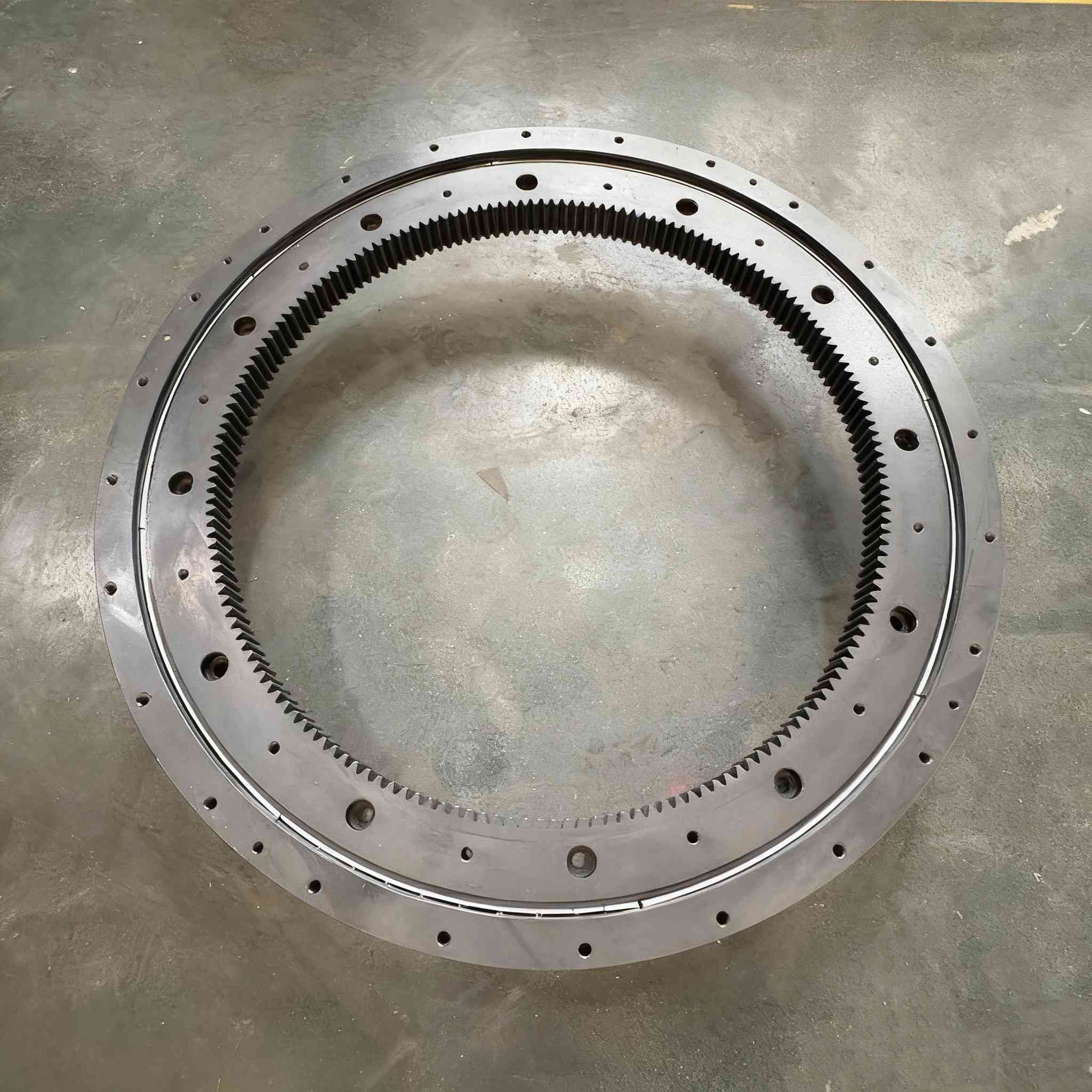
If you're planning a replacement cycle or specifying a bearing for a new crane build, send us your load data, housing dimensions, or existing drawings. Our engineering team can confirm fit, recommend bearing type, and provide a lead-time estimate before you commit to an order.