WhatsApp
 jessica.chai@ltzzc.com
 0086-379-69950051

How to Accurately Budget for Sourcing from a Chinese Slewing Bearing Manufacturer
As a slewing bearing engineer with over a decade of experience, I've seen many international procurement teams make the same critical error: they mistake a low FOB price for the final cost. When sourcing from a Chinese slewing bearing manufacturer, the initial quote is only the beginning of the story. Failing to account for logistics, duties, quality assurance, and potential risks can turn a seemingly good deal into a significant budget overrun. The key is to understand your total landed cost before you commit.
This isn't just about avoiding financial surprises; it's about ensuring your project timelines and equipment performance are protected. A low unit price means nothing if the bearing arrives damaged, fails prematurely, or gets held up in customs. At LTZC, we believe a transparent partnership starts with a clear understanding of all the costs involved in getting a high-quality precision slewing bearing from our factory floor to your assembly line.
Deconstructing the Quote: Beyond the Unit Price
Most initial quotations from suppliers in China are provided on Free on Board (FOB) terms. This means the seller’s price covers the cost of the product plus delivering it to the designated port of departure. The responsibility—and all subsequent costs—then transfers to you, the buyer. This is where the budget can quickly unravel if you haven't planned for the full journey.
The true measure of your investment is the landed cost. This figure represents the total expense of acquiring the product and getting it to your final destination. It includes not just the purchase price but every associated charge along the supply chain. For highly engineered components like large-diameter slewing rings, these "other" costs can be substantial.
One factor that significantly influences your initial cost calculation is the Minimum Order Quantity (MOQ). Many manufacturers impose high MOQs to make production runs efficient, forcing you to purchase more than you need. This is a particular challenge for projects requiring a single, large custom bearing or a small batch for a prototype. Recognizing this, we operate with no MOQ. This flexibility allows you to procure exactly what your project requires, whether it's a one-off custom part or a larger production run, without inflating your initial outlay.
Calculating Your Total Landed Cost: A Step-by-Step Formula
To create an accurate budget, you must break down every potential expense. Use the following formula and checklist to ensure no cost is overlooked. Thinking through each component will help you compare supplier quotes on a true "apples-to-apples" basis.
Total Landed Cost = (Product Cost) + (Logistics & Transport Costs) + (Import & Compliance Costs) + (Quality & Risk Mitigation Costs)
Here is a detailed breakdown of what to include in each category:
| Cost Component | Description & Key Considerations |
|---|---|
| Unit Price x Quantity | The base price of the bearings. Confirm if the price is volume-dependent and how custom specifications affect it. Our no-MOQ policy simplifies this for non-standard orders. |
| Export Packing | Large, heavy slewing bearings require specialized, robust crating to prevent damage during transit. This is not a place to cut corners. Ensure the quote includes seaworthy packaging. |
| Inland Freight (China) | The cost to transport the goods from the factory to the port of departure (e.g., Shanghai, Qingdao). This is typically included in an FOB price. |
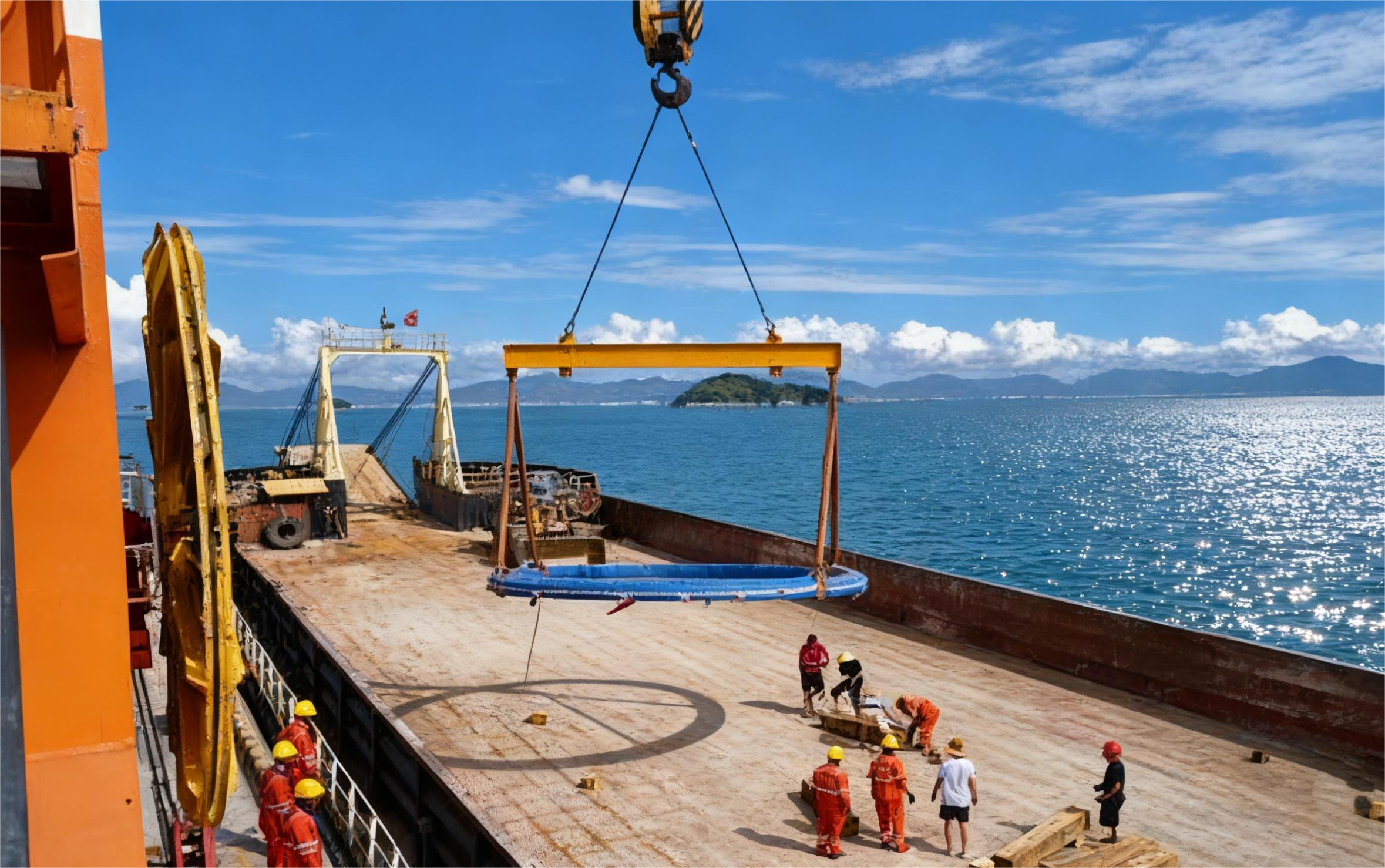
| Ocean/Air Freight | The primary transportation cost. Ocean freight is more economical for heavy items but has longer lead times (our standard delivery is 30-90 days). Air freight is faster but significantly more expensive. |
| Freight Insurance | Essential protection against loss or damage during transit. The cost is usually a small percentage of the goods' value but is critical for high-value components. |
| Customs Duties & Taxes | These are determined by your country's import regulations and the Harmonized System (HS) code for slewing bearings. Tariffs can vary widely by country, so consult a local customs broker for an accurate estimate. |
| Port & Handling Fees | Includes terminal handling charges, documentation fees, and customs brokerage fees at the destination port. These can add up and are often overlooked. |
| Rejection/Quality Buffer Cost | This is a crucial, often-unbudgeted risk factor. What is the cost to your project if a bearing fails inspection upon arrival? This includes potential rework, replacement, shipping a new part, and project delays. Working with an ISO9001:2015 certified partner significantly reduces this risk. |
How Material Selection Impacts Cost and Performance
The material you choose for your bearing is one of the most significant drivers of both unit cost and long-term performance. Selecting a material that is over-specified for your application can needlessly inflate your budget, while an under-specified material can lead to premature failure and costly downtime. As an experienced Customized Bearings manufacturer, we guide clients through this decision based on their specific operating conditions.
Here is a comparison of common materials used in slewing bearing manufacturing and their typical applications:
| Material | Key Properties | Common Applications | Relative Cost |
|---|---|---|---|
| GCr15 / SUJ2 | High hardness, excellent wear resistance, and high strength. The standard for most bearing applications. | General industrial machinery, rollers, ball bearings, Construction & Heavy Machinery. | $ |
| 20CrMo / 42CrMo | Alloy elements improve strength, hardness, and wear resistance compared to standard bearing steel. | Bearings under heavy or shock loads, such as those in mining equipment or large cranes. | $$ |
| AISI 440C | Good corrosion and oxidation resistance. Hardness is slightly lower than GCr15. | Marine environments, food processing equipment, applications exposed to moisture. | $$$ |
| CuSn6 (Bronze) | Good wear resistance and thermal conductivity. Often used for cages or separators within the bearing assembly. | Bearing cages, especially in applications with specific lubrication or friction requirements. | $$ |
| Ti-6Al-4V (Titanium Alloy) | Lightweight, high strength-to-weight ratio, and excellent high-temperature resistance. | Communication & Aerospace Slewing Bearings, high-performance robotics, and defense applications. | $$$$$ |
Verifying Supplier Capability to Mitigate Long-Term Costs
The most significant costs are often hidden ones that appear long after delivery. Downtime, maintenance, and premature replacement due to poor quality can dwarf any initial savings from a low-cost supplier. Verifying a potential partner’s technical capabilities and quality systems is the best way to protect your long-term investment.
Use this checklist during your evaluation process:
Quality Management Systems: Does the manufacturer hold internationally recognized certifications? Our operations are certified under ISO9001:2015 for quality management, alongside ISO14001:2015 (environmental) and ISO45001:2018 (occupational health and safety). These are not just papers on a wall; they represent a systematic commitment to consistent, repeatable quality.
Proven Track Record with Complex Projects: Ask for evidence of their work. A supplier's ability to produce standard-sized bearings doesn't guarantee they can handle large or complex designs. For example, in 2024, LTZC successfully delivered an integral three-row roller slewing ring with an outer diameter of 10.87 meters for a 2,000-ton lifting crane. We also produced an 8.445-meter integrated bearing for a major crane client in South Korea. These projects demonstrate a proven capability in large-scale, high-precision manufacturing.
In-House Capabilities and Facilities: What is the scale of their operation? With a 20,000 m² facility established in 1992, we have the space, equipment, and experienced team to manage projects from raw material to finished product.
Technical and After-Sales Support: What happens if you encounter an issue during or after installation? A reliable partner provides comprehensive support. We offer full post-sales service, including guidance on bearing installation, preventive maintenance training, and fault diagnosis. We guarantee a response to quality concerns within 24 hours and can initiate on-site service within 48 hours in China.
Choosing the right Chinese slewing bearing manufacturer is a strategic decision that goes far beyond comparing unit prices. By calculating your total landed cost and thoroughly vetting a supplier's capabilities, you can build a reliable supply chain, protect your budget, and ensure the long-term performance of your heavy-duty equipment.
To receive a transparent quote that details the costs for your specific project, submit your technical specifications to our engineering team for a full review.