WhatsApp
 jessica.chai@ltzzc.com
 0086-379-69950051

Compare Double Row Roller Slewing Ring Quotes
The cheapest line on a spreadsheet is often the one a buyer regrets most. Three weeks after the purchase order, someone finds that heat treatment records were never included, that the gear cut is priced separately, or that freight and crating were left out. If you are reviewing offers for a Double Row Roller Slewing Ring, the unit price is only the first number to check, and often the least reliable one.
This guide shows how to make quotes from different manufacturers comparable, how to separate confirmed costs from estimates and unknowns, and which questions expose risk before you commit.
Why two quotes for the same drawing are rarely the same product
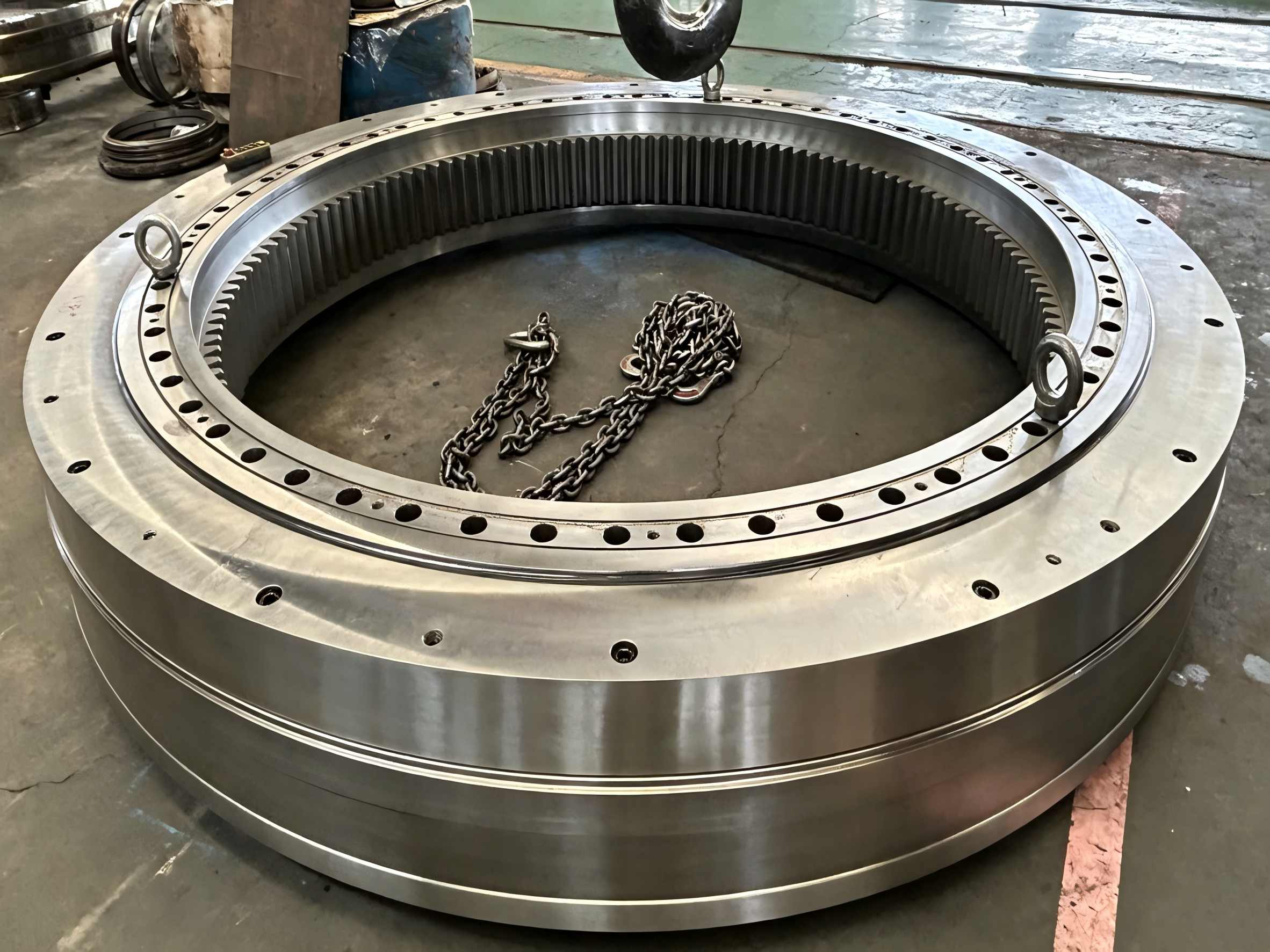
Two suppliers can receive identical drawings and return prices 20% apart. The gap usually comes from scope, not efficiency. One supplier may quote a forged ring with a hardened raceway and full inspection. Another may quote a bare minimum that matches the drawing on paper but omits tests you assumed were standard.
Conclusion: never compare prices until scope is normalized. Reasoning: a slewing ring is a made-to-order part, so every supplier fills the gaps in your specification with its own assumptions. Fits: any RFQ with two or more bidders. Limit: if you buy a repeat part from a supplier whose scope is already documented, a full normalization is unnecessary.
Line items every quote must state
Ask each bidder to fill in the same table. Anything left blank counts as "not included" until confirmed in writing.
| Item | What to ask | Red flag |
|---|---|---|
| Ring material and grade | Exact grade (for example 42CrMo or 20CrMo) and whether forged | "Alloy steel" with no grade |
| Heat treatment and raceway hardening | Process, hardened depth requirement, and record format | No records offered |
| Gear cut | Included or separate, module, and whether teeth are hardened or ground | Gear priced as an option after PO |
| Rolling elements, cage, seals | Material and supplier of rollers, seal type | Unspecified "standard" parts |
| Preload and clearance | Target value and how it is checked | No mention at all |
| Inspection and test reports | Dimensional report, hardness test, material certificate | Reports quoted as extra |
| Packing and incoterm | Crating type, EXW, FOB or CIF, port named | Price with no incoterm |
| Lead time | Days from drawing approval or from deposit | A single vague "short lead time" |
| Warranty terms | Duration, start date, what is excluded | Warranty only in verbal form |
A landed cost comparison method for slewing ring quotes
A landed cost comparison separates unit price from tooling, inspection, freight, and warranty risk. It also forces you to label each number by how certain it is. Use three categories and never mix them.
- Confirmed costs: stated in the written quote, with scope and incoterm. You can compare these directly.
- Estimated costs: your own or a forwarder's projection, such as freight to your port, duties, or third party witnessing fees. Mark each one "estimate" and record the source.
- Unknown costs: items nobody can price yet, such as warranty claim handling, rework after a failed inspection, or downtime from a late delivery. List them as open risks. Do not assign a made up number to hide the gap.
| Cost block | Quote A | Quote B | Status |
|---|---|---|---|
| Unit price | 100 | 112 | Confirmed |
| Tooling and fixtures | Not stated (assume extra) | Included | A unknown, B confirmed |
| Inspection and reports | Not stated | Included | A unknown, B confirmed |
| Freight and crating | EXW, to be arranged | FOB port named | Both estimated |
| Warranty terms | Verbal only | Written terms | A open risk |
The figures above are an illustrative index for explaining the method. They are not LTZC prices.
In this example, Quote A looks 12 points cheaper. Once you list what it leaves out, the gap is not a saving. It is a set of questions you have not asked yet. If Quote A then confirms tooling and inspection at a lower cost than Quote B, it may still win. The method does not pick the expensive supplier. It picks the one whose total you can actually defend.
Limit: this approach adds a few days to the evaluation. For urgent replacements where downtime costs more than any price difference, you may shorten it to scope, lead time, and warranty only.
Technical points that legitimately change the price
Some price differences are justified. Learn to tell them from omissions.
Material and heat treatment
Alloy steels such as 42CrMo and 20CrMo gain strength, hardness, and wear resistance from their alloying elements, which suits heavy loads. If one bidder quotes a different grade, ask why. A cheaper grade may be fine for a light duty application and wrong for a crane that lifts near its rated limit.
Gear and tooth finish
Gear scope varies widely. Cut teeth, hardened teeth, and ground teeth have different costs and different service lives. Our segmented gear ring supplied to a Hengshui customer, 6 meters in outer diameter with ground teeth, is an example of a spec where the finishing step carries real weight in the price. If you need a matching slewing ring gear, state the tooth requirements in the RFQ so every bidder prices the same thing.
Structure fit to the load case
Check that each quote matches your load case. If a supplier proposes a different row arrangement than your drawing, treat it as a design change, not a discount. For large equipment, the bearing selection guide can help you confirm that the structure suits your axial, radial, and moment loads before you compare prices.
Common mistakes when comparing quotes
- Comparing different incoterms. EXW against CIF is not a price comparison.
- Accepting "as per drawing" as full scope. Drawings rarely cover inspection, packing, or documentation.
- Ignoring the lead time start date. Days from drawing approval and days from deposit can differ by weeks.
- Treating a freight estimate as a quote. Large rings need special crating and sometimes special transport. Get a forwarder's figure for your actual dimensions.
- Leaving installation out of the cost. Poor mounting surfaces or bolt tightening errors can shorten ring life regardless of how well it was made. Plan for proper bearing installation support.
- Choosing on price when a supplier has not made your size. Ask for a comparable reference.
A five step procedure to review offers
- Freeze the specification. Send one drawing and one scope sheet to every bidder, including material, hardness, gear, test, and packing requirements.
- Normalize the incoterm. Ask all bidders to quote to the same named port.
- Fill the landed cost table. Label every number confirmed, estimated, or unknown.
- Close the unknowns by email. Ask each supplier to confirm missing items in writing. Compare again after the answers arrive.
- Check references and capability. Ask for similar size or similar application experience, then review certification evidence.
Capability, delivery, and support facts to verify
Price matters less if the supplier cannot make the size or support it afterward. These are the facts we can document for LTZC, and the same questions apply to any bidder.
- Quality systems: ISO9001:2015, ISO14001:2015, and ISO45001:2018, with certification by ISO, CCS, and ABS. Ask every supplier to provide certificates, not just logos.
- Experience and facility: founded in 1992, with a 20,000 m² facility. Product dimensions range from OD 200 mm to 20,000 mm.
- Order terms: no MOQ, and delivery typically falls in a 30 to 90 day window depending on the specification.
- Large ring references: in 2024 we delivered a slewing ring with a 10.87 meter outer diameter, an integral three row roller structure for 2,000 ton fixed lifting equipment, our largest to date. We also produced an integrated bearing with an 8.445 meter OD for a crane industry client in South Korea. Each case reflects its own design and scope, so use them as references for capability, not as a promise for every order.
- After sales: we respond to quality objections within 24 hours, and on site service in China starts within 48 hours. Installation guidance, maintenance training, and fault diagnosis are part of the support.
If your application falls outside standard catalog sizes, review how non-standard bearings are quoted, since custom scope often explains the largest price gaps. For smaller assemblies, a precision slewing bearing may fit better than a large ring.
Buyer checklist before you place the order
- Scope sheet matches the drawing, with no blanks.
- Same incoterm and destination across all quotes.
- Material grade, heat treatment, and hardness records confirmed in writing.
- Gear scope and tooth finish stated.
- Inspection reports and certificates listed as included.
- Lead time start date and delivery window written in the quote.
- Warranty terms and support response times documented.
- Unknown costs listed and owned by someone on your team.
Send us your drawing and load data, and we will return a line by line quote you can place next to your other offers. Our engineers can also review a competing quote for missing scope.