WhatsApp
 jessica.chai@ltzzc.com
 0086-379-69950051

Controlling Distortion in Custom Bearing Heat Treatment
For quality engineers and OEM buyers, receiving a custom bearing or gear ring that is out-of-spec dimensionally after heat treatment is a significant setback. Ovality, runout, and warpage can compromise the performance and lifespan of heavy machinery, leading to costly delays and rework. The core of the problem often lies in the complexities of the custom bearing heat treatment process, where thermal expansion, phase transformations, and thermal stresses converge. Understanding how to diagnose and, more importantly, prevent these distortions is essential for sourcing reliable, high-precision components.
Achieving dimensional stability, especially in large-diameter parts, requires a deep understanding of metallurgy and process control. At LTZC, we have manufactured components like an 8.445-meter outer diameter integrated bearing for a crane client in South Korea, where even minor distortion is unacceptable. This guide provides a systematic approach to identifying the root causes of distortion and outlines the critical process controls needed to ensure your components meet exact specifications. For engineers working on Customized Bearings, mastering these principles is fundamental.
Diagnosing Post-Treatment Distortion: A Step-by-Step Checklist
When a component fails dimensional inspection after heat treatment, a methodical diagnosis is necessary to identify the cause and implement corrective action. Before assuming a manufacturing defect, use this checklist to gather data and isolate variables. This process helps distinguish between issues related to material, process, or handling.
As an engineer with over a decade of experience in this field, I recommend starting with the most accessible, non-destructive checks first.
Buyer's Diagnostic Checklist for Bearing Distortion
1. Comprehensive Dimensional Measurement: Go beyond simple pass/fail checks. Map the distortion profile by measuring roundness (ovality), flatness (warpage), and runout at multiple points around the circumference. This data provides clues. For example, consistent ovality might point to improper fixturing, while random warpage could suggest uneven heating or cooling.
2. Visual Inspection: Carefully examine the component's surface. Look for signs of uneven scaling or discoloration, which can indicate non-uniform furnace temperatures. Check for surface cracks, particularly near sharp corners or section changes, which may signal excessive thermal stress or an overly aggressive quench.
3. Hardness Testing: Conduct hardness tests (e.g., Rockwell or Brinell) at several locations on the raceway and gear teeth. Significant variations in hardness across the part suggest inconsistencies in the quenching process. Softer-than-specified spots could be due to steam pockets (in water quenches) or insufficient quenchant flow, leading to non-uniform transformation and high Construction & Heavy Machinery parts with heat treatment residual stress.
4. Review the Heat Treatment Certificate: The supplier’s documentation is critical. Cross-reference the specified material (e.g., 42CrMo, GCr15) with the recorded furnace temperatures, soak times, quenching medium, and tempering cycle. Any deviation from the established metallurgical recipe for that material can be a direct cause of distortion.
5. Escalate to Microstructural Analysis (If Necessary): If the above steps are inconclusive, the final diagnostic step is a microstructural examination. A metallurgist can analyze a small sample to check for proper grain structure, retained austenite, or decarburization. While destructive, this analysis provides definitive proof of the heat treatment's effectiveness and can uncover issues not visible to the naked eye.
Key Process Controls to Prevent Bearing Ring Warpage
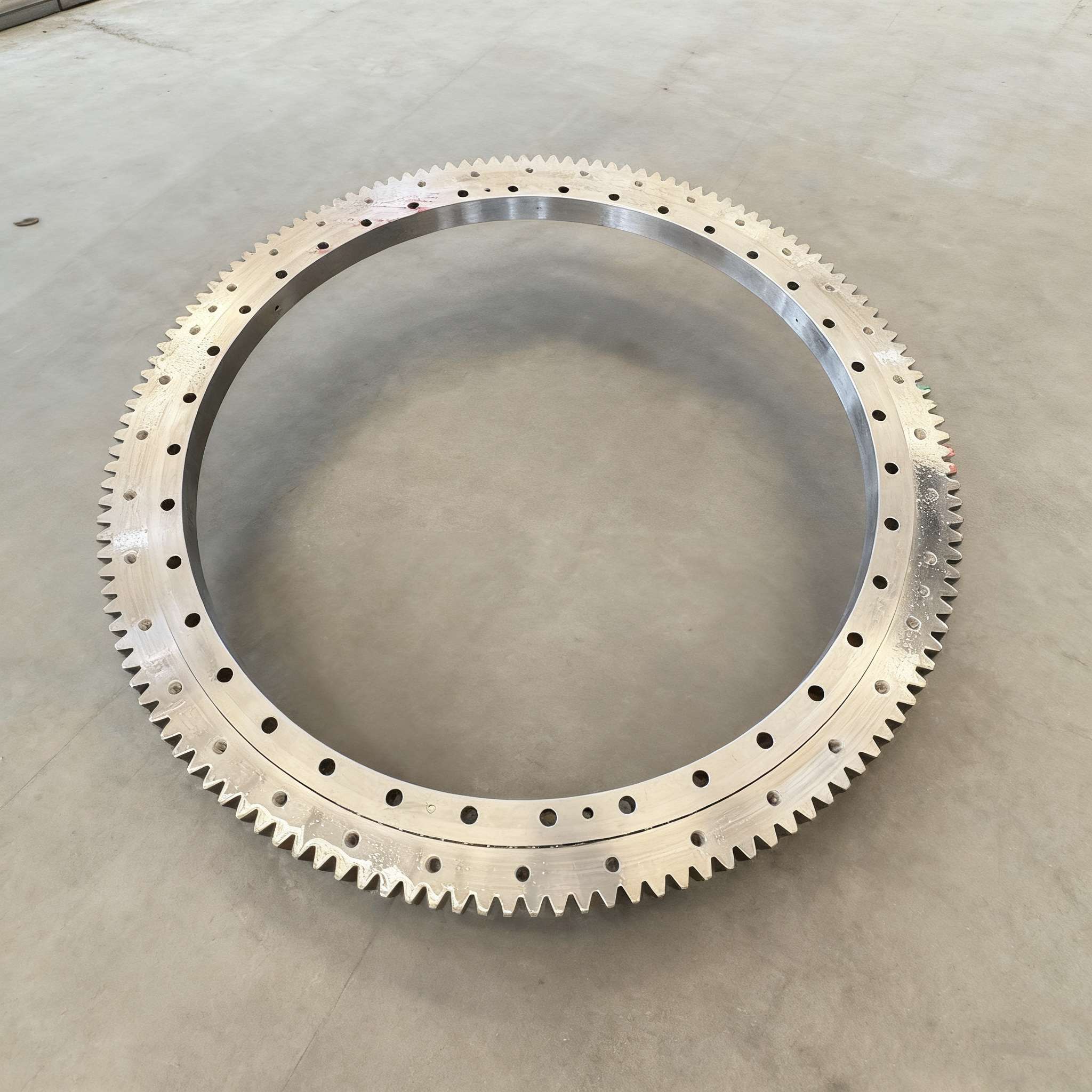
Preventing distortion is far more effective than correcting it. The key is rigorous process control at every stage of heat treatment. Ovality and runout in custom bearing rings are not random; they are the direct result of thermal and transformational stresses exceeding the material's elastic limit. Here is how fixturing, heating uniformity, quench selection, and stress relief directly address the problem of how to prevent bearing ovality after quenching.
Our ISO 9001:2015 certified quality management system mandates strict adherence to these principles, which is how we successfully delivered components like the 10.87-meter slewing ring for a 2,000-ton lifting application.
This table contrasts common failure points with best practices for dimensional stability.
| Control Point | Poor Practice (Leads to Distortion) | Best Practice (Ensures Stability) |
|---|---|---|
| Fixturing & Loading | Laying thin, large-diameter rings flat without support. Stacking parts directly on top of each other. Using fixtures that constrain the part too rigidly, preventing natural thermal expansion. | Supporting rings vertically or on custom-designed, conforming fixtures that allow for uniform expansion and contraction. Ensuring adequate spacing between parts for uniform exposure to heat and quenchant. |
| Heating Uniformity | Placing parts too close to heating elements, creating hot spots. Rapid heating cycles that cause the surface to heat much faster than the core, inducing significant thermal gradients and stress. | Utilizing furnaces with multiple control zones for precise temperature uniformity. Employing a slower, pre-heating step to allow the entire component to reach temperature evenly before the final austenitizing soak. |
| Quench Selection & Agitation | Using an overly aggressive quenchant (e.g., water instead of oil) for the material's section size. Insufficient or non-uniform quenchant agitation, leading to vapor pockets and inconsistent cooling rates. | Selecting the quenchant with the slowest cooling rate that still achieves the required hardness (e.g., polymer or oil for alloy steels). Using programmed, directional agitation to break up the vapor barrier and ensure a uniform quench across all surfaces, which is critical for minimizing bearing quench distortion. |
| Stress Relief & Tempering | Delaying the tempering process after quenching, allowing martensitic transformation stresses to cause cracking. Insufficient tempering time or temperature, leaving high levels of residual stress in the part. | Moving the component to the tempering furnace while it is still warm from the quench ("snap temper") to relieve transformation stresses immediately. Using a precisely controlled tempering cycle to achieve the final balance of hardness, toughness, and dimensional stability. |
Material Selection and Its Impact on Heat Treatment Stability
The material specified for a bearing has the single greatest influence on its response to heat treatment. Different steel alloys possess varying levels of "hardenability"—the ability to form a hardened martensitic structure at depth. This characteristic directly affects the severity of quenching required and, consequently, the risk of bearing heat treatment distortion.
Here’s a breakdown of common bearing materials we work with and their heat treatment considerations:
GCr15 / SUJ2: These are high-carbon chromium bearing steels. They have relatively low hardenability, meaning they require a faster quench to achieve full hardness. This makes them more susceptible to distortion, especially in larger cross-sections. Control of the quenching process is absolutely critical.
20CrMo / 42CrMo: As alloy steels, these materials have higher hardenability due to the inclusion of chromium and molybdenum. They can be hardened effectively using a slower oil or polymer quench, which significantly reduces thermal shock and the risk of warpage. This makes them an excellent choice for large, heavy-duty components like a Large Slewing Bearing.
AISI 440C: This stainless steel offers good corrosion resistance but is an air-hardening or oil-hardening grade. The slower cooling rates reduce distortion risk compared to water-hardening steels, but its high carbon and chromium content can still lead to retained austenite if not processed correctly.
Ti-6Al-4V: Titanium alloys are not hardened by quenching in the same way as steel. They undergo solution treating and aging. While distortion is generally lower, residual stresses from machining and non-uniform cooling from the solution temperature can still cause dimensional changes.
When designing a custom bearing, it's not enough to select a material based on final hardness alone. You must consider how its hardenability interacts with the component's geometry and the available heat treatment processes. A thicker-sectioned ring made from a low-hardenability steel is a recipe for distortion. In these cases, switching to an alloy steel like 42CrMo can be a problem-solving design change.
LTZC's Engineering for Large-Scale Dimensional Control
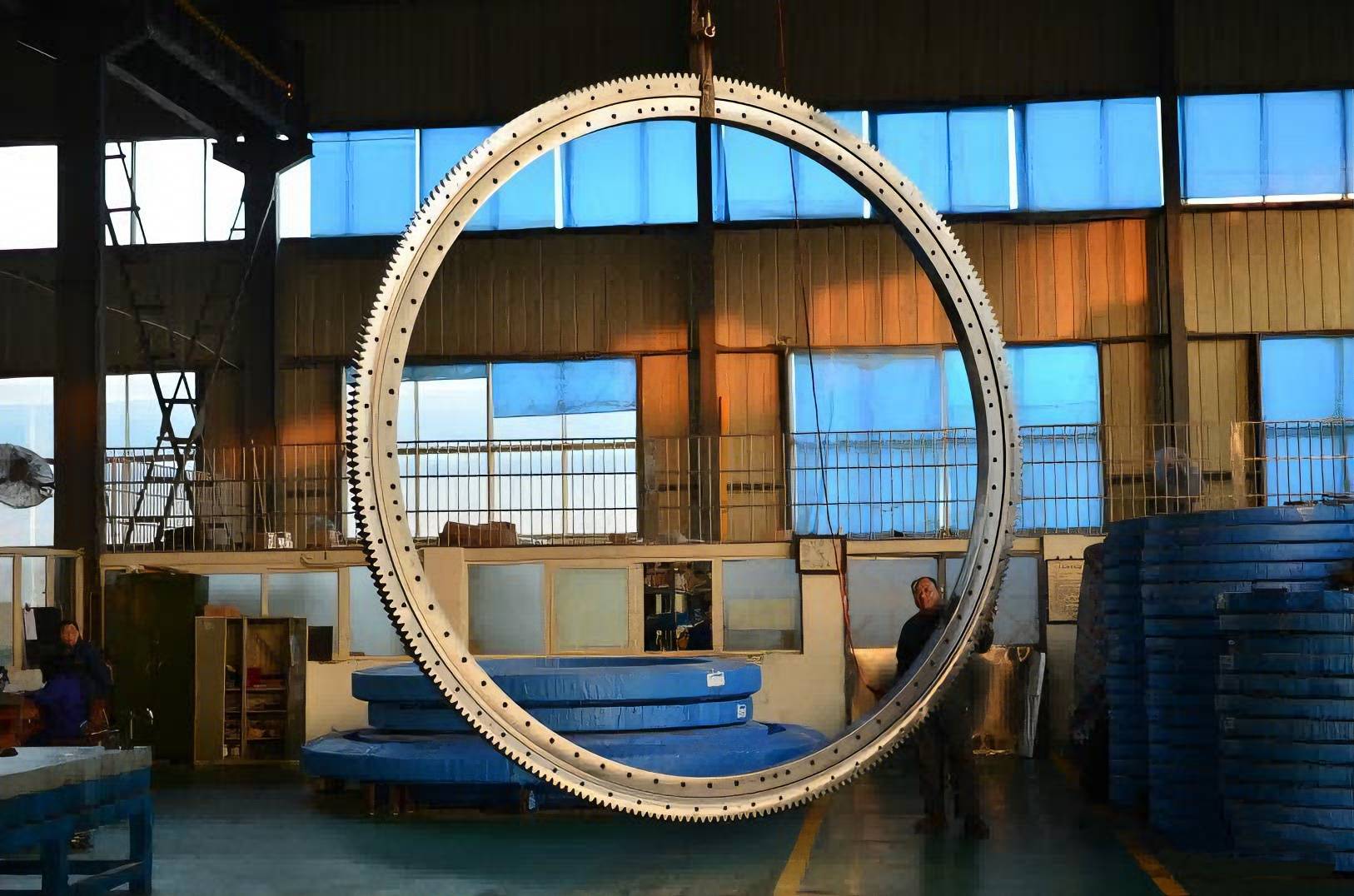
The challenges of heat treatment are magnified exponentially with component size. A one-degree temperature variance in a small furnace is negligible; in a furnace large enough to hold an 8-meter gear ring, it can create a significant thermal gradient that causes warpage. This is where specialized equipment and documented processes become non-negotiable.
Our experience producing large and non-standard components has been built on solving these exact challenges. For the 8-meter high-precision segmented gear rings supplied to Wuhan Heavy Industry, managing custom bearing ring warpage across multiple segments was the primary engineering challenge. Each segment had to be heat-treated to precise specifications while maintaining mating-surface flatness to ensure seamless assembly.
Similarly, for the φ24m segmented bearings delivered to Jiangsu Nantong Rainbow Heavy Machinery, our process involved:
Simulation and Modeling: Using software to predict thermal gradients and transformational stresses before the part ever enters the furnace.
Custom Fixturing: Designing and fabricating unique fixtures for each large project to support the component's geometry and prevent sagging under its own weight at high temperatures.
Zoned Furnace Control: Our large furnaces are equipped with multiple thermocouple arrays and independent heating zones, allowing our technicians to ensure uniform temperature across massive parts.
Engineered Quenching: For a Crane Slewing Bearing with a complex cross-section, we may design specific quenchant flow patterns to ensure critical areas like raceways and gear teeth cool at the optimal rate without distorting the overall web structure.
This level of process control, certified under ISO 14001:2015 and ISO 45001:2018, ensures that whether we are producing a single 10-meter ring or 90 pieces of ring rolls for a CRCC shield machine, the first part and the last part are dimensionally identical.
Controlling distortion during heat treatment is a science. It requires a partnership between the designer specifying the material and the manufacturer executing the process. By understanding the diagnostic steps and the critical process controls, you can better evaluate suppliers and ensure the high-precision components you source perform as designed.
If you are facing challenges with dimensional stability in your bearing or gear components, our engineering team is available to review your design and technical specifications. Contact us to discuss your requirements.