WhatsApp
 jessica.chai@ltzzc.com
 0086-379-69950051

How to Choose a High Precision Thin Section Bearing?
Three designs compete for the same compact envelope: radial, angular-contact and four-point-contact. They share a cross-section but behave very differently once a moment load or a preload requirement enters the picture. Choosing a High Precision Thin Section Bearing on bore size and ring width alone is how projects end up with tilting, torque drift or a redesign after the first prototype.
Here is the selection rule we use first. If your load is mostly radial with little tilting, start with a radial design. If axial load dominates in one direction, start with angular-contact. If one bearing must carry axial load both ways plus a tilting moment, start with four-point-contact. Everything below refines that rule. For a wider view of the product family, see our thin section bearing range and the bearing selection guide.
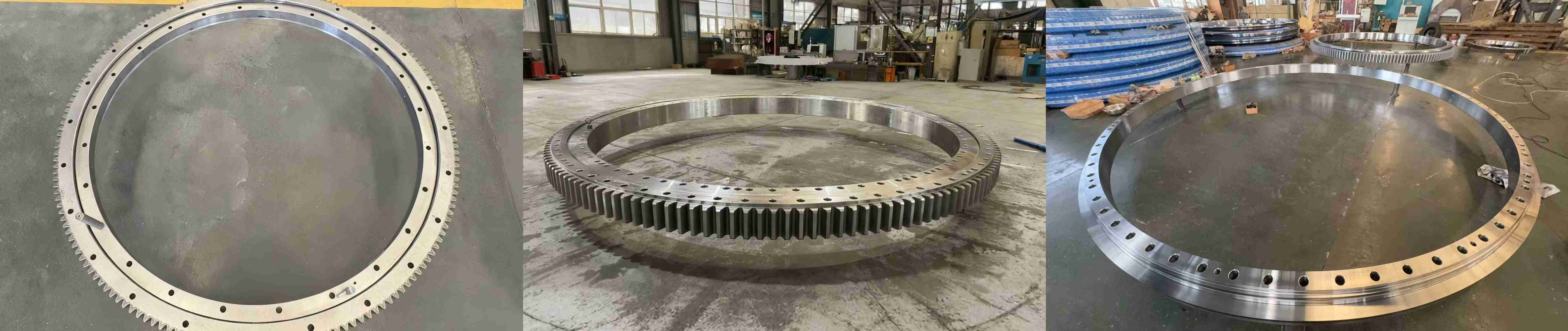
Load Direction and Preload Selection Table for Radial, Angular-Contact and Four-Point-Contact Designs
The table maps the load you actually have to the design that normally suits it. It is a starting point for shortlisting, not a substitute for a calculation on your own duty cycle.
| Criterion | Radial design | Angular-contact design | Four-point-contact design |
|---|---|---|---|
| Best-fit load direction | Mainly radial, light axial | Combined radial and axial, axial mostly in one direction | Axial in both directions plus radial, with tilting moment |
| Moment load capacity | Low; a single bearing tilts easily | Good when used as a pair with wide spacing | Good from a single bearing |
| How preload is applied | Light axial preload via spring or shimmed ring | Paired arrangement or spacer set; preload is built in by the mounting layout | Set through ball size and ring geometry; little adjustment at assembly |
| Preload sensitivity | Low | High; too much raises torque and heat | Medium; the bearing is sensitive to needing some axial load |
| Choose when | Light, low-friction rotation with radial loading | Stiffness and positioning accuracy in one axial direction matter | Space allows one bearing, not two, and moment load is present |
| Does not fit when | Moment or reversing axial load is significant | Axial load reverses and you cannot fit a second bearing | Radial load dominates over axial, or friction torque must be minimal |
How to read the table
Radial designs win on friction and cost but give up stiffness against tilting. Use them where the shaft is supported by two bearings far apart, so the pair, not each bearing, resists the moment.
Angular-contact designs give the most controllable stiffness, because preload is set by your mounting layout. The limit: they need a counter-bearing or mirrored pair. If you have one bearing position, this is the wrong choice.
Four-point-contact designs save axial space because one bearing handles load in both directions and moment. The limit is that the ball contacts the raceway at two points per side, so friction torque is higher and a purely radial load can cause skidding. If your duty cycle is radial-heavy, move to a radial or paired angular-contact layout instead. For heavy moment with high rigidity, also look at Cross Roller Slewing Bearings, which use roller contact.
Criteria That Change the Decision
Many specification lines look important but never change the outcome. These five do.
Combined load ratio. Write down radial, axial and moment values at peak and at normal duty. The ratio decides the design family more than the absolute numbers do.
Required stiffness versus allowed friction. Higher preload raises stiffness but also torque and temperature. If your drive motor is sized tightly, preload is a motor-sizing question.
Ring material. GCr15 and SUJ2 suit high hardness and wear resistance, and SUJ2 is typically specified for high-precision, high-load work. AISI 440C fits when corrosion resistance matters. Ti-6Al-4V is used where light weight and high temperature resistance count, such as aerospace.
Mounting accuracy. A thin ring follows its housing. If the seat is out of round or the shaft is uneven, the raceway is deformed and the bearing's precision is lost.
Size and standardization. If your envelope falls outside catalog sizes, move early to non-standard bearings rather than bending the design around a nearby catalog number.
Trade-offs by Situation
Compact rotary joint with moderate moment load
A four-point-contact design is usually the first candidate: one bearing, two-way axial support, and no second seat to machine. Confirm that the axial load never drops to zero in operation. Otherwise the ball can wander between contact points and torque becomes uneven.
Precision spindle or indexing axis with one dominant axial direction
Paired angular-contact bearings are more suitable. You set the preload through the spacer or mounting layout, and stiffness is predictable. The cost is a longer housing and two bearings to buy and align.
Light-duty, low-torque rotation
Radial thin section bearings keep friction down. If a small moment load appears later, adding it to a radial-only design is difficult, so check the load case before freezing the envelope.
Worked example
Take an automation turntable with a radial load of 1.2 kN, axial loading in both directions of up to 3 kN, and a tilting moment from an off-center tool. These numbers are illustrative. Radial load is well below axial, so skidding risk in a four-point design is low. One bearing carries all three load types, and the axial range is fully covered. A radial bearing would need a second one far away to resist the moment, which the envelope does not allow. A four-point-contact design is therefore the shortlisted option. What remains to confirm is friction torque against the motor and the flatness of the mounting faces. Applications like this are covered in our page on Robotics and Automation Slewing Bearings.
Common Mistakes When Specifying a Thin Section Bearing
Selecting by bore size only. Two bearings with the same bore can have very different moment capacity.
Over-preloading for stiffness. Extra preload shortens life and raises operating temperature. Preload to the stiffness you need, not the maximum available.
Ignoring the housing. A thin ring on a distorted seat is only as accurate as the seat.
Treating a four-point bearing as a radial bearing. If radial load dominates, expect skidding and heat.
Specifying material after the design is fixed. Corrosion or temperature requirements can change the ring material and, with it, the clearance and preload settings.
The Overlooked Factor: Can the Design Be Matched to Your Application?
A catalog bearing is a compromise. The useful question is whether the supplier can adjust the design to your load case if no catalog size fits. LTZC provides Customized Bearings based on your working conditions, existing designs and technical specifications, including material, size and performance requirements.
Some facts from our side that bear on this decision:
We have manufactured since 1992 on a 20,000 m² site, and our quality system is certified to ISO9001:2015, with ISO14001:2015 and ISO45001:2018 also in place.
There is no MOQ, so prototype quantities are practical. Lead time is 30 to 90 days, depending on specification.
Precision at large diameters is demonstrated by delivered work: 8-meter high-precision segmented gear rings supplied to Wuhan Heavy Industry for a vertical friction stir welding system, and an integrated bearing with an 8.445 m outer diameter for a crane client in South Korea. These are large-format examples rather than thin section catalog parts, but they show what we machine and inspect.
For installation support, our bearing installation guidance covers fitting practice, and after-sales service responds to quality objections within 24 hours, with on-site service starting within 48 hours in China.
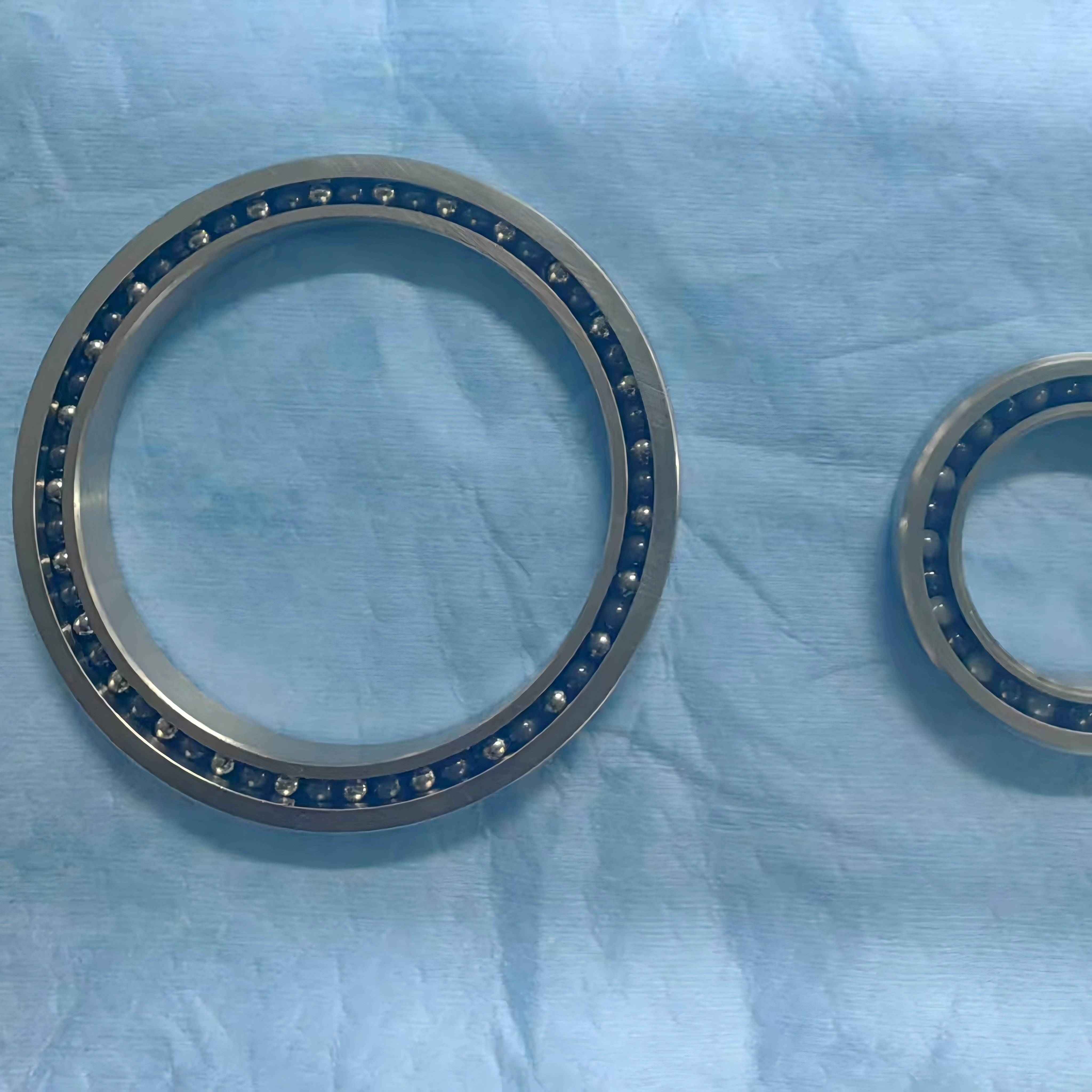
Selection Rule and What to Confirm Before You Order
Choose a radial design when loads are mainly radial, moment is small and low friction is the priority.
Choose paired angular-contact when you need controllable stiffness, axial load is mostly in one direction and you have room for two bearing positions.
Choose four-point-contact when one bearing must carry two-way axial load and a tilting moment, and axial load stays present in operation.
Consider roller-type or a custom design when moment loads are high, rigidity targets are strict or the envelope does not match a standard size.
Before requesting samples, confirm this checklist:
Peak and normal radial, axial and moment loads, with direction of axial load.
Rotation speed and the friction torque your drive can supply.
Required stiffness or maximum deflection under load.
Operating temperature and exposure to moisture or chemicals, which sets the material.
Shaft and housing tolerances and flatness of mounting faces.
Envelope limits: bore, outside diameter and width, and whether a second bearing position is possible.
Missing any of these inputs means the choice between designs cannot be finalized, and a sample would be a guess.
Send your drawings and load case to our engineers for selection advice, and we will recommend a configuration and quote it against your envelope.