WhatsApp
 jessica.chai@ltzzc.com
 0086-379-69950051

How to Verify the Factory Tests for a Three Row Roller Slewing Ring
Ordering a large, custom-engineered bearing involves significant investment and risk. A premature failure in heavy-duty equipment like a 2,000-ton crane or a tunnel boring machine is not just a component issue; it's a project-halting catastrophe. For a Three Row Roller Slewing Bearings, which is designed for the highest load capacities, the manufacturing and testing integrity are non-negotiable. Before you issue a purchase order, you must have a clear process for verifying your supplier's quality claims. Relying on a data sheet alone is a gamble you cannot afford to take.
As a slewing bearing engineer with over a decade of experience, I've seen firsthand how gaps in factory testing can lead to costly field failures. The difference between a reliable supplier and a risky one often lies in the quality of their documentation and their transparency during the inspection process. This guide outlines the critical factory tests you should be asking for and the evidence you need to see.
A Buyer's Checklist for Verifying Manufacturing Integrity
A supplier’s willingness to provide detailed, traceable test reports is a direct indicator of their confidence in their processes. When evaluating a potential manufacturing partner, request specific documentation for these four critical stages. A refusal or inability to produce these records should be a major red flag.
| Manufacturing Stage | Key Verification Question | Required Evidence | What to Look For |
|---|---|---|---|
| Raceway Hardening | Is the hardness depth and uniformity sufficient to handle the specified loads without premature wear or deformation? | - Heat Treatment Report - Hardness Test Reports (with mapping of test points) |
Check for a consistent hardness pattern and a case depth that meets your design specifications. Inconsistent readings can indicate poor process control, leading to soft spots and early failure. |
| Roller Sorting & Grading | Are the rollers in each row precisely matched to ensure even load distribution? | - Roller Sorting and Inspection Records - Assembly Clearance Reports |
Look for documentation showing rollers are graded and sorted into narrow tolerance groups. Mismatched rollers cause point loading, drastically reducing the bearing's operational life. |
| Gear Inspection | Does the gear geometry meet the required precision class for smooth power transmission and minimal wear? | - Gear Inspection Report - Tooth Profile and Lead Charts |
Verify that the gear quality meets the specified standard (e.g., AGMA, ISO). For high-precision applications, such as the ground teeth we supplied on a 6-meter segmented gear ring for our Hengshui customer, these reports are essential proof of capability. |
| Final Inspection & Traceability | Can the final assembled bearing's performance characteristics be traced back to its manufacturing and material data? | - Final Dimension Inspection Report - Rotational Torque Test Report - Material Test Certificates (MTCs) for all major components |
The final report should confirm all key dimensions, starting/running torque, and axial/radial clearance. Every bearing should have a unique serial number linking it to its entire production history. |
Material Selection and Why MTCs Matter
The performance of a heavy-duty slewing ring begins with the raw material. Using the wrong grade of steel or a substandard alloy can lead to catastrophic failure under load, even if the dimensions are perfect. At LTZC, our facility is certified to ISO 9001:2015, ISO 14001:2015, and ISO 45001:2018 standards, ensuring rigorous material control and traceability from start to finish.
When specifying a bearing, understanding material properties is key. Your supplier should be able to guide you and provide full material test certificates (MTCs) for every component.
- GCr15 / SUJ2: This is the workhorse for many rollers and rings due to its high hardness and excellent wear resistance. It is ideal for standard high-load applications.
- 42CrMo / 20CrMo: When you need higher toughness and strength to handle extreme shock loads or heavy-duty cycles, these alloy steels provide superior performance. We often recommend these for demanding applications in Mining and metallurgy slewing bearings.
- AISI 440C: For environments with moisture or corrosive elements, such as marine applications, this stainless steel offers good corrosion resistance without a significant trade-off in hardness.
- CuSn6: Typically used for cages or spacers, this bronze alloy provides good wear resistance and thermal conductivity, ensuring smooth roller operation.
Never accept a supplier who cannot provide complete MTCs. These documents are your only guarantee that the material specified is the material used. They should detail the chemical composition and mechanical properties of the steel heat, ensuring it meets international standards.
Proven Capability in Large-Scale Customization
Theoretical knowledge is one thing; proven execution is another. When evaluating a supplier for a large or non-standard bearing, look for concrete evidence of their ability to handle projects of a similar scale and complexity. Vague claims of "experience" are not enough.
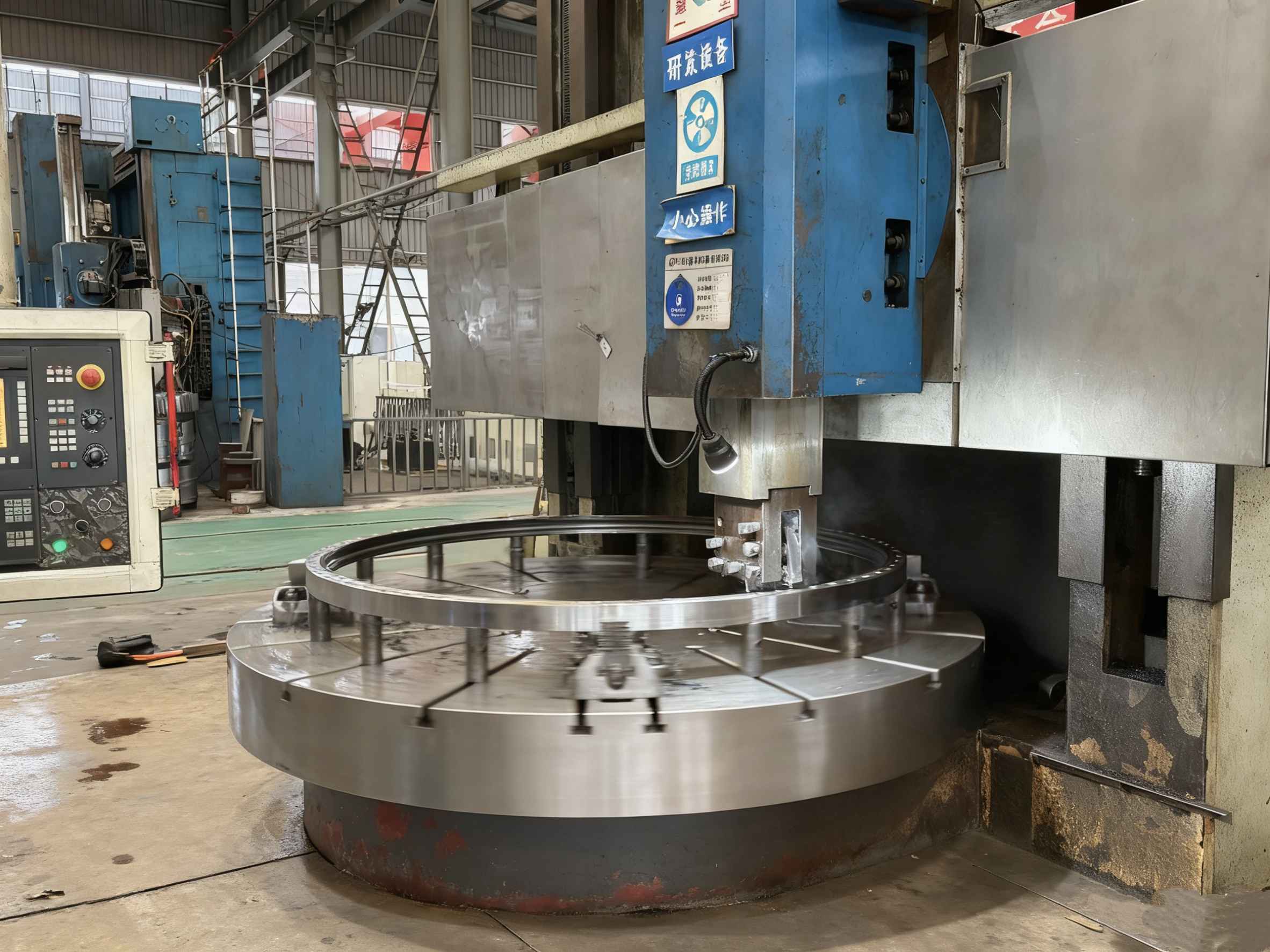
For example, our team at LTZC has a track record of delivering exceptionally large and precise slewing rings. In 2024, we set a new company record by producing an integral three-row roller slewing ring with an outer diameter of 10.87 meters for 2,000-ton fixed lifting equipment. That same year, we successfully manufactured an 8.445-meter integrated bearing for a leading crane client in South Korea. These projects are not just large; they demand extreme precision control over a massive scale.
Our capabilities extend to complex segmented designs as well. We have successfully delivered:
- φ24m segmented bearings for Jiangsu Nantong Rainbow Heavy Machinery.
- 8-meter high-precision segmented gear rings for Wuhan Heavy Industry, used in a key national friction stir welding system.
- A complete set of shield machine main drive ring rolls (90 pieces) for China Railway Construction Corporation (CRCC).
This experience demonstrates a verified ability to manage the complex logistics, machining, and quality control required for large-scale projects. We support this with flexible production terms, including no MOQ requirements and a standard delivery window of 30-90 days, allowing our clients to plan effectively without being constrained by arbitrary batch sizes. If you have a unique challenge, we provide Customized Bearings solutions based on your specific working conditions and technical drawings.
Beyond Delivery: Technical Support and Long-Term Partnership
The supplier’s responsibility does not end when the bearing leaves the factory. The long-term, stable operation of your equipment depends on correct installation, proper maintenance, and swift troubleshooting. A true manufacturing partner provides comprehensive after-sales support to protect your investment.
What should you expect from a supplier's after-sales service?
- Installation and Commissioning Guidance: Even a perfectly manufactured bearing can fail if installed improperly. Your supplier should provide clear documentation and technical guidance for the mounting procedure, including bolt tightening sequences and preload settings. We offer detailed support for bearing installation to ensure a successful start.
- Preventive Maintenance Training: We help our clients’ teams understand the proper lubrication schedules, inspection points, and signs of wear to look for. This proactive approach extends the service life of the bearing and the machinery it operates in.
- Fault Diagnosis and On-Site Support: In the event of an issue, you need a responsive partner. Our commitment includes a response to quality objections within 24 hours. For domestic clients, this includes the start of on-site service within 48 hours to analyze the problem and implement a solution.
This level of support ensures that you are not just buying a component, but a reliable, long-term solution backed by engineering expertise. It transforms the supplier relationship from a simple transaction into a valuable technical partnership.
Verifying a supplier's testing protocols is a critical step in mitigating risk for any heavy-duty application. By requesting and reviewing the right documentation, you can ensure the three-row roller slewing ring you procure is built to perform and last. If you require a detailed review of your technical specifications or have questions about our quality assurance process, please submit your drawings to our engineering team.