WhatsApp
 jessica.chai@ltzzc.com
 0086-379-69950051

How to Evaluate a Slewing Bearing Supplier: A Procurement Checklist
Most procurement teams start a slewing bearing project the same way: send the drawing to five suppliers, collect five quotes, compare the numbers. This checklist is written for the procurement manager who wants to avoid the three places where a wrong supplier decision actually costs money — assembly, commissioning, and after-sales.
Why Supplier Evaluation Decides Your Project's Real Cost
Most procurement teams start a slewing bearing project the same way: send the drawing to five suppliers, collect five quotes, compare the numbers. It feels efficient. It is also where most project risk begins.
The problem is that a slewing bearing is not a commodity. It is a custom-engineered component that sits at the rotating joint of your equipment. When it fails, it does not fail quietly. It stops a crane, halts a wind turbine, or takes a stacker-reclaimer offline. The cost of that failure shows up in three places a price comparison never captures:
At assembly. A bearing that arrives out of tolerance forces rework on the assembly line. The delay is charged to your project schedule, not the supplier's quote.
At commissioning. A bearing that was selected for the wrong load case may pass initial testing and still fail early in service. By then, the equipment is on site and the supplier is far away.
At after-sales. Field replacement of a large slewing bearing means dismantling the surrounding structure, crane time, and downtime. The unit price saved at purchase is often a fraction of a single field service event.
This is why experienced procurement managers treat supplier evaluation as a risk-management exercise, not a purchasing formality. The checklist below is built around the seven checks that most reliably separate a supplier who can deliver a bearing from one who can deliver a project.
A practical reference point: a supplier with three decades of continuous manufacturing experience, a defined precision-grade range, and documented delivery of very large custom bearings is operating at a different level than a trading company reselling standard units. LTZC, for example, has manufactured and delivered custom slewing bearings up to Φ5070mm for heavy industrial applications — the kind of project record that answers capability questions before they are asked.
Check 1: Manufacturing Capability for Extra-Large and Custom Bearings
The first question is the most basic: can this supplier physically make what you need?
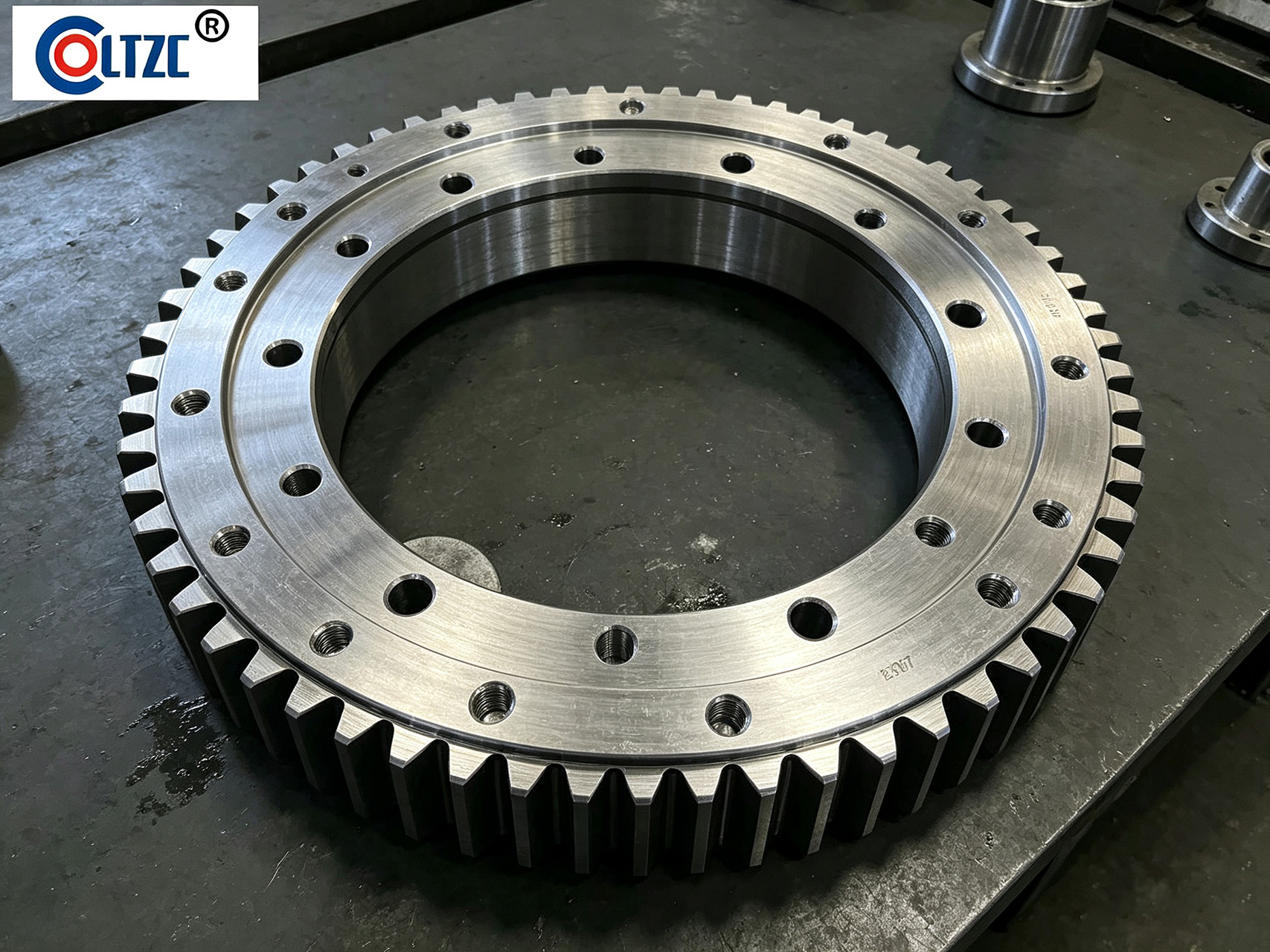
For standard-size bearings, this is rarely a differentiator. For extra-large and heavy-duty slewing bearings, it is the single biggest filter. Machining a ring with a diameter measured in meters involves heat treatment distortion control, segmented machining, precision measurement, and assembly techniques that only a limited number of manufacturers have in place.
What to look at:
Maximum machining diameter and maximum bearing weight the facility can handle
In-house heat treatment capability, or a qualified and controlled subcontractor
Measurement and inspection equipment rated for large-diameter geometry
Experience with split or segmented designs, which large bearings often require
What to ask for:
A list of comparable delivered projects, with diameter, application, and year
Photos or inspection records from those projects, not marketing renderings
The name of the largest bearing the company has shipped in the last 24 months
Red flag: A supplier who quotes any size but cannot name a specific large bearing they have delivered.
This is where a documented project record matters more than a capability statement. LTZC's delivery of a customized Φ5070mm slewing bearing for a 360-ton ladle turntable is the kind of reference that directly addresses the extra-large capability question — it is a verifiable data point, not a claim.
Check 2: Engineering Depth, Not Just Production Capacity
A supplier can have excellent machining equipment and still be the wrong choice. The reason is that manufacturing capability answers "can you make this?" while engineering depth answers "is this the right bearing to make?"
For procurement managers, this distinction has a direct consequence. If the supplier cannot evaluate your load case, speed, and duty cycle, then the selection responsibility falls back on your team — or worse, on no one.
What to look at:
Whether the company has an in-house R&D and engineering team, or only a sales and production function
Patent portfolio and participation in major research projects, as indicators of sustained technical investment
Ability to support both OEM modification and ODM development from scratch
Whether they offer design simulation and prototyping, not just drawing-based manufacturing
What to ask for:
A preliminary selection or load verification based on your actual working conditions
A named engineer who will be the technical contact for your project
Examples of bearings they redesigned or developed for a customer's specific problem
Red flag: Technical questions are routed to a salesperson with no engineering support behind them.
Engineering depth is also what protects the procurement manager internally. When a bearing is selected correctly, no one notices. When it is selected wrong, procurement is in the room explaining it. A supplier with genuine engineering capability — one that can review your application and propose a design, not just quote a drawing — shifts that risk back to where it belongs.
LTZC illustrates this model: the company holds 1,500 registered patents, employs a dedicated technical team, and offers ODM support covering design, simulation, prototyping, and production. For a procurement manager, that means the supplier can share the technical responsibility rather than simply execute an order.
Check 3: Certifications and Precision Grades That Match Your Application
Certifications are where many procurement teams stop too early. Seeing "ISO certified" on a website feels reassuring, but it answers a different question than the one that matters: certified for what, and by whom?
There are two distinct categories, and they serve different purposes.
System certifications (such as ISO) confirm that a manufacturer follows a documented quality management process. They are a baseline — necessary, but not sufficient. They tell you the factory is organized, not that its bearings will perform in your specific environment.
Industry and application certifications (such as CCS and ABS for marine, or equivalent class approvals) confirm that the product meets the standards of a specific sector. These are the ones that can stop a project at customs, at inspection, or at acceptance if they are missing.
The same logic applies to precision grades. P0, P6, P5, and P4 represent increasing levels of dimensional and running accuracy. Higher is not automatically better — it is more expensive. The correct grade is the one that matches your application's tolerance, speed, and operating demands. A supplier who pushes the highest grade without asking about your application is optimizing their revenue, not your outcome.
What to look at:
Which certifications the manufacturer actually holds, and whether they cover your product type
The declared precision-grade range, and whether the required grade is produced in-house
Whether certification documents are current and issued for the relevant scope
What to ask for:
Copies of certificates with validity dates and issuing bodies
Confirmation that the required precision grade is standard production, not a special one-off
For marine or export projects, written confirmation that documentation will support customs and class inspection
Red flag: Certificates displayed as logos only, with no scope, date, or issuing body available on request.
LTZC holds ISO, CCS, and ABS certifications and produces bearings across the P0, P6, P5, and P4 precision grades. For a procurement manager working on a marine or export project, that combination means the certification question can be settled at the supplier-selection stage rather than surfacing later at inspection.
Check 4: Customization and Non-Standard Capability
Very few real projects use a catalog bearing exactly as listed. Mounting interfaces change, load cases shift, space is constrained, or the surrounding structure dictates a non-standard geometry. The question is not whether you need customization, but whether your supplier can handle it without treating every deviation as a crisis.
This is where standard-product suppliers and genuine custom manufacturers diverge sharply. A trading company or catalog supplier can sell you a bearing, but when the requirement moves outside the standard range, the response is often delay, a price premium, or a quiet refusal.
What to look at:
Whether customization is a core business or an exception
Capability in related non-standard parts — seal rings, segmented tracks, gear rings, flanges — which often accompany a custom bearing
Experience with split or segmented bearing designs for applications where full-ring installation is not possible
Whether the company can support both OEM (modify an existing design) and ODM (develop a new one)
What to ask for:
A response to one requirement that sits slightly outside their standard catalog
Examples of non-standard bearings they have manufactured, with the deviation involved
Clarity on how customization affects lead time and price, stated upfront
Red flag: Every question about a non-standard requirement is answered with "we can do that" but no example, no timeline, and no engineering detail.
A useful test is to present a requirement that is realistic but not routine, and observe the quality of the response. A manufacturer with genuine customization capability will ask technical questions back. A reseller will simply confirm and quote.
LTZC's product scope reflects this custom-first model: in addition to standard slewing bearing types, the company manufactures non-standard bearings, bearing seal rings, and segmented track solutions — the peripheral parts that custom projects typically require. That breadth is a practical indicator that customization is normal business rather than a special favor.
Check 5: Quality Consistency Across Batches
A passing sample proves almost nothing about a supplier. The sample is usually made under close attention, sometimes by the best operator on the best machine. The real question is whether batch ten will match batch one — because your project, your assembly line, and your after-sales obligations depend on the answer.
For procurement managers, this is the check that most often gets skipped and most often causes problems later. A supplier who can produce one excellent bearing but cannot reproduce it consistently will eventually deliver a problem that lands on your desk, not theirs.
What to look at:
Process inspection records, not just final inspection reports
Batch traceability — whether a delivered bearing can be traced back to its material lot and production run
Control of critical processes: heat treatment, grinding, and assembly, where variation most affects performance
Whether key parameters are monitored statistically or checked only at the end
What to ask for:
The inspection and traceability process for a typical order
How the supplier controls consistency between the first article and mass production
A sample batch record or quality report from a recent comparable order
Red flag: Quality is described only in terms of final inspection, with no mention of in-process control or traceability.
Consistency is also a commercial issue, not just a technical one. When a batch problem occurs, the procurement manager is typically the one coordinating between the supplier, the assembly team, and the end customer. A supplier with documented process control reduces the probability of that situation arising at all — which is worth more than a marginal price advantage.
This is where a long manufacturing history becomes evidence rather than marketing. LTZC has been producing bearings since 1992, with a defined precision-grade range and documented large-project deliveries. Thirty years of continuous production implies, by itself, that batch-to-batch consistency is a managed process — a factory that could not reproduce quality would not have survived that long in heavy industry.
Check 6: Delivery Reliability and Project Scheduling
For extra-large bearings, lead time is not a logistics detail. It is a constraint that shapes the entire project plan. A crane, a wind turbine, or a tunnel boring machine cannot be commissioned without its bearing, and the bearing cannot be rushed once the ring is in heat treatment.
This makes delivery reliability a procurement issue in the truest sense. A supplier's quoted lead time is a promise; their scheduling capability is what determines whether that promise holds.
What to look at:
Current production load and how the supplier manages capacity across concurrent projects
Raw material preparation cycle, especially for large forged or cast rings with long procurement times
Historical on-time delivery performance, particularly for custom and large-diameter orders
Whether the supplier communicates proactively when a schedule risk appears, or only after a delay
What to ask for:
A production schedule with defined milestones, not just a single delivery date
Confirmation of how material procurement is factored into the quoted lead time
A named project contact responsible for schedule communication
Red flag: A lead time quoted without any reference to material preparation, production capacity, or milestones.
For procurement managers, delivery reliability is also a contract-design question. Milestone-based payment and communication terms convert a vague promise into a manageable commitment. A supplier confident in their scheduling will accept those terms; one who is not will resist them.
LTZC's project history includes large custom deliveries — such as the Φ5070mm slewing bearing for a 360-ton ladle turntable — which by definition required coordinated scheduling of material, machining, and assembly. For a buyer, that kind of completed project is more informative than a quoted lead time, because it demonstrates the schedule was actually managed to completion.
Check 7: After-Sales, Documentation, and Long-Term Support
A slewing bearing is a long-service component. The purchase decision made today will still be felt five or ten years from now, when the bearing needs inspection, maintenance, or replacement. This makes after-sales capability a procurement consideration, not a customer-service afterthought.
The most common mistake is to reduce after-sales to a single question: "How long is the warranty?" Warranty length says little about what actually happens when something goes wrong. What matters is whether the supplier can support the bearing through its service life.
What to look at:
Availability of installation and maintenance documentation, ideally before purchase
Whether the supplier offers failure analysis, not just replacement
Technical response time and whether support is handled by engineers or sales staff
Availability of spare parts and replacement bearings years after the original order
What to ask for:
Installation and maintenance guides for the specific bearing type
The process for reporting and analyzing a field issue
Confirmed response time commitments, in writing
Red flag: After-sales is described only in terms of warranty duration, with no mention of technical support, documentation, or failure analysis.
Good after-sales support also reduces the procurement manager's exposure. When a bearing issue occurs in the field, the person who has to explain it is usually the one who bought it. A supplier who provides documentation, responds technically, and analyzes failures rather than deflecting them makes that situation far more manageable.
LTZC provides installation and maintenance resources, selection guides, and technical support as part of its standard offering, alongside a product range that includes replacement parts such as seal rings. For a procurement manager, this means the relationship does not end at delivery — which is the point of evaluating after-sales in the first place.
A Printable Procurement Checklist
The table below condenses the seven checks into a format you can paste directly into an RFQ email, a supplier audit form, or an internal evaluation sheet.
| No. | Check | What to Look At | What to Request | Red Flag |
|---|---|---|---|---|
| 1 | Manufacturing capability | Max diameter, heat treatment, large-diameter measurement, split designs | Comparable delivered projects with diameter and year | Quotes any size, names no large delivered bearing |
| 2 | Engineering depth | In-house R&D, patents, OEM/ODM support, simulation | Preliminary load verification and a named engineer | Technical questions go to sales with no engineering backup |
| 3 | Certifications & grades | ISO, CCS, ABS scope; P0–P4 range produced in-house | Certificates with dates and issuing bodies | Logos only, no scope or date on request |
| 4 | Customization | Non-standard parts, seal rings, segmented tracks, OEM/ODM | Response to a non-routine requirement | "We can do that" with no example or timeline |
| 5 | Quality consistency | In-process inspection, batch traceability, critical process control | Batch record from a recent comparable order | Quality described only as final inspection |
| 6 | Delivery reliability | Capacity load, material prep cycle, on-time history | Milestone-based schedule and named contact | Lead time quoted with no milestones or material reference |
| 7 | After-sales & documentation | Installation/maintenance docs, failure analysis, response time | Written response commitments and support process | Warranty duration is the only answer given |
How to use this table: Score each supplier against the seven checks before comparing prices. A supplier who fails checks 1, 2, or 5 should be removed from consideration regardless of quote. A supplier who passes all seven but is not the cheapest is usually the better commercial decision — the difference in unit price is rarely larger than the cost of one field failure.
How LTZC Supports Procurement Teams
Luoyang Heavy-duty Bearing Co., Ltd. (LTZC) has been manufacturing bearings since 1992, specializing in the R&D, production, and sales of extra-large bearings. The company's product range covers slewing bearings, slewing drives, gear parts, thin-section bearings, and non-standard bearing components — with precision grades spanning P0, P6, P5, and P4, and certifications including ISO, CCS, and ABS.
For procurement teams evaluating suppliers against the checklist above, several points are directly relevant:
Extra-large capability: documented delivery of custom bearings up to Φ5070mm
Engineering depth: 1,500 registered patents and full ODM support from design to production
Customization as core business: non-standard bearings, seal rings, and segmented track solutions
Application coverage: marine and defense, wind and renewable energy, construction and heavy machinery, mining and metallurgy, industrial automation, medical and precision equipment, aerospace and communications
Track record: 30+ years of continuous manufacturing and 769 customers worldwide
If you are evaluating suppliers for an upcoming project, LTZC can provide a preliminary selection based on your working conditions, along with the project references and certification documents described in this checklist.
Get a quote — include your application, required dimensions, load conditions, and any certification requirements, and the engineering team will respond with a technical proposal rather than a bare price.
FAQ
How do I verify a slewing bearing manufacturer's capability?
Ask for specific delivered projects with diameter, application, and year — not capability statements. A manufacturer who can name a large bearing they have actually shipped is providing verifiable evidence. Cross-check the claimed size against their stated machining range and inspection equipment.
What certifications should a slewing bearing supplier have?
At minimum, an ISO quality management certification. For marine, offshore, or export projects, industry certifications such as CCS or ABS are typically required and can affect customs clearance and class inspection. Always request certificates with validity dates and scope, not just logos.
Is a lower unit price always better for slewing bearings?
No. Unit price captures only the purchase cost. For large slewing bearings, the greater risks are assembly rework, early field failure, and unplanned downtime — costs that appear after the invoice is paid. Evaluate suppliers on capability, consistency, and support before comparing price.
How long does it take to manufacture a custom slewing bearing?
Lead time depends heavily on diameter and material. Large rings require long material procurement cycles plus heat treatment, machining, and assembly. A supplier should quote lead time with reference to material preparation and production milestones, not as a single date.
Can a supplier develop a bearing from scratch if no standard design fits?
Yes, but this requires ODM capability rather than catalog supply. Look for in-house engineering, simulation and prototyping support, and a documented process from design to production. A supplier who offers only OEM modification may not be able to handle a from-scratch development.