WhatsApp
 jessica.chai@ltzzc.com
 0086-379-69950051

In the realm of industrial machinery and equipment, slewing bearings serve as core transmission components. They play a critical role in connecting stationary structures to rotating structures while transmitting axial loads, radial loads, and overturning moments. Widely utilized across engineering machinery—including excavators, cranes, wind turbines, port machinery, and tunnel boring machines—as well as in aerospace applications, these bearings are deployed in a multitude of scenarios characterized by heavy loads, low rotational speeds, and high-frequency rotation; consequently, they are often hailed as the "joints" of industrial equipment. As a specialized provider dedicated to the R&D, manufacturing, and service of slewing bearings, LTZC leverages years of industry experience to deeply specialize in the structural optimization and maintenance technologies of these components. Guided by the core objectives of "enhancing product efficiency, extending service life, and reducing user maintenance costs," the company delivers high-quality slewing bearing products and comprehensive technical support to users worldwide.
The operational efficiency and service life of a slewing bearing directly determine the overall stability, reliability, and operational economics of the host equipment. In practical applications, many users inadvertently compromise their equipment by neglecting the scientific maintenance of slewing bearings—particularly regarding proper lubrication procedures. Such oversight frequently leads to issues such as wear, corrosion, seizing, or even catastrophic failure of the bearings; this not only disrupts the normal operation of the equipment but also results in increased repair costs and financial losses due to downtime.
Key Factors Affecting the Efficiency and Service Life of Slewing Bearings
Various factors influence the operational efficiency and service life of slewing bearings, including load conditions, lubrication status, installation accuracy, sealing performance, operating environment, and maintenance practices.
1. Load Conditions
Slewing bearings typically withstand axial loads, radial loads, and overturning moments. Prolonged overloading or uneven load distribution can lead to serious issues, such as concentrated stress on rolling elements, severe wear of raceways, increased friction, and diminished operational efficiency.
2. Lubrication Condition
Lubrication is one of the most direct factors affecting slewing bearing performance. Insufficient lubrication or lubrication failure can result in elevated operating temperatures, intensified friction between rolling elements and raceways, and severe wear—all of which constitute operational failures. Therefore, slewing bearings require regular lubrication to establish a stable internal oil film, thereby enhancing transmission efficiency and extending fatigue life.
3. Installation Accuracy
The installation of slewing bearings is of critical importance, as it directly impacts the operational status and safety of the equipment. LTZC provides customers with training and guidance regarding bearing installation and maintenance. Prior to installation, both the equipment mounting surface and the bearing mounting surface must be inspected to ensure they are free of contaminants; an uneven mounting surface will result in uneven stress distribution across the raceways. Furthermore, bolt pre-tightening procedures must be executed strictly in accordance with the supplier's recommendations.
4. Operating Environment
Slewing bearings operating in high-temperature environments frequently suffer from grease breakdown; those in marine environments require special attention regarding corrosion and salt spray erosion; in dusty environments, impurities can easily infiltrate the raceways; and in low-temperature environments, the viscosity of the bearing grease tends to increase. Therefore, it is essential to select an appropriate lubrication strategy tailored to the specific operating environment.
5. Sealing Performance
The sealing mechanism of a slewing bearing has a profound impact on its service life. Seal failure can lead to grease leakage and the ingress of external contaminants, which rapidly degrades bearing performance and may even result in premature failure.
6. Maintenance Strategy
Scientific maintenance practices for slewing bearings can significantly extend their service life. Conversely, an unscientific maintenance regimen can lead to sudden failures, frequent operational interruptions, and other performance issues. LTZC emphasizes a philosophy of "preventive maintenance," leveraging regular inspections and data monitoring to enhance equipment reliability.
Why is Lubrication Important for Slewing Bearings?
For LTZC slewing bearings, scientific and proper lubrication not only allows the product's inherent advantages to be fully realized but also effectively enhances operational efficiency, extends service life, and reduces user maintenance costs and downtime losses.
(I) Reducing Frictional Resistance and Enhancing Operational Efficiency
The core function of a slewing bearing is to facilitate rotational motion; the frictional resistance between the rolling elements and the raceways is the primary factor influencing its operational efficiency. In the absence of lubrication—or in cases of insufficient lubrication—direct metal-to-metal contact occurs between the rolling elements and the raceways. This results in a high coefficient of friction, causing the bearing to rotate sluggishly and requiring greater power consumption to overcome the frictional resistance.
Scientific and proper bearing lubrication creates a uniform and stable lubricating film between the rolling elements and the raceways, as well as between the cage and the rolling elements. This film isolates the metal contact surfaces, transforming sliding friction into fluid friction within the lubricating film itself, thereby reducing the coefficient of friction.
(II) Minimizing Component Wear and Extending Service Life
Wear is one of the leading causes of slewing bearing failure, and lubrication is the most effective means of mitigating it. During operation, relative motion occurs between the rolling elements and the raceways, as well as between the cage and the rolling elements. Without the protective barrier of a lubricating film, the metal surfaces are susceptible to wear caused by friction. Over time, the cumulative effects of this wear can lead to raceway deterioration, deformation of the rolling elements, and damage to the cage—ultimately resulting in bearing failure.
Scientific and proper lubrication not only reduces frictional resistance but also serves a cushioning function, absorbing the impact loads generated during operation. Furthermore, it encapsulates dust and particulate matter, preventing them from acting as abrasives on the friction surfaces.
(III) Dissipating Heat, Cooling, and Protecting Bearing Components
During the operation of a slewing bearing, friction generates a significant amount of heat. If this heat cannot be dissipated in a timely manner, the bearing's temperature will rise. This not only accelerates the aging and deterioration of the lubricant (grease) but also causes thermal expansion of the bearing components. Consequently, the internal clearances narrow, rotational resistance increases, and severe malfunctions—such as seizing or thermal burnout—may occur. This issue is particularly critical under heavy-load or high-frequency rotational operating conditions, where friction generates even greater amounts of heat, making effective heat dissipation an even more pressing concern. Lubricating grease possesses excellent thermal conductivity, enabling it to promptly transfer heat generated by friction to the bearing's outer ring, from where it is dissipated into the surrounding air via the equipment housing, thereby serving to dissipate heat and lower the temperature. For instance, in high-temperature environments, selecting a complex lithium-based grease or polyurea-based grease ensures that excellent lubrication performance is maintained even at temperatures exceeding 120°C.
(IV) Rust and Corrosion Prevention: Protecting Bearing Surfaces
Lubricating grease forms a dense protective film on the metal surfaces of bearing components, effectively isolating them from contact with moisture, oxygen, and corrosive media, thereby preventing rust and corrosion. Furthermore, high-quality greases contain specialized anti-rust and anti-corrosion additives that further enhance the bearing's resistance to oxidation and corrosion, safeguarding the precision of its surface finishes. The greases supplied with LTZC slewing bearings undergo rigorous selection and contain highly effective anti-rust and anti-corrosion additives; they are capable of meeting rust-prevention requirements across diverse environments—particularly in marine settings—where they effectively resist corrosion caused by salt spray, thereby protecting the bearing components.
(V) Sealing Assistance: Enhancing Protective Effectiveness
Optimal protective performance in slewing bearings is achieved through the synergistic interaction between the bearing's sealing structure and the lubricating grease. The grease fills the minute gaps between the seals and the bearing components, thereby enhancing sealing efficiency and effectively preventing external contaminants—such as dust, moisture, and oil residue—from penetrating the bearing's interior. This protects the raceways and rolling elements, minimizing wear and corrosion. Additionally, the grease lubricates the seals themselves, preventing them from aging or cracking due to dryness or friction; this extends the service life of the seals and further augments the overall protective effectiveness of the bearing system.
(VI) Cushioning and Vibration Damping: Reducing Operational Noise
During the operation of a slewing bearing, contact between the rolling elements and the raceways—as well as gear meshing (in geared slewing bearings)—generates vibration and noise. These phenomena become particularly pronounced under heavy loads or impact-prone operating conditions. Lubricating grease possesses inherent elasticity and viscosity, enabling it to absorb vibrational energy generated during operation. By acting as a cushion and vibration damper, it mitigates the impact of vibrations on the bearing components and retards the onset of fatigue wear.
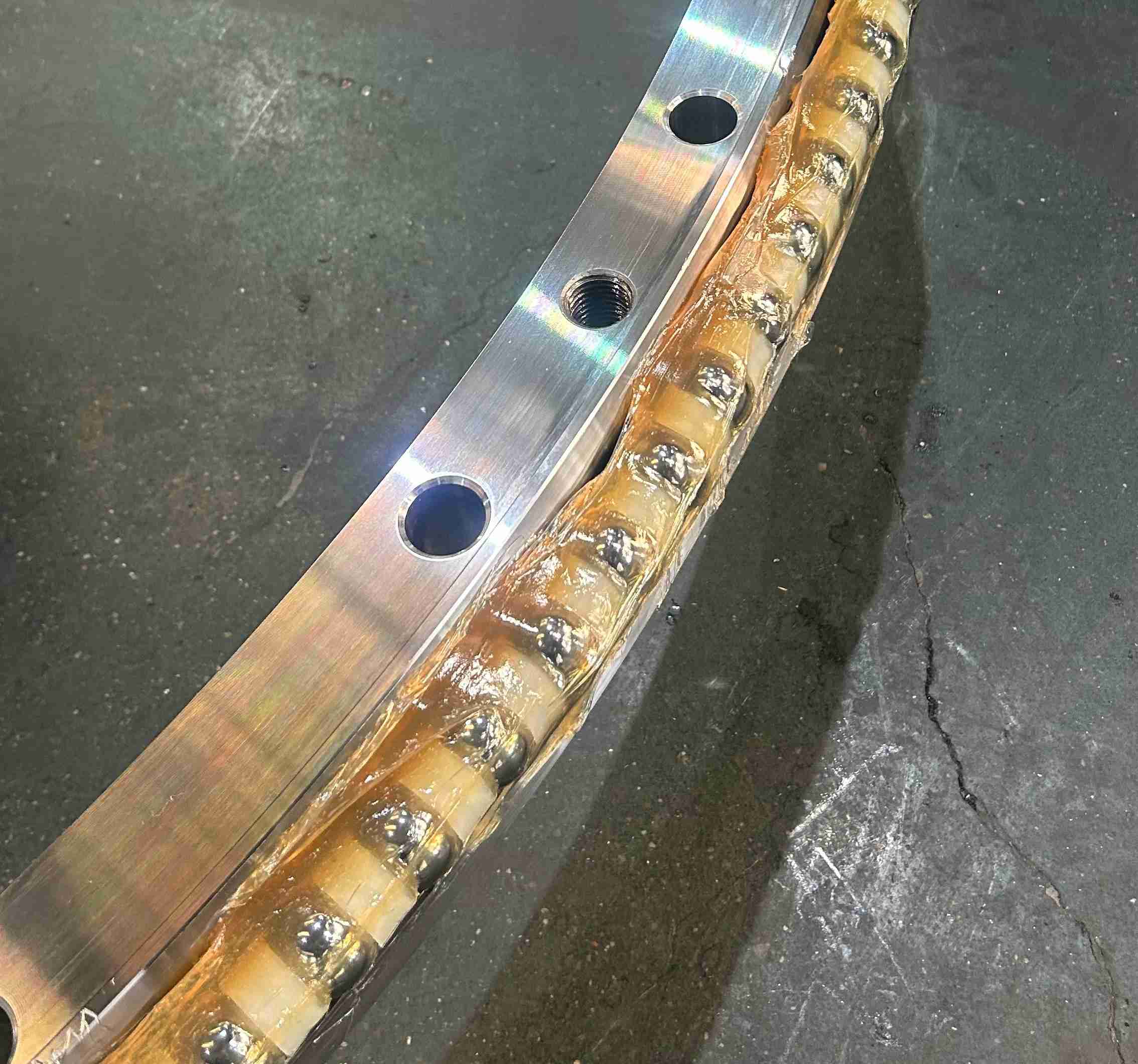
How to Properly Lubricate Slewing Bearings?
Preparation for Lubrication
1.Clean the bearing surface, grease fittings, and surrounding areas; clear any clogged lubrication channels. If old grease is present, the bearing must be disassembled and cleaned. Prepare the appropriate grease, a grease gun, and other clean tools.
2.Grease Selection
Select the appropriate grease based on the specific operating conditions of the LTZC slewing bearing. Key recommendations are as follows:
General Operating Conditions: NLGI Grade 2 Extreme Pressure (EP) Lithium-based Grease (-10°C to 60°C);
Heavy Loads / Moderate-to-High Temperatures: Lithium Complex Extreme Pressure (EP) Grease (-20°C to 120°C);
Low Temperatures / Humid Environments: Low-Temperature, Water-Resistant Lithium-based Grease (-40°C to 80°C);
Corrosive / Dusty Environments: Extreme Pressure (EP) Anti-Corrosion Grease containing Molybdenum Disulfide (-20°C to 100°C).
Lubrication Cycle
1. Normal Operating Conditions: Once every 100–150 hours, or once per week;
2. Heavy-Load or Shock-Load Conditions: Once every 50–100 hours, or once every 3–5 days;
3. High-Temperature, Humid, Dusty, or Corrosive Environments: Shorten the interval to once every 20–80 hours;
4. If the equipment remains idle for more than 3 months, a comprehensive lubrication is required prior to restarting. The lubrication cycle may be adjusted based on abnormal bearing operation or changes in operating conditions.
Lubrication Procedures
1. General Steps: Locate the grease nipple, connect the grease gun, and inject lubricant at a steady rate while slowly rotating the bearing; stop once the old grease has been expelled. Finally, clean the grease nipple and replace the dust cap.
2. Toothed Bearings: Additionally clean the gear teeth surfaces, apply a high-adhesion gear lubricant, and verify the smoothness of the gear meshing.
3. Do not mix different types of lubricants; the amount of lubricant injected must be moderate.
Post-Lubrication Inspection
1. Check whether the bearing rotates smoothly and without any abnormal noises;
2. Verify that the temperature remains below 70°C after 10–15 minutes of operation;
3. Ensure that the seals are intact and free of leaks;
4. Maintain lubrication records and periodically review the operating status.
Contact LTZC to customize a lubrication plan.
LTZC Provides Scientific Bearing Lubrication Solutions
The performance of a slewing bearing depends not only on its manufacturing quality but, more importantly, on how it is used and maintained. Through scientific lubrication and systematic maintenance, it is possible to enhance operational efficiency and extend service life. For LTZC, lubrication is not merely a maintenance procedure; it is a vital component in enhancing customer value.