WhatsApp
 jessica.chai@ltzzc.com
 0086-379-69950051

Introduction
Amidst the modern industrial trend toward high precision, lightweight design, and compact structures, bearings—as critical foundational components—directly determine the stability and service life of equipment. This is particularly true in fields such as automation equipment, robotics, medical devices, and precision instruments, where increasingly stringent demands are placed on both the dimensions and performance of bearings.
Against this backdrop, deep groove ball bearings remain one of the most widely utilized bearing types, distinguished by their simple structure and broad applicability. However, in application scenarios characterized by limited space and high-precision requirements, thin-section deep groove ball bearings emerge as the superior choice. As a specialized manufacturer, LTZC Bearing leverages years of accumulated technical expertise and precision manufacturing capabilities to drive continuous innovation in the field of thin-setion bearings, providing high-performance solutions to its customers.
What Are Deep Groove Ball Bearings?
1. Structure and Operating Principles
A defining characteristic of deep groove ball bearings is their deep-groove raceway design. Simply put, the raceway features a deep recess that effectively cradles the rolling elements (the balls). This structural design enables the bearing to withstand both radial and axial loads while effectively minimizing frictional resistance, thereby ensuring smooth and stable operation even at high rotational speeds. Deep groove ball bearings primarily consist of an inner ring, an outer ring, rolling elements (steel balls), and a cage.
2. Operational Performance Advantages
Their low coefficient of friction offers the following advantages:
Low starting resistance, making them suitable for equipment involving frequent start-stop cycles.
Minimal temperature rise, which helps extend the service life of the lubricant.
Low noise levels, making them ideal for use in precision equipment.
3. Broad Range of Applications
Due to their high degree of standardization and cost-effectiveness, deep groove ball bearings are widely utilized in:
Industrial motors and gear reducers
Automotive transmission systems
Home appliances and consumer electronics
Automation equipment
What Are Thin-Section Deep Groove Ball Bearings?
1. Core Definition of Thin-Section Structure
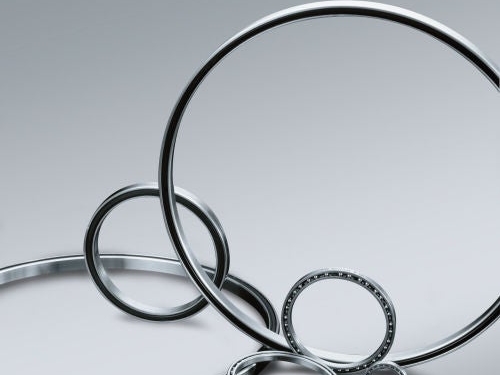
The defining characteristic of thin-section deep groove ball bearings is their extremely thin cross-section, which significantly reduces material usage; they are classified as lightweight, compact, and precision-engineered bearings.
2. Detailed Design Features
Small Cross-Sectional Dimensions: Ideal for equipment with severely limited installation space.
Lightweight: Reduces the overall load on the machine and enhances dynamic response capabilities.
Uniform Structure: Ensures smooth and stable operation.
High Precision: Typically utilized in high-end equipment.
3. Performance Differences Compared to Traditional Bearings
Compared to traditional bearings, thin-section bearings offer advantages that extend beyond mere dimensional optimization, translating into system-level performance enhancements:
Reduces the overall volume of the machine.
Improves system acceleration response.
Lowers energy consumption.
Design Advantages of Thin-Section Deep Groove Ball Bearings
1. Ultra-Compact Structure: Optimizing Equipment Space Utilization
Despite their extremely thin cross-section design, thin-section deep groove ball bearings maintain exceptional rigidity. They provide reliable support within minimal installation spaces, thereby offering greater flexibility in equipment design.
2. Significant Weight Reduction: Enhancing System Efficiency
In high-speed machinery, weight directly impacts energy consumption and response speed. By minimizing material usage, thin-section bearings effectively reduce rotational inertia, thereby boosting overall system operational efficiency.
3. A Blend of High Precision and Stability
Through high-precision grinding and assembly processes, LTZC bearings achieve both high operational accuracy and extremely low vibration levels—qualities that are particularly critical in medical and CNC equipment applications.
4. Superior High-Speed Performance
The thin-section structure minimizes the effects of centrifugal force, ensuring greater stability during high-speed operation. Furthermore, it reduces heat generation, thereby helping to maintain optimal lubrication conditions.
5. Robust Thermal Stability: Adapting to Complex Operating Conditions
Through the selection of appropriate materials and advanced heat treatment processes, these bearings maintain dimensional stability even in environments subject to temperature fluctuations, preventing accuracy degradation or seizing issues caused by thermal expansion.
6. Flexible Customization Capabilities
LTZC Bearing offers customized solutions tailored to diverse application scenarios, including:
Specialized dimensional designs
Various sealing configurations
Customized lubricants or lubrication methods
Alternative materials (e.g., stainless steel, ceramic balls, etc.)
Selection Criteria for Thin-Section Deep Groove Ball Bearings
1. Define Load Conditions to Ensure Safe Operation
During the selection process, it is essential to accurately calculate the radial and axial loads the bearing will bear, and to conduct a comprehensive analysis and evaluation in conjunction with the specific operating conditions. Proper selection helps prevent premature fatigue failure.
2. Speed Matching and Lubrication Design
Speed matching is a critical factor in bearing selection. For high-speed applications, bearings with a high precision grade must be chosen. Simultaneously, a lubricant (grease) and lubrication scheme suitable for high speeds should be selected, while also taking into account lubrication intervals and maintenance costs.
3. Installation Space and Structural Constraints
Determine the bearing's inner diameter, outer diameter, and cross-sectional dimensions based on the equipment's structural design. This ensures optimal performance within limited space while avoiding over-engineering that could lead to unnecessary cost waste.
4. Environmental Factor Assessment
Different operating environments have a significant impact on bearings. High-temperature environments require heat-resistant materials; humid environments require rust-proof designs; and dusty environments require sealed structures.
5. Service Life and Maintenance Cycles
By optimizing raceway designs and material properties, LTZC bearings maintain stable performance over long-term operation, thereby reducing maintenance frequency and enhancing equipment reliability.
How to Install Thin-Section Deep Groove Ball Bearings
1. System Preparation Prior to Installation
Before installation, thoroughly inspect the dimensional accuracy and surface roughness of both the shaft and the housing bore to ensure they meet the required fit tolerances. Additionally, clean the installation environment to prevent dust or impurities from entering the interior of the bearing.
2. Selecting the Appropriate Installation Method
(1) Press-Fitting Method
Suitable for interference fits, this method involves using pressing equipment to uniformly press the bearing into its installation position. Particular care must be taken to ensure that the applied force acts directly upon the fitted ring to prevent internal damage to the bearing.
(2) Hot-Fitting Method
This method involves heating the bearing to induce thermal expansion, thereby reducing installation resistance. It is suitable for larger-sized bearings; however, the temperature must be strictly controlled to avoid compromising the material's properties.
(3) Cold-Fitting Method
Suitable for small bearings or those with clearance fits, this method is simple to execute. However, it is essential to ensure a smooth installation process to avoid applying eccentric loads to the bearing.
LTZC Bearings recommends adopting standardized installation procedures for precision equipment to ensure that the bearing's full performance potential is realized. At the same time, LTZC provides bearing installation training and guidance to ensure that customers can maximize the performance of LTZC bearings.
Common Installation Pitfalls and Avoidance Strategies
1. Pitfall: Direct Striking During Installation
This practice can cause micro-cracks or indentations on the raceway surface, severely compromising the bearing's service life.
Avoidance Strategy: Use specialized installation sleeves or hydraulic tools for installation.
2. Pitfall: Neglecting Coaxiality
Misalignment during installation leads to uneven load distribution, resulting in abnormal wear or even premature failure.
Avoidance Strategy: Use inspection tools to ensure proper coaxiality.
3. Pitfall: Improper Lubrication Control
Both insufficient and excessive lubrication can adversely affect the bearing's operational status.
Avoidance Strategy: Select the appropriate lubricant quantity based on rotational speed and operating conditions.
4. Pitfall: Inadequate Contamination Control
The ingress of dust or particulate matter into the bearing interior accelerates wear and reduces precision.
Avoidance Strategy: Perform installation in a clean environment and utilize sealing mechanisms.
5. Pitfall: Neglecting Preload or Clearance Adjustment
Improper clearance settings can lead to issues such as vibration or excessive temperature rise.
Avoidance Strategy: Set the preload appropriately based on the specific application requirements
Summary
Thin-section deep groove ball bearings are emerging as critical foundational components within the high-end equipment manufacturing sector, offering significant advantages in terms of structural optimization, performance enhancement, and system integration. Through scientific selection and proper installation, their performance advantages can be maximized, thereby extending their service life.
Leveraging its extensive manufacturing experience and accumulated technical expertise, LTZC Bearing not only supplies high-quality products but also provides customers with comprehensive, integrated solutions—ranging from product selection to installation—thereby helping equipment achieve greater efficiency and more stable operation.