WhatsApp
 jessica.chai@ltzzc.com
 0086-379-69950051

How to Vet a Chinese Slewing Bearing Manufacturer Before You Send an RFQ
The costly mistake is not picking a slightly expensive supplier. It is discovering after the deposit that your precision slewing bearing was forged by one shop, ground by another and assembled by a third, with nobody accountable for the whole. Every Chinese Slewing Bearing Manufacturer says "factory direct" on its website. This guide shows what you can check before sending drawings, so the claim becomes evidence.
I have spent 10 years in slewing bearing, slew drive and thin section bearing sales and after-sales service. The pattern repeats: buyers who qualify the supplier first spend less time fixing disputes later.

Factory or Trading Company: Five Signals You Can Check in a Week
A trading company is not automatically a bad choice. It becomes a problem when it presents itself as a producer. For a heavy-load slewing ring, the person answering your technical question should be able to reach the people who cut the raceway. Compare what each type of supplier typically shows you.
| Signal | Likely a producing factory | Likely a trader or assembler |
|---|---|---|
| Drawing questions | Asks about raceway hardness depth, gear module, mounting hole pattern, load case | Asks only for quantity and target price |
| Process route | Can list each step for your part and say where it runs | Gives a general description with no part-specific route |
| Site evidence | Shows live work in progress with your part number or a comparable ring | Shows finished goods or catalogue photos only |
| Facility facts | States a verifiable site size and registered address you can audit | Gives an office address, or avoids the question |
| Lead time | Explains what drives the schedule (material, machining, heat treatment) | Quotes one number with no breakdown |
None of these signals proves anything alone. Three or four pointing the same way is a useful result. Limit: a producing factory may still outsource a single step such as large-diameter heat treatment. That is why the next section exists.
Verify In-House Forging, Gear Cutting, Heat Treatment and Assembly
This is the check most competitor pages skip. Ask for a written process route for your specific part, and for each step, ask: "Is it done in your facility, or sent out?" Subcontracting is not forbidden. Undisclosed subcontracting is the issue, because accountability for hardness, tooth accuracy and final fit then sits somewhere you cannot see.
| Process step | What to ask | Evidence to request | Red flag |
|---|---|---|---|
| Forging / ring rolling | Who forges the blank? What material grade (for example GCr15, 42CrMo, 20CrMo)? | Material certificate tied to the heat or batch number | Certificate without batch traceability |
| Gear cutting | Is the slewing ring gear cut and ground in the same plant? Which gear accuracy can you inspect? | Gear inspection report; photos of the tooth-cutting stage on your order | "Gear is made by our partner" with no partner name |
| Heat treatment | Where is raceway hardening done? Who records hardness results? | Hardness test record for the actual ring | Generic hardness range copied from a catalogue |
| Raceway finishing | How is raceway geometry checked before assembly? | Dimensional report, inspection stage photos | No intermediate inspection, only final check |
| Assembly and final test | Who assembles rolling elements, cage and seals? How is rotation checked? | Final inspection record, assembly photos | Assembly done at the shipping point by a third party |
Apply the same test to us. LTZC was established in 1992 and operates from a 20,000 m² facility. We produce slewing bearings, gear rings, racks and bearing unit assemblies, and we offer customized solutions built on your working conditions and drawings. For any part you send, ask us for the step-by-step route and which stages are carried out where. A supplier confident in its process will answer in specifics.
When this check matters less: for a catalogue-standard, low-load item bought in volume, a reputable trader with its own inspection may be acceptable. For large, welded-into-the-machine rings, one failed raceway can stop a crane or a tunnelling rig. Verification pays there.
Certificates and Customer Cases: What They Prove and What They Do Not
Quality system certificates show that a documented process exists. LTZC holds ISO9001:2015 quality management, ISO14001:2015 environmental management and ISO45001:2018 occupational health and safety certification, and is certified by ISO, CCS and ABS. Ask any supplier for the certificate copy, the scope statement and the issue date. Check that the scope covers the products you are buying. A certificate for "trading of bearings" is not the same as one covering manufacture.
Cases carry more weight than adjectives, as long as you read their limits. These are LTZC projects we can cite:
| Case | What it shows a buyer | What it does not prove |
|---|---|---|
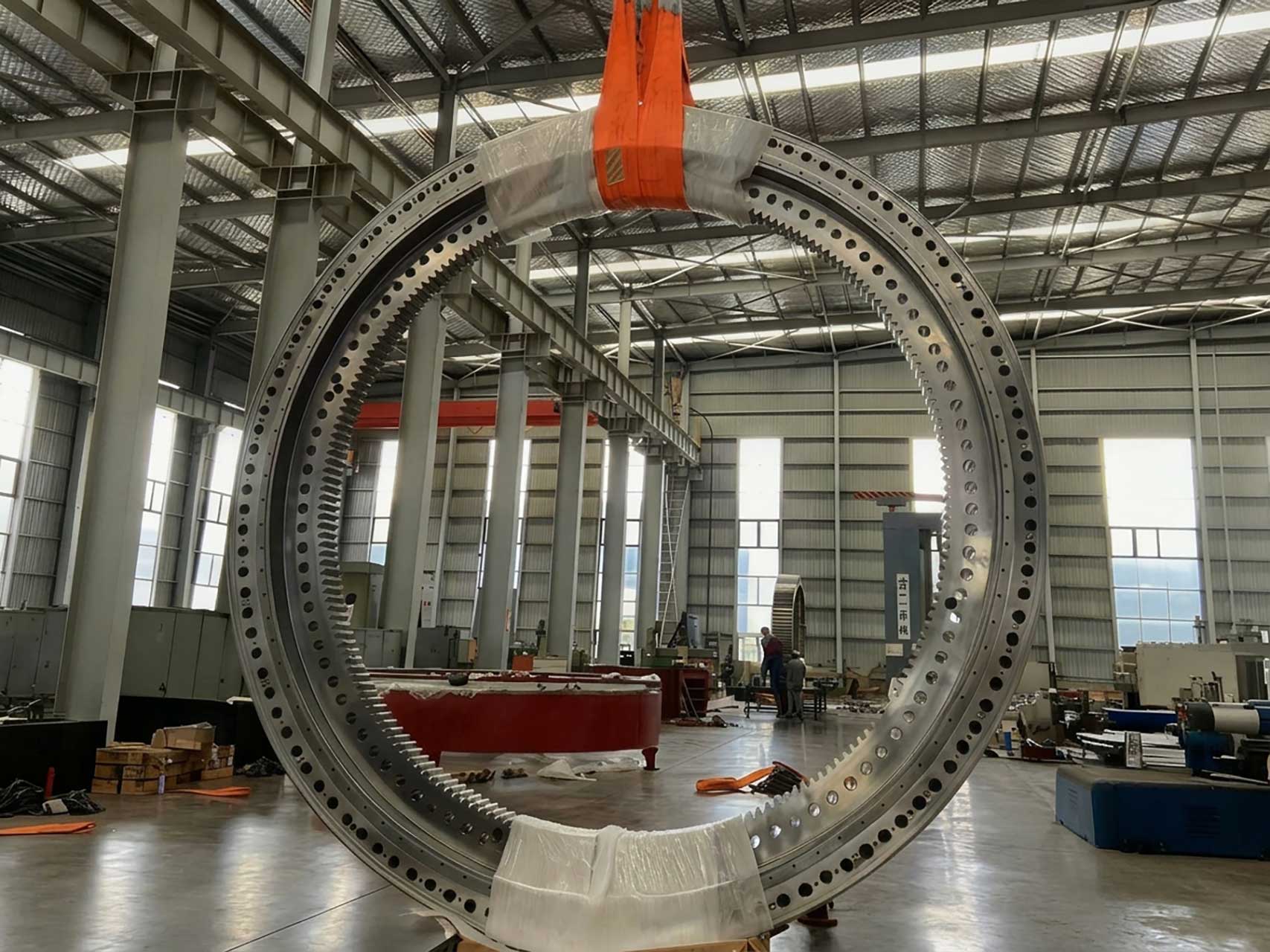
| 2024: 10.87 m outer diameter integral three-row roller slewing ring for 2,000 ton fixed lifting equipment, the largest slewing ring LTZC has made | Capacity for very large single-piece Three Row Roller Slewing Bearings | That every size or schedule is equal to this project |
| 2024: 8.445 m integrated bearing for a crane industry client in South Korea | Export delivery of a large crane bearing | Local stock or a Korean office |
| 8 m high-precision segmented gear rings for Wuhan Heavy Industry, used in a vertical friction stir welding system of a key national project | Gear accuracy on large segmented rings | Suitability for your duty cycle without review |
| φ24 m segmented bearings delivered to Jiangsu Nantong Rainbow Heavy Machinery | Segmented design for diameters too large for one-piece handling | Pricing or lead time for your project |
| Ring rolls for CRCC shield machine main drives: 15 series, 90 pieces in total | Repeat production across multiple series | Identical specs for non-tunnelling applications |
| 6 m segmented gear ring with ground teeth, supplied through a Hengshui customer to end customers | Ground-tooth gear work delivered through an intermediary | That ground teeth suit every gearing requirement |
A smaller reference also exists: a 3 m turntable bearing that held up the main torch tower in the opening ceremony of the World Military Olympic Games. Treat it as a use-case reference, not a load rating.
A Six-Step Vetting Procedure Before You Share Drawings
Request documents first. Business licence, certificate copies with scope, and a facility address. Reject "available later."
Ask for a part-specific process route. Use the table above and mark each step "own plant" or "outsourced."
Request records from a similar past order. Hardness, dimensional and final inspection records with identifying numbers. Customer names can be redacted.
Hold a technical call with an engineer. Discuss load case, mounting stiffness and gearing. Use the bearing selection guide to prepare your questions.
Audit remotely or on site. A live video walk-through of the stage your part is in beats a slide deck.
Agree acceptance in writing before payment: inspection items, who witnesses, and what happens on failure.
Worked example. A buyer needs a large three-row roller ring with an external gear for fixed lifting equipment. At step 2 the supplier says gear cutting is subcontracted. The buyer asks for the subcontractor's name, gear inspection report format and whether the ring is inspected again after gear cutting. The answers settle whether to proceed, or to ask a factory with integrated gear work for a quote to compare.
Common Vetting Mistakes
Treating years in business as proof of production. Experience claims are easy to write. Ask what was made, at which diameter, for whom.
Comparing only unit price. A lower quote often omits heat treatment depth checks, gear grinding or an inspection witness.
Skipping material traceability. Whether the ring is GCr15, 42CrMo or another grade should be tied to a batch certificate, not a line on a quotation.
Accepting photos as a factory audit. Photos can be borrowed. A live stage check on your part cannot.
Leaving after-sales for later. Installation errors cause many early failures. Ask about bearing installation guidance before you order.
Cooperation Terms to Confirm in Writing
Stated LTZC terms: there is no minimum order quantity, and delivery runs 30 to 90 days. The actual figure depends on the part, so confirm it against your drawing and material. Customized work, including Customized Bearings and non-standard parts, is based on your working conditions, existing designs and technical specifications.
After-sales support covers installation and commissioning guidance, preventive maintenance training, and fault diagnosis. LTZC responds to quality objections within 24 hours, and on-site service starts within 48 hours in China. That 48-hour commitment applies to China. For overseas projects, agree how remote and on-site support will work in the contract.
Matters to settle with any Chinese Slewing Bearing Manufacturer, ours included, before a purchase order:
Which inspection reports ship with the goods, and who may witness testing.
Material grade and certificate format.
Packaging and transport responsibility for oversized rings.
Remedy and responsibility if the ring fails acceptance.
Technical support scope after delivery, and where it is delivered.
Buyer Checklist and Next Step
Certificates received, scope covers manufacture of your product type.
Process route received, each step marked own plant or outsourced.
One past order record reviewed with hardness and dimensional data.
Engineer, not only a salesperson, answered your technical questions.
Lead time, acceptance criteria and after-sales scope agreed in writing.
If a supplier cannot tick every line, you know what is still unproven and can decide whether the price gap justifies the risk. If you are comparing a Large Slewing Bearing or a segmented gear ring supplier, send us your drawing, load case and target delivery window. We will reply with the process route for your part and tell you plainly which stages we would run where.