WhatsApp
 jessica.chai@ltzzc.com
 0086-379-69950051

Prevent Bearing Distortion During Custom Heat Treatment
You've received a prototype or first-run production batch of custom bearings, but the post-heat-treatment inspection report shows unacceptable dimensional changes. Ovality, runout, and size variations have pushed the components out of tolerance, leading to production delays and potential assembly failures. This is a common but solvable problem in manufacturing large or non-standard bearings. Understanding the causes of bearing heat treatment distortion is the first step toward implementing effective process controls and achieving consistent, predictable results.
The goal of any custom bearing heat treatment is to achieve specific mechanical properties—like hardness and wear resistance—without compromising the part's geometric integrity. Distortion occurs when internal stresses, introduced during heating and cooling, exceed the material's elastic limit. For engineers, diagnosing the source requires a methodical look at the entire process, from material selection to the final quench.
Initial Diagnostic Checklist for Distortion Issues
Before making process changes, start with a systematic review of the distorted part and its manufacturing records. This helps differentiate between a material issue, a design flaw, or a heat treatment process error. In my 10 years of experience with slewing bearings and other large-scale components, I've found this initial data collection phase prevents incorrect assumptions and wasted effort.
Use this checklist to gather essential information:
Review the Heat Treatment Specification Sheet: Confirm the specified temperatures, soak times, and quenching medium match the process records. Were there any deviations? An incorrect austenitizing temperature can lead to excessive grain growth or retained austenite, both of which affect final dimensions.
Compare "As-Quenched" vs. "Final" Dimensions: Does the distortion appear immediately after quenching, or does it develop during post-quench processes like tempering or machining? This can help isolate the source of the stress.
Inspect for Visual Clues: Look for discoloration or surface patterns that indicate uneven cooling. A part that cooled faster on one side will contract differently, leading to warping. This is especially common in Large Slewing Bearing manufacturing, where uniform quenching is a significant challenge.
Verify Material Certification: Ensure the correct material was used. A simple mix-up between alloys like GCr15 and 42CrMo can result in unexpected dimensional changes, as each has a different response to thermal cycling. Our ISO 9001:2015 certified quality system enforces strict material traceability to prevent such errors.
Analyze Part Geometry: Are there significant variations in cross-section thickness? Thin sections cool much faster than thick sections, creating a thermal gradient that is a primary driver of bearing quench distortion.
Key Process Controls to Prevent Ovality and Runout
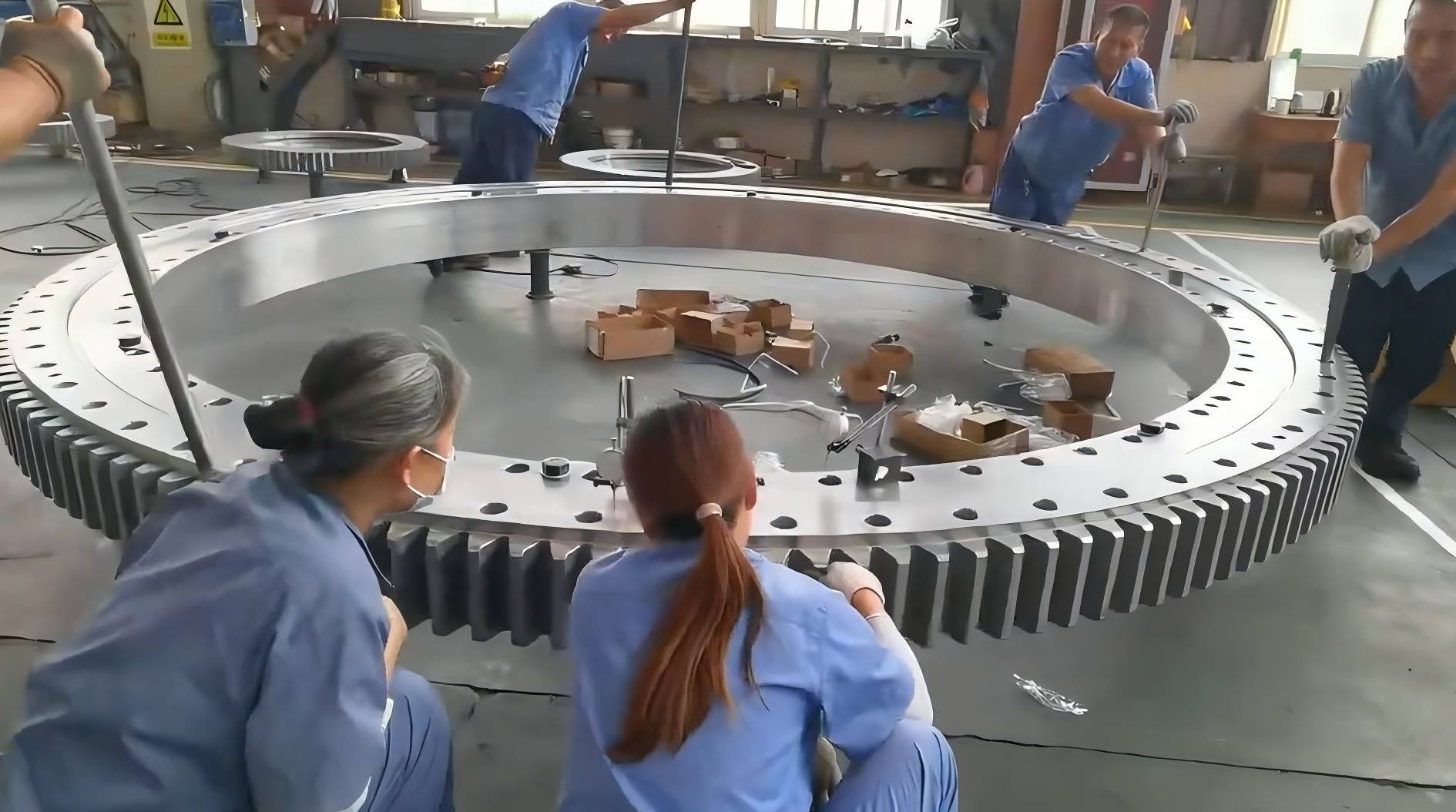
Dimensional stability is not accidental; it is the result of carefully controlling four critical factors during the heat treatment process. Understanding how fixturing, quench severity, section thickness, and stress relief interact is essential to prevent bearing warping. For large or complex parts, like the 10.87-meter slewing ring we recently produced for 2,000-ton lifting equipment, these controls are absolutely paramount.
This table outlines best practices versus common mistakes for each control point.
| Control Factor | Poor Practice (Causes Distortion) | Best Practice (Ensures Stability) |
|---|---|---|
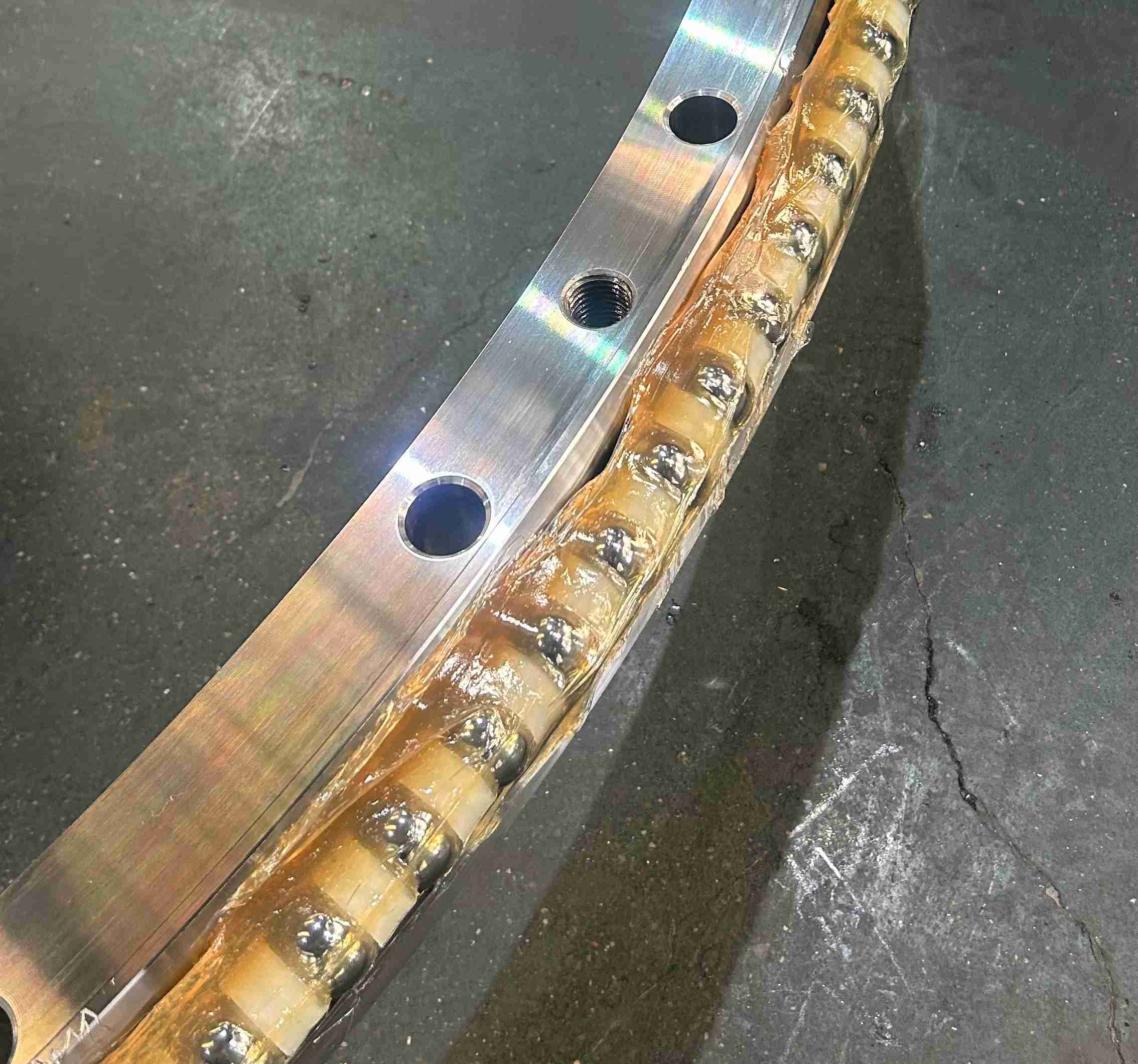
| Fixturing & Support | Laying the part flat on the furnace hearth or using minimal point contacts. This allows the bearing's own weight to cause sagging at high temperatures. | Using custom-designed, conforming fixtures that support the bearing ring's entire geometry. For large rings, vertical orientation or specialized press-quenching fixtures are used to maintain roundness. |
| Quench Severity | Using an overly aggressive quenchant (e.g., water or brine) for a material or geometry that doesn't require it. The rapid, non-uniform cooling creates massive thermal stresses. | Matching the quenchant to the material's hardenability (e.g., oil or polymer for alloy steels like 42CrMo). Employing controlled agitation in the quench tank to ensure uniform heat extraction from all surfaces. |
| Section Thickness | Ignoring variations in cross-section. The part is treated with a one-size-fits-all process, causing thin sections to cool and transform long before thick sections. | Adjusting the process for geometry. This may involve using insulating blankets on thin sections, orienting the part in the quench for more uniform flow, or modifying the design to add radii and reduce sharp transitions. |
| Stress-Relief Steps | Moving directly from final machining to hardening. This traps residual stresses from turning and milling, which are then released unpredictably during heat treatment. | Implementing a dedicated bearing stress relief process. This includes a sub-critical anneal after rough machining and before hardening, as well as immediate tempering after quenching to reduce brittleness and stabilize the martensitic structure. |
Diagnosing Common Distortion Types and Their Root Causes
Once you've identified the type of distortion, you can narrow down the potential root causes. Different process errors manifest as specific geometric deviations. For example, ovality and warping often point to different problems.
Ovality (Out-of-Roundness)
This is one of the most frequent forms of bearing heat treatment distortion, especially in thin-section rings.
Primary Cause: Non-uniform cooling during the quench. If one side of the ring cools and contracts before the other, the part will be pulled into an oval shape.
Contributing Factors: Improper support in the furnace, allowing the ring to sag under its own weight; inconsistent agitation in the quench tank; or loading the furnace in a way that shields part of the ring from heat.
Solution: Re-evaluate the fixturing to ensure the ring is fully supported. For quenching, consider press-quenching, where the part is held in a die during cooling to physically restrain it from distorting. This is a common technique for high-precision thin section bearing manufacturing.
Warping (Dish or Potato-Chip Effect)
Warping refers to axial runout, where the bearing faces are no longer flat and parallel.
Primary Cause: Release of non-symmetrical residual stresses. These stresses can be inherent from the raw material (e.g., rolled plate) or introduced during machining operations like turning or gear cutting.
Contributing Factors: Asymmetrical part design (e.g., a flange on one side); aggressive machining that induces high surface stress.
Solution: A stress-relief cycle before final hardening is the most effective solution. This involves heating the part to a temperature below its transformation point (e.g., 600-650°C for steel) and holding it long enough for internal stresses to relax.
Size Change (Growth or Shrinkage)
All parts change size during heat treatment due to phase transformations in the metal's crystal structure. The problem arises when this change is unpredictable or excessive.
Primary Cause: Incomplete transformation of austenite to martensite during quenching, resulting in retained austenite. This softer phase is less dense and causes the part to "grow." Incorrect austenitizing temperatures can also lead to abnormal size changes.
Contributing Factors: Insufficient soak time at temperature; a quenchant that is too slow; high carbon or alloy content in the steel.
Solution: For issues with retained austenite, a sub-zero treatment (cryogenics) after quenching can be effective. Chilling the part to temperatures like -80°C forces more of the retained austenite to transform into martensite, increasing hardness and improving dimensional stability. Proper furnace calibration and temperature control are also critical.
Material Selection's Role in Dimensional Stability
The material you choose has a profound impact on its behavior during heat treatment. At LTZC, we offer a range of materials for our Customized Bearings, each selected for specific performance characteristics and processing requirements.
Here’s how some common bearing materials influence distortion:
GCr15 / SUJ2: These are standard high-carbon chromium bearing steels. They have relatively low hardenability, meaning they require a faster quench to achieve full hardness. This makes them more susceptible to quench distortion, especially in larger cross-sections. Careful process control is essential.
20CrMo / 42CrMo: These alloy steels have higher hardenability due to elements like chromium and molybdenum. This allows them to be hardened with a slower, less severe quench (e.g., oil instead of water), which significantly reduces thermal stress and the risk of distortion and cracking. They are an excellent choice for heavy-load bearings that require a good balance of strength and stability.
AISI 440C: As a stainless steel, 440C behaves differently. It's an air-hardening steel, meaning its transformation occurs during cooling in still air. This extremely slow "quench" results in very low distortion, but it requires precise atmospheric control in the furnace to prevent surface reactions.
Choosing the right material from the start, based on both the application's demands and the part's geometry, is a key strategy for minimizing heat treatment challenges. Our engineering team often assists clients in material selection to ensure manufacturability and performance.
Controlling distortion during custom bearing heat treatment requires a holistic approach that considers design, material, and every step of the thermal process. By implementing systematic diagnostics and precise process controls, you can achieve the required mechanical properties while holding an exacting geometric tolerance. For complex or large-scale projects, partnering with a manufacturer experienced in these nuances is key.
If you are facing challenges with dimensional stability in your custom bearings, submit your drawings and technical specifications for a detailed process review by our engineering team.