WhatsApp
 jessica.chai@ltzzc.com
 0086-379-69950051

How Does Custom Bearing Heat Treatment Extend Life?
Why does a ring that passes a surface hardness check still spall early in service? The usual answer is that surface hardness says little about what happens 2 to 5 mm below the raceway, where rolling contact stress peaks. Custom bearing heat treatment extends life by matching the hardness profile, microstructure and residual stress state of a ring to the load it carries. A higher number on a hardness report does not do that by itself. This article explains which heat-treatment parameters change fatigue life, how they interact, and what to put on a drawing before you contact a supplier. It applies to a precision slewing bearing and to non-standard rings alike.
What Heat Treatment Changes Inside Bearing Steel
Bearing steel heat treatment does three things to a ring. Each has its own effect on life.
Hardness. Quenching and tempering turn the steel into tempered martensite. Higher hardness resists the plastic deformation and wear that start raceway damage. The trade-off is lower toughness. A ring hardened past what its section and shock loads allow can crack instead of wearing.
Microstructure. Carbide size and distribution, grain size and retained austenite content all come from the austenitizing temperature, hold time, quench rate and tempering. Coarse grain or networked carbides create initiation sites for subsurface fatigue cracks.
Residual stress. Quenching and tempering leave stress in the ring. Compressive stress near the raceway tends to slow crack growth. Tensile stress, or distortion that forces heavy grinding afterward, works against fatigue life.
This is the practical answer to how heat treatment affects bearing life. Fatigue life depends on whether hard, clean, stable material sits at the depth where the stress is highest. It does not depend on peak hardness alone.
Bearing Hardness Depth and Why It Must Match the Load
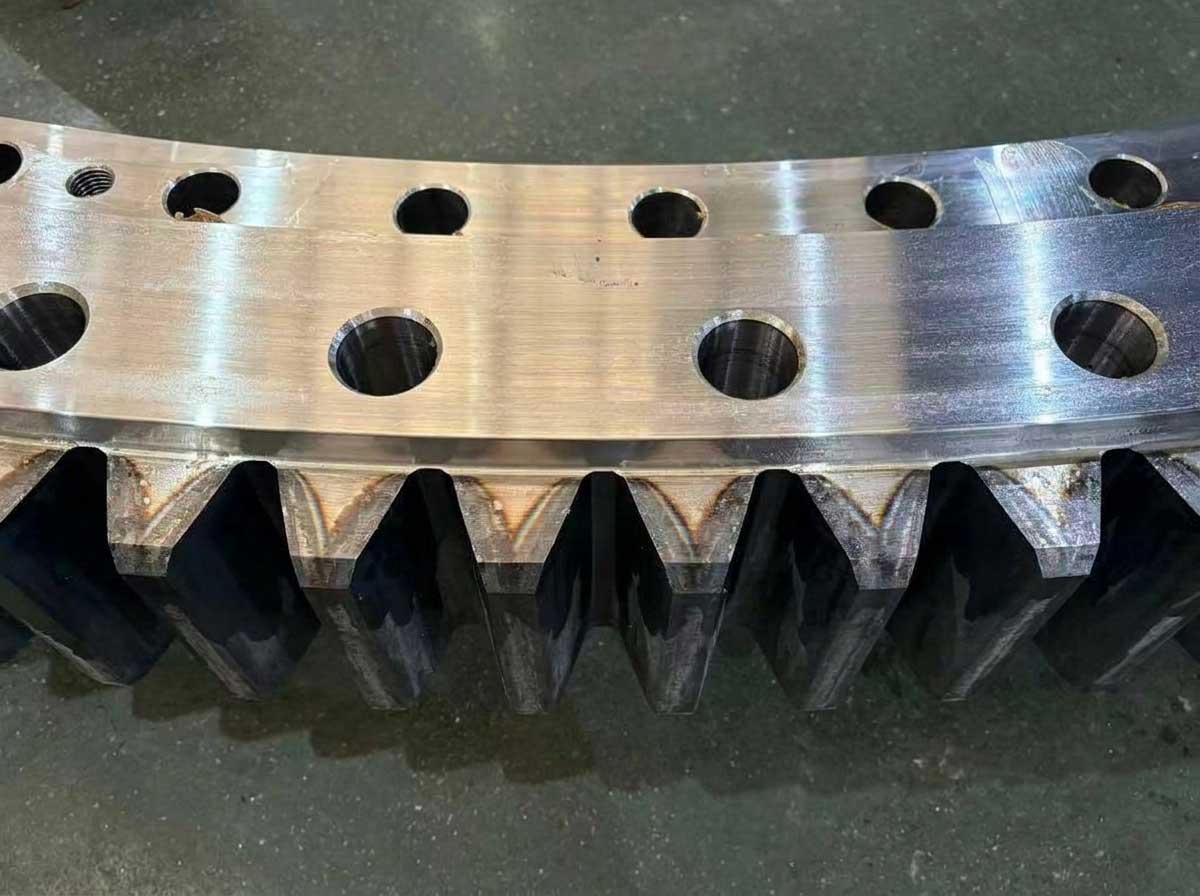
In rolling contact, the maximum shear stress sits below the surface. The depth grows with rolling element size and load. A small ball bearing has a shallow stress zone. A large roller raceway on a heavy-duty ring has a much deeper one. If the hardened layer ends close to that zone, cracks start at the boundary where hard material meets softer core, and the surface looks fine until the spall appears.
Bearing hardness depth is only meaningful with a stated definition. Drawings should name the hardness threshold that marks the edge of the effective layer and the method used to measure it, typically a micro-hardness traverse on a cut section. Two suppliers quoting the same depth with different thresholds are not offering the same part.
Conclusion: specify effective hardened depth with a threshold, not just "deep hardened".
Reasoning: the layer must extend well past the subsurface shear stress zone, with margin for grinding stock and wear.
Fits: surface-hardened raceways on Large Slewing Bearing rings, where roller loads are high and the stress zone is deep.
Limits: a deeper layer is not automatically better. Excess depth in an induction-hardened section raises distortion and cracking risk and can leave tensile stress in the core. Through-hardened rings do not have this issue, because hardness is uniform across the section.
Through-Hardening, Case Hardening and Induction Hardening Compared
The three routes give different hardness profiles, retained austenite behavior and fatigue characteristics. The table compares them under general metallurgical behavior. Actual values depend on steel grade, section thickness and furnace or coil control, so confirm them against your own drawing.
| Attribute | Through-hardening | Case hardening (carburizing) | Induction hardening |
|---|---|---|---|
| Typical steel | GCr15, SUJ2 (52100 equivalent family) | Low-carbon alloy steel such as 20CrMo | Medium-carbon alloy steel such as 42CrMo |
| Hardness profile | Near-uniform from surface to core in thin sections. Thick sections may show a softer core. | Hard, high-carbon case over a tough, softer core. Gradual transition. | Hard layer on the raceway only. Core stays at its pre-treatment strength. Layer follows the coil pattern. |
| Retained austenite | Controlled by austenitizing and tempering. Too much lowers hardness and risks dimensional change over time. | Can run higher in the case if carbon potential is high. Needs control to avoid growth and soft surface. | Usually low, because heating is brief and carbon content is moderate. |
| Fatigue-life effect | Strong, consistent rolling contact fatigue resistance when the section is small enough to harden fully. | Good contact fatigue with compressive stress in the case. Strong under shock thanks to the tough core. | Targets the loaded raceway at lower cost. Life depends on layer depth, uniformity and the treatment of the start/finish zone. |
| Main limit | Large cross-sections cannot be through-hardened uniformly. Quench distortion grows with size. | Long cycle, distortion, and grinding allowance needed to remove oxidized surface. | Hardening gap or soft zone where the layer starts and ends. Requires placement away from the main load zone. |
For slewing rings, induction-hardened raceways on alloy steels such as 42CrMo are a common choice because the ring is large and the load path is local. Through-hardened GCr15 or SUJ2 fits smaller precision rings and rolling elements, where full-section hardness is achievable. These are general mechanisms, not a blanket rule. Section size, load direction and shock decide each case.
How Steel, Ring Size and Process Interact
Parameters do not act alone. Three interactions change decisions most often.
Steel grade sets the achievable depth. Hardenability limits how deep martensite forms for a given quench. Specifying a deep layer on a steel that cannot deliver it produces a soft core or a shallow layer, not a better ring.
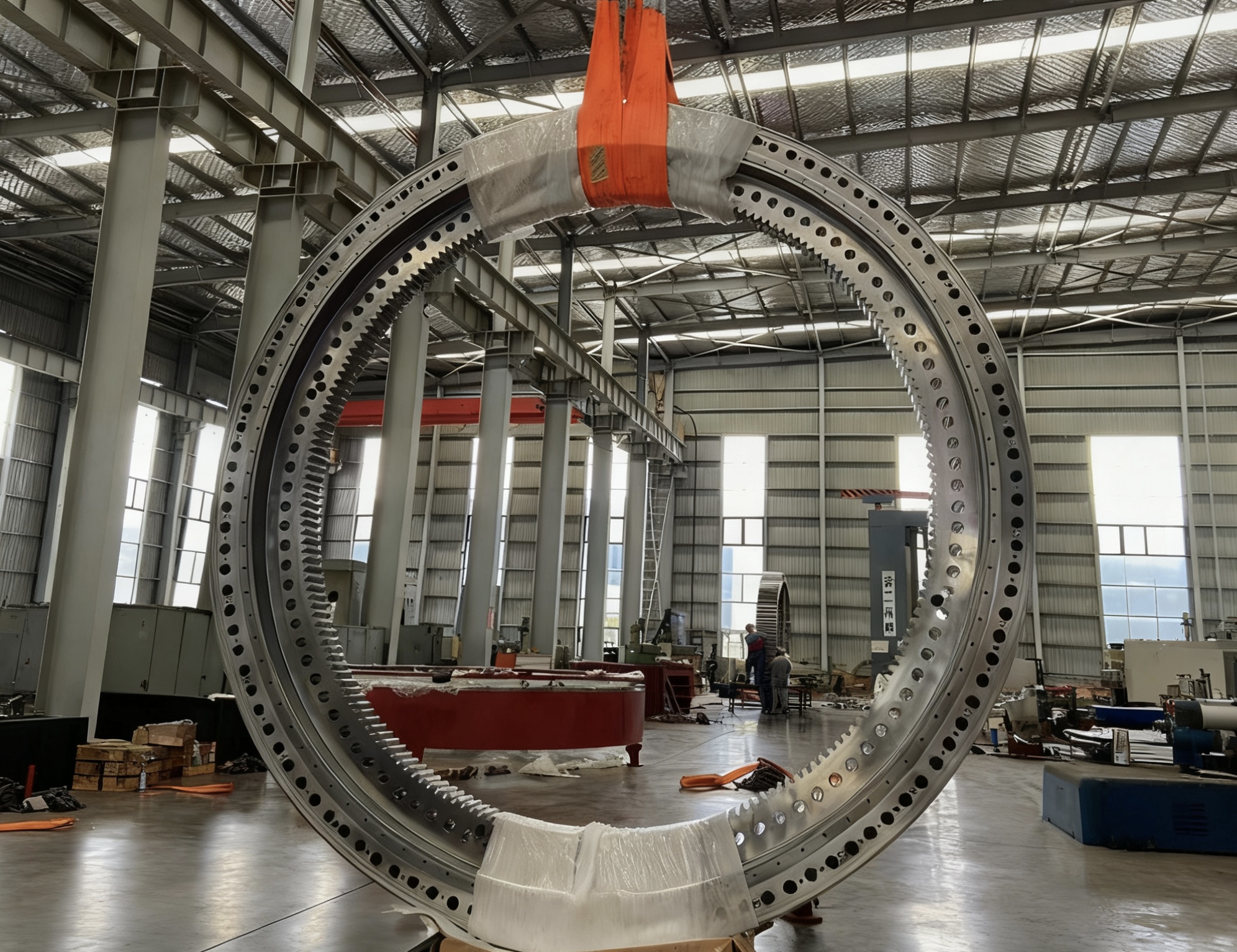
Ring size sets the quench strategy. Large diameters and thin cross-sections distort easily. Cases such as our 10.87 m three-row roller slewing ring for 2,000 ton fixed lifting equipment, or the 8-meter segmented gear rings supplied to Wuhan Heavy Industry, show why scale matters. At that size, flatness, roundness and tooth accuracy depend on controlled heating, supported quenching and allowance for finish machining. These examples show the scale we work at. They do not mean every ring gets the same process.
Tempering and finishing close the loop. Tempering trades a small amount of hardness for toughness and dimensional stability. Grinding after heat treatment removes distorted material, but grinding too aggressively can burn the surface and undo the benefit. The drawing should state hardness after tempering and the grinding allowance together.
Custom bearing heat treatment is therefore a process chain, and the final result depends on all links. Where the supplier also controls machining and grinding, that coordination is easier. LTZC operates under an ISO9001:2015 quality management system, and process records can be tied to a batch rather than described verbally.
Material notes for customization
GCr15 / SUJ2: high hardness, wear resistance and strength, used for rolling elements and precision rings. This is the family closest to 52100 bearing heat treatment practice.
20CrMo / 42CrMo: alloying improves strength, hardness and wear resistance for heavy-load bearings. Choose carburizing or induction hardening based on section and load.
AISI 440C: chosen when corrosion resistance matters. Its heat treatment window differs from GCr15, so do not copy a 52100 specification onto it.
Ti-6Al-4V and CuSn6: these are not hardened by martensitic quenching in the same way. Performance comes from alloy properties and other routes, so do not apply steel hardness targets to them.
Common Misunderstandings and How to Verify Them
The misunderstanding that changes decisions most is "higher HRC means longer life." Past a point, extra hardness lowers toughness and raises sensitivity to inclusions, edge loading and shock. A ring at the top of the range in a shock-loaded crane slew may fail sooner than a slightly softer, tougher ring with a properly sized hardened layer.
Common mistakes in specifying heat treatment
Writing only a surface hardness range, with no depth, threshold or measurement location.
Applying a through-hardening specification to a large cross-section that cannot be fully hardened.
Ignoring the induction hardening start/finish zone, which leaves a soft spot that may land in the load zone.
Treating retained austenite as purely good or bad. It is a controlled parameter that affects hardness and dimensional stability.
Comparing hardness readings taken with different methods or scales as if they were equivalent.
Skipping post-treatment inspection for cracks on rings with sharp section changes.
What to request and what it proves
| Evidence | What it establishes | What it does not establish |
|---|---|---|
| Surface hardness readings at several positions | Uniformity of the hardened surface | Depth, or core condition |
| Micro-hardness traverse on a section | Effective hardened depth against your stated threshold | Behavior of the whole ring if only a sample piece was cut |
| Microstructure report | Martensite quality, carbide distribution, retained austenite level | Hardness at the raceway under load |
| Crack inspection record (e.g., magnetic particle) | Absence of surface defects after quench and grind | Subsurface fatigue life |
| Heat-treatment batch record | Traceable temperatures and times for the lot | Whether the cycle was the right choice for your load |
If a supplier cannot show a section-based depth measurement for a surface-hardened raceway, the depth claim is unverified. That is the question to ask first.
Worked Example: Choosing a Route for a Heavy-Load Slewing Ring
This is an illustrative scenario, not a customer record. A design engineer needs a three-row roller slewing ring for a fixed lifting application with slow rotation, high axial load and occasional shock. Section thickness is too large for uniform through-hardening.
Pick the steel. A medium-carbon alloy such as 42CrMo gives core strength for heavy loads and responds well to surface hardening.
Choose the route. Induction hardening of the raceways fits the size and the local load path. Carburizing is an alternative if the design needs a very tough core and the ring size permits it.
State depth and threshold. Define effective depth at a named hardness value, and set the minimum in line with the roller size and load from your calculation.
Locate the soft zone. Ask that the hardening start/finish gap sit outside the main load zone, and mark it on the drawing.
Set verification. Require surface hardness at stated points, a section micro-hardness traverse from a test ring or witness piece, and crack inspection.
For the product type, see our Three Row Roller Slewing Bearings. In 2024 LTZC delivered an integral three-row roller slewing ring with a 10.87 m outer diameter for 2,000 ton fixed lifting equipment, the largest ring we have built. Rings at this scale are the reason these checks are specified up front.
Specification Checklist Before You Contact a Supplier
Steel grade and any required equivalents (for example GCr15, SUJ2 or 52100 family).
Process route: through-hardening, carburizing or induction hardening, and why.
Surface hardness range after tempering, plus measurement locations.
Effective hardened depth, hardness threshold and measurement method.
Retained austenite limit, if dimensional stability or fatigue sensitivity requires it.
Position of any induction start/finish zone relative to the load zone.
Grinding allowance and final dimensional tolerances.
Inspection and record requirements, including the sample or witness piece.
Operating conditions: load type, shock, speed, temperature, corrosion exposure.
Missing items on this list are the points to settle with the supplier before a heat-treatment route is fixed. LTZC offers no MOQ, quotes 30 to 90 day delivery, and builds to your drawings or working conditions as Customized Bearings. If you are still deciding on bearing type, the bearing selection guide covers the earlier steps.
Send your drawing, material, load data and hardness requirements to our engineering team and we will review the heat-treatment route and verification plan with you before you place an order.