WhatsApp
 jessica.chai@ltzzc.com
 0086-379-69950051

Selecting the Right Single Row Ball Slewing Ring Configuration
Choosing the correct basic bearing size and capacity is only the first step. For engineers and procurement managers, the subsequent decisions about gear configuration and sealing arrangements are what truly determine a bearing's integration efficiency, maintenance requirements, and long-term performance. A Single Row Ball Slewing Ring is a highly versatile component, but its effectiveness hinges on selecting the right options for your specific application. Misunderstanding how an internal gear affects maintenance access or how sealing interacts with the drive system can lead to costly design revisions or premature equipment failure.
This guide provides direct answers to common questions about gear types, lubrication access, and sealing. It will help you specify a bearing that not only meets your load requirements but also fits seamlessly into your operational and maintenance workflows. As an engineer with a decade of experience in this field, I've seen how these details make all the difference in applications from wind turbines to heavy excavators.
Key Differences Between External, Internal, and Gearless Slewing Rings
The primary distinction between slewing ring types lies in the placement of the gear teeth, or their absence entirely. This single design choice influences the machine's overall footprint, drive mechanism, and exposure to environmental contaminants. Understanding these trade-offs is fundamental to proper bearing selection.
At LTZC, our advanced production capabilities allow us to manufacture high-precision, non-standard bearings tailored to your exact needs, whether you require an external, internal, or gearless design. Our process is certified under ISO 9001:2015, ensuring consistent quality for every component.
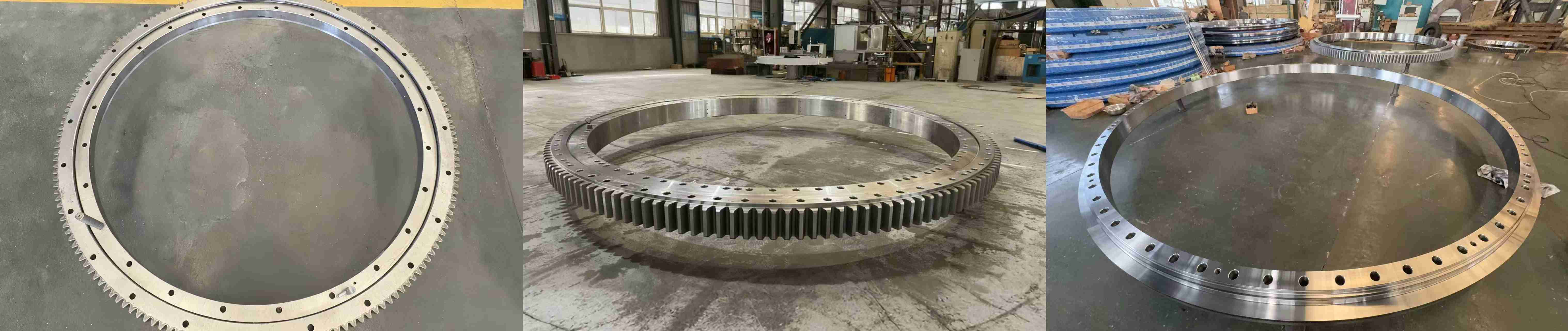
The table below outlines the functional differences to guide your initial decision-making process.
| Feature | External Gear | Internal Gear | Gearless |
|---|---|---|---|
| Drive Pinion Position | Mounted on the outside diameter, engaging externally. | Mounted within the inner diameter, engaging internally. | No gear; driven by other means (e.g., hydraulic motor, belt). |
| Gear Protection | Exposed. Requires external guarding to protect from debris and for personnel safety. | Inherently protected within the machine structure. Offers better protection from falling debris. | Not applicable. The drive mechanism requires its own protection. |
| Space Requirement | Requires additional radial space for the pinion and its housing. | More compact radially, as the drive is contained within the bearing's inner diameter. | Depends entirely on the external drive system. Can be very compact. |
| Maximum Speed | Generally allows for higher rotational speeds due to better heat dissipation. | Lower maximum speed due to heat buildup in the enclosed gear mesh. | Speed is limited by the bearing's rolling elements, not a gear mesh. |
| Typical Applications | Cranes, excavators, access platforms where space is less constrained. | Wind turbines, tank turrets, bottling machines where a compact and protected drive is needed. | Radar antennas, medical scanners, satellite dishes where smooth, precise, un-geared rotation is necessary. |
Gear and Seal Access FAQ for Different Configurations
Once you have a general idea of the gear type you need, practical questions about maintenance and integration arise. Here are answers to the most frequent queries we receive from clients regarding lubrication and sealing for various slewing ring configurations.
How does gear type affect lubrication access for the gear teeth?
The location of the gear teeth directly impacts how you apply grease to the gear mesh. This is a separate consideration from lubricating the bearing's internal raceway.
External Gear: Access is straightforward. The gear teeth are exposed, allowing for easy visual inspection and manual application of open-gear lubricant. The main challenge is ensuring that the lubricant is not immediately flung off during high-speed rotation or washed away by rain.
Internal Gear: Access is more restricted. The gear mesh is shielded by the machine's structure. Lubrication is typically handled by automated systems that feed grease through dedicated ports or by applying it during assembly. While harder to inspect, this configuration protects the grease from environmental contamination.
Gearless: This is not a concern for gearless rings, as there are no gear teeth to lubricate.
Where are the lubrication points for the bearing raceway located?
This is a critical point of clarification: raceway lubrication is independent of gear lubrication. All slewing rings, regardless of gear type, require grease for the rolling elements (balls or rollers) inside the sealed raceway. Grease fittings for the raceway are typically located on the face of either the inner or outer ring. Their position and quantity are determined by the bearing size and design. At LTZC, we provide customized bearing solutions and can position these grease fittings to align with the access points on your equipment, simplifying maintenance.
How do sealing systems differ between the configurations?
The primary seals on a slewing ring are designed to protect the internal raceway from contamination and retain grease. The standard seal material is typically NBR (Nitrile rubber). While the fundamental sealing design is similar across all three configurations, the overall effectiveness is influenced by the gear type.
An internal gear configuration provides an additional layer of structural protection for the entire assembly. Because the drive is enclosed, the slewing ring seals are less exposed to direct impact from debris or high-pressure water spray.
An external gear configuration leaves the seals more exposed to the elements. This may not be an issue in clean environments, but for harsh applications like mining or marine use, it's a factor to consider. We can provide alternative seal materials like Viton for applications involving high temperatures or chemical exposure.
Are there access challenges for mounting bolts with internal gears?
Yes, this is a common design consideration. With an internal gear ring, the structure supporting the pinion drive can sometimes obstruct access to the inner ring's mounting bolts. Engineers must plan for this during the machine design phase, ensuring there is adequate clearance for torque wrenches and maintenance personnel. External and gearless rings typically offer more open access to all mounting bolts.

Common Mistakes in Slewing Ring Specification and Installation
A perfectly manufactured bearing can still fail prematurely if specified or installed incorrectly. Avoiding these common errors is essential for achieving the expected service life of your equipment. We have seen these issues arise across many industries, and they are almost always preventable.
Ignoring Mounting Surface Flatness: A slewing ring must be mounted on a rigid, flat surface. An uneven foundation distorts the bearing rings when the bolts are tightened, creating tight spots in the raceway that lead to rapid wear and failure. Always check surface flatness against the manufacturer's specifications before bearing installation.
Incorrect Bolt Tightening Procedure: Simply tightening bolts to their final torque value is not enough. Bolts must be tightened in a star or crisscross pattern in stages (e.g., 30%, 70%, 100% of final torque) using a calibrated torque wrench. This ensures even clamping pressure and prevents ring distortion.
Mismatching Pinion and Gear Specifications: When using a geared slewing ring, the drive pinion must be perfectly matched to the slewing ring gear. This includes the module, pressure angle, and material hardness. A mismatch will cause excessive noise, vibration, and destructive wear on the gear teeth.
Inadequate Lubrication Schedule: The factory-fill grease is for initial startup and corrosion protection only. A regular re-lubrication schedule must be established based on the application's speed, load, and operating environment. Failure to replenish grease is a leading cause of premature bearing failure.
Selecting the Wrong Seal for the Environment: Standard NBR seals are suitable for most industrial conditions. However, they are not ideal for extreme temperatures or exposure to aggressive chemicals. Specifying the wrong material can cause seals to harden, crack, and fail, allowing contaminants to enter the raceway.
A Buyer's Checklist for Sourcing Custom Slewing Bearings
To ensure you receive a precision slewing bearing that meets your exact requirements without delays, it is helpful to have all necessary information ready when you submit a request for quotation (RFQ). This checklist covers the key data our engineering team needs to provide an accurate and effective solution.
Define Operating Conditions: Provide details on all loads the bearing will experience—axial, radial, and tilting moment. Also specify the rotational speed, duty cycle, and total angle of rotation.
Specify Gear Requirements: Clearly state if you need an external, internal, or gearless configuration. For geared rings, provide the gear module, number of teeth, required precision class, and any specific backlash requirements.
Confirm Environmental Factors: Describe the operating environment. Will the bearing be exposed to extreme temperatures, moisture, saltwater, dust, or specific chemicals? This information determines the required sealing materials and corrosion protection.
Provide Technical Drawings: The most effective way to communicate your needs is through detailed drawings of the mounting structures and mating components. This helps us identify potential integration challenges and ensures a perfect fit.
Clarify Certification Needs: State any required third-party certifications. LTZC is certified by ISO, CCS, and ABS, in addition to holding ISO 9001:2015, ISO 14001:2015, and ISO 45001:2018 certifications for our management systems.
Discuss Logistics and Quantity: We offer flexible delivery times, typically between 30 and 90 days, and have no minimum order quantity (MOQ). Providing your target delivery date and order volume helps us plan production accordingly.
By preparing this information, you enable us to move quickly from quotation to production, delivering a high-quality, customized bearing that meets your project timeline and performance goals.
If you have a specific application or need guidance on selecting the right bearing configuration, submit your technical specifications to our engineering team for a customized solution.