WhatsApp
 jessica.chai@ltzzc.com
 0086-379-69950051

How to Validate Custom Slewing Ring Gear and Seal Options
Specifying a custom slewing ring that fails prematurely is a costly mistake. The wrong gear configuration can lead to unexpected wear and torque issues, while an inadequate seal invites contamination that destroys raceways. Before you finalize a design or issue a purchase order, you must validate that these critical options align perfectly with your equipment's operating environment and duty cycle. Getting this wrong means unplanned downtime, expensive field replacements, and a compromised project timeline.
As a slewing bearing engineer with 10 years of experience, I've seen firsthand how a small mismatch in specifications can lead to major operational problems. A successful customized slewing ring is not just about size and load capacity; it's about the fine details of its gear and sealing system. At LTZC, we partner with clients to ensure every aspect of the design is fit for purpose, leveraging our ISO9001:2015 certified processes to deliver solutions that last. We offer this guidance based on decades of manufacturing experience, including producing components for demanding national projects.
Matching Gear Configuration to Your Application's Demands
The choice between an internal and external slewing ring gear is one of the first and most important decisions in your design. This choice impacts the overall machine footprint, power transmission, maintenance access, and protection against environmental hazards. It is not merely a preference but a foundational design decision with long-term consequences.
External Gears
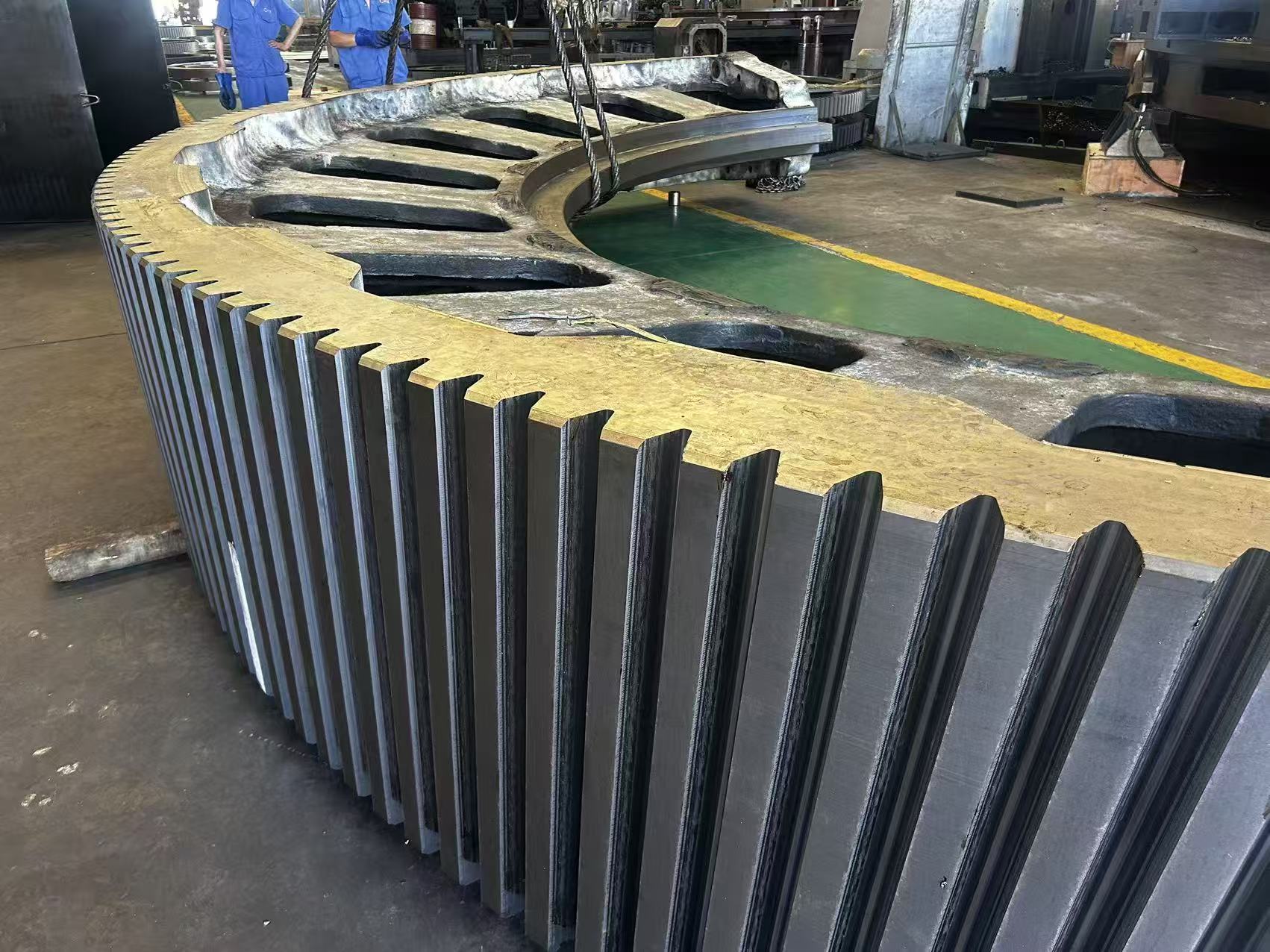
An external gear configuration, where the gear teeth are on the outer diameter of the ring, is the most common design. The primary advantage is accessibility. The pinion drive is mounted on the outside, making inspection, lubrication, and maintenance straightforward. This configuration often simplifies the overall drive system design.
Best for: Applications where space around the outer diameter is not restricted and regular access for maintenance is possible. Examples include cranes, excavators, and access platforms.
Limitations: The gear teeth are exposed to the environment. In highly abrasive or corrosive settings (like mining or marine applications), this exposure requires more robust protection or more frequent maintenance to prevent premature wear.
Internal Gears
An internal gear configuration places the gear teeth on the inner diameter of the ring. This design offers significant protection for the gear and pinion, shielding them from external impacts and contamination. It also allows for a more compact machine design, as the drive mechanism is contained within the bearing's footprint.
Best for: Equipment with tight space constraints or those operating in harsh, debris-filled environments. Tunnel boring machines, wind turbines, and certain types of robotics benefit greatly from this protected, compact design.
Limitations: Access to the gear and pinion for maintenance and inspection is more difficult. This requires careful consideration during the initial machine design to ensure serviceability.
The decision is a trade-off between accessibility and protection. Your choice should be determined by your machine's layout, its operating environment, and your planned maintenance schedule.
Duty-Based Selection Matrix for Gears and Seals
A bearing's longevity is directly tied to how well its sealing system protects the internal raceways and rolling elements from contamination. A gear configuration that works in a clean factory will fail quickly in a quarry. Use this matrix to guide your selection based on real-world operating conditions.
This table outlines recommendations for different operational challenges, helping you specify a more resilient and reliable Customized Bearings solution.
| Operating Condition | Recommended Gear Feature | Recommended Seal Type | Rationale for Selection |
|---|---|---|---|
| High Contamination (Dust, Debris, Mud) e.g., Mining, Construction | Internal Gear | Double-lip NBR seals or Labyrinth seals | An internal gear naturally shields the pinion from large debris. Double-lip seals provide a superior barrier against fine particulates, while metal labyrinth seals offer a non-contact, durable solution for extreme abrasive environments. |
| High Bidirectional Torque e.g., Heavy Lifting Cranes, Excavators | Ground Teeth (for precision) | Standard NBR or HNBR seals | Ground teeth provide better contact and load distribution, reducing wear under heavy, reversing loads. Standard Nitrile (NBR) seals are effective, but Hydrogenated Nitrile (HNBR) offers better resistance to grease and higher temperatures. |
| Limited Maintenance Access e.g., Wind Turbines, Aerospace | Internal Gear | Viton (FKM) seals with long-life grease | The protected nature of an internal gear reduces the need for frequent cleaning. Viton seals offer excellent resistance to temperature extremes and chemical degradation, extending service intervals significantly when paired with high-performance grease. |
| Corrosive Environment (Salt Spray, Chemicals) e.g., Marine & Defense Slewing Bearings | External gear with protective coating (e.g., zinc plating) | Viton (FKM) or specialized polymer seals | While an internal gear offers protection, an external gear is easier to inspect for corrosion. A proper coating is essential. Viton seals provide superior chemical resistance compared to standard NBR. |
Material Selection: The Foundation of Performance
The raw material of your slewing ring dictates its hardness, wear resistance, and ability to withstand specific environmental challenges. While standard bearing steel is common, custom applications often demand specialized alloys to meet performance targets. Our engineering team helps you select the optimal material based on your technical specifications and working conditions.
Here are some of the materials we work with and their typical applications:
GCr15 / SUJ2: This is a high-carbon chromium bearing steel known for its high hardness, excellent wear resistance, and good strength. It is the standard for a vast range of ball and roller bearing applications where conditions are not extreme.
AISI 440C: A stainless steel option that provides good corrosion and oxidation resistance. It is the ideal choice for equipment used in humid, wet, or mildly corrosive environments, such as food processing or medical applications.
20CrMo / 42CrMo: These are alloy steels with added chromium and molybdenum. The alloying elements improve strength, hardness, and toughness, making them suitable for heavy-duty bearings that experience high shock loads and stresses, common in Construction & Heavy Machinery.
Ti-6Al-4V: This titanium alloy is specified for applications where weight is a critical factor and high-temperature performance is needed. Its high strength-to-weight ratio makes it a prime material for aerospace and high-performance robotics.
A Buyer's Checklist for Specifying Your Custom Slewing Ring
To ensure we can provide an accurate and effective design proposal, it's helpful to have key information prepared. A detailed RFQ prevents delays and miscommunication. With no minimum order quantity (MOQ), we can support everything from single-unit prototypes to full production runs. Before contacting a manufacturer, run through this checklist:
Define All Loads: Provide the full load spectrum, not just the maximum. This includes axial, radial, and tilting moment loads. Are the loads static or dynamic? Is there a shock load component?
Specify Rotational Parameters: What is the required rotational speed? Is the rotation continuous, intermittent, or oscillating?
Describe the Operating Environment: Detail the temperature range (min/max), exposure to moisture or chemicals, and the level of abrasive contaminants (dust, sand, etc.).
Provide Mounting Structure Details: What is the flatness and rigidity of the supporting structure? An insufficiently rigid mount is a common cause of premature bearing failure.
State Gear Requirements: Do you need an internal gear, external gear, or no gear? Specify the module, pressure angle, and required precision level (e.g., milled vs. ground teeth).
Confirm Dimensional Constraints: Are there any limitations on the inner diameter, outer diameter, or height of the bearing?
Establish Life and Reliability Targets: What is the required operational life in hours or rotations? Are there specific industry standards or certifications that must be met?
Having this data ready allows our engineers to develop a solution tailored to your exact needs. We have experience producing very large and complex bearings, such as the recent 10.87-meter, three-row roller slewing ring for a 2,000-ton lifting crane and an 8.445-meter integrated bearing for a South Korean crane client. This experience ensures we can handle projects of significant scale and technical complexity.
Beyond the Component: Our Commitment to Your Project's Success
Choosing a supplier for a customized slewing ring is about more than just the physical product. It's about securing a technical partner invested in your equipment's long-term performance. At LTZC, our commitment extends from initial design to post-installation support.
Our 20,000 m² facility operates under ISO9001:2015, ISO14001:2015, and ISO45001:2018 certifications, ensuring every component we produce meets stringent quality and environmental standards. We are also certified by CCS and ABS for marine applications.
Our partnership includes comprehensive after-sales support to protect your investment. This includes:
Installation & Commissioning Guidance: Proper bearing installation is fundamental to achieving the designed lifespan. We provide expert guidance to ensure your team gets it right.
Preventive Maintenance Training: We can train your technicians on correct lubrication, inspection, and bolt-tightening procedures to maximize reliability.
Fault Diagnosis & On-site Support: If an issue arises, we respond quickly. Our policy is to respond to quality objections within 24 hours, with on-site service available within 48 hours in China to diagnose problems and implement solutions.
This level of support ensures that your heavy-duty equipment maintains stable, long-term operation, from the main torch tower at the World Military Olympic Games to key national friction stir welding systems—all of which rely on LTZC bearings.
If you are developing equipment that requires a specialized slewing solution, submit your drawings and technical specifications. Our engineering team will review your requirements and propose a design that delivers the performance and reliability your application demands.