WhatsApp
 jessica.chai@ltzzc.com
 0086-379-69950051

Delivered to Türkiye: 4 Sets of Double-Row Slewing Bearings for Large Tower Cranes
At a Glance
| Item | Detail |
|---|---|
| Model | 021.35.2220.03 |
| Quantity | 4 sets |
| Bearing type | Double-row different-diameter ball slewing bearing |
| Destination | Türkiye |
| Application | Large tower crane |
| Key design | Upper row (large balls): axial force + tilting moment; lower row (small balls): radial force; dual raceways share load |
| Sealing | Rubber seals on inner and outer rings — water and dust protection for open-air operation |
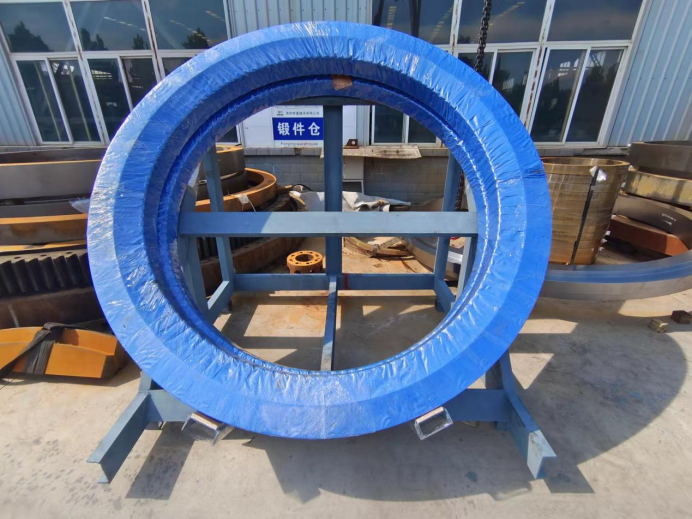
The Requirement: A Slewing Bearing Built for Tower Crane Duty
A Turkish customer operating large tower cranes in open-air construction environments approached LTZC with a specific need: a slewing bearing that could reliably carry the combined load cases a tower crane imposes — axial force and tilting moment from the jib and lifted load, plus radial force from rotation — while withstanding dust, rain and temperature variation on site.
Tower crane slewing bearings sit at the interface between the crane's upper structure and its base. They are not a "fit and forget" component: they rotate under load continuously, they are exposed to the weather, and a seizure or premature raceway failure stops the entire machine. The customer needed a bearing matched to this duty, not a catalog standard unit chosen by boundary dimensions alone. This is a common requirement across tower crane applications, where the bearing must be selected against the actual load curve rather than by outer diameter.
Why the Double-Row Different-Diameter Ball Design Fits This Application
The 021.35.2220.03 is a double-row ball slewing bearing. Its structure is deliberately asymmetric, and that asymmetry is what makes it suitable for tower crane duty:
Upper row — large balls, axial load and tilting moment.
The upper raceway carries the larger balls. In a tower crane, the dominant loads are axial (the weight of the jib, counter-jib and lifted load) and the tilting moment generated by the load radius. The large-ball upper row is sized to take this combination, giving the bearing the moment capacity the crane structure demands.
Lower row — small balls, radial load.
The lower raceway carries smaller balls and is arranged to resist radial force — the horizontal component that appears as the crane slews and as wind and dynamic effects act on the jib. Separating the radial duty onto a dedicated lower row keeps the upper row focused on axial and moment load, rather than forcing one raceway to do everything.
Dual raceways share the load.
Because the load path is split across two raceways, neither row is overloaded in isolation. The result is higher rigidity under combined loading and a more uniform stress distribution through the rings — both of which matter for a component that sees millions of slewing cycles over its service life.
Rubber seals on inner and outer rings.
Tower cranes work outdoors. Dust, rain and wash-down water are constant. The bearing is fitted with rubber seals on both the inner and outer rings, sealing the raceways against water and particulate ingress. This protects the grease film and the raceway surfaces — the two things that determine bearing life in an open-air application. The sealing system is specified as part of the bearing design, not added as an afterthought: seal material and contact pressure are matched to the operating environment so that the seal protects the raceway without adding excessive friction torque.
From Drawing to Shipment: How the Four Sets Were Built
The four bearings were produced in-house at LTZC, with the process controlled from raw material through to final inspection. Bearing selection for this project was supported by LTZC's bearing selection support service, which reviews the customer's load data and mounting interface before the drawing is finalized.
Ring material and raceway treatment.
Rings are machined from 42CrMo, with the raceways induction-hardened to a controlled depth and hardness. For a tower crane bearing, raceway hardness and core toughness need to be balanced: the surface must resist fatigue and indentation, while the ring body must absorb the structural loads without cracking.
Machining and raceway grinding.
Turning, raceway grinding and (where specified) gear machining are carried out under one roof. Raceway geometry — profile, roundness and surface finish — is checked against drawing tolerances before assembly. For a double-row different-diameter design, the relationship between the two raceways is critical: if the upper and lower rows are not correctly matched, the intended load sharing is lost.
Assembly and clearance control.
The balls are matched to their respective rows, and the bearing is assembled with the specified internal clearance. Clearance is verified because it directly affects load distribution between the two rows — too tight and the bearing runs hot; too loose and the upper row may not engage as designed under moment load.
Seal fit and grease.
The rubber seals are fitted to both inner and outer rings and checked for uniform contact. Each bearing is pre-greased and the seal integrity verified before packing, so the customer receives a unit ready for installation rather than one requiring field greasing and seal adjustment.
Inspection before shipment.
Each of the four sets was inspected for dimensions, raceway condition, clearance and seal fit. Inspection records and material documentation accompany the shipment.
Packaging and Logistics to Türkiye
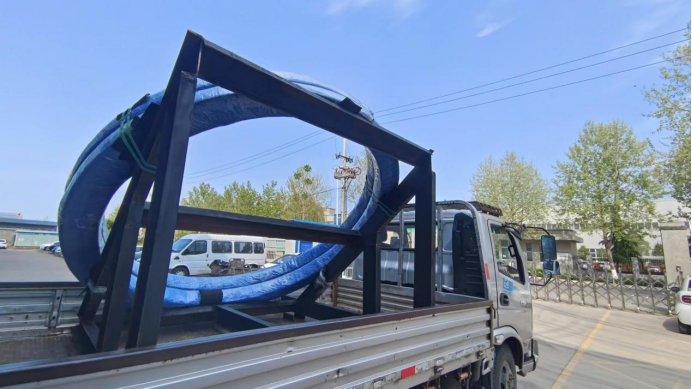
The four bearings were prepared for export shipment to Türkiye:
Anti-rust protection on machined surfaces
Desiccant and VCI protection inside the packing
Wooden cases suitable for long-haul sea and inland transport
Packing list, inspection reports and material certificates included
The shipment was coordinated with the customer's preferred logistics arrangement, with the bearings protected against moisture during transit — a detail that matters for a sealed bearing whose performance depends on the grease film remaining intact until installation.
What This Delivery Represents
This shipment is a small but representative example of what LTZC does: application-matched slewing bearings for heavy lifting equipment, built to the load case rather than selected from a catalog by outer diameter alone.
For tower crane applications, the relevant inputs are the axial load curve, the tilting moment, the radial load, the mounting bolt pattern and the operating environment. With those, LTZC's engineering team can propose a Large Slewing Bearing structure — double-row different-diameter ball, three-row roller, or another configuration — that matches the duty.
The four bearings for Türkiye are now on their way to site. If you are specifying a slewing bearing for a tower crane or similar slewing application, send us your load data and mounting dimensions, and we will come back with a proposal and a drawing. You can also browse our slewing bearing case studies to see how other crane and heavy-equipment projects were specified and delivered.