WhatsApp
 jessica.chai@ltzzc.com
 0086-379-69950051

How to Audit a Crossed Roller Slewing Bearing Supplier Before You Place the Order
The quote looks right, the drawing is signed, and the first ring arrives with rough raceway grinding, uneven rotating torque and no heat-lot paperwork. That is the sourcing risk buyers regret most. A Crossed Roller Slewing Bearing is chosen for rotational accuracy and stiffness in a compact section, so a supplier's claims about those two properties need evidence, not brochures.
Where Supplier Risk Hides in Crossed Roller Slew Rings
In a crossed roller design, cylindrical rollers sit at alternating 90° angles in one raceway. A single row then carries axial load, radial load and tilting moment together. The same geometry makes the product unforgiving. Raceway form errors, roller sizing spread and housing distortion show up directly as torque variation and runout. You can see more about the product family on our Cross Roller Slewing Bearings page, and the wider precision slewing bearing range sits alongside it.
Typical applications are robotics, medical equipment, rotary tables and compact turntables. Heavier lifting duty is a different case. Where moment loads are very high and the section can be large, a Three Row Roller Slewing Bearings design may be the better fit. A good crossed roller slew ring supplier should tell you which of the two suits your load case, even if that means recommending the other.
Three failure patterns recur in supplier shortlists:
Price-led selection. The lowest quote often omits grinding allowance, preload control or material certificates.
Catalog data treated as process evidence. A dimension table says nothing about how the raceway was finished or measured.
Certificates read as capability. A management-system certificate shows a controlled process. It does not state your tolerance.
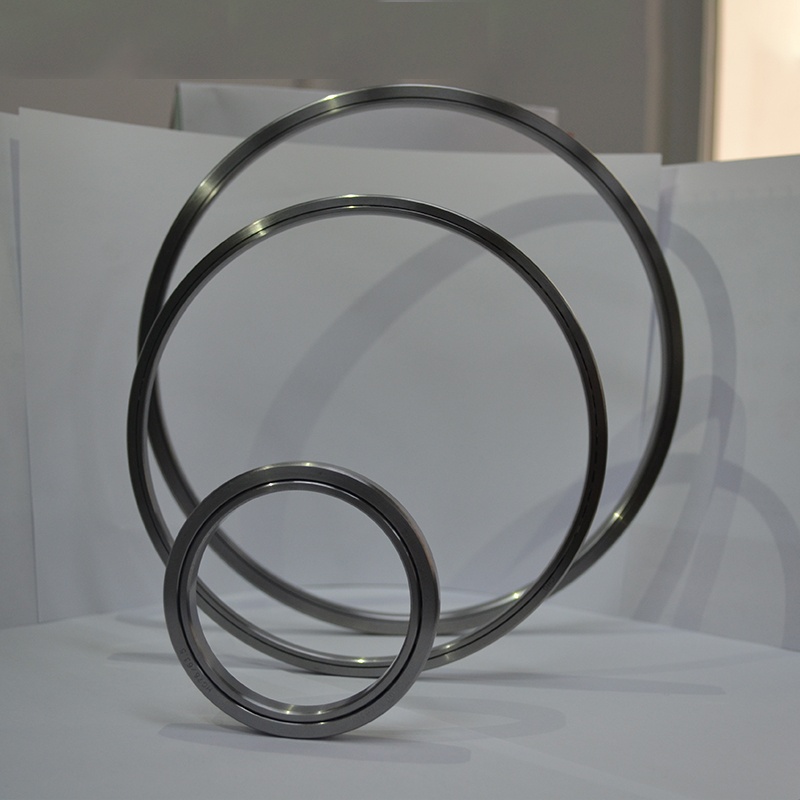
Supplier-Capability Matrix for Raceway Grinding, Runout, Preload, Traceability and Load Testing
Use the matrix below as an RFQ attachment. Ask each shortlisted crossed roller slewing bearing manufacturer to fill in the right-hand column in writing. Where an answer is vague, treat the item as unverified.
| Capability | Evidence to request | Red flag | What to confirm with LTZC in the RFQ |
|---|---|---|---|
| Raceway grinding | Process route showing grinding after heat treatment; surface finish and hardness record per lot | "Standard process" with no route sheet | Grinding route and inspection record for your ring size. Our brief does not list grinding figures, so we agree them against your drawing. |
| Runout metrology | Axial and radial runout report from a rotating-ring check, with the instrument and calibration date | Pass/fail stamp without readings | Readings reported per serial number against the tolerance on your drawing |
| Preload verification | Rotating torque or clearance record showing the preload condition requested | "Preload adjusted by feel" | Method, acceptance range and sampling plan written into the order |
| Material traceability | Mill certificate and heat-lot number linked to the ring serial number (for example GCr15 or 42CrMo) | Generic grade statement only | Material grade options from our range (GCr15, 42CrMo, SUJ2, AISI 440C) and the certificate format you need |
| Load-test reporting | Defined test (torque, rotation, or proof load) with report format and who witnesses it | Claim of "tested" with no report template | Test scope and witness arrangement to be agreed before production |
One limit applies. The matrix verifies process discipline. It does not replace a trial installation in your machine, because mounting-surface flatness and bolt tightening affect preload as much as the bearing itself. Our bearing installation guidance covers that side.
How to Audit Bearing Suppliers: A Step-by-Step Procedure
This sequence works for a remote document audit and for an on-site visit. It fits orders where a failed ring costs you more than the ring itself.
Fix your acceptance numbers first. Write the runout limit, rotating torque range and hardness requirement on your drawing. A supplier cannot be audited against a target you have not stated.
Request the quality manual and certificates. Check that scope, issue date and certifying body match the facility that will make your ring. LTZC lists ISO9001:2015, ISO14001:2015 and ISO45001:2018, with CCS and ABS also named in our brief. Ask for the certificate copies and verify scope.
Walk the process route. Follow forging or ring rolling, heat treatment, raceway grinding, assembly, inspection and packing. Ask which steps are done in the supplier's own plant and which are outsourced.
Ask for a sample inspection record. Take a recent report on a similar ring. Look for actual readings, instrument IDs and signatures, not summary statements.
Witness bearing runout inspection and a bearing preload test. Do it in person or by live video on your order or a comparable ring. Note how the ring is supported, because poor fixturing gives false readings.
Trace one material lot. Pick a serial number and follow it back to the mill certificate. Time how long it takes. Fast traceability signals real record-keeping.
Agree the nonconformance route. Settle who decides acceptance, what happens to rejected rings, and the response time for quality objections.
What LTZC's Record Supports, and Where It Stops
LTZC Bearings Co.,Ltd. was established in 1992 and operates from a 20,000 m² facility. Our products include slewing bearings, non-standard precision bearings, gear rings, racks and bearing unit assemblies. That scope matters for an audit because a buyer often needs the bearing and the matching slewing ring gear from one source.
Our documented cases show large-diameter and precision work. None of them is a crossed roller ring, so read them as evidence of ring manufacturing and inspection capacity, not as proof of a specific crossed roller tolerance.
| Delivered case | What it shows | What it does not show |
|---|---|---|
| 10.87 m OD integral three-row roller slewing ring for 2,000-ton fixed lifting equipment (2024) | Capacity for very large integral rings; our largest to date | Crossed roller geometry or compact-section accuracy |
| 8.445 m integrated bearing for a South Korean crane client (2024) | Export delivery of a large bearing to a target market | Local stock or approvals in Korea |
| 8 m high-precision segmented gear rings for Wuhan Heavy Industry's vertical friction stir welding system | Precision gear-ring work on a national project | Raceway grinding on a rolling-element bearing |
| 3 m turntable bearing carrying the main torch tower at the World Military Olympic Games opening ceremony | Turntable bearing supplied for a visible, schedule-bound event | Load rating or tolerance class |
For oversized or segmented requirements, see our Large Slewing Bearing page. Our ISO-certified management systems give you something concrete to audit. As an ISO bearing factory we expect buyers to check them, not take them on trust.
Common Mistakes When Qualifying a Crossed Roller Slew Ring Supplier
Accepting one measurement without conditions. A runout figure is meaningless without the fixture, mounting torque and rotation speed used.
Skipping preload definition. "Light preload" means different things to different plants. Specify torque range or clearance in numbers.
Auditing only the sample. A hand-finished sample can pass where series production will not. Ask for inspection records on production lots too.
Ignoring the mating structure. Housing flatness and bolt pattern errors will distort a thin-section ring. If your design is still open, review our bearing selection guide before fixing the interface.
Mixing up certificate scope and product scope. Confirm the certified site and activity cover the product you are ordering.
Cooperation Terms to Agree Before the Purchase Order
The supplied terms are simple. LTZC states no MOQ, a delivery window of 30 to 90 days, and customized bearing solutions based on your working conditions, existing designs and technical specifications. Lead time within that window depends on size, material and tolerance, so ask for a dated schedule on your specific ring rather than assuming the shortest figure. For non-catalog sizes, our Customized Bearings page describes the route.
After delivery, our post-sales commitment is a response to quality objections within 24 hours, and on-site service starting within 48 hours in China. Outside China, on-site timing is not stated in our brief, so agree remote support, documentation and fault analysis steps in the contract.
Buyer's checklist before issuing the PO:
Runout, torque and hardness limits written on the drawing
Material grade and certificate format named
Preload method and acceptance range agreed
Test report template and witness rights confirmed
Dated production schedule inside the 30–90 day window
Nonconformance and warranty responsibilities written down
Send us your drawing, load case and acceptance figures, and we will return a filled-in version of the matrix above for your ring, so you can compare our crossed roller slewing bearing manufacturer answers line by line against other quotes. Request a quote or selection advice from our engineering team.