WhatsApp
 jessica.chai@ltzzc.com
 0086-379-69950051

Customized Slewing Bearings Cut Lifetime Costs When the Design Matches the Duty
The cheapest line on a quotation is rarely the cheapest bearing. Buyers who approve a catalog slewing bearing on unit price alone often discover the real bill later: a crane out of service, a retrofit of mounting structures, or a replacement cycle nobody budgeted. Customized slewing bearings cost more at the purchase order stage, but the question for a budget approval is whether that premium is smaller than the costs it removes over five years. This article gives you a way to test that, with confirmed, estimated and unknown costs kept separate.
Where Standard Bearings Quietly Add Cost
A catalog bearing is designed for an average duty. Your machine probably is not average. In my ten years supporting slewing bearing, slew drive and thin section bearing customers, the same friction points come up again and again between the design office and the maintenance team.
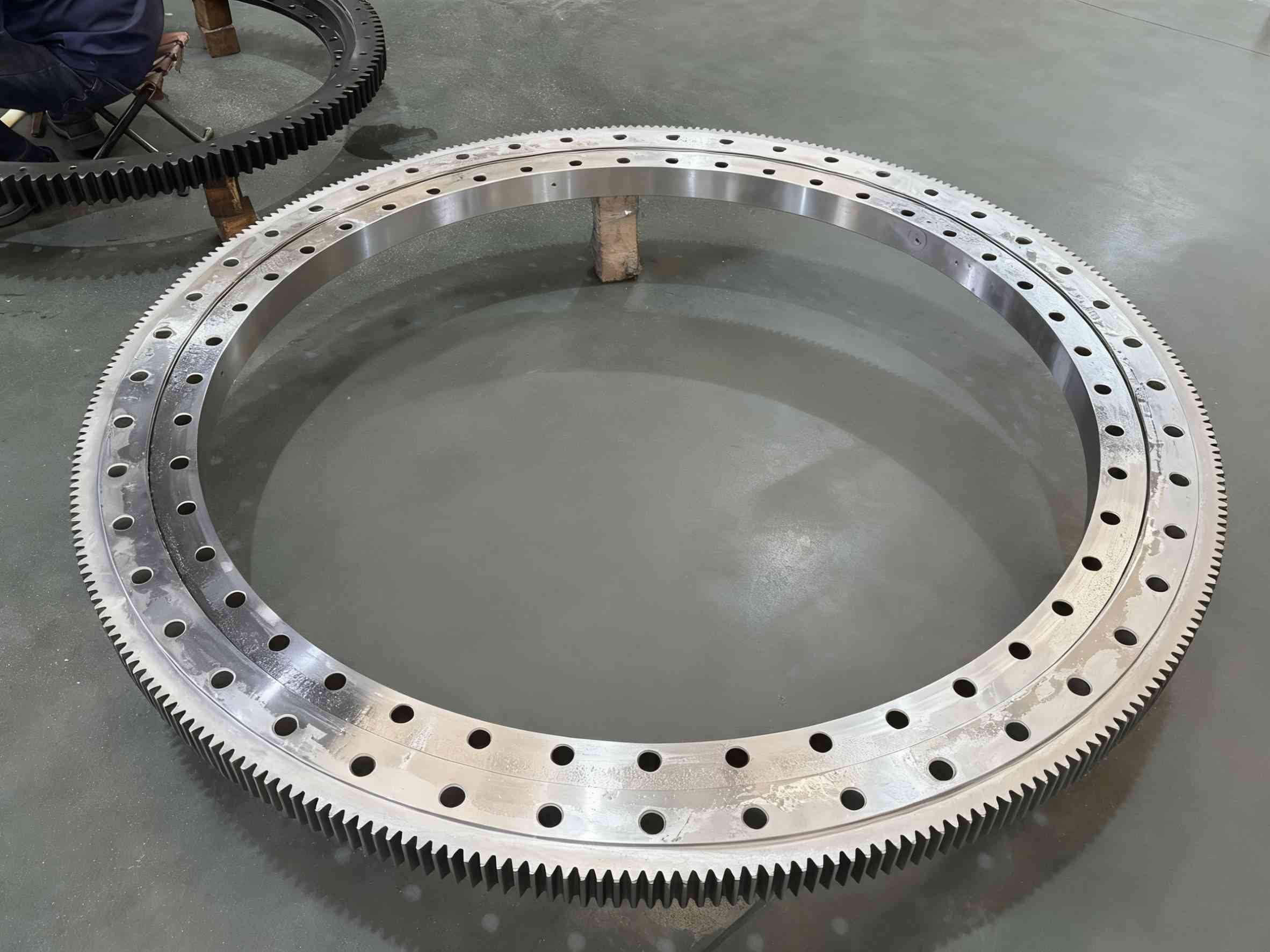
Interface mismatch. If the bearing's bolt circle, flange height or gear position does not match your structure, you pay for adapter plates, extra machining or a redesigned base.
Environment mismatch. Dust, washdown, salt air or low temperatures can overwhelm a standard seal and lubricant arrangement, shortening the interval between service events.
Load mismatch. Where the real moment load is well below or above the catalog assumption, you either carry an oversized, heavier bearing or accept early raceway wear.
Integration gaps. A separate pinion, drive or sensor arrangement may add parts, assembly steps and alignment work that an integrated design could avoid.
Limit to keep in mind: if your duty cycle is light, your envelope is flexible and downtime costs you little, a catalog part is usually the correct choice. Customization pays when at least one of the four mismatches above is real and measurable on your machine.
A Five Year Total Cost Model for Custom Versus Catalog Designs
The model below compares an off-the-shelf choice with a tailored design across the cost lines that matter. The key discipline is to label every number honestly. Only some inputs are known when you request approval, and the rest come from your own records or from engineering review.
Use this structure for each option:
Five year cost = purchase price + installation labor + (maintenance events × cost per event) + (downtime hours × cost per hour) + (replacements × [unit price + replacement labor + downtime])
| Cost line | Confirmed | Estimated | Unknown until reviewed |
|---|---|---|---|
| Purchase price | Written quotation for each design option | Freight and duties, if not quoted | Tooling or engineering charges, if the supplier has not itemized them |
| Lead time cost | LTZC's stated delivery window of 30 to 90 days; no MOQ | Cost of holding a machine build for that period | Exact delivery date for your design until drawings are reviewed |
| Installation labor | Your shop's hourly rate and past mounting times | Hours saved if the interface matches your structure | Rework hours if tolerances on your base are unverified |
| Maintenance | Your current greasing and inspection schedule | Change in interval from improved sealing or lubrication design | Field behavior in your specific environment |
| Downtime | Your internal cost per idle hour | Fewer stoppages from a better matched design | Failure frequency of the catalog part on your duty cycle |
| Replacement frequency | Service history of earlier bearings on the same machine | Expected life difference between the two designs | Actual life, which only operating data can show |
How to read the table
Fill the confirmed column first. If the premium for tailoring is larger than everything you can confirm, the case depends entirely on the estimated and unknown columns. That is a legitimate decision, but present it to management as a risk judgment, not as a savings figure.
Be careful with one line in particular: replacement frequency. It is the biggest swing factor and the one most often presented as fact. Unless you hold service records for a comparable bearing, treat any claimed life improvement as an estimate and ask the supplier to explain the design reason behind it, such as raceway treatment, sealing or load rating.
A worked scenario
Consider a hypothetical equipment builder fitting a rotating platform for outdoor use. The catalog bearing needs an adapter ring to match the frame, and past units of similar design were regreased more often than planned because of dust ingress. The buyer enters the adapter ring cost and extra machining as confirmed items, pulls maintenance hours from existing service logs, and lists extended life as an estimate only. The tailored design removes the adapter, so installation labor and parts count fall with certainty. Everything else stays in the estimate column until field data arrives. The budget request is then honest about which savings are firm and which are expected.
Design Choices That Change the Cost Curve
Not every customization earns its price. Here is how common design decisions map to the cost lines above. It also shows when each does not apply.
| Design choice | Cost line it affects | Fits when | Does not apply when |
|---|---|---|---|
| Matching bolt circle, height and flange to your structure | Installation labor, parts count | You currently need adapters or extra machining | Your frame is already designed around a standard dimension |
| Gear specification and position | Drive integration, alignment time | You pair the bearing with a specific pinion or drive | You use an external drive with no gear interface |
| Sealing and lubrication arrangement | Maintenance cost, replacement frequency | Dust, moisture or washdown is part of daily operation | The machine runs indoors in clean conditions |
| Material and heat treatment selection | Replacement frequency | Loads or temperatures sit outside typical catalog assumptions | Load data is not available to justify a change |
| Section size and weight optimization | Structure cost, transport, installation handling | Weight or envelope is limited, as with thin section bearing applications | Space is generous and weight is irrelevant |
If your project needs a standard envelope with improved specifications, a precision slewing bearing may be enough. If your envelope is unusual, non-standard bearings built to your drawings are the more direct route. For compact designs where weight matters, look at a thin section bearing. Where a rotating drive is part of the system, check the Slewing Drives option before you commit to a separate bearing and gearbox.
Common Mistakes When Justifying a Custom Design
Comparing unit prices only. The premium looks large until installation, maintenance and replacement lines are added.
Presenting estimated life gains as facts. Finance teams remember the first number you showed them. Label estimates clearly.
Customizing for its own sake. Each change must tie to a specific cost line. If it cannot, drop it.
Sending incomplete data. Without load cases, speed, environment and duty cycle, any design is a guess and so is any price.
Ignoring the mounting structure. A well matched bearing on a flexible or uneven base will still wear early. Verify flatness and stiffness, and follow proper bearing installation practice.
Forgetting the gear side. If the ring gear is part of the design, review it together with the pinion, not as a later add-on. A well specified slewing ring gear belongs in the first discussion.
What to Confirm With the Supplier Before Budget Approval
A tailored design shifts risk to the supplier's engineering and production quality. Ask for evidence, not assurances. For LTZC, the facts I can state are these:
The quality management system is certified to ISO9001:2015, with ISO14001:2015 and ISO45001:2018 also certified. Certification is by ISO, CCS and ABS.
Delivery is 30 to 90 days. The exact window depends on the design, so confirm it against your drawing before you fix your build schedule.
There is no minimum order quantity, which matters for prototype runs, pilot batches and low volume machines where a custom bearing otherwise looks impossible to justify.
Designs are developed from your working conditions, existing designs and technical specifications, with material, size and performance requirements specified by you.
No MOQ also changes the cost model. You can test a tailored design on a first unit and gather operating data before you commit a full series, turning unknown costs into confirmed ones.
Buyer's Checklist and Steps Before You Send an RFQ
Collect your cost inputs. Downtime cost per hour, current maintenance schedule, installation hours and any past replacement records.
Document the duty. Axial, radial and moment loads, rotation speed, swing angle, temperature range and environment.
Mark the interface. Mounting dimensions, bolt pattern, gear requirement and any sensor or seal constraints.
Request itemized quotes. Ask for the standard option and the tailored option side by side, with lead time on each.
Label the model. Mark each number confirmed, estimated or unknown before it enters the approval document.
Plan the validation. Decide what data you will collect on the first units, so the unknowns are resolved after delivery.
If you are still deciding which bearing family fits, our bearing selection guide covers the basics before you move to a custom drawing.
When you are ready to compare options, send your drawings, load data and duty details to LTZC for selection advice or a quotation on customized slewing bearings. We will respond with the design options, a quotation and the lead time for your specification.