WhatsApp
 jessica.chai@ltzzc.com
 0086-379-69950051

Excavator Slewing Bearing Failure: Causes of Broken Teeth and Solutions
Early Warning Signs: How to Detect Gear Wear Before Teeth Break
Abnormal Acoustic Signatures (Noise): The most obvious indicator of impending failure is a change in the machine's operational acoustics. If the rotation begins to produce harsh grinding noises, heavy popping sounds, or a deep clunking during acceleration or deceleration, the gear meshing is compromised. This often points to spalling on the gear teeth or a severe lack of lubrication.
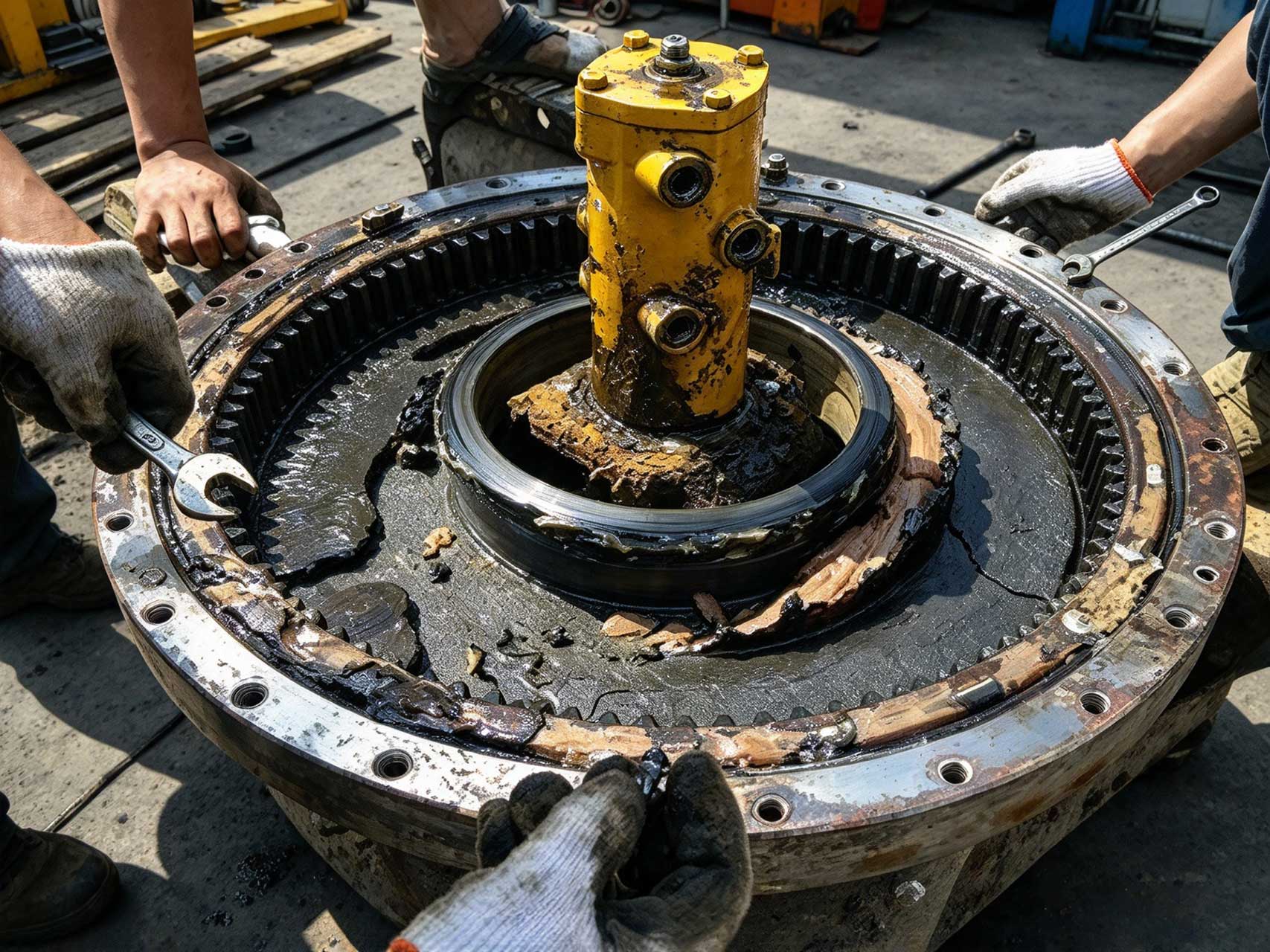
Metal Shavings in the Grease (Contamination): Routine maintenance should always involve a visual inspection of the purged grease from the swing gear tub. If the grease is shimmering with silver metallic flakes or contains larger, distinct metal shards, it is a definitive sign of rapid gear face wear. This metal-on-metal degradation reduces the structural thickness of the teeth, severely lowering their bending strength.
Jerky or Erratic Swing Motion: When an excavator operator feels a noticeable hesitation, a "dead zone," or a sudden jolt when initiating or stopping the swing, it indicates excessive backlash (play) between the pinion and the slewing ring. This mechanical slop forces the gears to slam into each other upon engagement, creating the exact type of shock load that fractures teeth.
Unusual Vibration Transfer: Excessive wear alters the involute profile of the gear teeth. Instead of rolling smoothly against one another, the pinion and ring gear begin to scrape and judder. This erratic movement translates into a low-frequency vibration that an experienced operator can feel directly through the cabin floor.
Top Reasons for Broken Teeth on Excavator Slewing Bearings
1. Improper Backlash Adjustment and Installation Errors
Clearance Too Small (Tight Meshing): If the gears are meshed too tightly, the natural thermal expansion of the steel during continuous operation will cause the gears to bind. This creates immense friction, stripping the lubrication film and eventually leading to a mechanical jam that can snap a tooth.
Clearance Too Large (Loose Meshing): If there is too much space between the teeth, the pinion will violently slap against the ring gear during every rotation start and stop. This continuous hammering effect causes severe fatigue at the tooth root.
Ignoring the High Point of Runout: Because no large-diameter bearing is perfectly round, manufacturers mark the point of maximum radial eccentricity (the "high point of runout")—usually with green or red paint on the gear teeth. Installers must set the backlash using a dial indicator specifically at this point. Failing to do so means the gears will bind tightly once the bearing rotates to this high spot, creating a massive spike in torque that can easily break a tooth.
2. Severe Shock Loads & Operator Error
Side-Sweeping: Using the side of the bucket and the boom to forcefully sweep heavy boulders or demolish concrete walls applies lateral torque that the swing gear is not designed to absorb.
Sudden Braking with Heavy Loads: Swinging a fully loaded bucket at high speed and abruptly releasing the controls forces the ring gear to absorb the massive rotational inertia of the entire upper structure, instantly exceeding the bending fatigue limit of the gear roots.
3. Foreign Object Contamination
4. Lubrication Starvation
5. Poor Gear Heat Treatment
If the gear surface is quenched too rapidly without proper tempering, the steel becomes overly brittle and will shatter under impact.
More critically, many low-cost manufacturers only harden the faces of the teeth to save money, skipping the vital root induction hardening (contour hardening). The root of the tooth is where bending stress is highest. Without proper induction hardening extending down through the tooth root, the gear lacks the necessary tensile strength and fatigue resistance to survive heavy excavation work.
Can a Broken Slewing Bearing Tooth Be Repaired by Welding?
Destruction of Heat Treatment: Slewing bearings are precision heat-treated components. The extreme temperatures generated by arc welding will instantly destroy the original quenching and tempering of the surrounding metal. This creates a Heat-Affected Zone (HAZ) that is effectively annealed, making the steel soft and highly susceptible to rapid wear.
High Risk of Secondary Failure: A welded tooth cannot replicate the forged grain structure or the high-tensile bending strength of the original gear. Under the massive torque of an excavator swing drive, the welded tooth will inevitably shear off again—often within days or weeks.
Catastrophic Collateral Damage: When that welded repair snaps during operation, the solid chunk of steel will fall directly into the path of the rotating pinion gear. This will violently jam the mechanism, often destroying the swing motor gearbox, snapping the pinion shaft, and costing thousands of dollars in secondary damages.
Solutions & Preventive Maintenance
Precision Installation: Never "eyeball" the gear alignment. Always use precision dial indicators to measure and set the correct backlash precisely at the gear's marked high point of runout. Ensure all high-strength mounting bolts are torqued to the manufacturer's exact specifications.
Rigorous Lubrication Cycles: Adhere strictly to the OEM greasing intervals. Use high-quality Extreme Pressure (EP) lithium-based grease formulated with molybdenum disulfide (moly) to handle high load friction. Pumping fresh grease not only lubricates the gears but also purges old, contaminated grease and flushes out abrasive micro-particles.
Inspect and Replace Seals: Make it a routine to visually inspect the condition of the rubber lip seals around the slewing ring. If a seal is torn, cracked, or missing, it must be replaced immediately to prevent rock and sand from entering the raceway and gear tub.
What to Look for When Sourcing an Aftermarket Replacement
Material Certification: Avoid standard 50Mn steel for heavy-duty excavators. Demand high-tensile alloy steels such as 42CrMo or 42CrMo4 forgings, and ask the supplier for the Material Test Certificate (MTC).
Contour Hardening: Explicitly ask the manufacturer about their heat treatment process. Ensure they perform full contour induction hardening that covers both the gear flanks and the gear roots (typically achieving HRC 55–62).
Dimensional Accuracy: Ensure the supplier has the exact OEM dimensional data for your specific excavator model (e.g., Caterpillar, Komatsu, Hitachi, Volvo). The mounting hole patterns, gear module, and pitch circle diameter must be perfectly matched to guarantee a drop-in installation without modifications.
LTZC Bearings: Professional Slewing Bearing Customization for Your Heavy Machinery
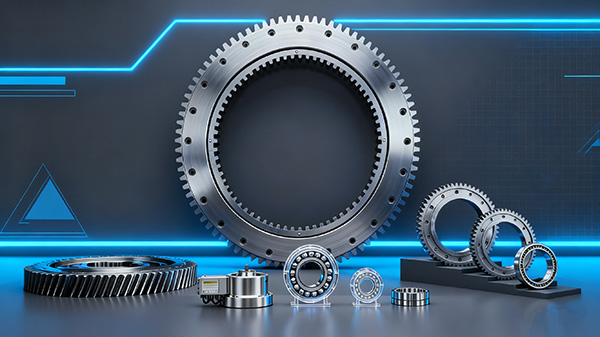
When heavy machinery requires uncompromising rotational reliability, partnering with a dependable and highly qualified supplier is essential. Luoyang Heavy-duty Bearing Co., Ltd. (LTZC) steps in to meet this exact need. Founded in 1992, LTZC has established itself as a premier source manufacturer specializing in the research, development, production, and global sales of extra-large and custom bearings. The company's core product portfolio includes slewing bearings, slewing drives, gear parts, thin section bearings, and non-standard bearing components—providing comprehensive rotational solutions for heavy machinery, mining, and industrial applications worldwide.
Backed by over 30 years of R&D and specialized manufacturing experience, our sprawling 20,000-square-meter production facility is equipped with advanced CNC vertical lathes, precision gear hobbing machines, and raceway grinders. We provide a comprehensive range of rotational solutions, with our main products including heavy-duty slewing bearings, thin-section bearings, precision gear rings, slewing drives, and custom flanges.
Understanding that an excavator's operational life depends entirely on the metallurgical integrity of its parts, LTZC strictly adheres to the principle of "Making customers' operation more precise." Our precision grades cover P0, P6, P5, and P4, ensuring that whether you are operating a massive mining excavator or a high-precision robotic positioner, the bearing delivers flawless kinematic accuracy.
To specifically combat the issue of broken gear teeth in extreme applications, LTZC utilizes premium 42CrMo high-strength steel forgings. We apply advanced, strictly controlled contour induction hardening to both the gear faces and the critical gear roots. This ensures the teeth possess a highly wear-resistant exterior while maintaining a tough, shock-absorbing inner core that violently resists bending fatigue under heavy digging loads.
For customers evaluating replacement options or designing new equipment, LTZC offers a straightforward, engineering-first approach. Submit your machinery specifications, load conditions, or OEM part numbers to our technical team. We will conduct a thorough feasibility review and provide a tailored design—or an exact OEM equivalent—that addresses your specific heavy-duty constraints.
There is no obligation and no cost for this initial technical evaluation. Contact LTZC today to discuss your slewing bearing requirements and discover how three decades of metallurgical mastery can permanently solve your heavy machinery downtime.
FAQ About Excavator Slewing Bearings
Q1: How often should I grease my excavator's slewing bearing to prevent gear wear?
While you should always consult your machine's OEM manual, a general industry standard is to lubricate the gear teeth and bearing raceway every 50 to 100 operating hours. For heavy-duty applications like mining or working in highly dusty environments, daily greasing may be required. Always rotate the cabin at least two full revolutions while pumping the grease to ensure an even protective film across all gear teeth.
Q2: What exactly is the "high point of runout" marked on a new bearing?
Because no large-diameter forged ring is perfectly round at a microscopic level, the high point of runout is the specific spot on the gear with the maximum radial eccentricity (the tightest point). Manufacturers typically mark this tooth with green or red paint. You must set the gear backlash between the slewing ring and the swing motor pinion exactly at this mark to prevent the gears from mechanically binding during a full 360-degree rotation.
Q3: Why did my previous aftermarket swing bearing break a tooth so quickly compared to the original?
Premature failure in aftermarket bearings is almost always a metallurgical issue. Many low-cost suppliers use cheaper 50Mn steel instead of high-tensile 42CrMo. Furthermore, they often skip the expensive contour induction hardening process, meaning only the surface of the tooth is hardened while the root—the area under the most bending stress—remains weak and eventually snaps under standard excavator shock loads.
Q4: Is it possible to replace just the broken gear ring instead of buying a whole new slewing bearing?
No. In excavator slewing bearings, the gear teeth are integrally forged and machined directly into either the inner or outer ring of the bearing itself. They are not separate, detachable components. If a tooth breaks on the gear ring, the entire slewing bearing assembly must be replaced as a single unit to ensure structural integrity and rotational precision.
Q5: Can LTZC provide a direct drop-in replacement for my specific brand of excavator?
Yes. LTZC maintains an extensive database of OEM part numbers and dimensional specifications for all major heavy machinery brands, including Caterpillar, Komatsu, Hitachi, Volvo, Doosan, and Hyundai. Our replacement bearings are engineered to perfectly match the original mounting hole patterns, gear modules, and load ratings, ensuring a seamless and reliable installation without the need for equipment modification.