WhatsApp
 jessica.chai@ltzzc.com
 0086-379-69950051

Slewing Bearing Clearance: Why It Matters for Load Capacity, Rotation, and Service Life
Slewing bearing performance depends on more than load capacity and bearing size. Internal clearance is another important parameter because it affects how the rolling elements interact with the raceways during rotation and under load.
If the clearance is inappropriate for the bearing design and operating conditions, the result may be excessive movement, increased rotational resistance, reduced positioning accuracy, abnormal wear, or shortened service life. However, smaller clearance is not automatically better. The correct value depends on the bearing structure, load conditions, required rigidity, rotational characteristics, mounting conditions, and operating environment.
For this reason, clearance should be considered as part of the overall design and selection process for slewing bearings rather than as an isolated specification.
This guide explains what slewing bearing clearance means, why it matters, how it is checked, what causes it to change during service, and what information buyers should provide when specifying a bearing.
What Is Slewing Bearing Clearance?
Slewing bearing clearance generally describes the amount of relative movement available between the bearing rings and rolling elements before the internal components become fully constrained in a particular direction.
The required clearance is determined during bearing design and manufacturing. It must provide the operating characteristics required by the application while accounting for the geometry of the raceways, rolling elements, fits, loads, and structural conditions.
Two commonly discussed forms are radial clearance and axial clearance.
Radial Clearance
Radial clearance refers to relative movement between the inner and outer rings in the radial direction.
It can influence radial positioning, running behavior, and the way the bearing responds to radial loads. The acceptable radial clearance depends strongly on the bearing structure and application rather than on one universal value.
Axial Clearance
Axial clearance describes relative displacement between the bearing rings along the bearing axis.
This parameter can be particularly important in applications where axial movement, tilting rigidity, or positioning accuracy must be controlled. Excessive axial movement may also be one indication that wear has developed during service.
Internal Clearance vs. Operating Clearance
The clearance measured before installation should not automatically be treated as identical to the clearance that exists during operation.
Mounting conditions, structural deformation, temperature changes, external loads, and fits can influence the internal geometry of an installed bearing. For this reason, bearing selection should consider the expected operating condition rather than relying only on an unloaded measurement.
Why Is Clearance Important in a Slewing Bearing?
A slewing bearing often has to carry axial load, radial load, and tilting moment at the same time. The relationship between the rolling elements and raceways therefore has a direct influence on how effectively these loads are transmitted.
Load Distribution and Load-Carrying Performance
When a slewing bearing is loaded, the load is not necessarily distributed equally across every rolling element. Bearing geometry, structural stiffness, mounting accuracy, and clearance all influence which rolling elements enter the effective load zone and how the load is shared.
If the internal condition is unsuitable, fewer rolling elements may carry a disproportionate share of the load. Local contact stresses can then increase, potentially contributing to accelerated raceway or rolling-element wear.
Clearance should therefore be evaluated together with the bearing structure and expected load combination.
Rotational Resistance and Running Accuracy
Clearance also affects the relationship between freedom of rotation and rigidity.
Excessive clearance can permit unwanted relative movement between the rings. This may reduce positioning stability in equipment that requires controlled rotational motion.
Insufficient clearance, on the other hand, can increase internal resistance. In severe cases, the bearing may require greater starting or running torque and generate additional heat.
The objective is not simply to minimize clearance but to achieve an internal condition appropriate for the required rotational performance.
Wear, Heat Generation, and Service Life
Long-term bearing life depends on appropriate contact conditions, lubrication, load distribution, and installation.
Improper clearance can disturb these conditions. Excessive internal movement may contribute to impact and uneven contact, while insufficient clearance may increase friction and heat generation.
Clearance is therefore one of several interacting factors that influence the long-term condition of the raceways and rolling elements.
What Happens When Slewing Bearing Clearance Is Incorrect?
Both excessive and insufficient clearance can cause problems. The symptoms and failure mechanisms, however, are different.
Effects of Excessive Clearance
Excessive clearance allows greater relative movement between the inner and outer rings. Depending on the equipment, this may appear as rocking, reduced rotational accuracy, vibration, or unstable positioning.
As wear progresses, clearance may increase further. This can change the contact conditions between the rolling elements and raceways and may contribute to uneven loading.
In geared slewing systems, excessive movement in the bearing or its supporting structure can also affect the relationship between the bearing gear and the mating pinion. Gear meshing problems should therefore be evaluated as part of the complete assembly rather than attributed to the bearing alone.
Effects of Insufficient Clearance
Clearance that is too small for the actual operating condition can restrict free rolling motion and increase internal friction.
Potential consequences include:
Higher starting or running torque
Increased operating temperature
Greater sensitivity to dimensional changes caused by temperature
Unfavorable internal contact conditions
Accelerated wear if lubrication and contact conditions deteriorate
This is why specifying the smallest possible clearance is not a reliable approach to improving precision.
Clearance vs. Preload
Clearance and preload are related concepts, but they are not interchangeable.
A bearing with positive clearance allows a defined amount of internal movement. A preloaded bearing is intentionally assembled so that the rolling elements and raceways are kept under controlled internal load even before the main external working load is applied.
Preload can improve rigidity and rotational accuracy in suitable applications, but it can also increase friction and heat generation. It must therefore be determined according to bearing design, speed, load, lubrication, temperature, and precision requirements.
Not every slewing bearing should be preloaded. Heavy-duty equipment and precision rotary equipment can have very different requirements even when both use slewing-type bearings.
What Determines the Correct Slewing Bearing Clearance?
There is no single clearance value that is correct for every slewing bearing. The required condition must be matched to the bearing and the machine.
Bearing Type and Internal Design
Different bearing structures distribute loads in different ways.
Single-row four-point contact ball bearings provide a compact solution for combined loads, while cross roller slewing bearings use crossed cylindrical rollers and are commonly selected where high rigidity and rotational accuracy are important. LTZC describes its crossed-roller design as capable of simultaneously supporting axial, radial, and tilting loads.
For heavier load combinations and large tilting moments, three-row roller slewing bearings may be used. Their separate roller rows allow different load components to be supported through different raceways.
Because the internal geometry differs between these designs, their clearance requirements should not be assumed to be identical.
Axial, Radial, and Moment Loads
The magnitude and direction of the applied loads are fundamental selection inputs.
A slewing bearing may experience a large axial load together with radial force and an overturning moment. In applications such as cranes, mining equipment, rotary platforms, and material-handling machinery, these loads may also vary substantially during a working cycle.
The manufacturer therefore needs realistic load information rather than only the total machine weight.
Peak loads, normal working loads, shock conditions, and load combinations can all be relevant when determining the bearing design and internal parameters.
Rotation Speed and Duty Cycle
Many slewing bearings operate at relatively low rotational speeds, but operating patterns differ significantly.
One machine may rotate occasionally and remain stationary for long periods. Another may perform frequent start-stop movements throughout the day. Some precision systems require continuous smooth motion.
Speed and duty cycle affect friction, heat generation, lubrication behavior, and contact conditions. These factors should be considered when determining an appropriate internal bearing configuration.
Accuracy and Rigidity Requirements
A construction machine and a precision rotary table do not necessarily require the same running characteristics.
Where positioning accuracy and rigidity are critical, unwanted ring movement may need to be tightly controlled. In other applications, accommodating heavy loads and structural deflection may be the primary design concern.
Clearance should therefore be specified according to the functional requirements of the machine rather than selected independently.
Temperature and Operating Environment
Temperature affects the dimensions of bearing components and the surrounding structure. If the inner ring, outer ring, mounting structure, and adjacent components experience different temperatures, their dimensional changes may alter the effective internal condition of the bearing.
Contamination, corrosion, lubrication conditions, and environmental exposure can also influence bearing performance over time.
Applications exposed to high temperatures, dust, moisture, salt spray, or other demanding conditions therefore require a broader assessment than clearance alone.
How to Measure and Check Slewing Bearing Clearance
Clearance measurements can be useful during manufacturing, installation, commissioning, and maintenance. However, the measurement method and acceptance criteria should follow the bearing design, technical documentation, and manufacturer instructions.
Measuring Axial Clearance
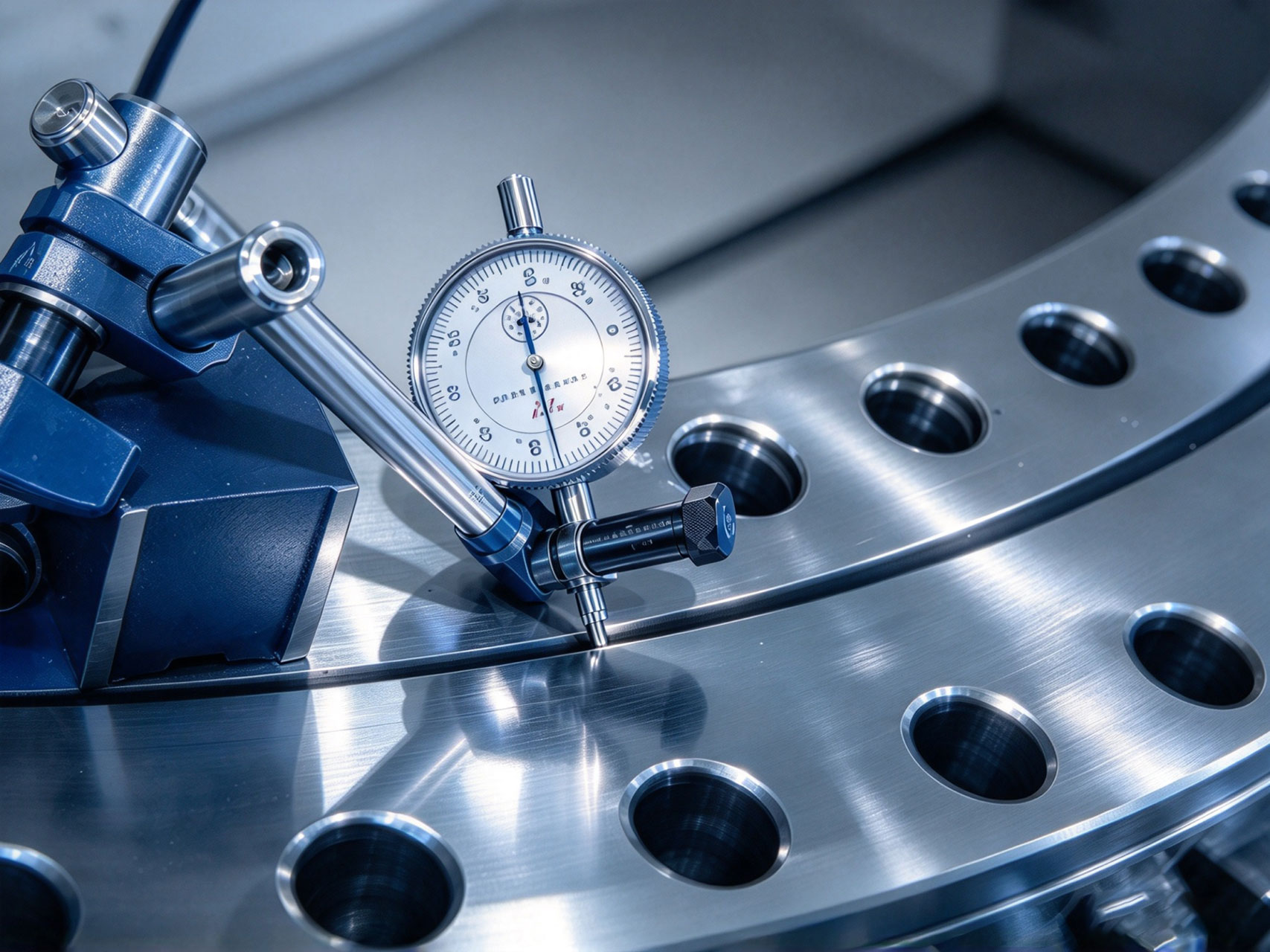
Axial movement can typically be evaluated by measuring the relative displacement between the bearing rings when controlled loads are applied in opposite axial directions.
A dial indicator or another suitable displacement-measuring instrument can be positioned to record the movement.
For meaningful results, the bearing and measuring equipment must be properly positioned, and the measurement procedure should be repeatable. Applied force, measurement location, bearing orientation, and mounting condition can affect the result.
Measuring Radial Clearance
Radial clearance is evaluated by measuring relative radial displacement between the bearing rings under controlled conditions.
As with axial measurement, the procedure should account for bearing size, structure, measuring position, and the applied force. For large slewing bearings, inconsistent measuring conditions can produce results that are difficult to compare.
For this reason, maintenance personnel should compare measurements using a consistent procedure and, where available, the limits specified for the particular bearing.
Common Signs of Excessive Clearance
A clearance problem may first become noticeable through changes in machine behavior rather than through a scheduled measurement.
Possible warning signs include abnormal rocking or movement, increased vibration, changes in rotational accuracy, unusual noise, and progressive changes in gear meshing.
These symptoms do not prove that internal bearing clearance is the sole cause. Loose mounting bolts, deformation of the supporting structure, gear wear, lubrication problems, or other mechanical faults can produce similar behavior.
Inspection should therefore consider the complete slewing system.
Why Does Slewing Bearing Clearance Increase During Service?
A slewing bearing that has operated for thousands of working cycles will not necessarily have exactly the same internal condition as when it was installed.
A gradual change can occur as components wear and the machine structure responds to repeated loading.
Raceway and Rolling Element Wear
Repeated rolling contact produces stress at the contact surfaces. Under appropriate operating conditions, the bearing is designed to sustain this contact over its intended service life.
However, contamination, insufficient lubrication, overload, impact, corrosion, or other unfavorable conditions can accelerate wear. As material is progressively lost from contact surfaces, measurable internal movement may increase.
A significant increase in clearance can therefore be an important maintenance indicator.
Mounting Surface Deformation
The bearing depends on its supporting structure.
If the mounting surface lacks sufficient flatness or rigidity, or if it deforms under load, the bearing rings may also deform. This changes the internal contact conditions and can produce uneven load distribution.
For large-diameter bearings in particular, the bearing, mounting flange, bolts, and machine frame should be treated as an interacting structural system.
Bolt Loosening and Structural Deflection
Loose or improperly tensioned mounting bolts can permit movement between the bearing and supporting structure. This movement can sometimes be mistaken for internal bearing clearance.
Before concluding that a bearing has excessive internal wear, the condition of the mounting bolts and surrounding structure should therefore be inspected.
Lubrication and Contamination
Lubrication separates and protects rolling contact surfaces while helping reduce friction and wear. Contamination can damage those surfaces and accelerate deterioration.
Dust, abrasive particles, water, and other contaminants may enter the bearing if sealing or maintenance is inadequate.
Following appropriate slewing bearing installation and maintenance procedures is therefore important throughout the bearing's service life. LTZC's maintenance guidance specifically identifies lubrication, bolt inspection, bearing clearance, and gear condition as routine inspection areas.
How to Specify Slewing Bearing Clearance When Ordering
Buyers do not always need to determine the final clearance value themselves. In many projects, the more useful approach is to provide the bearing manufacturer with complete application information so that the internal configuration can be evaluated as part of the bearing design.
Useful information includes:
Required bearing dimensions and mounting envelope
Bearing type, if already specified
Axial load
Radial load
Maximum tilting moment
Normal and peak load conditions
Rotational speed
Frequency of rotation and start-stop cycles
Required positioning accuracy and rigidity
Operating temperature range
Environmental conditions
Gear configuration and drive arrangement
Lubrication requirements
Existing bearing drawings or equipment drawings
For replacement projects, information about the existing bearing can also be valuable. This may include model numbers, drawings, mounting dimensions, bolt patterns, gear data, operating history, and observed failure or wear conditions.
Where standard products do not match the equipment geometry or operating requirements, customized bearings can be developed around the actual application. LTZC states that its customized product range covers different bearing structures, dimensions, materials, sealing arrangements, lubrication options, and operating environments.
The key point is that clearance should not be selected from a generic number without considering the complete application.
How LTZC Supports Slewing Bearing Clearance Selection and Quality Control
LTZC approaches slewing bearing selection as an engineering process rather than treating clearance as an isolated manufacturing dimension.
During the selection and customization stage, application information such as loads, operating conditions, bearing dimensions, precision requirements, and equipment configuration can be evaluated to determine an appropriate bearing solution. LTZC's Support Center lists application analysis, load evaluation, product selection, specification support, and customized design among its pre-sales services.
For non-standard applications, LTZC manufactures multiple slewing bearing structures, including four-point contact ball, double-row ball, crossed roller, and three-row roller designs, with internal gear, external gear, gearless, and split configurations.
Quality control is also important because the final operating characteristics depend on manufacturing and assembly accuracy. According to LTZC's non-standard bearing information, each bearing undergoes testing across more than 20 parameters, including radial clearance, rotational accuracy, and tooth profile accuracy, with test documentation provided for the finished bearing.
This combination of application analysis, bearing design, precision manufacturing, assembly, and inspection helps ensure that clearance is considered in relation to the actual operating requirements of the equipment.
For new equipment, replacement bearings, or non-standard rotary systems, providing complete operating data at the inquiry stage can reduce uncertainty and help engineers select an appropriate bearing structure and internal configuration.
Need help selecting a slewing bearing for your application?
Send LTZC your bearing drawing, dimensions, load data, rotational requirements, and operating conditions. Our engineering team can review the application and help determine a suitable slewing bearing configuration, including the clearance and precision requirements needed for reliable operation.
Contact LTZC to discuss your slewing bearing requirements and request a customized bearing solution.