WhatsApp
 jessica.chai@ltzzc.com
 0086-379-69950051

Standard vs. Custom Slewing Bearings: When Does Your Project Need a Tailored Solution?
For mechanical engineers and procurement managers, selecting the right slewing bearing is a critical decision that directly impacts the performance, safety, and lifespan of heavy machinery. As modern equipment trends toward greater automation, heavier payloads, and more compact designs, teams inevitably face a common dilemma during the R&D phase: should you adapt your equipment design to fit a standard catalog bearing, or should you invest in a custom slewing bearing engineered specifically for your application?
While standard bearings offer baseline convenience, industrial engineering often pushes equipment to its absolute structural limits. Understanding when to make the leap from off-the-shelf to custom-engineered is key to optimizing both machine kinematics and the Total Cost of Ownership (TCO).
What Are Standard Slewing Bearings and When Are They Sufficient?
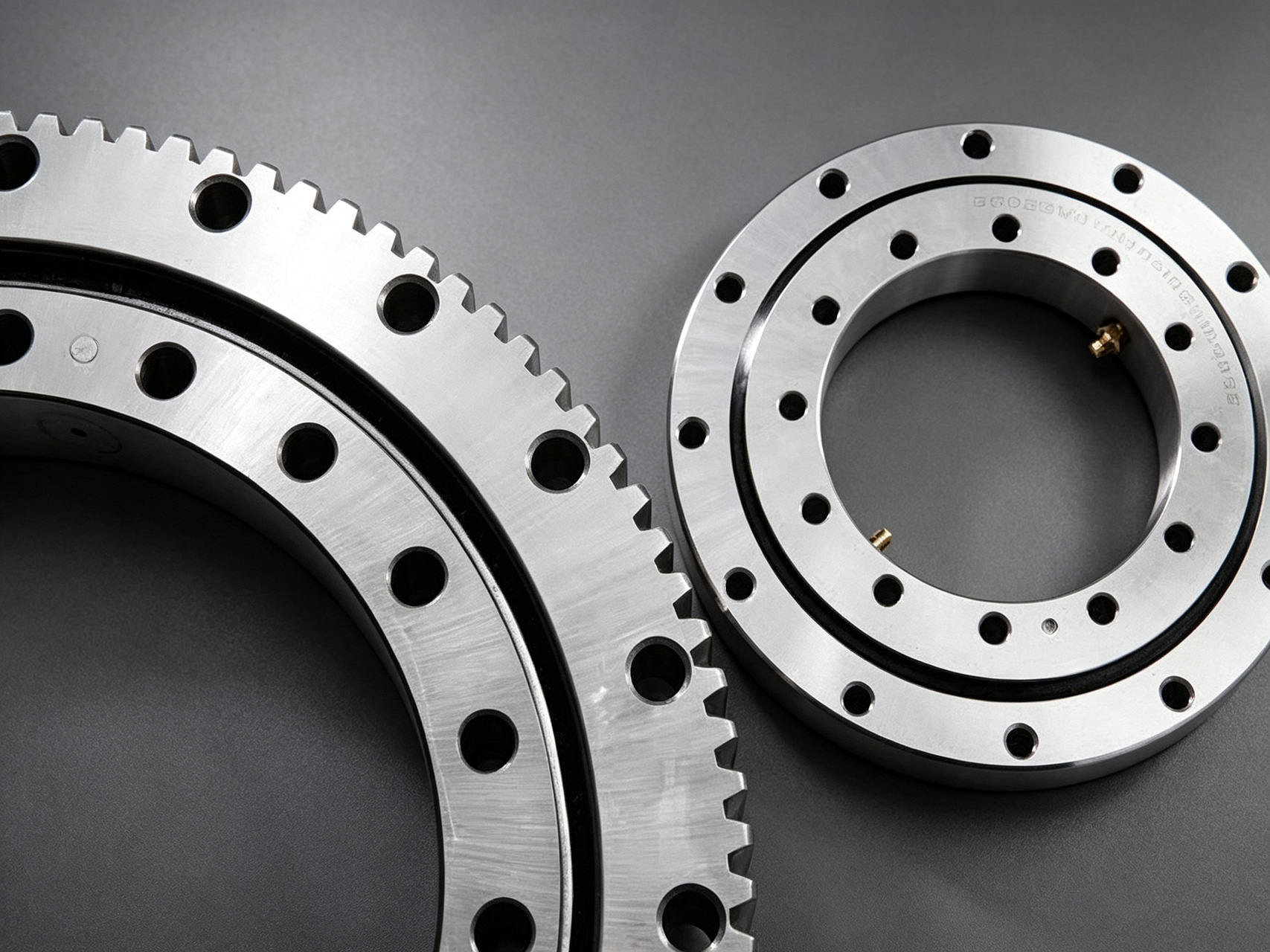
Standard slewing bearings are pre-engineered components manufactured to universally accepted dimensions, load ratings, and baseline precision grades (typically P0). They are mass-produced based on industry-standard catalogs and are designed to cover a broad spectrum of general-purpose applications.
Standard bearings are highly effective when your project meets the following criteria:
Predictable Load Profiles: The equipment operates under normal axial, radial, and tilting moment loads without extreme, sudden impact forces or asymmetric weight distribution.
Flexible Design Space: The machinery design is in its early conceptual stages, allowing engineers ample room to size the housing, mounting plates, and structural supports around the standard bearing's fixed dimensions.
Controlled Environments: The operating environment lacks extreme temperature fluctuations, highly corrosive marine elements, or severe dust contamination.
Routine Applications: For general construction machinery (like standard excavators, light duty truck cranes, or simple indexing tables), standard catalog bearings provide fast procurement and reliable operational life.
When your application falls squarely within these boundaries, standard bearings offer a cost-effective, straightforward procurement path.
What Does “Custom” Actually Mean for a Slewing Bearing?
Customizing a slewing bearing goes far beyond simply scaling the inner or outer diameter to fit a specific hole. It is a comprehensive re-engineering of the bearing’s internal geometry, material science, and structural interfaces to solve highly specific mechanical challenges identified through Finite Element Analysis (FEA).
A truly custom slewing bearing may include:
Optimized Raceway Geometry: Adjusting the internal contact angle of the rolling elements (balls or rollers) to handle highly specific ratios of axial loads to overturning moments, ensuring uniform stress distribution.
Non-Standard Gearing and Heat Treatment: Machining custom gear modules, adjusting pressure angles, or applying specialized hardening profiles (such as tooth root induction hardening) to match an existing pinion drive and prevent gear fatigue under heavy torque.
Tailored Mounting Configurations: Designing irregular bolt hole patterns, integrating tapped/threaded holes, or forging custom flanges directly into the bearing rings to eliminate the need for heavy adapter plates in constrained spaces.
Preload and Clearance Calibrations: Engineering negative internal clearance (preload) to achieve zero backlash, a critical requirement for high-precision tracking applications like robotics, radar antennas, or satellite dishes.
Specialized Lubrication Pathways: Relocating grease fittings or designing integrated internal lubrication channels to align with automated greasing systems, simplifying maintenance in hard-to-reach installations.
Key Engineering Factors That Drive Customization
Engineers typically transition to custom solutions when standard catalog specifications hit physical or metallurgical limits. The primary drivers for customized engineering include:
1. Extreme Load and Spatial Constraints
If a machine requires massive load-carrying capacity but has strict weight or space limitations, a standard bearing will likely be too bulky. Custom engineering solves this by upgrading the raw material (e.g., shifting from standard 50Mn to high-tensile forged 42CrMo or 42CrMo4V) or altering the internal structure. For example, upgrading from a single-row four-point contact ball to a compact cross-roller or three-row roller design increases dynamic load capacity exponentially without increasing the component's footprint.
2. High-Precision and Rigidity Requirements
Applications like medical CT scanners, automated welding positioners, and military targeting turrets cannot tolerate rotational runout or vibration. Standard P0 bearings generally have clearances that result in unacceptable positioning errors at the end of a robotic arm or boom. Custom bearings can be precisely ground to P5 or P4 precision grades, with strict micrometer-level runout controls, ensuring smooth, rigid, and repeatable positioning.
3. Severe Operating Environments
Standard bearings can deteriorate rapidly in harsh conditions. Offshore marine deck cranes and port machinery require specialized anti-corrosion surface treatments, such as hot-dip galvanizing, zinc-nickel plating, or multi-layer marine-grade epoxy coatings. Conversely, mining equipment or Tunnel Boring Machines (TBMs) operating in highly abrasive underground environments require custom sealing systems—such as dual-lip FKM (Viton) seals or steel labyrinth seals—to prevent aggressive silica dust and slurry from destroying the raceways.
Common Misconceptions About Custom Slewing Bearings
Misconception 1: Custom bearings always inflate the project budget.
While the initial unit cost of a custom-forged bearing is higher, it often dramatically reduces the overall system cost. Forcing a standard bearing into a complex system usually requires engineers to design heavy, costly transition plates, modify adjacent structural components, and adapt gear drives. A custom bearing drops right into your optimized design, reducing assembly time and material weight.
Misconception 2: Custom manufacturing causes unacceptable project delays.
Many buyers assume custom bearings require six to twelve months of lead time because they deal with trading companies or distributors. While engineering a new bearing takes time, working directly with a source manufacturer equipped with in-house forging, CNC machining, and heat treatment capabilities compresses this timeline significantly. Concurrent engineering allows production planning to start the moment the 3D drawings are approved.
Cost, Lead Time, and Risk: Standard vs. Custom
When evaluating the two options, procurement and engineering teams should look beyond the initial purchase order and calculate the impact on the final product's market competitiveness.
| Aspect | Standard Slewing Bearings | Custom Slewing Bearings |
|---|---|---|
| Initial Unit Cost | Lower due to mass production, existing tooling, and standard materials. | Higher due to dedicated engineering hours, specialized tooling, and custom forgings. |
| Total Cost of Ownership (TCO) | Higher if the bearing is undersized or poorly suited to the environment, leading to frequent replacements and warranty claims. | Lower. Purpose-built, optimized designs prevent premature failure, reduce maintenance overhead, and eliminate costly machine downtime. |
| Procurement Lead Time | Short (Often in stock or available in standard rolling production runs). | Moderate (Requires precise design reviews, FEA validation, and specialized production scheduling). |
| System Integration Risk | Higher in complex or compact machines. May force equipment design compromises to accommodate the bearing's fixed dimensions. | Minimal. The bearing is engineered specifically as a structural counterpart to interface flawlessly with your existing equipment. |
Real-World Scenarios: When Customization Becomes Necessary
Scenario A: Wind Turbine Pitch & Yaw Systems
Wind turbines operate continuously in highly variable wind conditions, facing massive, fluctuating overturning moments. Because they are installed in remote or offshore locations, maintenance is incredibly expensive. The bearings must withstand these aerodynamic loads and last for 20+ years. Standard bearings will succumb to raceway spalling. These applications strictly demand custom three-row roller bearings with specific induction hardening depths, highly durable anti-corrosion coatings, and automated lubrication ports to ensure uninterrupted power generation.
Scenario B: Advanced Industrial Robotics and Automation
An industrial robot base requires rapid acceleration, deceleration, and pinpoint stopping accuracy to perform welding or assembly tasks. Any internal clearance (backlash) in the bearing will amplify vibration at the tool tip, causing the robot to miss its exact coordinates. This scenario requires a custom cross-roller slewing ring with a precise negative clearance (preload) and P4 rotational accuracy to guarantee stiffness and exact motion control.
Scenario C: Heavy-Duty Mining and Excavation
In heavy-duty excavators and stacker-reclaimers used in open-pit mining, the slewing ring must support the massive dead weight of the upper structure while enduring severe shock loads from digging hard rock. Customization here focuses on material toughness. Engineers specify highly customized internal gear configurations to handle extreme pinion torque and require deep surface hardening on both the gear teeth and the raceway to prevent premature fatigue in an environment filled with abrasive dust.
Partnering with LTZC for Your Custom Bearing Solutions
Since 1992, Luoyang Heavy-duty Bearing Co., Ltd. (LTZC) has specialized in the research, development, and manufacturing of extra-large and custom slewing bearings. We understand that in heavy industry, the bearing is the mechanical heart of your equipment.
Operating a 20,000-square-meter facility equipped with advanced CNC vertical lathes, precision gear hobbing machines, and raceway CNC grinders, LTZC bridges the gap between complex engineering requirements and reliable, scalable manufacturing. We provide full-cycle OEM customization:
Precision Manufacturing: Tolerances and precision grades covering P0, P6, P5, and up to P4 for exacting applications.
Extensive Size Capabilities: From compact thin-section bearings to extra-large heavy-duty slewing rings exceeding 5,000mm in diameter.
Uncompromising Quality Assurance: Every custom bearing undergoes 100% Non-Destructive Testing (Ultrasonic Testing and Magnetic Particle Testing), Coordinate Measuring Machine (CMM) dimensional verification, and comes with comprehensive Material Test Certificates (MTC) and inspection reports.
By partnering directly with a source factory backed by over 30 years of metallurgical and mechanical experience, you eliminate middlemen, ensure transparent communication, and guarantee that your custom mechanical designs are brought to life exactly as intended. For customers evaluating standard versus custom bearings, LTZC offers a straightforward approach: submit the application requirements and drawings. The engineering team will evaluate whether a standard bearing can meet the requirements, and if not, propose a custom design that addresses the specific constraints. There is no obligation and no cost for the initial evaluation.
Contact LTZC today to discuss your slewing bearing requirements and determine whether a custom solution is the right choice for your application.
FAQs
Q1: What is the Minimum Order Quantity (MOQ) for a custom slewing bearing?
At LTZC, we understand the iterative nature of the R&D and prototyping phases in machine design. We support low-volume requirements and can manufacture a single custom bearing prototype. This allows your engineering team to perform real-world testing and validation before committing to mass production.
Q2: Can you manufacture a replacement bearing based on an existing competitor part number or a broken sample?
Yes. If you are servicing equipment and need to replace an existing bearing from major global brands (such as Rothe Erde, Rollix, SKF, or IMO), our engineers can reverse-engineer the component or work from the part number to provide a fully interchangeable custom replacement. We match the exact dimensions, gear specifications, and load ratings to ensure a seamless drop-in fit.
Q3: What engineering information do I need to provide to get a custom quote?
To generate an accurate design proposal and quotation, our engineers need the basic envelope dimensions (Outer Diameter, Inner Diameter, Height), the required gear type (internal, external, or ungeared), the desired precision grade, and a summary of the working load spectrum (maximum axial load, radial load, and tilting moment). Providing a 2D DWG or 3D STEP/IGES CAD model is the fastest way to initiate the DFM (Design for Manufacturing) process.
Q4: Can you customize the heat treatment process for specific wear applications?
Absolutely. Heat treatment is critical to a bearing's load capacity and longevity. We offer customizable induction hardening for raceways (typically achieving HRC 55–62) and specialized gear hardening (such as tooth surface or tooth root quenching) to dramatically improve the wear resistance of the pinion interface based on your specific torque requirements.