WhatsApp
 jessica.chai@ltzzc.com
 0086-379-69950051

Three Row Roller Slewing Ring Five-Year Cost Drivers
A low purchase price can become an expensive decision if a high-load bearing requires difficult mounting work, repeated lubrication attention, or an unplanned machine outage. Before issuing an RFQ, operations and sourcing teams should compare the complete cost exposure rather than the bearing quotation alone.
A Three Row Roller Slewing Ring is often considered for cranes, excavators, lifting equipment, and other machines where axial load, radial load, and overturning moment must be managed at the same time. The design may justify a higher initial investment when the alternative exposes the equipment to greater replacement or outage risk. It is not automatically the right answer for every rotating machine.
LTZC Bearings Co., Ltd. supplies slewing bearings, gear rings, racks, bearing unit assemblies, Slewing Drives, and non-standard bearing parts. Buyers assessing high-load equipment can compare the product scope with our Three Row Roller Slewing Bearings and broader precision slewing bearing options before deciding whether a three-row arrangement fits the duty.

Confirm whether the higher-capacity design fits the machine duty
Recommendation: Specify a three-row roller arrangement when the machine has meaningful combined loading and the cost of a bearing-related stoppage is high. The reason is functional separation: one roller row can be assigned to axial load in one direction, another to axial load in the opposite direction, and a third to radial load. This arrangement is commonly relevant to large cranes, heavy excavators, and fixed lifting equipment.
The recommendation has limits. A machine with moderate load, limited overturning moment, or low consequence of downtime may be better served by another bearing type. Overspecifying the ring can increase purchase cost, freight effort, and mounting complexity without producing a useful economic return. A buyer should therefore compare the actual load cases, duty cycle, mounting interfaces, gear arrangement, and maintenance access before approving the higher-capacity option.
| Machine condition | Likely bearing decision | Why it may fit | When it may not fit |
|---|---|---|---|
| Heavy crane with repeated lifting and large overturning moment | Consider a three-row roller arrangement | It can separate axial and radial load paths for demanding combined-load duty. | Do not decide from lifting capacity alone; the mounting structure and duty cycle still require review. |
| Excavator with severe working loads and costly field access | Compare heavy-duty roller design against the existing bearing | Replacement work and equipment downtime can materially affect ownership cost. | It may not be justified where machine use is intermittent or replacement access is simple. |
| Moderate-load rotating platform | Review alternative bearing structures | A smaller or different bearing design may meet the application requirement at lower total cost. | Do not reduce capacity without confirming all axial, radial, and moment loads. |
| Large custom lifting equipment | Request a condition-based technical review | Standard catalog assumptions may not match the actual ring diameter, gear, or mounting arrangement. | Do not approve a custom design without agreed drawings and acceptance requirements. |
LTZC can provide customized bearing solutions based on working conditions, existing designs, and technical specifications. This is relevant where the buyer needs a defined material, size, or performance requirement rather than a generic replacement. Product dimensions cover outer diameters from 200 mm to 20 m. That range indicates the company can discuss both compact and very large ring requirements, but it does not replace application-specific confirmation.
Use a five-year ownership-cost model before approving the RFQ
Recommendation: compare each candidate bearing across five years using the same cost categories. The reasoning is simple: purchase price is visible on day one, while mounting work, lubrication effort, outage exposure, and replacement planning are often held in separate budgets. This model fits budget approval, replacement planning, and supplier comparison. It does not produce a valid decision if the operating assumptions are missing or if competing quotations do not describe the same scope.
| Five-year cost driver | What to compare | Effect of selecting a higher-capacity roller design | Information required from the buyer |
|---|---|---|---|
| Purchase price | Bearing structure, diameter, material requirement, gear form, sealing scope, and documentation. | The initial amount may be higher because the design is selected for demanding combined loads. | Drawing, required outer diameter, load cases, gear requirement, and target delivery date. |
| Mounting work | Access to bolts, lifting plan, alignment work, gear engagement checks, and commissioning time. | A larger or heavier ring can require more planning and handling during replacement. | Machine layout, available lifting equipment, mounting surface details, and field access constraints. |
| Lubrication | Lubrication-point access, maintenance intervals set by the equipment owner, grease routes, and labor access. | Maintenance cost depends on the installed machine arrangement, not on bearing purchase price alone. | Current lubrication practice, operating environment, contamination exposure, and planned service windows. |
| Downtime risk | Cost of a stopped crane, excavator, or production line; spare availability; replacement duration; site access. | A suitable design can reduce mismatch risk, but no supplier should promise outage avoidance without duty data. | Cost of lost operating time, backup equipment availability, and whether replacement can occur during shutdown. |
| Replacement intervals | Expected service planning, inspection evidence, wear history, and the condition of the mating structure. | The correct interval must be based on actual application conditions rather than a generic calendar rule. | Existing bearing history, observed wear, loads, rotation speed, maintenance records, and failure findings. |
For internal approval, place the quotation beside the costs that sit outside procurement: maintenance labor, crane rental or lifting resources for installation, lost production time, and the financial impact of a delayed repair. A bearing with a lower invoice amount is not necessarily lower cost when its installation or replacement timing creates operational exposure.
A practical comparison can be arranged as a sourcing worksheet:
- List each quoted bearing and record the stated configuration, ring dimensions, gear requirement, and sealing scope.
- Identify all mounting tasks, including removal of the old unit, lifting access, bolt work, alignment, and commissioning checks.
- Assign internal ownership for lubrication and inspection records rather than treating maintenance as an unspecified future cost.
- Estimate the consequence of an unplanned outage using the buyer’s own production, rental, labor, or project-delay figures.
- Compare replacement planning assumptions over the same five-year period and flag assumptions that have not been validated.
- Approve only after technical scope, delivery expectation, acceptance criteria, and after-sales responsibilities are clear.
The model is deliberately not a price formula. LTZC does not have enough application data from a general inquiry to state a universal lifecycle cost, replacement interval, or downtime reduction figure. Those values should be established from the individual machine and its service record.
Control the cost drivers that change the quotation and field workload
Recommendation: request a quotation that separates the technical variables instead of asking only for a ring diameter and price. This approach fits new equipment, replacement rings, and custom heavy-duty machinery. It is less necessary for a fully documented like-for-like replacement with confirmed drawings, although the buyer should still verify gear and sealing details.
Bearing diameter and ring structure
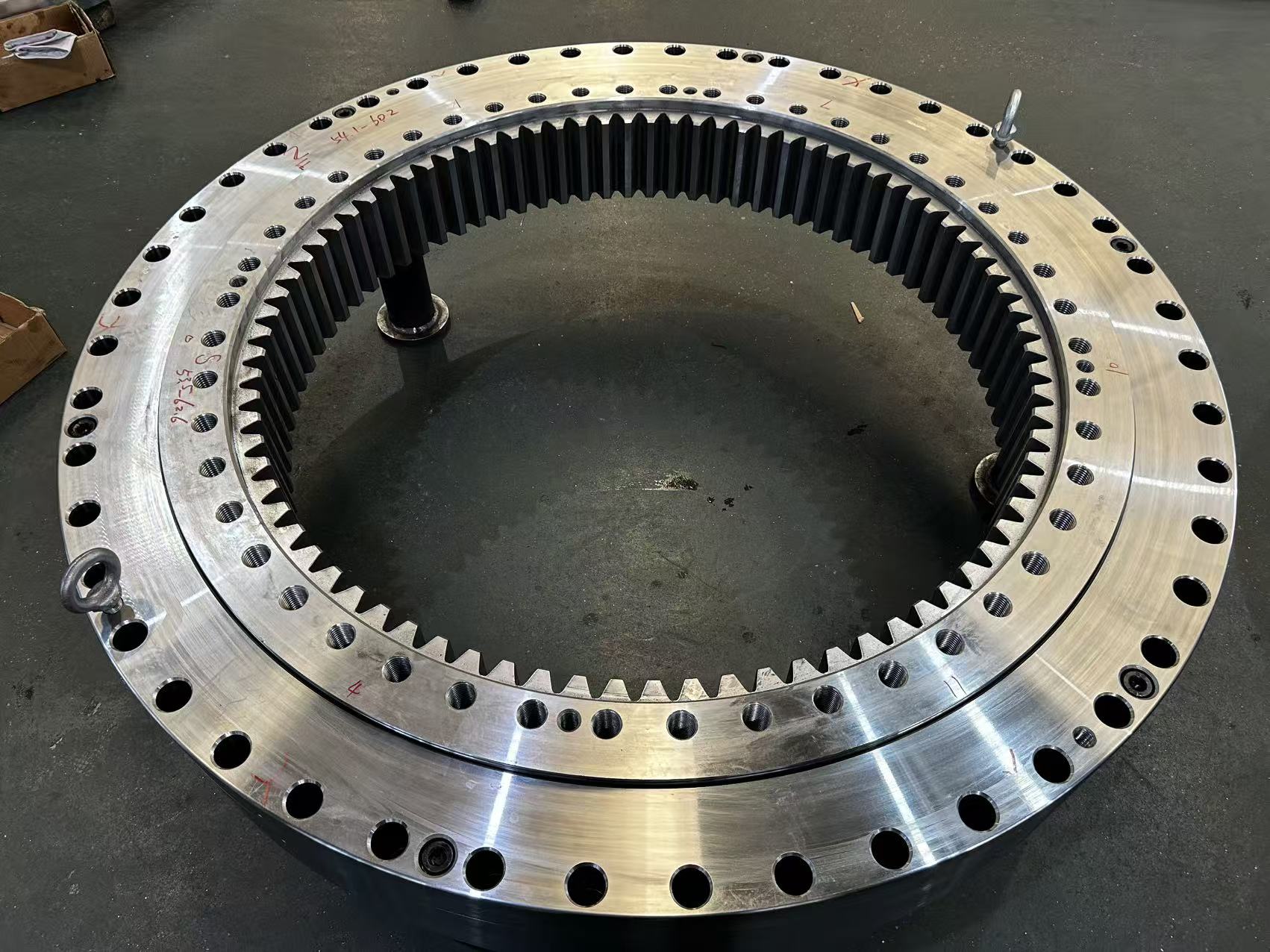
Diameter affects material usage, handling, freight planning, mounting access, and the practical difficulty of installation. Large rings can also require closer coordination between the bearing, the machine structure, and the lifting method. LTZC delivered a slewing ring with an outer diameter of 10.87 m in 2024 for 2,000-ton fixed lifting equipment. The ring used an integral three-row roller structure. This case is evidence that LTZC has supplied a very large ring for a defined lifting application; it is not a universal capacity statement for every crane project.
Gear configuration
Gear form changes both the bearing scope and the work needed to integrate it with the drive. The buyer should state whether a gear is required, where it is positioned, what mating pinion arrangement exists, and whether tooth finishing is specified. Gear selection should not be treated as a minor accessory decision because poor definition can create commissioning delays.
LTZC also supplies slewing ring gear products. In a confirmed customer case, segmented gear ring US8.419.1606 with a 6 m outer diameter and ground teeth was delivered for Hengshui customers and their end customers. The case supports discussion of large segmented, ground-tooth gear requirements. It does not establish that every project requires segmented rings or ground teeth.
Sealing and working environment
Sealing requirements should be tied to the actual environment: dust, moisture, corrosion exposure, washdown practice, temperature, and access for inspection. A stronger sealing requirement can affect purchase scope, while an unsuitable arrangement can increase maintenance attention. The limit is clear: no sealing choice should be accepted as suitable without knowing the exposure conditions.
Material and custom requirements
Material selection should follow the service environment and loading requirement. LTZC lists GCr15 for high hardness, wear resistance, and strength in roller and ball bearing applications. AISI 440C is listed for corrosion and oxidation resistance where higher corrosion resistance is required. Alloy materials such as 20CrMo and 42CrMo are listed for strength, hardness, and wear resistance in heavy-load bearing use. These are material options, not automatic recommendations; the buyer must identify the exposure and duty before selecting one.
Reduce installation and outage exposure before delivery
Recommendation: plan mounting and commissioning at the RFQ stage, not after the ring arrives. This is most relevant where the bearing is large, the machine is difficult to access, or a shutdown window is short. It may be a lighter task for a small, documented replacement, but basic mounting-surface and gear checks still apply.
The buyer should request and agree on the information needed for the installation plan. LTZC provides bearing installation guidance, maintenance training, fault analysis, and on-site technical assistance as after-sales support. The stated post-sales commitment is a response to customer quality objections within 24 hours, with on-site service starting within 48 hours in China. This on-site timing applies specifically in China and should not be represented as a service-time commitment for other countries.
Use the following pre-delivery checklist to limit avoidable disruption:
- Confirm the approved drawing and identify the bearing orientation, gear position, mounting holes, and any special interfaces.
- Inspect the mating structure for flatness condition, damage, contamination, and bolt-hole compatibility according to the machine’s own approved requirements.
- Confirm lifting equipment and lifting points are appropriate for the actual component handling plan.
- Define who checks gear engagement, fastener installation, lubrication access, and rotation during commissioning.
- Record baseline condition after installation so later inspection findings can be compared with a known starting point.
- Arrange maintenance training where site personnel need support for inspection, lubrication, or fault identification.
For project teams needing additional preparation material, LTZC provides guidance on bearing installation. The linked guidance should support the project plan, not replace the equipment maker’s installation requirements or site safety procedures.
Assess supplier fit using verified scope and documented evidence
Recommendation: select a supplier only after matching its verified supply scope to the machine’s actual risk profile. The logic is that a large, custom, or high-load ring has different sourcing exposure from a routine replacement. This approach fits crane builders, heavy-equipment owners, and project procurement teams. It does not mean every application needs a custom design.
LTZC was established in 1992 and operates a 20,000 m² facility. Its management system certifications include ISO9001:2015, ISO14001:2015, and ISO45001:2018, with certification also listed from ISO, CCS, and ABS. For a sourcing team, these credentials are useful supplier-qualification evidence. They do not by themselves prove that a specific bearing design fits a specific load case.
Relevant large-ring evidence includes an integrated bearing with an 8.445 m outer diameter produced in 2024 for a crane industry client in South Korea. LTZC also developed and delivered 24 m segmented bearings to Jiangsu Nantong Rainbow Heavy Machinery. These cases indicate experience with large-scale and segmented bearing requirements. They should be used as discussion points when evaluating comparable needs, not as a substitute for drawing review, acceptance criteria, or application data.
Commercial terms also affect approval timing. LTZC states no MOQ and a delivery range of 30 to 90 days. No MOQ can suit replacement planning, pilot equipment, or low-volume custom demand. The stated delivery range should be treated as a planning reference; final timing must be confirmed against the requested configuration, technical scope, and order conditions.
Submit the data that makes a cost comparison usable
A useful request should identify more than the desired diameter. Send the drawing or existing bearing designation, axial and radial load information, overturning moment where available, operating environment, rotation duty, gear requirement, sealing expectation, and planned delivery date. Also state whether the requirement is a new machine, a replacement, or an upgrade after a service issue.
For heavy lifting equipment, include the outage constraint: can installation occur during a scheduled shutdown, or would a failure stop a project? That single distinction often changes the weight given to mounting work, service support, spare planning, and replacement risk in the five-year comparison.
Submit your drawing and operating conditions to LTZC for a focused selection and quotation review.