WhatsApp
 jessica.chai@ltzzc.com
 0086-379-69950051

How Large Slewing Bearings Reduce Crane Boom Deflection
As a slewing bearing engineer with over 10 years of experience, a common challenge I help clients solve is excessive boom deflection in heavy lifting equipment. While many factors contribute to this issue, the slewing bearing at the heart of the machine's rotation is a primary determinant of system stiffness. A frequent misconception is that simply increasing the diameter of a Large Slewing Bearing will solve the problem. The reality is more nuanced. True stability comes from a holistic understanding of load dynamics, bearing geometry, and the supporting structure.
This article will explain the mechanical principles behind how a slewing bearing influences deflection, detail when a larger diameter is insufficient, and provide actionable criteria for specifying a bearing that ensures the rotational accuracy and structural integrity of your equipment. We will explore how advanced designs, such as a specialized Three Row Roller Slewing Bearings, are engineered to handle extreme tilting moments.
Beyond Diameter: When Increasing Bearing Size Is Not Enough
For any given load, a larger diameter bearing generally provides greater stiffness due to a wider moment arm for resisting tilting forces. However, there is a point of diminishing returns. When dealing with extreme eccentric loads—typical in heavy-lift cranes with long booms—boom-side deflection becomes less about diameter and more about the bearing's internal design and its ability to manage tilting moments. Simply scaling up a basic bearing design often fails to provide the required stiffness.
This boundary is crossed when the tilting moment load (M) causes significant elastic deformation within the bearing's raceways and rolling elements. At this point, two other factors become far more important than diameter alone: raceway geometry and multi-row roller configurations.

Here is a breakdown of when to look beyond simple diameter increases:
| Scenario | Limitation of Diameter-Only Approach | Effective Engineering Solution |
|---|---|---|
| High Tilting Moment Loads (e.g., long-reach cranes, offshore platforms) |
A larger single-row bearing may still experience significant raceway deformation and "ovalization" under a high tilting moment, leading to imprecise rotation and increased wear. | Multi-Row Roller Design: A three-row roller bearing separates the load paths. The upper and lower rollers handle the tilting moment, while the central rollers manage the radial load. This drastically increases moment capacity and stiffness. Our recent 10.87-meter OD three-row roller bearing for a 2,000-ton crane is a prime example of this principle in action. |
| Requirement for High Rotational Accuracy (e.g., radar systems, precision machine tools) |
Even minimal elastic deformation in the bearing can translate to significant positional errors at the end of a long boom or instrument arm. A larger diameter doesn't guarantee the elimination of this micro-deflection. | Optimized Raceway Geometry & Preload: Modifying the contact angle of the raceways can increase axial and moment stiffness. Applying a specific preload during assembly removes internal clearance, resulting in a much stiffer system from the start of rotation. |
| Insufficient Structural Support (e.g., retrofitting a crane with a non-rigid mounting flange) |
The stiffest bearing in the world will perform poorly if its supporting structure flexes. A larger bearing mounting pattern can even exacerbate stress on a weak foundation. | System-Level Analysis: The solution involves stiffening the mounting structure itself (e.g., thicker flanges, added gussets). The bearing must be designed in concert with its foundation, not as an isolated component. Our engineering team provides guidance on structural interface requirements. |
Material Selection and Manufacturing Precision for Optimal Stiffness
A bearing's ability to resist deflection is fundamentally tied to its material properties and the precision of its manufacture. Even with an ideal design, substandard materials or loose manufacturing tolerances will undermine performance. Since our establishment in 1992, we have focused on controlling these variables within our 20,000 m² ISO 9001:2015 certified facility.
The choice of steel is the first critical decision. Different alloys offer distinct advantages depending on the load, environment, and operational demands.
- GCr15 / SUJ2: These high-carbon chromium bearing steels are the standard for many applications. They provide an excellent balance of high hardness, wear resistance, and fatigue strength, making them suitable for the balls, rollers, and rings in many heavy-duty precision slewing bearing applications.
- 20CrMo / 42CrMo: For applications with extreme shock loads or where higher core toughness is required, these alloy steels are superior. The addition of chromium and molybdenum improves hardenability and strength, ensuring the bearing can withstand heavy dynamic loads without fracture.
- AISI 440C: In corrosive environments, such as marine or offshore cranes, stainless steel like 440C is necessary. While it offers good hardness and wear resistance, its primary benefit is its ability to resist rust and oxidation, preserving the integrity of the raceway surfaces.
Beyond material, manufacturing precision is paramount. The conformity of the raceway profile to the rolling elements, the uniformity of hardness after heat treatment, and the flatness of the mounting faces all contribute to how evenly the load is distributed. Any imperfection becomes a point of concentrated stress, leading to localized deformation that contributes to overall system deflection.
Buyer's Checklist for Specifying a Low-Deflection Slewing Bearing
To ensure you procure a bearing that meets your stiffness requirements, it’s essential to provide your supplier with a complete set of operational parameters. Approaching the specification process with a clear checklist prevents miscommunication and results in a more effective design. Before issuing an RFQ, gather the following information:
- Define the Full Load Spectrum: Don't just specify the maximum load. Provide the complete spectrum, including axial force (Fa), radial force (Fr), and tilting moment (M). Specify which loads occur simultaneously. The tilting moment is the most critical driver of deflection.
- Quantify Maximum Allowable Deflection: What is the maximum angular or linear displacement permissible at the operational point (e.g., the tip of the crane boom)? This target value dictates the required bearing stiffness.
- Detail the Supporting Structure: Provide drawings of the mounting flanges. Specify the material, thickness, and bolt pattern. A highly rigid bearing cannot compensate for a flexible foundation. We must analyze the bearing and structure as a single system.
- Specify the Operational Environment: Note the temperature range, exposure to moisture or corrosive agents, and any presence of abrasive dust. This informs material selection (e.g., 440C for marine use) and sealing arrangements.
- Describe the Duty Cycle: Is the rotation continuous or intermittent? What are the rotational speed and acceleration? This affects lubrication requirements and the dynamic capacity needed from the bearing.
- Check Gearing Requirements: If the bearing includes an integral slewing ring gear, specify the module, pressure angle, and required precision class. For large-diameter applications, segmented gear rings, like the 8-meter high-precision ones we supplied to Wuhan Heavy Industry, may be necessary.
Proven Performance in Demanding Applications
Theory and specifications are important, but real-world performance is the ultimate measure of capability. Our engineering expertise is validated by successful deliveries for some of the world's most demanding projects. These cases demonstrate our ability to produce large, high-stiffness bearings that perform under pressure.
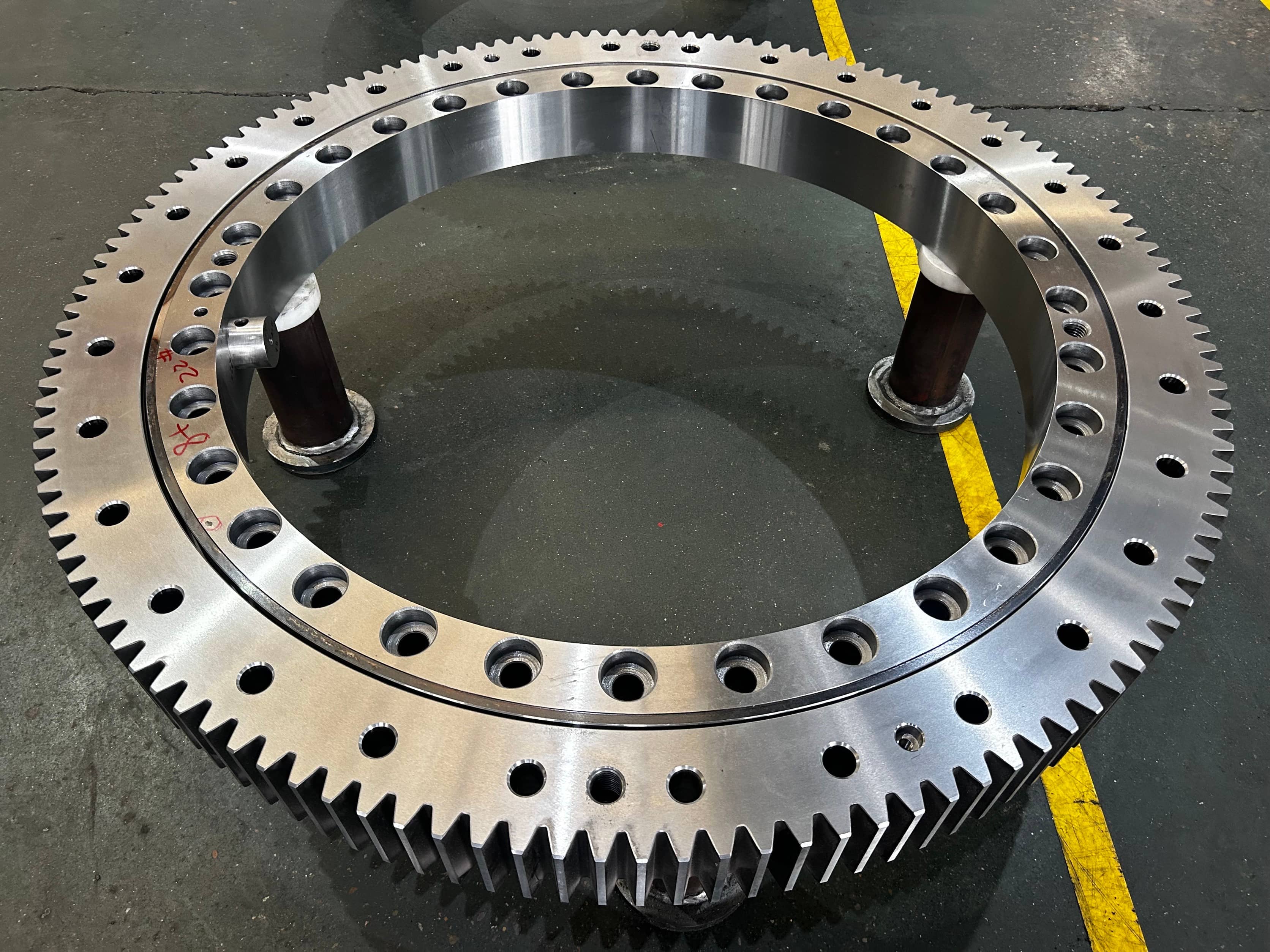
For instance, in 2024, our team successfully produced and delivered an integral three-row roller slewing ring with an outer diameter of 10.87 meters. This component is the rotational heart of 2,000-ton fixed lifting equipment, where managing deflection under immense tilting moments is non-negotiable. In the same year, we also manufactured an 8.445-meter integrated bearing for a leading crane manufacturer in South Korea, meeting their stringent requirements for load capacity and rotational accuracy.
Our capabilities are not limited to integral rings. For a key national project in China, we provided 8-meter segmented gear rings for a vertical friction stir welding system, showcasing our precision grinding and manufacturing for massive components. These examples, along with our work for clients like CRCC and Jiangsu Nantong Rainbow Heavy Machinery, confirm our experience in turning complex engineering challenges into reliable, high-performance hardware.
Beyond the Bearing: The Importance of Installation and Support
Procuring the correct bearing is only half the battle. Proper installation and maintenance are essential to realizing its designed stiffness and lifespan. Even a perfectly manufactured bearing will exhibit excessive deflection if installed improperly.
Key installation factors include:
- Mounting Surface Flatness: The supporting structures must meet strict flatness and rigidity specifications. Any deviation creates high spots, concentrating the load and causing deformation.
- Correct Bolt Tensioning: Mounting bolts must be tightened to the specified torque in the correct sequence to ensure uniform clamping force. Uneven tension can distort the bearing rings.
- Proper Gearing Backlash: For geared bearings, setting the correct backlash with the drive pinion is vital to prevent excessive wear and rotational inaccuracies.
We provide full after-sales support, including detailed bearing installation guidance, maintenance training, and on-site technical assistance. Our commitment is to ensure the long-term, stable operation of your equipment, which starts with a correctly specified and properly installed bearing.
Controlling crane deflection is a system-level challenge where the slewing bearing plays a central role. By moving beyond a simple diameter-based approach and considering raceway geometry, roller configuration, materials, and manufacturing precision, you can achieve the stiffness and stability your heavy equipment demands.
If you are designing heavy machinery and need to control deflection, our team can help. Submit your drawings and technical specifications for a customized bearing solution designed for maximum stiffness and reliability.