WhatsApp
 jessica.chai@ltzzc.com
 0086-379-69950051

How to Set Lubrication Intervals for a Mining Slewing Bearing
As a slewing bearing engineer, I often see maintenance plans that treat lubrication as a simple calendar event. A common question is, "How often should we grease our excavator's slew ring?" The standard answer of "every 50-100 operating hours" is a dangerous oversimplification for the mining industry. This fixed-interval approach fails to account for the extreme and variable loads that define mining operations, leading directly to unplanned downtime and costly replacements. A mining slewing bearing operating in a hot, dusty quarry requires a vastly different maintenance strategy than one in a temperate, clean environment.
The key to maximizing bearing life is to move from a time-based to a condition-based lubrication schedule. By calculating intervals based on the machine's actual duty cycle—considering factors like swing frequency, temperature, and contamination—maintenance planners can ensure the bearing receives the right amount of grease at the right time. This article provides a practical method for establishing such a schedule. At LTZC, we not only manufacture high-performance bearings but also provide the engineering support to help you maintain them. Our operations are certified under ISO 9001:2015, ISO 14001:2015, and ISO 45001:2018, ensuring a foundation of quality in every component we produce.
The High Cost of Incorrect Lubrication Schedules
Both under-lubrication and over-lubrication create distinct failure modes in large diameter slewing rings. Understanding these risks highlights why a generic, one-size-fits-all schedule is insufficient for high-stakes mining equipment. Getting the interval wrong is not a minor issue; it directly impacts operational availability and budget.
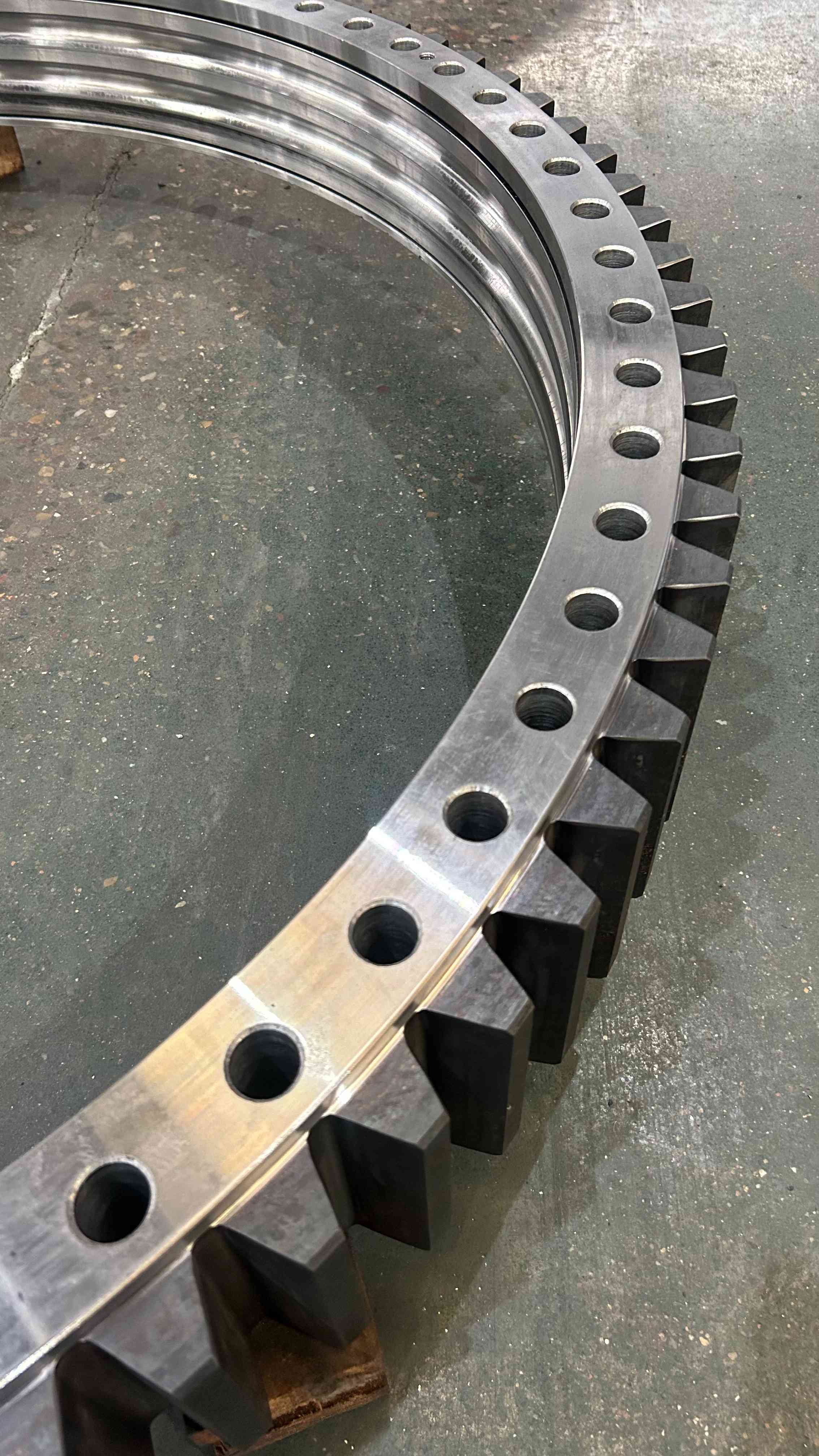
Consequences of Under-Lubrication
When the grease interval is too long, the lubricant film breaks down. The grease degrades, loses its base oil, and can no longer separate the rolling elements from the raceways under heavy load. This leads to:
Adhesive Wear and Spalling: Metal-to-metal contact creates microscopic welds that break apart, pulling material from the raceway surfaces. This damage, known as spalling or flaking, rapidly accelerates wear and leads to catastrophic failure.
Increased Friction and Heat: Without a sufficient lubricating film, friction skyrockets. The resulting heat can alter the steel's microstructure, reducing its hardness and load-carrying capacity.
Corrosion: Old, broken-down grease can no longer protect metal surfaces from moisture. This is especially problematic in wet mining environments, where water ingress can quickly lead to rust and pitting on critical surfaces.
Contamination Buildup: The grease is no longer being purged effectively, allowing abrasive particles like rock dust and dirt to accumulate within the bearing, causing three-body abrasion.
Consequences of Over-Lubrication
Applying grease too frequently can be just as damaging. The internal pressure from excessive grease can overwhelm the bearing seals. This is a common mistake I've seen field technicians make, believing that more grease is always better.
Seal Damage: The primary consequence is blown seals. Once a seal is compromised, it creates a direct path for contaminants like water and abrasive dust to enter the bearing, and for grease to leak out.
High Operating Temperatures: Pumping too much grease into the bearing housing increases fluid friction, or "churning." This generates excess heat, which accelerates grease oxidation and degradation, ironically reducing its effective life.
Environmental Contamination: Leaking grease is a significant environmental and safety hazard on a mine site, creating slip risks and requiring costly cleanup.
Wasted Resources: Over-lubrication wastes a considerable amount of expensive, specialized heavy duty bearing grease and man-hours over the life of the machine.
A Duty-Cycle Method for Setting Lubrication Intervals
Instead of relying on a fixed number of hours, this method adjusts a baseline interval using factors that reflect the real-world severity of the application. This ensures the lubrication schedule is tailored to the machine's actual workload, protecting your investment and preventing premature excavator slew ring failure.
The process is straightforward: start with a baseline, then apply multipliers for key operational variables to calculate a customized service interval. This data-driven approach is fundamental to a modern preventive maintenance program.
Step-by-Step Guide to Calculating Your Interval
Establish a Baseline: Start with the OEM's general recommendation. If none is available, a conservative baseline of 100 operating hours is a reasonable starting point for a mining slewing bearing.
Apply Adjustment Factors: Use the table below to find the appropriate factor for each condition. Multiply your baseline interval by each of the four factors to find your adjusted interval.
Calculate the Final Interval: The formula is: Adjusted Interval = Baseline Interval × FTemp × FContam × FSpeed × FLoad
Verify and Refine: After the first adjusted interval, inspect the purged grease. If it is heavily discolored, watery, or full of particulates, shorten the interval. If it looks clean, you may be able to slightly extend the next interval. This feedback loop is essential for fine-tuning the schedule.
Duty Cycle Adjustment Factor Table
To determine your specific interval, multiply your baseline by the corresponding factor from each category below.
| Factor Category | Condition | Description | Multiplier (F) |
|---|---|---|---|
| Temperature (FTemp) | Normal | Ambient temperature between 0°C and 40°C (32°F to 104°F) | 1.0 |
| High | Consistently above 40°C (104°F), direct sun exposure | 0.5 | |
| Low | Consistently below 0°C (32°F) | 0.7 | |
| Contamination (FContam) | Clean | Dry environment, low dust (e.g., salt mining) | 1.0 |
| Moderate | Moderate dust, occasional moisture (e.g., standard quarry) | 0.5 | |
| Severe | High dust, high moisture, slurry (e.g., coal, iron ore) | 0.1 - 0.3 | |
| Swing Speed / Frequency (FSpeed) | Low | Slow, infrequent slewing (e.g., lifting operations) | 1.0 |
| Medium | Consistent slewing, truck loading cycles | 0.6 | |
| High | Rapid, continuous slewing (e.g., mass excavation) | 0.4 | |
| Load Conditions (FLoad) | Light | Operating at less than 50% of machine's rated capacity | 1.0 |
| Standard | Operating between 50-85% of rated capacity | 0.7 | |
| Heavy / Shock | Operating above 85% capacity, high shock loads from rock breaking | 0.3 |
Worked Example:
An excavator in an iron ore mine (Severe Contamination) operates in a hot climate (High Temperature) for continuous truck loading (Medium Speed) at near-full capacity (Heavy Load).
Baseline: 100 hours
FTemp: 0.5
FContam: 0.2 (chosen within the 0.1-0.3 range)
FSpeed: 0.6
FLoad: 0.3
Calculated Interval: 100 × 0.5 × 0.2 × 0.6 × 0.3 = 1.8 hours. This extremely short interval highlights the severity of the application and suggests that an automated lubrication system is likely necessary to maintain the equipment properly.
Choosing the Right Grease and Application Method
An accurate service interval is only effective if you use the correct lubricant. For a mining slewing bearing, the grease must be able to withstand immense pressure, resist water, and function in a wide temperature range. The proper bearing installation and lubrication procedure is just as important as the product itself.
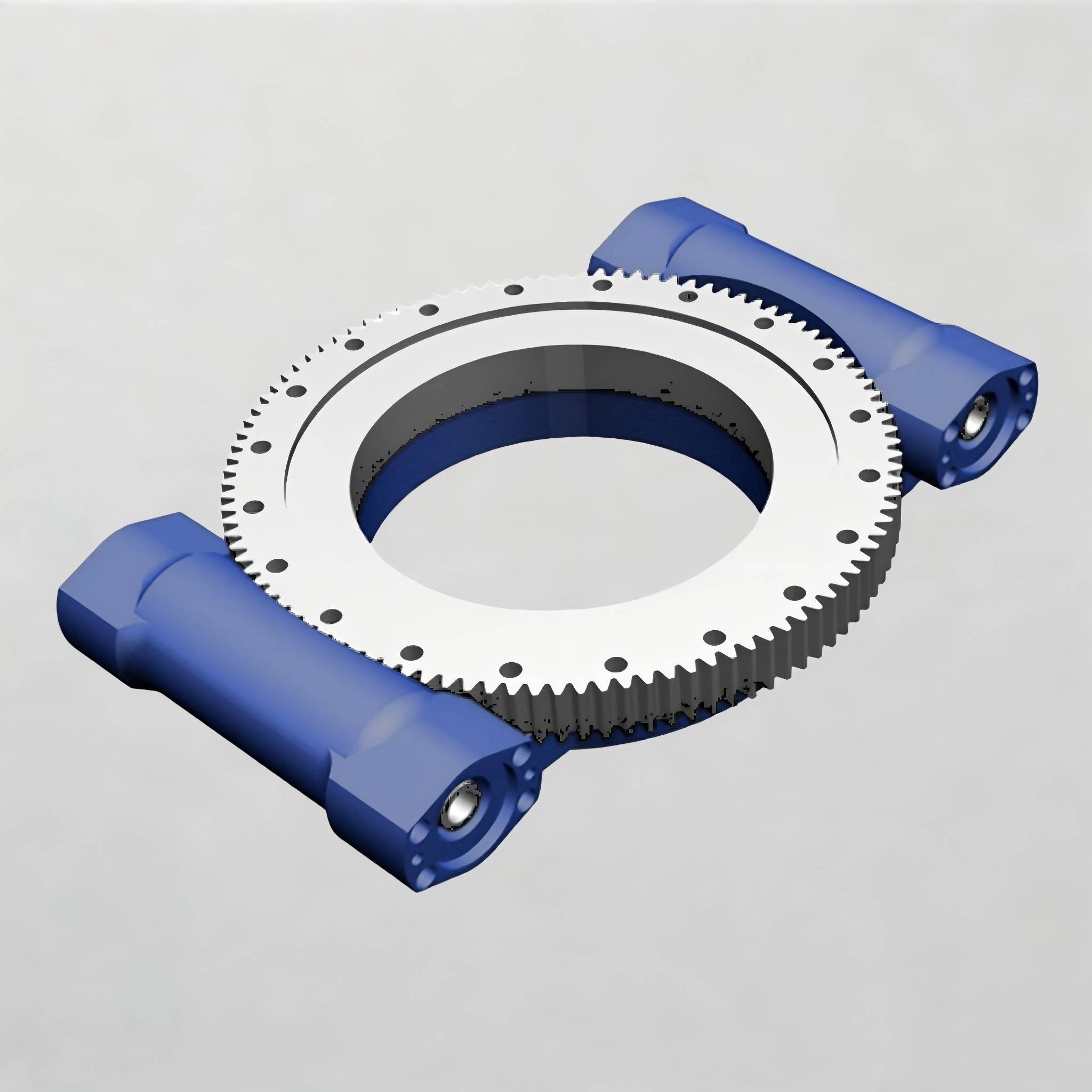
Key Grease Specifications
Consistency (NLGI Grade): Most slewing bearings require an NLGI Grade 2 grease. It is firm enough to stay in place but soft enough to be pumped through lubrication lines.
Base Oil Viscosity: For slow-moving, heavily loaded applications like mining, a high base oil viscosity (ISO VG 220 or higher) is essential to maintain a strong lubricating film.
Additives (Extreme Pressure - EP): Always select a grease with an EP additive package. These additives form a sacrificial layer on the metal surfaces to protect against wear during shock loads and high-pressure events.
Water Resistance: Look for greases with excellent water washout and spray-off resistance, often formulated with calcium sulfonate or aluminum complex thickeners.
Common Lubrication Mistakes to Avoid
Here is a checklist of common errors I have observed over my 10 years in sales and after-sales service that lead to premature bearing failure.
Using the Wrong Grease: Applying a general-purpose automotive grease to a multi-million-dollar excavator is a recipe for disaster. Always verify the grease meets OEM or bearing manufacturer specifications.
Not Purging Old Grease: The goal is to pump in new grease until you see old grease being purged from the seals around the entire circumference of the bearing. This process removes contaminants and degraded lubricant.
Forgetting to Rotate the Bearing: To ensure complete grease distribution across the raceways and rolling elements, the bearing should be rotated slowly during lubrication. Apply grease at several points, rotate 90 degrees, and repeat.
Mixing Incompatible Greases: Mixing greases with different thickener types (e.g., lithium complex with calcium sulfonate) can cause the mixture to lose consistency and fail to lubricate properly. If changing grease types, the bearing must be thoroughly cleaned first.
Custom Bearing Solutions for Harsh Environments
Sometimes, even the best maintenance practices cannot overcome a bearing design that is mismatched for the application. At LTZC, we specialize in providing non-standard bearings and customized industrial bearing solutions. If you are experiencing repeated failures despite a diligent maintenance schedule, the issue may lie with the bearing's material, internal geometry, or sealing arrangement.
Our engineering team can analyze your specific working conditions—load, speed, environment, and duty cycle—to design a custom slewing ring that provides superior performance and longevity. Our advanced production capabilities, backed by CCS and ABS certifications, ensure high precision and consistent quality. We understand the needs of maintenance departments, which is why we offer a no MOQ policy and a flexible 30-90 day delivery window to help you manage your inventory and respond to urgent needs. Whether you need a unique flange configuration, a specialized slewing ring gear, or a complete system including our Slewing Drives, we can deliver a solution tailored to your equipment.
By moving to a duty-cycle-based lubrication schedule and ensuring you have the right bearing for the job, you can significantly reduce downtime and extend the service life of your critical mining machinery.
If your operating conditions are causing premature bearing failures, send us your technical specifications. Our team can help design a custom bearing solution to meet the demands of your specific application.