WhatsApp
 jessica.chai@ltzzc.com
 0086-379-69950051

Slewing Bearing Maintenance Starts With a Lubrication Interval You Can Defend
"Grease it every 100 hours" is printed in many manuals, yet a crane swinging near rated load on a coastal site and a lightly loaded indexing table do not share a schedule. This article answers one question: how often should you lubricate a slewing bearing on your equipment? Good slewing bearing maintenance begins with turning your actual duty into a number you can write down, check and adjust. If the bearing is new, review the bearing installation notes first, because a poorly seated bearing will not hold any interval.
By the end you will have a starting interval, a way to correct it for four duty factors, and a check that tells you whether to lengthen or shorten it.
Information to Collect Before You Set an Interval
You do not need laboratory data. You need six facts, and two of them block progress if missing.
Blocking: the OEM or bearing manufacturer's lubrication instruction. Grease type, raceway grease points and any stated maximum interval override every generic figure here. If you cannot find it, ask the supplier of your precision slewing bearing and use the planning values below only as a temporary baseline.
Blocking: the current grease in the bearing. Mixing incompatible greases can soften or separate the film. Check the grease label or the maintenance record before adding anything.
Typical load as a share of rated capacity, and whether shock loads occur (hooks snatching, bucket impact, wind gusts).
Rotation pattern: continuous turning, short oscillation, or long idle periods.
Environment: dust, water, salt, wash-down, ambient and surface temperature.
Whether the bearing has an external gear. The gear teeth need their own grease and their own interval.
Items 3 to 5 can be estimated now and refined after the first inspection cycle.
Duty-Cycle Lubrication Interval Matrix: Load, Speed, Contamination and Temperature
The method has two parts: pick a baseline duty class, then step the interval shorter for each severe factor. The values below are planning values for a first schedule, not an LTZC specification. Your equipment manual and the grease maker's limits always take priority.
Step 1: Choose the baseline class
| Duty class | Typical use | Starting raceway interval (whichever comes first) |
|---|---|---|
| A – Light | Occasional rotation, well under rated load, clean indoor area | 500 operating hours or 6 months |
| B – Medium | Daily rotation, moderate load, covered or mild outdoor | 250 operating hours or 3 months |
| C – Heavy | Frequent or continuous swing, loads near rated capacity, outdoors | 100 operating hours or 1 month |
| D – Severe | Shock loads, heavy dust, water or salt, sustained heat or cold | 50 operating hours or 2 weeks |
Step 2: Apply the four correction factors
| Factor | Condition | Adjustment | Reason and limit |
|---|---|---|---|
| Load | Regularly above about 80% of rated load, or any repeated shock | Move one class shorter | High contact stress thins the film and wears grease faster. Does not apply if the load is high only a few times a year. |
| Rotation speed and pattern | Small-angle oscillation (a few degrees back and forth) | Move one class shorter and purge slightly more | Rolling elements keep hitting the same spots and squeeze grease out, which invites fretting. Continuous slow rotation spreads grease better and needs no extra step. |
| Contamination | Dust, water spray, salt air, process debris | Move one class shorter and purge until the grease at the seal looks clean | Fresh grease pushes contaminated grease out through the seal. Damaged seals defeat this, so repair them first. |
| Temperature | Sustained above roughly 70 °C or below roughly -20 °C at the bearing | Move one class shorter and confirm the grease is rated for that range | Heat oxidizes grease and cold stiffens it. If the grease is not rated for the range, changing the interval will not fix the problem. |
Rules: never move more than two classes shorter in total without asking the manufacturer. If you land beyond Class D, treat it as a design question, not a greasing question.
Worked example (illustrative)
A crawler crane works outdoors near a coastal port, swinging continuously at roughly 70 to 90% of rated load. Baseline: Class C, 100 hours or 1 month. Salt air adds a contamination step, so the schedule becomes Class D: every 50 hours or 2 weeks, with purging until clean grease shows at the seal. Temperature is moderate and rotation is continuous, so no further change. After three cycles, if the purged grease is clean and shows no water, extend one step to 100 hours. Not two steps.
How to Re-Grease a Slewing Bearing in Sequence
Clean the grease fittings and seal area. Wipe dirt away so it is not pushed into the raceway. Checkpoint: the fitting and the seal lip are visibly clean before the gun connects.
Confirm the grease type. Compare against the record. Most common error: topping up with whatever is nearby.
Grease while turning the bearing. Pump slowly, rotating the bearing a small angle between strokes, so every section of the raceway receives grease. Greasing a stationary bearing fills only the area around the fitting. If rotation is not possible, note it in the log and shorten the next interval.
Watch the seals. Stop when a thin continuous bead of fresh grease appears along the seal. Pushing harder can fold the seal lip and let water in.
Wipe off the purged grease and record what you saw. Color, water droplets, metal glitter or grit tell you more than the calendar does.
Lubricate the gear separately. If the bearing has a slewing ring gear, apply gear grease to the teeth at an interval suited to its load and exposure. Do not use the raceway interval by default.
Record date, hours, grease type, quantity and condition. Without this log, you cannot justify a longer interval.
While you are at the machine, spot-check bolt tightness against the manual. Loose bolts change the load path and make grease behavior harder to read.
Completion Check and Recovery
The task is complete when you have a written interval with its basis (class and correction factors), at least one logged greasing cycle with seal observations, and a rule for when to extend or shorten it.
| What you see | Likely cause | Go back to |
|---|---|---|
| Grey or dark grease with metal glitter at the seal | Wear or interval too long | Shorten one class. If glitter continues after two cycles, request a fault inspection. |
| Milky or watery grease | Water ingress | Step 4. Check the seals, purge until clean and move one class shorter. |
| No grease reaches the seal after normal pumping | Blocked fitting or line, or too few strokes | Step 1. Clean or replace the fitting before adding more pressure. |
| Hard, dry crust around the seal | Heat, or wrong grease for the temperature | Check the grease rating against the temperature factor. |
| Rotation torque increases or noise appears between greasings | Dry raceway, contamination, or an installation problem | Re-grease with rotation, then review the installation notes. |
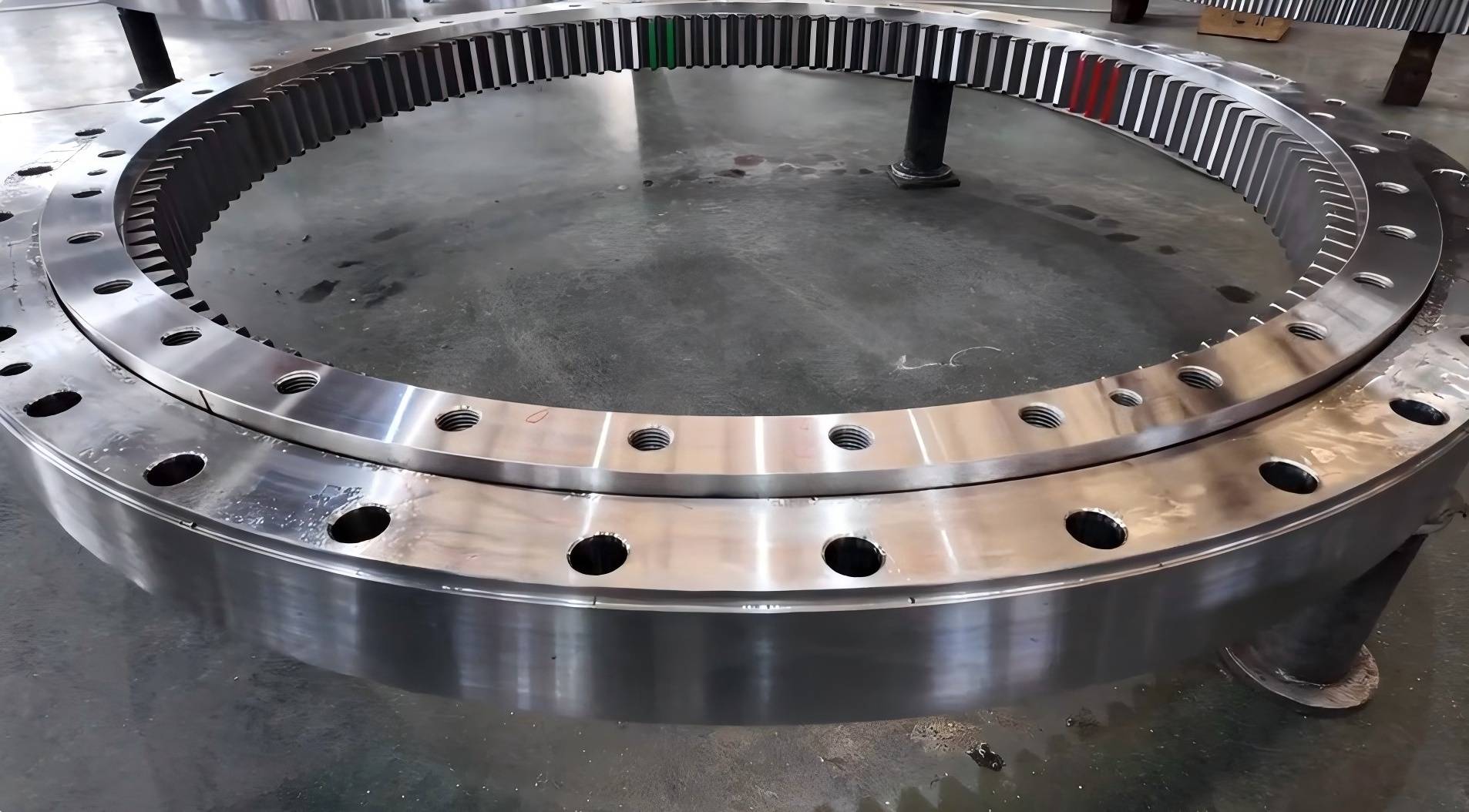
Large bearings leave little room for guesswork. LTZC delivered a 10.87-meter integral three-row roller slewing ring in 2024 for 2,000-ton fixed lifting equipment, and an 8.445-meter integrated bearing for a crane client in South Korea. At that size, a single cycle of uneven greasing can leave a long arc of raceway with a thin film, so rotating in increments during greasing matters more. Our facility is ISO9001:2015 certified. After-sales support includes maintenance training and fault diagnosis, and our post-sales commitment is a response to quality objections within 24 hours and on-site service starting within 48 hours in China.
Variations That Change the Schedule
Heavy-load roller types. Three Row Roller Slewing Bearings often work at high contact loads, so start in the heavier class and verify with seal observations.
Oscillating applications. Wind pitch and yaw positions rotate through small angles. Apply the speed and pattern correction, and see Wind & Renewable Energy applications for context.
Cranes. A Crane Slewing Bearing combines shock load, weather and long working hours, so Class C or D is the usual starting point.
Long idle periods. Re-grease before storage or a long shutdown, and again with rotation before restart. This protects the raceway surface from moisture while stationary.
Common mistakes
Using a calendar interval and ignoring operating hours, or the reverse. Use whichever comes first.
Extending the interval by two steps at once because the bearing "sounds fine".
Greasing without rotating the bearing.
Treating gear teeth and raceways as one lubrication point.
Pumping until the seal bulges instead of stopping at a thin bead.
If you are unsure which class your equipment falls into, send the duty details (load, rotation pattern, environment, temperature range and bearing drawing) to our engineers, and we will help you confirm a starting interval and a lubrication plan for your slewing bearing.