WhatsApp
 jessica.chai@ltzzc.com
 0086-379-69950051

Understanding Your Slewing Gear Ring Backlash and Its Limits
As an engineer or maintenance manager, you may have asked: why is there play in my machine's rotation, and how much is too much? That movement, known as backlash, is a critical parameter in any system using a Slewing gear ring. While a certain amount of backlash is necessary for proper function, excessive play can indicate serious wear, leading to positioning errors, damaging shock loads, and eventual system failure. Understanding the difference between designed clearance and detrimental wear is essential for the long-term health of your heavy equipment.
At LTZC Bearings, with over three decades of experience since our establishment in 1992, we frequently assist clients in diagnosing and specifying backlash for demanding applications. This guide provides direct answers on its causes, acceptable limits, and how to measure it correctly. For a deeper look at our gear components, you can review our slewing ring gear solutions.
What is Gear Backlash and Why Does It Matter?
In simple terms, backlash is the clearance or gap between the meshing teeth of the gear ring and its driving pinion. When you reverse the direction of rotation, it is the amount the driving pinion can turn before it makes contact with the driven gear's tooth on the opposite flank. This small gap is not a flaw; it's an intentional and necessary feature of gear design.
Why is some backlash necessary?
Thermal Expansion: As machinery operates, gears heat up and expand. Without backlash, the teeth could bind and jam, causing catastrophic failure.
Lubrication: The clearance provides space for a lubricating film to form between the tooth surfaces, preventing direct metal-to-metal contact and reducing friction and wear.
Manufacturing Tolerances: It is impossible to manufacture and assemble parts with perfect dimensions. Backlash accommodates minor variations in tooth profile, gear position, and center distance.
However, when backlash becomes excessive, it transitions from a design feature to a serious operational problem. Excessive backlash can cause imprecise positioning, which is unacceptable in equipment like robotic arms or radar systems. It also creates damaging shock loads when the rotational direction is changed, leading to loud noise and accelerating bearing installation wear on both the gear teeth and the drive train components.
Identifying Backlash Sources: Designed Play vs. Harmful Wear
A frequent question from field technicians is how to determine if the backlash they are observing is normal or a sign of a developing problem. The source and characteristics of the play provide the answer. This section breaks down the key distinctions.
What are the sources of backlash in a new system?
In a newly installed or properly maintained system, backlash is a calculated result of design and manufacturing tolerances. It is not caused by wear. The primary sources include:
Gear Tooth Thickness Allowance: Teeth are intentionally cut slightly thinner than their theoretical size to create clearance.
Center Distance Variation: The mounting structures for the gear ring and pinion have their own manufacturing tolerances, affecting the final distance between their centers.
Runout: Eccentricity in the gear or its mounting surface can cause the backlash to vary slightly as the gear rotates.
Bearing Internal Clearance: The internal clearance of the slewing bearing itself allows for slight positional shifts that can manifest as part of the total system backlash.
What is an acceptable amount of backlash?
There is no single universal value. Acceptable backlash is application-specific and should always be defined by the Original Equipment Manufacturer (OEM) or the gear designer. A bulk material handling crane can tolerate significantly more backlash than a high-precision machine tool. The value is a balance between ensuring free rotation under all conditions and meeting the required positional accuracy of the machine.
How can I distinguish normal mesh play from harmful wear-related backlash?
This is the most important diagnostic question. The key is to assess the quality of the movement, not just the quantity. A system with wear-related backlash will behave differently from one with normal, designed-in play.
| Characteristic | Normal Backlash (Designed Play) | Wear-Related Backlash (Problem) |
|---|---|---|
| Feel & Sound | Smooth, consistent resistance when rocking the gear. A faint "tick" on direction reversal is normal. | A noticeable "clunk" or impact when reversing direction. May be accompanied by grinding or popping noises under load. |
| Measurement Consistency | The measured value is consistent around the circumference and matches the OEM specifications. | The measured value exceeds OEM limits. It may be significantly larger in the most frequently used sectors of the gear. |
| Gear Tooth Appearance | Tooth flanks are smooth and polished, showing a normal contact pattern. | Visible signs of pitting, scuffing, spalling, or significant material loss on the tooth flanks. The tooth profile may appear thinned. |
| Progression Over Time | The value remains stable over thousands of hours of operation with proper maintenance. | The backlash value steadily increases over time, indicating ongoing degradation of the gear teeth. |
A Practical Guide to Measuring and Assessing Backlash
Measuring backlash is a straightforward process that should be part of any preventive maintenance schedule for geared equipment. Performing this check correctly provides the hard data needed to assess the health of your slewing gear ring.
Buyer's Decision Checklist: Preparing for Measurement
Safety First: Ensure the equipment is de-energized and follows all lock-out/tag-out procedures.
Tools Required: You will need a dial indicator with a magnetic base or appropriate clamps.
OEM Specifications: Have the manufacturer's documentation on hand, which should state the acceptable backlash range.
Cleanliness: Clean the gear teeth in the areas where you will be measuring to ensure accurate readings.
Step-by-Step Measurement Procedure
Secure the Pinion: Lock the drive pinion gear so it is completely immobile. The slewing ring must be free to move through its backlash range.
Position the Indicator: Mount the dial indicator so its measuring tip is touching a gear tooth on the slewing ring. The tip should be perpendicular to the tooth flank and near the pitch line for the most accurate reading.
Zero the Indicator: Gently push the slewing ring to take up the slack in one direction until the gear teeth make firm contact. Zero the dial indicator in this position.
Measure the Play: Carefully rock the slewing ring in the opposite direction until you feel the teeth make firm contact on the other side. Do not apply excessive force.
Record the Reading: The total movement shown on the dial indicator is the backlash at that specific point.
Repeat at Intervals: Take measurements at a minimum of four points (e.g., every 90 degrees) around the gear's circumference. For very large gears, more points are recommended. This helps identify uneven wear.
After recording the values, compare them to the OEM's specified limits. If your measurements exceed the maximum allowable backlash, it is a clear sign that an inspection for gear tooth wear is necessary.
Material and Manufacturing Control: The Foundation of Predictable Performance
Controlling backlash begins long before installation. It is engineered into the gear from the very beginning through careful material selection and high-precision manufacturing. As an ISO 9001:2015 certified manufacturer, our processes are designed to produce gears with predictable and consistent backlash characteristics.
The choice of material is fundamental. High-hardness, wear-resistant steels like GCr15 and 42CrMo are commonly used to ensure the gear teeth maintain their precise profile under heavy loads, minimizing wear-induced backlash over the component's life. Our ability to work with a range of materials allows us to tailor a Customized Bearings solution to your specific load and environmental conditions.
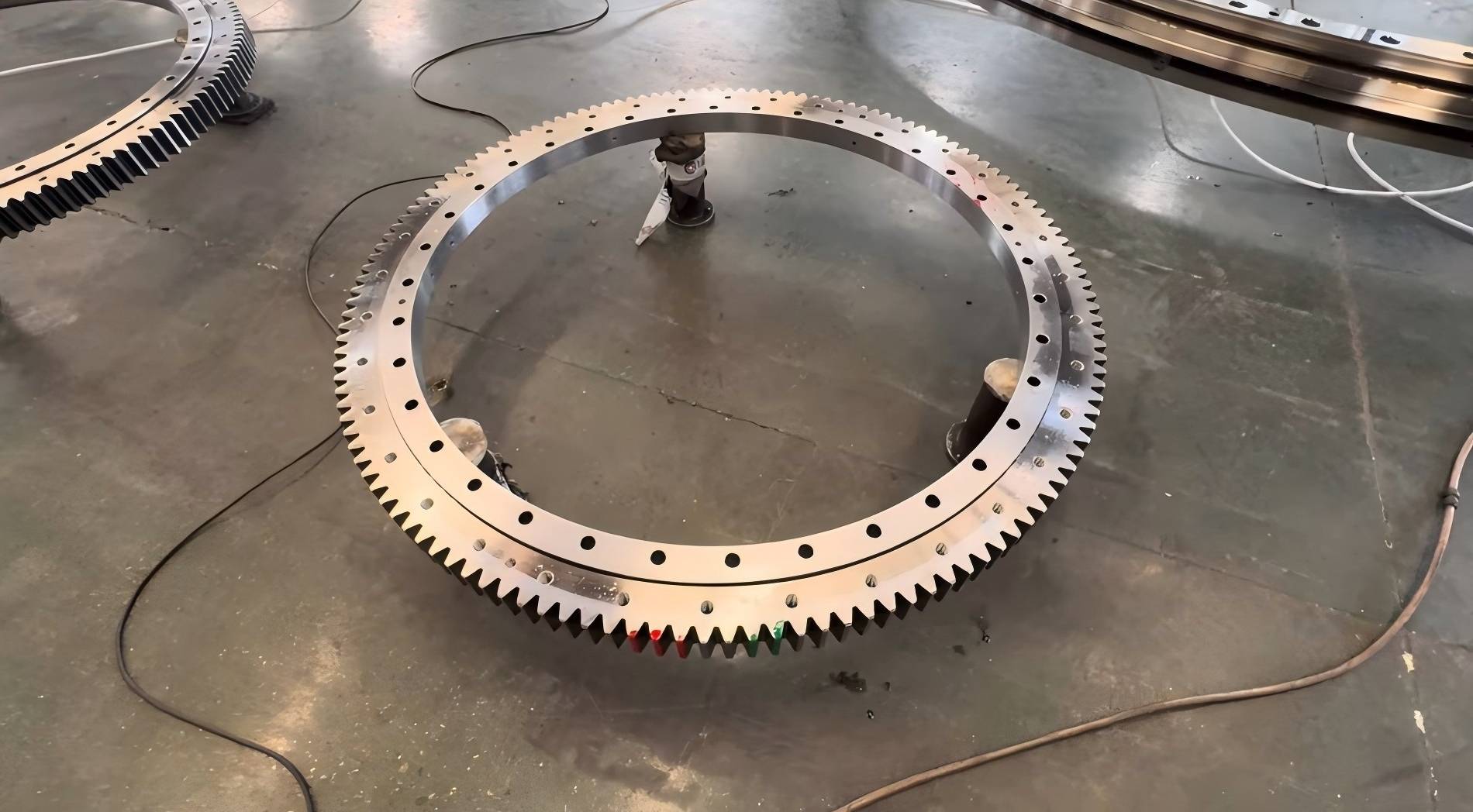
Manufacturing precision is equally important. For example, for a valued customer in Hengshui, we supplied a 6-meter segmented gear ring with ground teeth, a process that achieves superior accuracy and surface finish. This level of precision is critical in applications where minimal backlash and smooth operation are required. Our success in producing extremely large components, such as the 10.87-meter slewing ring for 2,000-ton lifting equipment delivered in 2024, is built on this foundation of manufacturing excellence.
After-Sales Support for Long-Term Operation
Managing backlash and ensuring the long life of your equipment is an ongoing process. LTZC provides full after-sales support to help you maintain optimal performance.
Our services are designed to address the entire lifecycle of the component:
Installation & Commissioning Guidance: We provide expert assistance to ensure the initial setup, including setting the correct pinion backlash, is done right the first time.
Preventive Maintenance Training: Our engineers can train your maintenance teams on proper lubrication, inspection techniques, and how to correctly measure for backlash and monitor for gear tooth wear.
Fault Diagnosis & On-site Support: If you detect excessive backlash, we can help. We offer a 24-hour response to quality objections and can provide on-site technical assistance to diagnose the root cause, whether it's gear wear, a mounting issue, or a lubrication failure.
This commitment to partnership ensures your heavy-duty equipment achieves long-term, stable operation.
If you are experiencing issues with gear backlash or require a custom slewing gear ring designed for specific performance requirements, submit your technical specifications to our engineering team for a detailed analysis and quotation.