WhatsApp
 jessica.chai@ltzzc.com
 0086-379-69950051

Turntable Bearing Costs A 5-Year Landed-Cost Model
A low quoted price can become an expensive procurement decision when machining changes, freight exposure, installation work, lubrication, and unexpected replacement are excluded from the comparison. Before issuing a purchase order, an OEM buyer should evaluate the full five-year cost of a Turntable Bearing, not only the line item shown on the supplier quotation.
This matters most when comparing domestic supply with export sourcing. A supplier with a lower unit price may still create higher total cost if the mounting interface is unclear, the gear arrangement does not match the drive, or replacement lead time has not been considered. Conversely, an export supplier can be commercially suitable when drawings, acceptance requirements, shipment planning, and technical responsibilities are agreed before production.
LTZC Bearings Co.,Ltd. supplies slewing bearings, non-standard precision bearings, gear rings, racks, bearing unit assemblies, Slewing Drives, gear parts, and non-standard bearing parts. Buyers evaluating a rotating assembly can compare a precision slewing bearing with the mounting structure, drive interface, and gear requirements instead of treating the bearing as an isolated purchased component.
Start with the sourcing risks that quoted unit price does not show
The first commercial decision is not simply domestic versus export. It is whether each supplier has quoted the same technical and commercial scope. A bearing quotation is not directly comparable if one supplier assumes a finished mounting ring while another assumes the buyer will machine it, or if one price includes teeth and another does not.
Recommendation: compare suppliers only after placing every cost and responsibility into one procurement worksheet. This approach fits OEMs that have completed preliminary sizing and have identified possible suppliers. It does not replace engineering validation of loads, bolt connections, gear mesh, or structural stiffness.
| Cost area | What the buyer should define before comparison | Why it changes five-year cost |
|---|---|---|
| Purchased component | Bearing type, dimensions, internal or external gear, material, accessories, and drawing revision | A lower price is not meaningful if the offered design does not match the required interface. |
| Mounting preparation | Who machines mounting faces, bolt holes, locating features, and any adjacent ring structure | Late machining corrections can delay assembly and create rework cost. |
| Freight and import | Packaging scope, transport method, insurance responsibility, import duties, and receiving inspection | Export freight and import handling may materially change the delivered cost. |
| Assembly work | Installation labor, lifting plan, torque procedure, alignment checks, and commissioning responsibility | Complex installation can outweigh a modest difference in bearing price. |
| Lubrication and service | Lubricant, access points, service intervals, inspection records, and maintenance labor | Maintenance cost accumulates over the operating period. |
| Failure exposure | Replacement source, spare strategy, lead time, removal work, and equipment downtime ownership | The cost of unavailable equipment may exceed the component cost. |
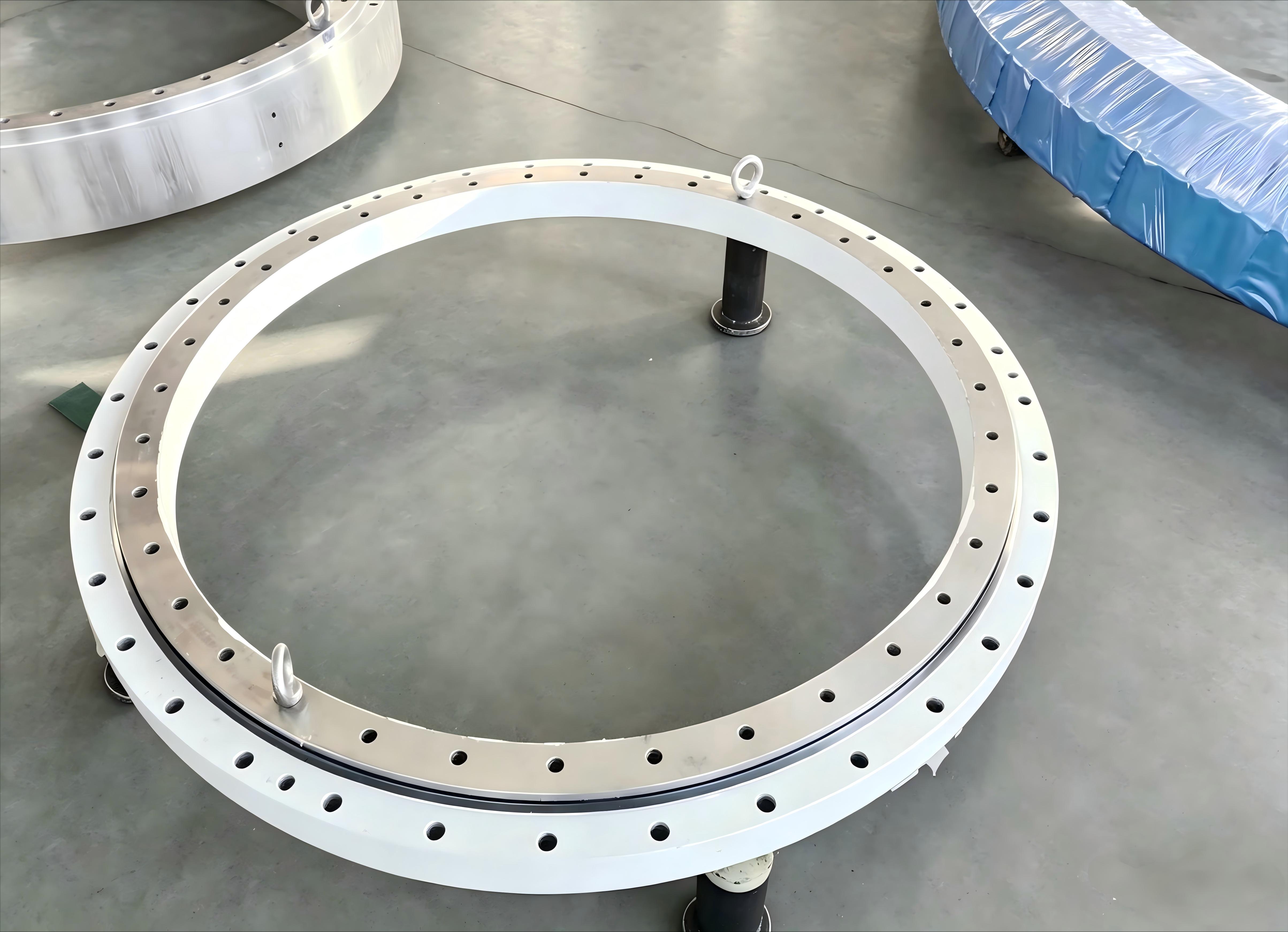
For example, a crane or heavy equipment buyer should identify whether the required design needs a Three Row Roller Slewing Bearing, a ball design, or another arrangement before comparing price. The correct choice depends on the load case and equipment structure. A three-row roller configuration may suit high-load lifting equipment, but it is not automatically the best selection for a compact positioning system with different accuracy and envelope requirements.
Use a five-year landed-cost formula that separates unit price from machining, freight, installation, lubrication, downtime, and replacement-risk costs
Conclusion: calculate the five-year landed cost as a sum of distinct cost categories, then compare suppliers using the same assumptions. This gives procurement and engineering teams a common basis for decision-making. It is suitable for new machine builds, replacement programs, and supplier qualification. It is less reliable when the buyer cannot estimate downtime value or has not defined the operating duty cycle; in that case, show those items as separate scenarios rather than treating them as zero.
The working formula is:
Five-Year Landed Cost = Unit Price + Machining Cost + Freight and Import Cost + Installation and Commissioning Cost + Five-Year Lubrication Cost + Expected Downtime Cost + Replacement-Risk Cost
| Formula item | What to include | Procurement question to ask |
|---|---|---|
| Unit Price | Quoted bearing, gear teeth if applicable, agreed accessories, and documented technical scope | Is every supplier quoting the same drawing revision and design configuration? |
| Machining Cost | Mounting surface preparation, bolt-hole work, adapter rings, gear-interface work, inspection, and rework allowance | Which party provides finished mounting conditions, and what tolerance requirements must be agreed? |
| Freight and Import Cost | Export packing, inland transport, sea or air freight, insurance, customs work, duties, and delivery to the assembly site | Where does responsibility transfer, and what charges are excluded from the quoted price? |
| Installation and Commissioning Cost | Labor, lifting equipment, tools, alignment, bolt tightening, initial lubrication, inspection, and start-up checks | Does the site have a documented installation plan for this bearing size and mass? |
| Five-Year Lubrication Cost | Lubricant, labor, access equipment, scheduled inspections, and maintenance records | Can the lubrication points be accessed safely after the equipment is installed? |
| Expected Downtime Cost | Lost production, idle labor, rental equipment, schedule impact, emergency freight, and removal work during an outage | What is the internal cost of one hour or one day of unavailable equipment? |
| Replacement-Risk Cost | Probability-weighted replacement procurement, removal, reinstallation, freight, and recommissioning exposure | What spare, documentation, and supplier-response plan exists if the bearing must be replaced? |
The formula should not be manipulated to make a preferred supplier appear cheaper. Use the same duty assumptions, freight route, installation labor basis, and downtime valuation for each option. If the buyer has uncertainty, build three scenarios: expected case, delayed-delivery case, and replacement case. The final award can then reflect the cost of uncertainty instead of hiding it inside a low initial quote.
Worked evaluation example without invented price figures
Consider an OEM sourcing a geared rotating bearing for a machine that will be assembled at its own site. Supplier A offers a lower component price. Supplier B has a higher quoted component price but provides a design that matches the existing mounting arrangement and gear layout.
Supplier A may be preferable when its technical offer matches the drawing, the buyer already has qualified machining and installation resources, and freight timing is acceptable. The lower unit price then has a reasonable chance of becoming the lower five-year cost.
Supplier B may be preferable when it reduces mounting changes, avoids a new gear-interface design, or lowers the likelihood of corrective work during assembly. The higher component price may be justified by lower machining and installation exposure.
Neither option can be selected responsibly if load data, mounting requirements, bolt details, lubrication access, or shipment terms remain undefined. The correct action is to close the technical and commercial gaps before award.
This method is especially useful for equipment where removal requires major access work. It is less significant for a readily accessible, low-consequence rotating assembly where downtime and replacement labor are limited.
Match the bearing configuration to the cost drivers of the machine
Configuration affects more than purchase price. It changes mounting design, drive arrangement, assembly effort, lubrication access, and replacement planning. A buyer should compare applicable designs against the machine’s real constraints rather than selecting from catalog appearance alone.
| Configuration question | Decision impact | When the comparison needs more engineering input |
|---|---|---|
| Ball or roller arrangement | Influences the selected bearing structure and the way the assembly handles its load conditions. | When combined loads, moment loads, speed, or structural deflection have not been defined. |
| Internal gear, external gear, or no gear | Changes drive integration, guarding requirements, gear machining, and service access. | When the pinion, gearbox, or tooth form has not been confirmed. |
| One-piece or segmented structure | Can change transport planning, site handling, installation sequence, and replacement work. | When access restrictions prevent lifting or positioning a full ring at the assembly location. |
| Standard or custom geometry | Changes the balance between initial procurement effort and interface fit. | When the equipment uses a unique mounting envelope or non-standard load arrangement. |
LTZC provides customized bearing solutions based on working conditions, existing designs, and technical specifications. This can be relevant when an OEM needs a non-standard interface, special material selection, or a bearing arrangement that does not fit a standard catalog design. Buyers with established equipment drawings can also review options for Customized Bearings. Custom work is not automatically the lowest-cost route; a standard configuration may remain better when it fully meets the technical requirement and simplifies future replacement.
Material requirements should be linked to the service environment rather than specified by habit. LTZC lists GCr15 for hardness, wear resistance, and strength in roller and ball bearing applications; AISI 440C for corrosion and oxidation resistance; 20CrMo and 42CrMo for improved strength, hardness, and wear resistance under heavy loads; CuSn6 for wear resistance, thermal conductivity, and corrosion resistance; SUJ2 for high-precision and high-load uses; and Ti-6Al-4V for lightweight, high-temperature aerospace and high-strength applications. Material selection still requires agreement against the actual design and operating conditions.
Test supplier fit with evidence that affects procurement risk
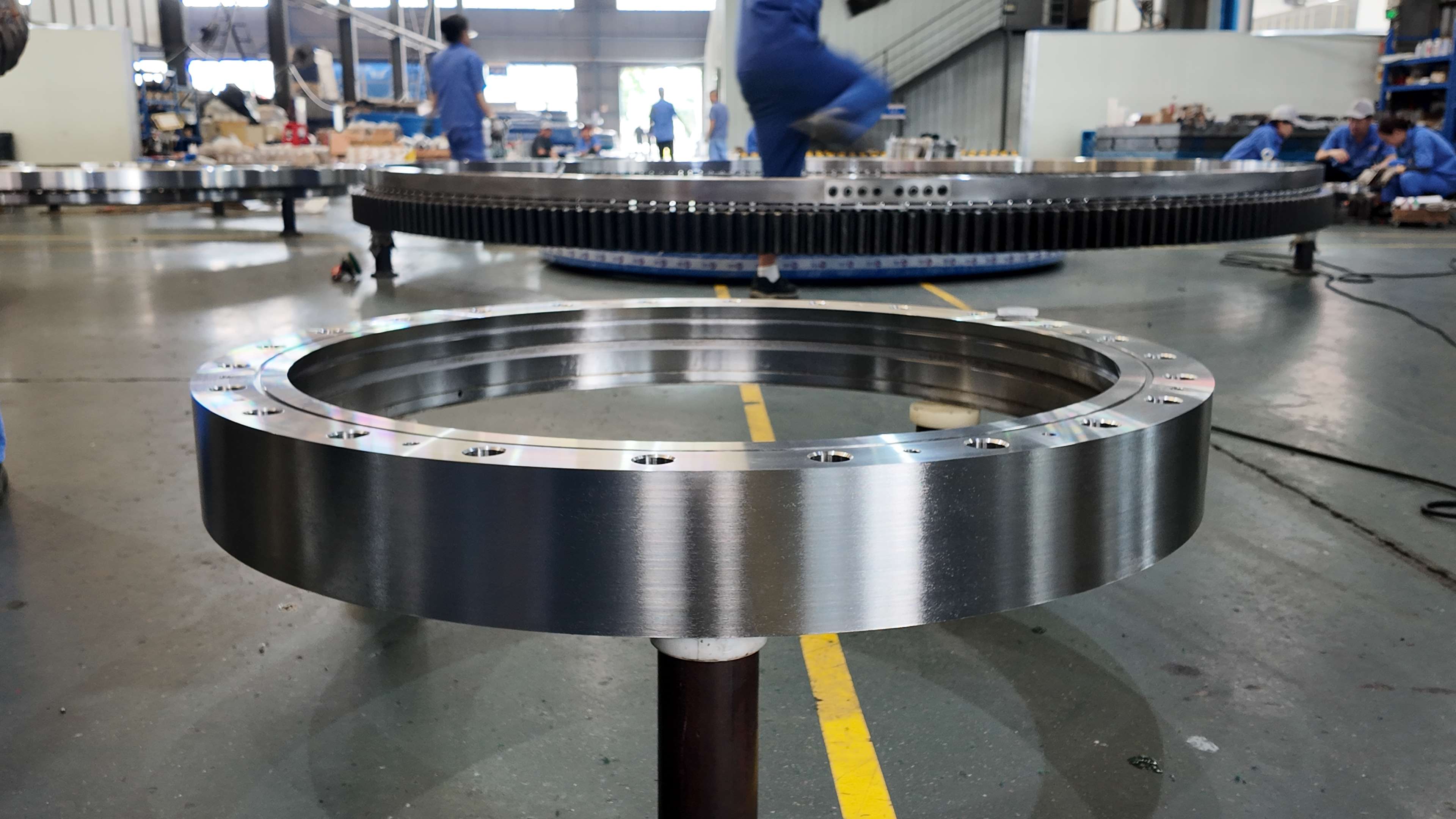
For export sourcing, buyers should separate verifiable supplier evidence from general marketing claims. LTZC was established in 1992 and has a facility size of 20,000 m². Its listed management system certifications are ISO9001:2015, ISO14001:2015, and ISO45001:2018, and it is certified by ISO, CCS, and ABS. These facts can support an initial supplier assessment, but they do not remove the buyer’s responsibility to define inspection documents, drawing control, and acceptance criteria for the actual order.
Large completed applications can also matter when the buyer is evaluating ring scale and structural complexity. In 2024, LTZC delivered an integrated three-row roller slewing ring with an outer diameter of 10.87 meters for 2,000-ton fixed lifting equipment. In the same year, it produced an integrated bearing with an outer diameter of 8.445 meters for a crane industry client in South Korea. LTZC has also supplied 8-meter high-precision segmented gear rings for a vertical friction stir welding system in a key national project.
Practical reading of this evidence: these cases show experience with large and segmented ring-related work. They are relevant for buyers evaluating large lifting, welding, and heavy machinery applications. They do not prove that every smaller machine, every operating environment, or every custom design has the same requirements or outcome. A buyer should still request confirmation for the specific drawing, application, and acceptance needs.
LTZC states a delivery range of 30 to 90 days and no minimum order quantity. These cooperation terms can help OEMs evaluating prototypes, replacements, or limited production volumes. Delivery timing should still be confirmed for the required configuration, material, machining scope, and transport destination; the stated range is not a shipment guarantee for every order.
Prevent common cost-model errors before supplier nomination
The most expensive errors usually occur before production starts. They arise when procurement treats technical scope, logistics, and after-sales responsibility as separate conversations. Use the following review list before final supplier nomination.
Comparing prices from different technical scopes. Correct this by attaching the same drawing revision and a line-by-line scope sheet to each request for quotation. This applies to all competitive bids. It does not solve an incomplete design, which must first be clarified by engineering.
Leaving mounting preparation unassigned. Specify who provides finished mounting faces, bolt holes, and interface parts. This is most relevant for custom or replacement installations. It may be less complex for an unchanged, repeat production assembly with controlled fixtures.
Ignoring the drive and gear interface. Confirm whether the ring includes gear teeth and verify how the pinion or drive connects. Review the relevant slewing ring gear requirements when gearing is part of the rotating system. This does not replace validation of the full transmission design.
Using freight as a single estimated line. Separate packing, freight, insurance, customs, import duties, inland delivery, and site handling. This is particularly important for export orders and oversized components. It may be a smaller variable in local deliveries, but it should still be documented.
Assigning zero value to downtime. Ask operations to provide the cost basis for unavailable equipment, including lost output and recovery work. This is highly relevant for production-critical machinery. It may have limited influence for non-critical equipment with available standby capacity.
Assuming after-sales support has no boundaries. Agree who will handle installation issues, fault analysis, site attendance, and associated travel or access arrangements. LTZC offers installation and commissioning guidance, preventive maintenance training, fault diagnosis, and on-site support. For quality objections, it states a response within 24 hours and on-site service starting within 48 hours in China. Buyers outside China should confirm the support arrangement for their location rather than assuming identical on-site timing.
Set commercial terms that keep the five-year model usable after purchase
A five-year calculation has value only if procurement records the assumptions used. The purchase documentation should connect the technical offer to the later installation and service plan. This protects both the OEM and supplier from disputes created by missing scope.
Freeze the technical reference. Record the drawing revision, bearing configuration, material requirements, gear arrangement, accessories, and any requested documents.
Assign interface responsibilities. State who controls mounting preparation, bolt selection, installation tooling, lubrication access, and final machine alignment.
Define commercial delivery assumptions. List packaging, freight, insurance, import responsibility, delivery location, and receiving-inspection expectations.
Document acceptance requirements. Agree which dimensional, material, or inspection records are required and how nonconformities will be reported.
Create a service file. Retain installation records, lubrication history, inspection findings, and operating observations. Use the supplier’s available bearing installation support as part of the planned handover where applicable.
Review replacement exposure. Decide whether the machine requires a spare strategy, what lead-time assumptions apply, and who authorizes emergency transport or field work.
LTZC can be considered by OEMs seeking a supplier for slewing bearings, custom bearing requirements, gear-related parts, and large ring applications, including buyers serving target markets such as Italy, Germany, Canada, South Korea, and Japan. Final fit depends on the actual technical package, export terms, and service expectations agreed for the order.
Submit your drawing, load conditions, mounting details, gear requirements, delivery destination, and expected operating profile to request a five-year landed-cost quotation review.