WhatsApp
 jessica.chai@ltzzc.com
 0086-379-69950051

How to Source Turntable Bearings for Rotating Equipment?
The most expensive mistake in sourcing happens before the purchase order. Two suppliers quote the same "turntable bearing," one price is 30% lower, and only after the parts arrive do you find a different bolt-hole pattern, a different gear module, or no stated hardening depth. Most of these mismatches trace back to an RFQ that described the bearing by diameter alone.
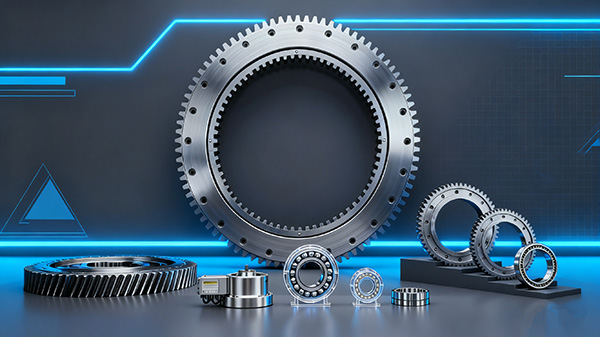
A turntable bearing is the same component family as a precision slewing bearing: a large-diameter ring set that carries axial load, radial load and tilting moment while the machine rotates. This guide shows what to put in your RFQ so quotations can be compared line by line. It also explains how to judge whether a supplier like LTZC fits your requirement.
Where LTZC Fits in a Turntable Bearing Purchase
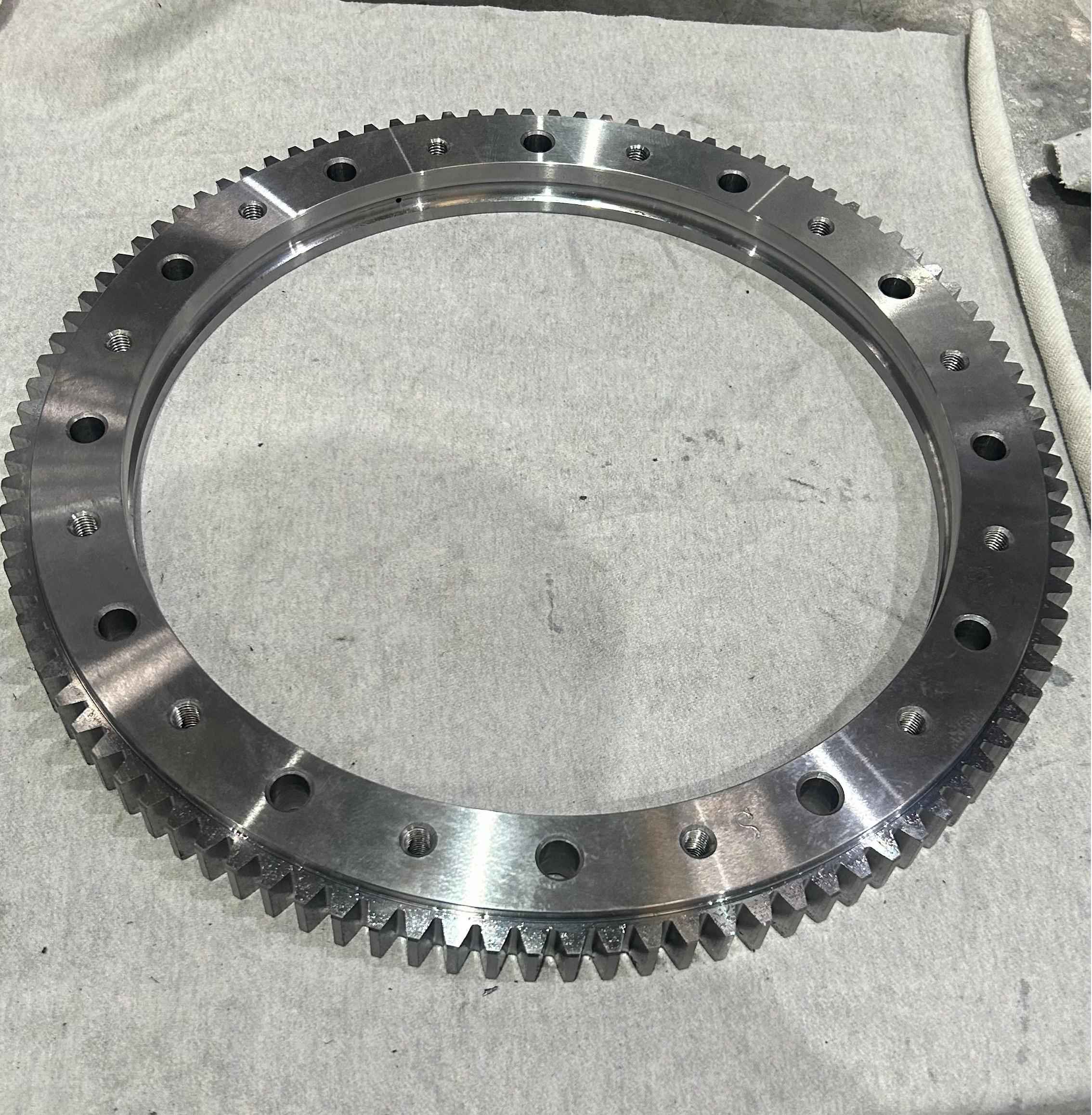
LTZC Bearings Co.,Ltd. was established in 1992 and operates a 20,000 m² facility. Our product scope covers slewing bearings, non-standard precision bearings, gear rings, racks, bearing unit assemblies, Slewing Drives and gear parts. That scope suits OEMs who need the bearing, the gear and sometimes the drive specified together.
It does not suit every request. If you need a catalog item off the shelf in a standard size, a stockist is the faster route. If your design is non-standard, your gear needs ground teeth, or the diameter is large, a manufacturer that handles Customized Bearings is the better match. We build to your working conditions, existing designs and technical specifications, and we can discuss specific materials, sizes and performance requirements.
Material choice is part of the fit conversation. Our brief lists GCr15 and SUJ2 for high hardness and wear resistance, 42CrMo and 20CrMo for heavier loads, AISI 440C where corrosion resistance matters, and CuSn6 or Ti-6Al-4V for special cases. Your RFQ should state the environment so the material can be agreed, not assumed.
Sourcing Checklist: Mounting Interface, Combined Loads, Gear and Acceptance
This is the section to copy into your RFQ template. Each row removes one common cause of mismatched quotations.
| Item | What to specify | Why it prevents mismatch | Limit / when it does not apply |
|---|---|---|---|
| Mounting interface | Outer and inner diameter, ring height, bolt circle diameter, hole count, hole size or thread, flange or plain face, and the flatness of your mating structure | Suppliers otherwise quote their own standard pattern, and the part will not bolt onto your frame | If you are redesigning the frame too, send a draft and mark which dimensions are still open |
| Combined-load data | Axial force, radial force and tilting moment, each as working and extreme case, plus rotation speed and duty cycle | Raceway size and rolling-element count depend on the load combination, not on one number | For slow or intermittent swing, state this. Do not give peak load as continuous load, or you will pay for oversize |
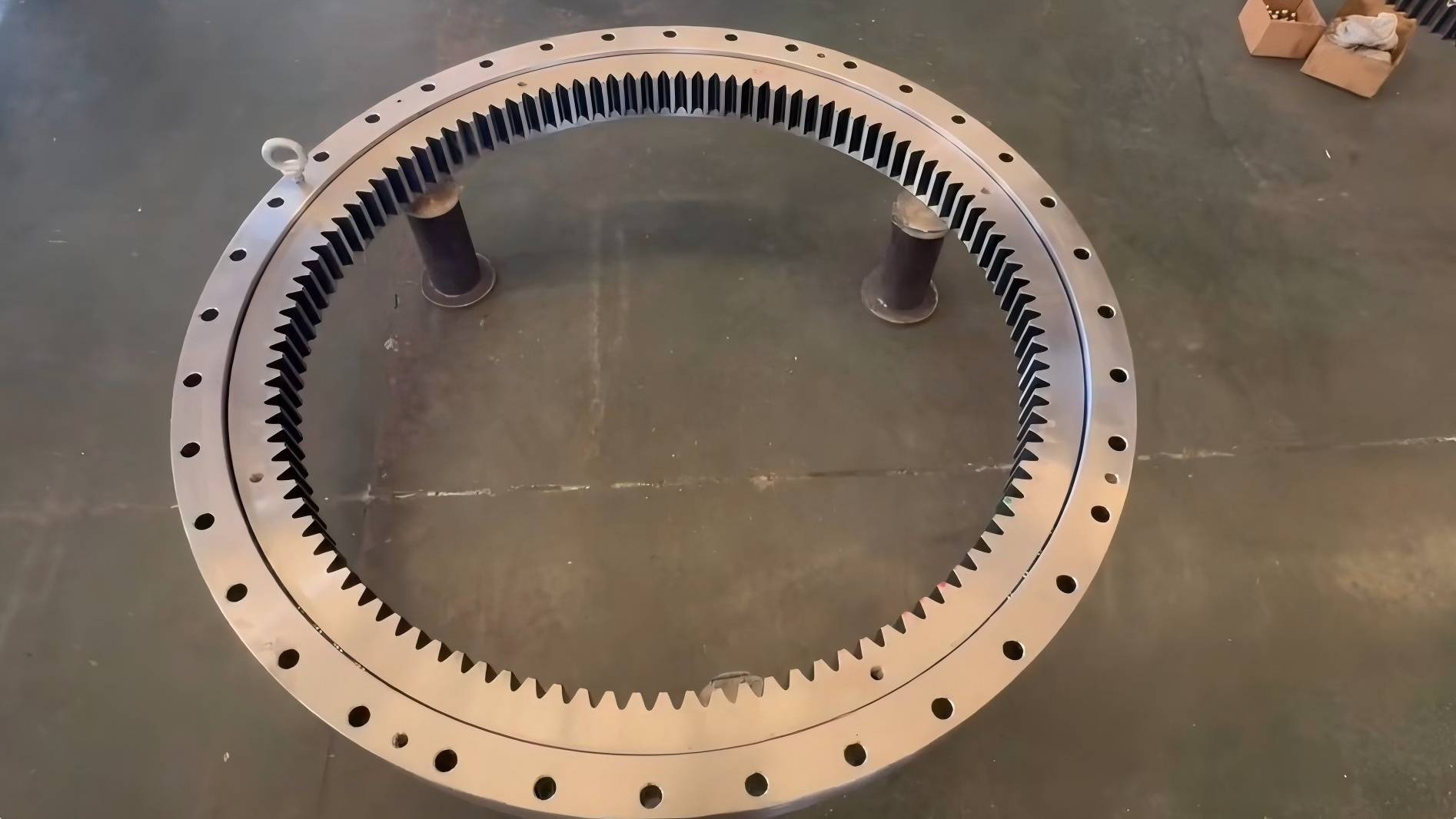
| Gear requirements | Internal, external or no gear; module, tooth count, pressure angle, profile shift, hardened or soft teeth, ground or milled, accuracy grade, segmented or integral | Gear data changes ring thickness, heat treatment and manufacturing route, so cost differs sharply | If a separate pinion or drive supplies the mesh, share its data so backlash can be agreed |
| Acceptance criteria | Dimensional tolerances, rotation torque expectation, material and heat-treatment records, inspection reports, and who witnesses them | Without written criteria, a dispute over "quality" has no reference | Do not request tests the supplier has not confirmed it can provide. Ask first, then write them into the order |
| Environment and sealing | Temperature range, dust, water or salt exposure, lubrication method | Drives seal type, grease choice and material selection | Indoor clean-room use may need less sealing, but say so |
| Commercial terms | Quantity, target delivery, packing, documents, after-sales scope | Lets you compare total cost, not only unit price | Delivery windows are agreed per order |
Match the Bearing Structure to the Load Before You Request Prices
Buyers sometimes ask suppliers to propose the structure. That produces quotes for different designs, which cannot be compared. Decide the family first, or ask for two named options.
| Structure | Best fit | Limit |
|---|---|---|
| Single Row Ball Slewing Bearings | Light to medium loads, compact machines, rotating platforms | Less suited to heavy tilting moment |
| Double Row Ball Slewing Bearing | Higher axial load with moderate moment where ball contact is still acceptable | Needs a stiffer mounting structure and wider ring |
| Cross Roller Slewing Bearings | High rigidity and rotating accuracy in compact sections, such as precision tables | Preload and mounting flatness become critical |
| Three Row Roller Slewing Bearings | Heavy axial load and large moment, such as heavy lifting equipment | Larger and costlier. Overkill for light duty |
If you are still choosing between these, our bearing selection guide walks through the load logic. For thin-profile designs with tight radial space, review a thin section bearing as an alternative.
Common RFQ Mistakes That Cost Weeks
Sending only OD, ID and height. The supplier fills in the missing data with assumptions, and each one assumes differently.
Quoting the peak load as the normal load. You buy a heavier bearing than the machine needs, and the extra weight hits your frame design.
Leaving gear accuracy blank. Milled and ground teeth are different products at different prices.
Ignoring the mating structure. A precision ring bolted onto an uneven frame loses its accuracy and life. Specify flatness for your side too.
Treating a certificate as the acceptance plan. ISO certification covers the management system. It does not replace a part-level inspection agreement.
Skipping installation data. Bolt grade, preload and grease points belong in the order discussion. See our notes on bearing installation for what to confirm.
Evidence to Request from Any Supplier, and What We Can Show
A capability claim is only useful if it connects to a buyer concern. Here is how we map ours, using facts we can state.
| Buyer concern | Supporting fact |
|---|---|
| Quality system | ISO9001:2015 quality management certification, plus ISO14001:2015 and ISO45001:2018. Our brief also lists ISO, CCS and ABS certification. Ask for the certificate scope for your project. |
| Very large diameters | In 2024 we delivered an integral three-row roller slewing ring, OD 10.87 m, for 2,000-ton fixed lifting equipment. This is our largest to date. We also produced an 8.445 m integrated bearing for a crane-industry client in South Korea. For related designs, see our Large Slewing Bearing range. |
| Segmented construction | φ24 m segmented bearings were developed and delivered to Jiangsu Nantong Rainbow Heavy Machinery. |
| Gear precision | 8-meter high-precision segmented gear rings were supplied to Wuhan Heavy Industry for a vertical friction stir welding system in a key national project. A 6-meter segmented gear ring with ground teeth was delivered through our Hengshui customer to end users. Details on slewing ring gear options are on our gear parts page. |
| Visible, rotating-platform use | A 3-meter-diameter turntable bearing carried the main torch tower at the World Military Olympic Games opening ceremony. |
| Series supply | A full set of main-drive ring rolls for shield machines, 15 series and 90 pieces in total, was developed for CRCC. |
These cases show what has been built. They do not mean your design will follow the same route, so share your own drawing and let the engineering review decide. Serving buyers in Italy, Germany, Canada, Korea and Japan does not imply local stock or regional approvals. Confirm any market-specific requirement in your RFQ.
Cooperation Terms and Matters Still to Agree
Our brief supports these conditions: no MOQ, a 30-90 day delivery window, and after-sales support covering installation guidance, maintenance training, and fault diagnosis. For quality objections, we respond within 24 hours, and on-site service in China starts within 48 hours.
Those are starting points. The delivery window within 30-90 days depends on size, material and gear requirement, so we fix it per order. Several items are not preset and should be agreed in writing before an order:
Final drawing revision and which dimensions are fixed.
Material and heat-treatment route for the load case.
Inspection items, report format and who attends.
Packing, shipping terms and document list.
Scope of installation guidance or on-site support outside China.
A Practical Sequence for Your Next RFQ
Fix the application, then collect load cases: axial, radial and moment, working and extreme.
Draw the mounting interface and mark the open dimensions.
Define gear needs, or state that none are required.
Write acceptance criteria and ask each supplier to confirm which it can meet.
Send the same package to every supplier, and compare quotes row by row against the checklist above.
Review any deviation in writing before approving a design.
Heavy cranes, wind equipment, mining machinery and test rigs each add their own conditions. If yours is one of them, mention the sector, such as Construction & Heavy Machinery, so the engineers know the duty cycle.
Send your drawing, load data and gear requirements to our engineering team for a fit check. We will tell you what is clear, what is missing, and which of the items above still need your decision before we quote.