WhatsApp
 jessica.chai@ltzzc.com
 0086-379-69950051

How to Verify a Non-Standard Slewing Bearing Factory's True Capability
Choosing a supplier for a custom-engineered component like a non-standard slewing bearing carries significant risk. A misstep in vetting can lead to production delays, unexpected costs, and premature equipment failure. The core problem is distinguishing between a genuine manufacturer with deep engineering and production control, and a trading company that outsources critical processes. Before you issue a purchase order, you must verify the factory's actual, in-house capabilities. Failure to do so puts your entire project timeline and budget in jeopardy.
With over 10 years of experience providing engineering solutions for industrial clients, I've seen firsthand how a mismatch in supplier capability and project requirements creates problems. This guide outlines the essential verification steps to ensure your partner can deliver the precision, quality, and scale your application demands. We will focus on the tangible evidence you should request and the key technical benchmarks that separate top-tier manufacturers from the rest.
Beyond the Brochure: Key Manufacturing Capabilities to Scrutinize
A supplier’s website may list impressive specifications, but true capability is proven on the factory floor. When evaluating a potential partner for a Customized Bearings solution, focus your questions on these five critical production areas. The answers will reveal the depth of their control over quality and precision.
Here’s a direct comparison of what to look for, using LTZC's demonstrated capabilities as a benchmark:
Maximum Ring Diameter: This is a primary indicator of a factory's physical capacity. Small shops simply cannot handle large-scale components.
What to Ask: "What is the largest single-piece or segmented bearing you have successfully manufactured and delivered?"
LTZC Benchmark: We have a proven track record of producing exceptionally large bearings. In 2024, we delivered an integral three-row roller slewing ring with a 10.87-meter outer diameter for 2,000-ton lifting equipment. We also produced an 8.445-meter integrated bearing for a crane client in South Korea, demonstrating our capacity for challenging Large Slewing Bearing projects.
Gear Cutting and Grinding: The precision of the gear teeth is essential for smooth rotation and power transmission. A supplier should have advanced gear manufacturing capabilities.
What to Ask: "Do you perform gear cutting and grinding in-house? What is your maximum module and gear quality level?"
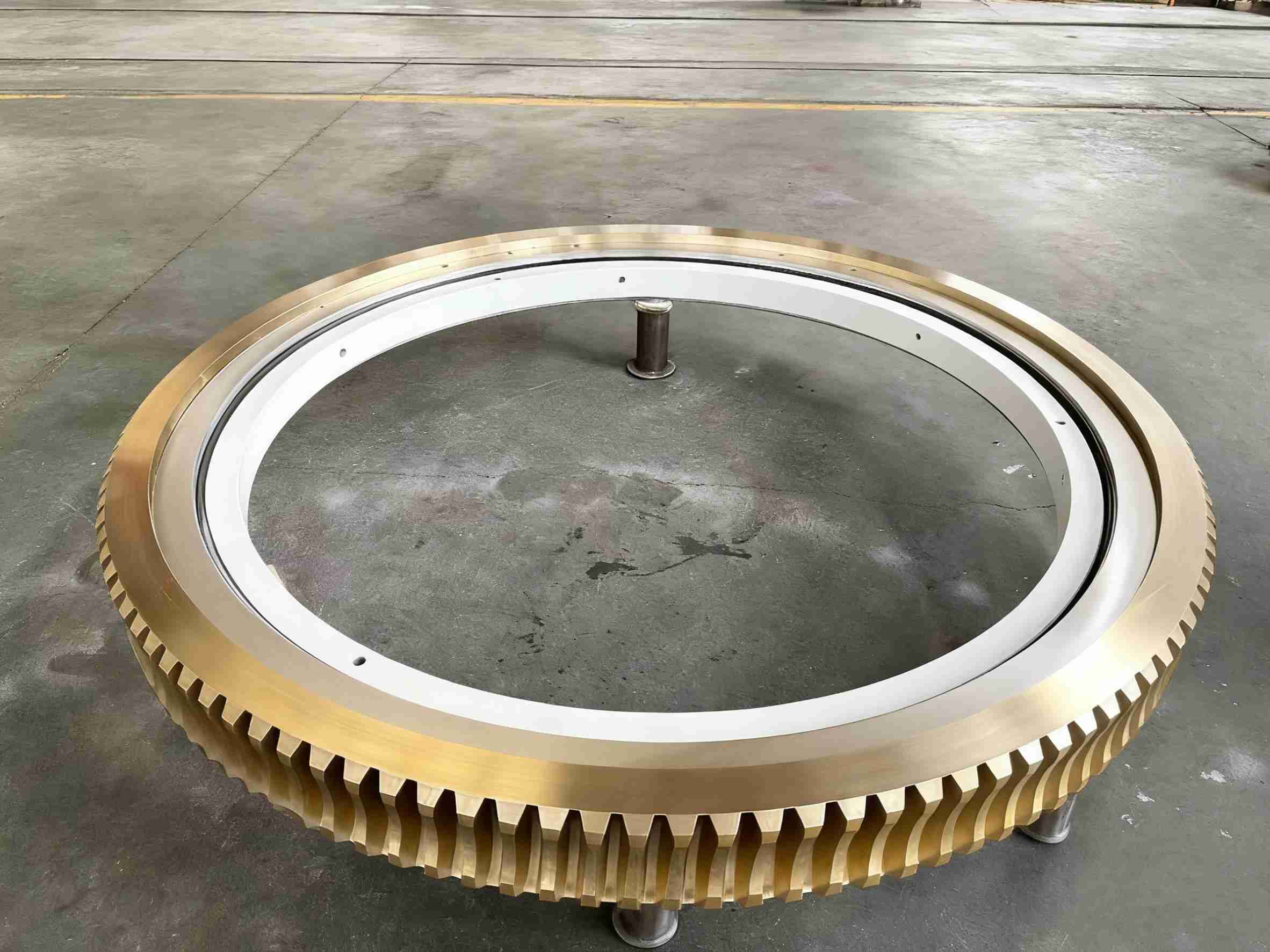
LTZC Benchmark: We possess the equipment and expertise for high-precision gearing. A notable example is our delivery of a 6-meter outer diameter segmented gear ring with ground teeth for a client in Hengshui. This level of precision is critical for applications requiring minimal backlash and high efficiency.
Heat Treatment: Proper heat treatment of the raceways and gear teeth determines the bearing's hardness, wear resistance, and service life. In-house control is always superior to outsourcing.
What to Ask: "Is your heat treatment process (e.g., raceway quenching) performed in-house? What quality controls are in place to ensure consistent hardness and case depth?"
LTZC Benchmark: Our ISO 9001:2015 certified quality management system governs all critical processes, including heat treatment, to ensure every bearing meets stringent performance standards.
Raceway Grinding: The final grinding of the raceways dictates the bearing's rotational accuracy and load distribution. This is a non-negotiable process for high-performance bearings.
What to Ask: "What is the largest diameter you can grind? What level of precision (e.g., runout) can you achieve?"
LTZC Benchmark: Our successful delivery of 8-meter high-precision segmented gear rings for Wuhan Heavy Industry's friction stir welding system, part of a key national project, confirms our ability to achieve tight tolerances on large-diameter components.
Load-Test Capacity: The ability to test a bearing under simulated loads verifies the design and manufacturing quality.
What to Ask: "Do you have facilities to perform load testing on finished bearings? What is the maximum load and moment you can test for?"
LTZC Benchmark: We are certified by both CCS (China Classification Society) and ABS (American Bureau of Shipping), which involves rigorous inspection and verification of product performance for demanding applications like Marine & Defense Slewing Bearings.
Material Selection and Traceability: The Foundation of Durability
The performance of a non-standard slewing bearing is fundamentally tied to the material it's made from. A capable manufacturer does more than just machine metal; they provide expert guidance on material selection based on your specific operating conditions. They must also maintain strict traceability through a certified quality management system like ISO 9001:2015.
When discussing your project, a knowledgeable supplier should be able to explain the trade-offs between different materials. Here are some common options we work with at LTZC and their typical applications:
| Material Grade | Key Characteristics | Best-Fit Applications |
|---|---|---|
| GCr15 / SUJ2 | High hardness, excellent wear resistance, and high fatigue strength. The industry standard for many rolling elements and rings. | General industrial machinery, crane hooks, excavators, and applications requiring high precision and load capacity. |
| 20CrMo / 42CrMo | Alloyed steel with improved strength, toughness, and hardenability compared to standard carbon steels. Excellent for high-impact loads. | Heavy-duty equipment such as tunnel boring machines, large gear rings, and mining machinery where shock loads are common. |
| AISI 440C | Stainless steel with good corrosion resistance and high hardness after heat treatment. | Marine environments, food processing equipment, and medical devices where exposure to moisture or corrosive agents is a concern. |
| Ti-6Al-4V | Titanium alloy offering a high strength-to-weight ratio and excellent performance at elevated temperatures. | Aerospace, defense, and high-performance robotics where weight reduction is a primary design driver. |
| CuSn6 | Bronze alloy with good wear resistance, thermal conductivity, and anti-corrosive properties. | Often used for cages or separators within the bearing assembly, especially in specialized applications. |
A supplier's ability to source, machine, and heat-treat these diverse materials is a strong indicator of their technical depth. Ask for material test reports (MTRs) and inquire about their raw material sourcing and quarantine process. This documentation is your assurance that you are receiving exactly what you specified.
Evaluating a Supplier's Project Portfolio and Engineering Depth
A supplier's project history is their resume. It provides concrete proof of their ability to handle projects of varying scale and complexity. When you review their past work, don't just look at pictures. Ask for details that demonstrate their problem-solving and manufacturing skills.
Look for evidence in these key areas:
Scale and Complexity: Have they manufactured bearings of a similar size and structural complexity to your requirement? For example, our work producing the whole set of ring rolls for CRCC's shield machine main drive involved 15 different series and a total of 90 pieces, proving our capacity for large-scale, serialized production.
Precision Under Pressure: Can they deliver high-precision components for critical applications? The 3-meter-diameter turntable bearing we supplied for the main torch tower at the World Military Olympic Games had to perform flawlessly in a high-visibility, zero-failure-tolerance event.
Advanced Structures: Do they have experience with more than just standard single-row bearings? Our delivery of a φ24m segmented bearing to Jiangsu Nantong Rainbow Heavy Machinery showcases our proficiency in designing and manufacturing complex, large-scale segmented solutions.
End-to-End Solutions: Can they manage the entire process for a complex assembly? A genuine manufacturing partner can deliver more than just a ring; they can provide a complete bearing unit assembly, integrating components and ensuring proper fit.

A Practical Checklist for Final Supplier Verification
Before making a final decision, use this checklist to conduct your due diligence. A transparent and capable partner will readily provide this information.
Request and Verify Certifications.Ask for current copies of their quality (ISO 9001:2015), environmental (ISO 14001:2015), and safety (ISO 45001:2018) certifications. For specific industries, ask for relevant approvals like ABS or CCS. Ensure the certificates apply to the actual manufacturing facility.
Clarify In-House vs. Outsourced Processes.Get a clear statement on which key manufacturing steps (forging, heat treatment, gear cutting, grinding, assembly) are performed in-house. Heavy reliance on subcontractors introduces variables in quality control and lead times.
Review Relevant Case Studies.Ask for project summaries or technical data on past work that is similar to your application in size, load, material, or industry. This is more valuable than a generic customer list.
Assess Engineering and Technical Support.Who will be your technical point of contact? What is their experience level? A dedicated engineer with years of experience, like the members of our team, can help optimize your design and prevent costly errors.
Confirm After-Sales Service and Support Structure.What happens after delivery? Inquire about their process for bearing installation guidance, maintenance training, and fault analysis. At LTZC, we formalize this with a commitment to respond to quality objections within 24 hours and initiate on-site service within 48 hours in China.
Understand Their Terms.Clarify the delivery timeline (e.g., our standard is 30-90 days), and ask about minimum order quantity. LTZC is proud to offer no MOQ, providing flexibility for prototypes and one-off projects.
Vetting a supplier for a non-standard slewing bearing is an investment of time that pays dividends in project success and long-term equipment reliability. By focusing on proven manufacturing capabilities, material expertise, and a verifiable project history, you can build a partnership with a supplier that is truly equipped to meet your needs.
If you have technical specifications or a design for a custom bearing, submit your drawings to our engineering team for a detailed review and proposal.