WhatsApp
 jessica.chai@ltzzc.com
 0086-379-69950051

A Non-standard slewing bearing needs a five-year cost model
Before issuing an RFQ, buyers should identify every cost that can follow a custom bearing purchase—not only the quoted unit price. A low initial quote can become the higher-cost option if it omits engineering clarification, prototype validation, spare-part planning, freight conditions, or the cost of an unplanned equipment stoppage.
A Non-standard slewing bearing is commercially justified when an available catalogue design cannot meet the required mounting envelope, load arrangement, rotation accuracy, gear arrangement, material requirement, or operating environment. The decision should be based on total ownership cost across five years, rather than on the bearing price alone.
LTZC Bearings Co.,Ltd. supplies slewing bearings, non-standard precision bearings, gear rings, racks, bearing unit assemblies, Slewing Drives, gear parts, and non-standard bearing parts. The stated product dimension range begins at OD Φ200 mm and extends to Φ20. For buyers comparing a standard replacement against a purpose-designed solution, this range matters because the cost model changes significantly with ring diameter, structure, logistics requirements, and the consequences of equipment downtime.
Start by confirming whether the application needs a precision slewing bearing with modified interfaces or a fully custom ring. For applications where the bearing and rotation mechanism are evaluated together, review the available Slewing Drives range as part of the assembly cost, rather than pricing the bearing in isolation.
Decide first whether a custom ring is commercially justified
Conclusion: A custom ring should be considered when changing the surrounding structure would cost more, create more schedule risk, or introduce more operational compromise than adapting the bearing itself. This is most relevant for retrofit projects, large equipment, space-limited assemblies, and machinery with non-standard load paths. It does not automatically apply to equipment that can accept an established standard bearing without structural changes.
The first commercial question is not “What does the ring cost?” It is “What must change if the ring is not customized?” A standard design may appear attractive until the buyer accounts for adapter plates, altered bolt circles, a separate gear interface, machining changes to the host structure, or a loss of motion accuracy.
| Buying route | Best fit | Cost advantage | Cost exposure | When it does not fit |
|---|---|---|---|---|
| Catalogue bearing | Existing design accepts published mounting and operating limits | Usually lower engineering effort and faster comparison of alternatives | May require adapters, changes to adjacent parts, or later replacement difficulties | Not suitable when the mounting envelope, load arrangement, or gear requirement cannot be accommodated |
| Modified standard platform | A known bearing type is close to the application but needs interface or gear changes | Can reduce design uncertainty compared with a fully new arrangement | Tooling and validation requirements still need confirmation | Not suitable if internal load distribution or structural geometry must change materially |
| Purpose-designed ring | High-value equipment, unusual dimensions, demanding duty, or replacement of an unavailable legacy design | Can remove costs elsewhere in the equipment system | Requires disciplined definition of design engineering, validation, spares, and acceptance scope | Not suitable when the buyer has not yet defined the actual operating conditions |
For example, a crane, rotating platform, or metallurgical machine may require a specific gear arrangement and mounting pattern. In that case, buying a cheap catalogue part and redesigning the surrounding machinery can be less attractive than sourcing the ring to suit the existing structure. Where the load is predominantly axial, radial, or overturning moment, the bearing type must also be assessed rather than selected by diameter alone. Buyers can compare options such as Three Row Roller Slewing Bearings when the application calls for a structure intended for demanding load arrangements.
A five-year cost model separating design engineering, tooling, prototype validation, unit price, freight, spares, and downtime exposure
Conclusion: Use a line-by-line five-year model that separates one-time costs from recurring costs and risk exposure. This gives procurement, engineering, and finance a common basis for approving a custom solution. The model is especially useful when comparing one prototype, a small production requirement, and a repeat supply requirement. It is less useful if operating conditions, annual quantity, or the cost of an equipment stoppage are unknown.
Do not combine all costs into a single “customization charge.” Each line should have an owner, an assumption, and a quote reference. The buyer can then identify whether a higher initial offer is actually lower cost over the intended service period.
| Cost category | Year 1 cost treatment | Years 2–5 cost treatment | Information required for comparison | Commercial decision use |
|---|---|---|---|---|
| Design engineering | Record separately as a one-time cost for technical review, drawings, interface definition, and agreed design work | Usually no repeat cost unless the design changes | Scope of supplied drawings, required inputs, revision responsibility, and acceptance criteria | Shows whether a low unit price excludes necessary engineering work |
| Tooling | Record as a one-time cost where special production tooling is required | Include only if future design revisions or repeat setup require it | Tooling scope, ownership terms, storage terms, and reuse conditions | Prevents hidden first-order cost from being spread without buyer approval |
| Prototype validation | Record the prototype ring, inspection requirements, application-level validation, and any required review cycle | Repeat only when the application or design changes | Prototype quantity, validation responsibility, pass/fail criteria, and rework responsibility | Distinguishes a development purchase from a production purchase |
| Unit price | Multiply unit price by first-year quantity; state whether gears, fasteners, lubrication-related items, or assemblies are included | Multiply by forecast replacement or production quantity for each year | Quantity by year, included components, packaging basis, currency, and validity period | Allows fair comparison between like-for-like quotations |
| Freight | Record packing, shipping, insurance if requested, import-related buyer costs, and destination handling as separate fields | Forecast repeat shipment needs, including emergency replenishment exposure | Delivery location, Incoterms, shipment method, packaging requirements, and unloading constraints | Highlights logistics cost for large-diameter or heavy rings |
| Spares | Record recommended initial spare ring, gear components, or critical replacement items if the buyer chooses to hold them | Carry inventory, replacement, storage, and obsolescence exposure through Year 5 | Target availability, storage conditions, asset criticality, and approved interchangeability | Converts spare-part policy into a measurable budget decision |
| Downtime exposure | Estimate the commercial effect of installation delay, failed fit-up, or unexpected replacement during Year 1 | Estimate annual exposure based on production loss, repair access, labor, and schedule impact | Cost per hour or day of outage, planned shutdown windows, access limitations, and backup equipment availability | Shows why the cheapest ring can be the most expensive option |
A usable calculation is:
Five-year ownership cost = design engineering + tooling + prototype validation + total unit purchases + total freight + spare-part cost + estimated downtime exposure.
The formula is simple. The quality of the result depends on the assumptions behind it. A buyer should document which costs are confirmed in writing, which are internal estimates, and which remain unresolved at RFQ stage.
Prototype and production-volume scenarios should not use the same logic
Conclusion: Evaluate prototype work as a risk-reduction purchase and production volume as a repeatability purchase. A prototype may carry more engineering, tooling, and validation cost per ring, while repeat volume may distribute those one-time costs over more units. This does not mean a prototype is overpriced; it means its purpose is different.
| Scenario | Primary buying objective | Costs that deserve the most scrutiny | Recommended buyer action |
|---|---|---|---|
| Single replacement for legacy equipment | Restore operation without forcing major structural changes | Reverse-engineering scope, dimensional confirmation, freight, installation access, and downtime exposure | Provide existing drawings, photographs, interface dimensions, load information, and required delivery location |
| Prototype for a new machine | Confirm fit and application suitability before repeat demand | Design engineering, tooling, prototype validation, revision terms, and acceptance criteria | Separate prototype pricing from projected repeat pricing in the RFQ |
| Low-volume equipment program | Control total ownership cost across a limited number of units | Tooling allocation, unit price, planned spares, and repeat order conditions | Request a quote schedule by quantity break and state the expected annual forecast |
| High-consequence equipment | Reduce the commercial impact of an unplanned outage | Spare strategy, logistics plan, installation support needs, and downtime exposure | Define replacement access, planned shutdown windows, and technical support expectations before ordering |
Use supplier evidence to test whether the quote scope is credible
Conclusion: A supplier should be assessed against evidence relevant to the bearing size, structure, and application risk—not against generic claims. This fits buyers approving custom designs or comparing suppliers with materially different quotes. It does not replace application-specific engineering review, because a past project is evidence of relevant experience rather than proof that every new duty is suitable.
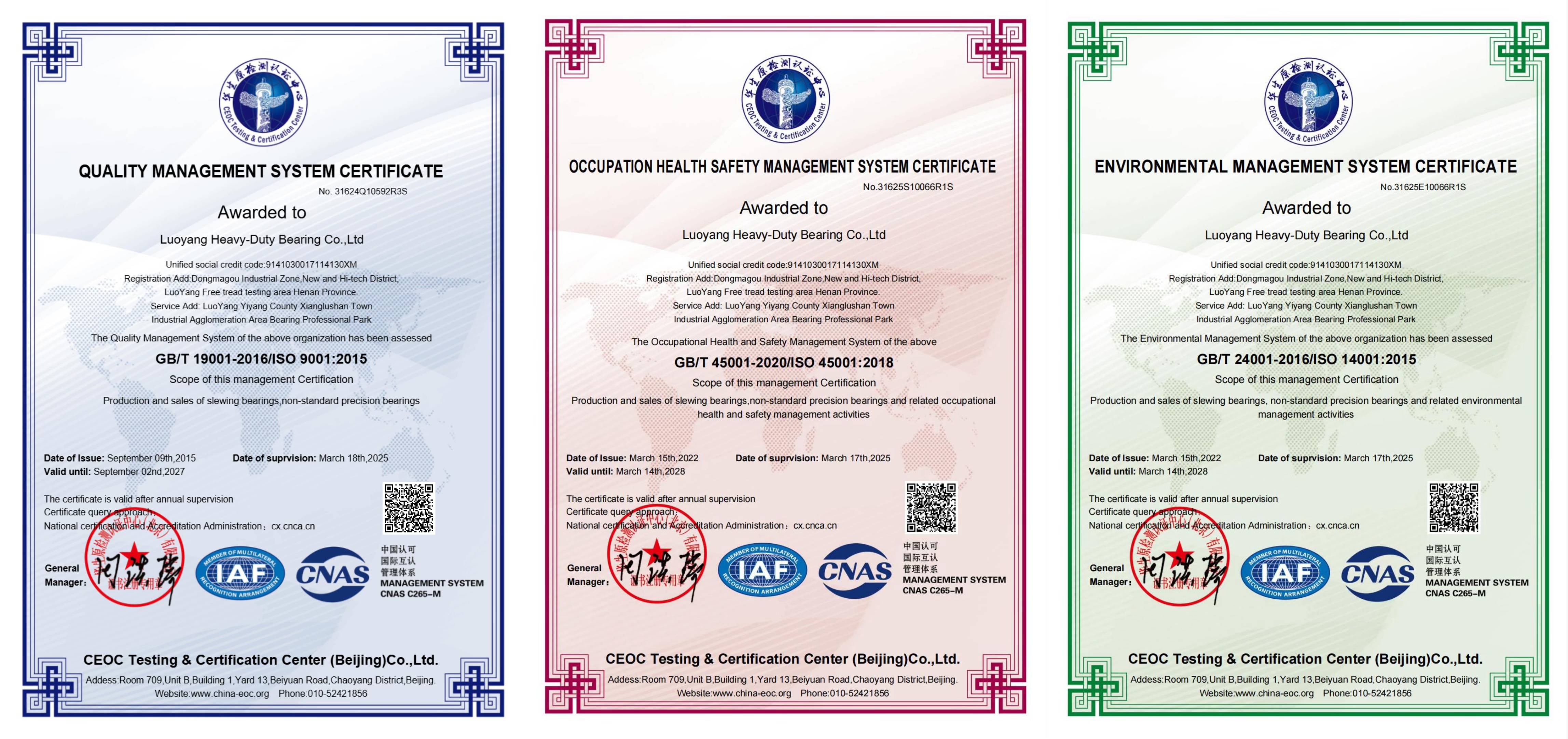
LTZC was established in 1992 and lists ISO9001:2015, ISO14001:2015, and ISO45001:2018 management system certifications, together with ISO, CCS, and ABS certification. For a sourcing team, these are useful qualification points to record, but they should be paired with project-specific questions on scope, drawings, materials, inspection expectations, and acceptance requirements.
Large-ring references can be relevant when a buyer is assessing physical scale and fabrication experience. In 2024, LTZC delivered an integral three-row roller slewing ring with an OD of 10.87 meters for 2,000-ton fixed lifting equipment. In the same year, LTZC reported successful production of an integrated bearing with an OD of 8.445 meters for a crane industry client in South Korea. These examples support discussion of large custom ring requirements; they do not establish a standard lead time, performance guarantee, or universal suitability for another application.
Other documented references include φ24 m segmented bearings delivered to Jiangsu Nantong Rainbow Heavy Machinery and 8-meter high-precision segmented gear rings supplied for a vertical friction stir welding system in a key national project. If the buyer’s requirement combines a bearing with teeth or a segmented ring, the scope should identify whether the requested item is a bearing, a slewing ring gear, or a coordinated assembly of both.

Build an RFQ that makes quotes comparable
Conclusion: A quote comparison is only valid when each supplier receives the same technical and commercial inputs. This approach fits budget approval and supplier selection stages. It will not solve an undefined engineering problem, so missing operating data must be identified rather than assumed.
Use the following checklist before asking suppliers to price a custom ring:
Application and duty: State the machine type, rotation mode, operating environment, expected duty cycle, and any installation restrictions.
Load information: Provide axial load, radial load, overturning moment, shock conditions, and the direction of each principal load where available.
Geometry: Include drawings or measured dimensions for outside diameter, inside diameter, height limits, mounting faces, bolt circles, gear position, and assembly clearances.
Rotation and accuracy: Define rotation speed, positioning expectations, backlash needs where gearing is included, and allowable movement requirements.
Material needs: Identify corrosion exposure, temperature considerations, and any requested material. LTZC lists GCr15, AISI 440C, 20CrMo, 42CrMo, CuSn6, SUJ2, and Ti-6Al-4V among available material options for suitable applications.
Commercial basis: State quantity for the first order and the expected five-year demand, required destination, requested delivery term, and whether prototype and repeat pricing must be separated.
Validation and acceptance: Define required documents, inspection expectations, acceptance method, responsibility for installation checks, and process for handling nonconformance.
Spare strategy: State whether a spare bearing, gear part, or replacement component should be quoted with the initial order.
Common mistakes create false savings during the quote stage:
Comparing incomplete unit prices: One supplier may include gear machining or packing while another does not. Compare stated scope line by line.
Ignoring mounting interfaces: A ring that fits by diameter may still be unsuitable because of bolt pattern, raceway position, height, or gear location.
Leaving delivery terms undefined: Freight can be material for a large ring. Confirm packaging, destination, shipping responsibility, and unloading conditions.
Assuming prototype pricing predicts production pricing: Prototype work may contain costs that do not repeat at volume. Request separate values.
Omitting downtime from the approval case: For production equipment, a planned spare or better-defined replacement arrangement may cost less than an emergency outage.
Using a past bearing code without checking operating conditions: A legacy part number is useful input, but it does not confirm that present loads, speeds, interfaces, or environmental conditions are unchanged.
Match cooperation terms to the project risk
Conclusion: Commercial terms should match the level of customization and the consequence of delay. LTZC states no MOQ and a delivery range of 30–90 days. These terms can suit prototype, replacement, and limited-quantity inquiries, but the applicable delivery date for a specific order still needs confirmation against final design scope, material selection, quantity, and logistics requirements.
No MOQ is relevant when a project needs a single replacement or an initial validation unit. It does not remove the need to define tooling, prototype validation, and freight separately. Likewise, the 30–90 day delivery range should be treated as planning information, not as a substitute for an agreed order schedule.
After delivery, bearing installation conditions affect the value achieved from the purchase. LTZC offers installation and commissioning guidance, preventive maintenance training, fault diagnosis, and on-site technical assistance. The company states that it responds to customer quality objections within 24 hours and that on-site service in China starts within 48 hours. Buyers outside China should confirm available support arrangements, travel scope, and response expectations rather than assuming identical on-site conditions.
For the procurement file, agree the following before releasing an order:
Final drawing revision and responsibility for design changes.
Included supply scope, including bearing, gear, assembly items, documentation, and packaging.
Prototype and production acceptance criteria.
Tooling cost, ownership, reuse, and change-control terms where applicable.
Confirmed lead time from the point at which technical inputs and commercial terms are complete.
Freight basis, delivery location, and handling responsibility.
Spare-part recommendation and planned replacement approach.
Installation guidance and after-sales support scope for the project location.
Turn the cost model into an approval-ready supplier comparison
Conclusion: The preferred supplier is not necessarily the one with the lowest first-order number. Select the quotation with the clearest technical scope, traceable five-year assumptions, credible evidence for the application scale, and terms that address the project’s downtime exposure. This method fits sourcing leaders who need to defend a decision to engineering and finance. It does not remove the buyer’s responsibility to verify final application suitability.
Create one comparison sheet with the seven cost categories as rows and each supplier as a separate column. Add a final column titled “assumption or exclusion.” Any blank cell should be treated as an unresolved commercial risk, not as a zero-cost item. If one supplier quotes a lower unit price but does not identify tooling, prototype validation, or freight scope, the apparent difference may disappear once the model is completed.
LTZC can support customized bearing requirements based on working conditions, existing designs, and technical specifications. For projects where installation planning is part of the lifecycle-cost decision, review the available bearing installation guidance alongside the procurement scope.
Submit your drawings, operating conditions, expected five-year quantity, and delivery location to request a quote structured around your actual cost model.