WhatsApp
 jessica.chai@ltzzc.com
 0086-379-69950051

Precision Manufacturing: LTZC Angular Contact Ball Bearings Enable Industrial Robots to Achieve Micron-Level Positioning Accuracy
As industrial robots continue to advance toward ever-higher levels of precision, speed, and reliability, the core transmission and rotational components utilized within them rely indispensably on the function of bearings. In the past, bearings were often viewed merely as standardized components; however, today—particularly in high-end sectors such as semiconductor manufacturing, medical equipment, and precision assembly—bearings have emerged as a critical factor in determining the ultimate performance limits of equipment. This is especially true in robotic joints and spindle systems, where angular contact ball bearings serve as key rotational components enabling micrometer-level precision positioning. Drawing upon years of experience in manufacturing precision bearings, LTZC deeply integrates traditional bearing technology with modern precision machining philosophies to provide industrial robots with stable, reliable, and high-precision motion support solutions.
1. What Are Angular Contact Ball Bearings?
Structurally, angular contact ball bearings differ fundamentally from standard deep groove ball bearings. Their raceway design is asymmetrical; instead, it incorporates a specific "contact angle" between the inner and outer ring raceways, enabling the rolling elements to simultaneously support both radial and axial loads when subjected to force. While this design modification may appear subtle, it profoundly alters the bearing's load transmission path and dynamic performance, allowing it to maintain stable operation even under conditions involving high-speed rotation and complex loading scenarios.
In practical operation, the contact points between the steel balls and the raceways are not perpendicular to the bearing axis; rather, they transmit loads along the direction of the contact angle. This structural characteristic endows the bearing with an inherent advantage when subjected to axial forces. However, this design also implies that a single bearing typically can only accommodate axial loads in one specific direction; consequently, engineering applications often require installing bearings in pairs to achieve bidirectional load-carrying capability. Common pairing configurations include back-to-back (DB), face-to-face (DF), and tandem (DT) arrangements, with each configuration offering distinct characteristics regarding rigidity and load capacity.
In the realm of industrial robotics, angular contact ball bearings must possess not only fundamental load-carrying capabilities but also the ability to meet exceptionally stringent requirements for rotational precision and rigidity. For instance, at the input stage of a servo motor or gearbox, even the slightest degree of axial runout can be amplified into a significant positioning error at the robot's end effector. Therefore, critical factors such as bearing clearance control, raceway precision, and assembly consistency directly impact the overall performance of the robotic system. Through the application of precision grinding and superfinishing technologies, LTZC achieves an extremely low surface roughness on bearing raceways, thereby reducing vibration and the accumulation of errors at the source.
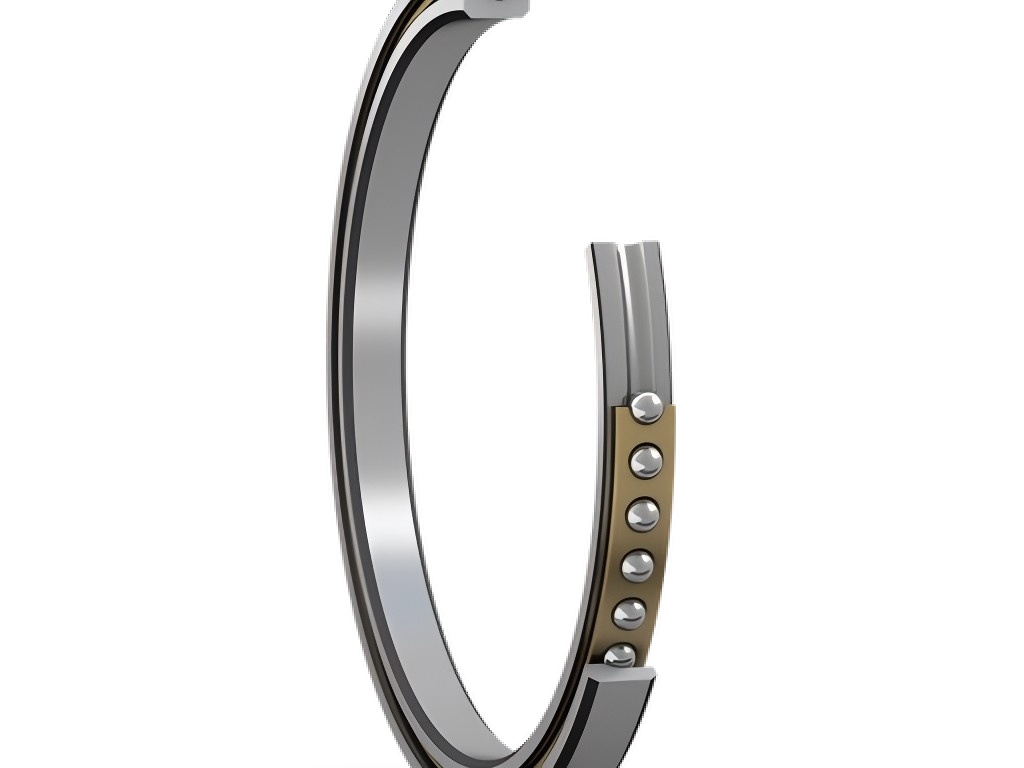
2. What Are Thin Section Angular Contact Ball Bearings?
As the structural designs of industrial robots trend toward greater compactness and lightweighting, traditional bearings—characterized by their larger dimensions or thicker walls—have become increasingly unsuitable for use in compact equipment designs. Against this backdrop, thin section angular contact ball bearings have emerged to address the limitations of their traditional counterparts. Featuring thinner walls and smaller overall dimensions, these lightweight bearings enable superior space utilization and significant weight reduction.
The design of thin section bearings involves far more than simply "making them thinner"; it requires maintaining structural rigidity and machining precision while simultaneously reducing the cross-section. Because of the reduced wall thickness, these bearings are more susceptible to elastic deformation under load; consequently, this places stringent demands on material selection, heat treatment processes, and machining accuracy. In this specialized field, LTZC utilizes high-purity bearing steel combined with advanced heat treatment techniques. This approach ensures that the material retains high hardness while possessing excellent toughness, thereby effectively resisting deformation and fatigue.
Contact LTZC for customizing bearing
3. Applications of Thin Section Angular Contact Ball Bearings
In industrial robots, thin section angular contact ball bearings are typically deployed in joint mechanisms or rotary platforms. These specific locations are characterized by limited spatial availability and extreme sensitivity to inertia. Lighter bearings translate directly into lower rotational inertia, enabling robots to respond more rapidly during acceleration and deceleration phases, resulting in smoother motion. Furthermore, the thin-section structure contributes to reduced energy consumption and enhanced overall system efficiency.
Most importantly, throughout the manufacturing process of its thin section bearings, LTZC employs precise control over raceway geometry and optimizes the matching of steel balls. This meticulous approach ensures that, despite their lightweight construction, these bearings consistently deliver high-precision operational performance.
4. What are the standard model series for angular contact ball bearings?
The model nomenclature for angular contact ball bearings is derived from international standard systems; its classification reflects not only differences in dimensions and structure but also the specific requirements of various application scenarios. Focusing on the most common single-row angular contact ball bearings: the 7000 series is typically utilized in light-load, high-speed applications; the 7200 series strikes a balance between load-carrying capacity and speed; while the 7300 series is better suited for heavy-load operating conditions. These series prioritize different aspects—such as structural dimensions, contact angles, and load capacities—thereby offering a wide array of options for engineering design.
In practical applications, to meet demands for higher rigidity and load-carrying capacity, engineers often opt for double-row angular contact ball bearings or enhance performance by mounting single-row bearings in pairs. The double-row structure is essentially equivalent to a combination of two single-row bearings, yet its overall design is more compact, making it ideal for scenarios where space is limited and bidirectional load support is required. Four-point contact ball bearings, conversely, feature a specialized raceway design that enables a single bearing to accommodate bidirectional axial loads; these are commonly found in rotary systems and large-scale machinery.
Regarding thin-section series, their model designations typically reflect a combination of standardized cross-sectional dimensions and varying inner diameters—examples include the KA, KB, and KC series. This design approach allows engineers to replace bearings of different sizes without altering the overall structural layout, thereby significantly enhancing design flexibility.
In terms of precision, angular contact ball bearings are typically classified into grades ranging from P0 to P2, with the P4 and P2 grades being primarily designated for high-precision equipment. LTZC is capable of consistently supplying products meeting P4-grade precision standards—or even higher—and offers non-standard customization services tailored to specific client requirements. These services include specialized contact angle designs, preload matching, and factory-matched bearing sets, all aimed at ensuring that the bearings achieve optimal performance in their actual applications.
5. LTZC Single-Row Angular Contact Ball Bearings Enable High-Precision Positioning in Robotics
In a high-end European industrial robotics project, a client presented extremely stringent requirements regarding the positioning accuracy of their new generation of six-axis robots. Specifically, the robots' repetitive positioning accuracy needed to be maintained within a tolerance of ±2 microns, while the equipment was simultaneously required to exhibit low vibration and high stability during high-speed operation.
To address this challenge, LTZC provided the client with a customized solution featuring single-row angular contact ball bearings. During the design phase, the engineering team first conducted a detailed analysis of the force distribution within the robot's joints; based on this analysis, they determined that a "back-to-back" mounting configuration—pairing the bearings in opposition—would be the optimal approach to enhance overall structural rigidity. During the manufacturing process, LTZC adhered to P4-class precision standards and subjected the bearing raceways to super-finishing treatments. This process ensured that surface roughness was controlled to an extremely low level, thereby significantly reducing rolling friction and vibration.
Furthermore, LTZC precisely matched the bearing preload—the internal tension applied to the bearings—by optimizing the size and quantity of the steel balls. This optimization ensured that, once assembled, the bearings achieved an ideal state of internal stress. This level of meticulous control not only eliminated axial clearance but also enhanced system rigidity, enabling the robots to maintain exceptional stability even during high-speed movements.
Performance Results of the Single-Row Angular Contact Ball Bearings
Upon deploying the single-row angular contact ball bearings manufactured by LTZC, the client reported that operational performance far exceeded their expectations. The robot's repetitive positioning accuracy improved to ±1.5 microns, and noise levels were significantly reduced. The feedback provided by the client serves as compelling evidence that, within the realm of high-end equipment manufacturing, bearings are not merely foundational components; they are, in fact, critical determinants of overall system performance.
Contact LTZC for customizing bearing
6. LTZC Propels Precision Manufacturing to New Heights
Driven by technology and grounded in quality, LTZC delivers high-performance bearing solutions to global clients through continuous innovation and lean manufacturing. From standard products to custom designs, and from individual components to system-level optimization, LTZC is constantly pushing the boundaries of traditional bearings, empowering industrial robots to achieve greater precision, enhanced stability, and extended service life.
As we enter the era of intelligent manufacturing, LTZC will continue to deepen its expertise in the field of precision bearings, collaborating with global partners to drive industrial equipment toward ever-higher levels of performance.
Contact LTZC for customizing bearing