WhatsApp
 jessica.chai@ltzzc.com
 0086-379-69950051

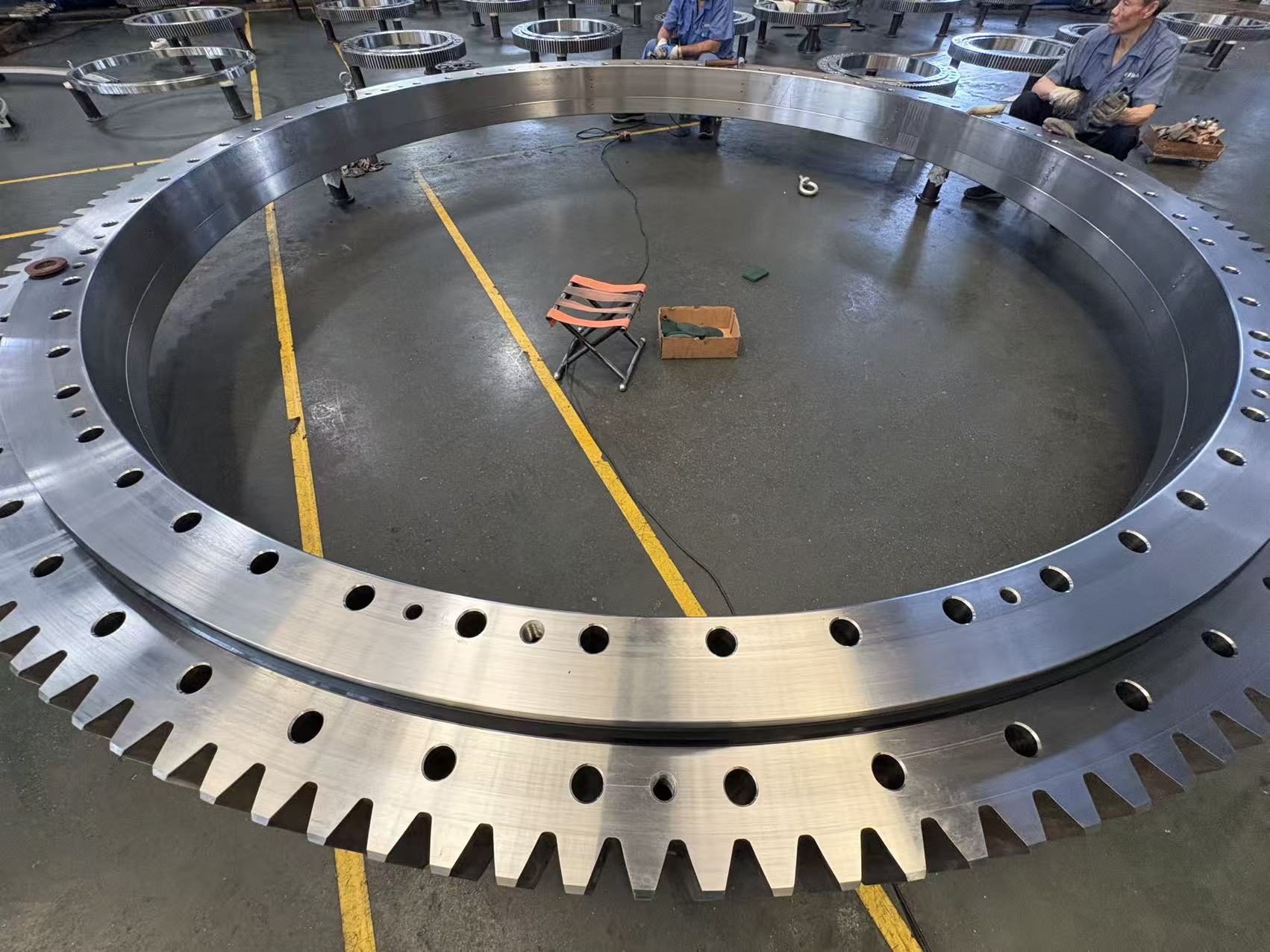
Three-row roller slewing bearing for stacker-reclaimer successfully assembled.
I. Why Stacker-Reclaimers Must Use Three-Row Roller Slewing Bearings
1.1 Operating Requirements for Stacker-Reclaimer Slewing Bearings
Stacker-reclaimer model: DQ4000/2500
Rated stacking capacity: 4000 t/h
Total equipment weight: 620 tons
Slewing bearing load: 580 tons
Operating environment: High dust levels, heavy loads, continuous low-speed operation, and significant temperature fluctuations.
During the project's initial phase, the owner evaluated two alternative solutions—crossed roller slewing bearings and single-row four-point contact ball slewing bearings—but rejected both after load verification:
Crossed roller slewing bearings: For the same outer diameter, the ultimate overturning moment is only 62% of that of a three-row roller structure; the probability of raceway pitting increases by 78% after 12 months of continuous full-load operation, failing to meet the 20-year design life requirement.
Single-row four-point contact ball bearings: Radial load capacity is insufficient; instantaneous impact loads during reclaiming operations easily cause plastic deformation of the steel balls, resulting in a mean time between failures (MTBF) of less than 18 months.
Industry technical standards JT/T 373 and JB/T 2300-2011 explicitly mandate that large stacker-reclaimers with a total load exceeding 450 tons and an overturning moment exceeding 2000 t·m must use three-row roller slewing bearings as the standard configuration.
II. Complete Technical Specifications for Customized Three-Row Roller Slewing Bearings
2.1 Model 130.45.3200 External-geared three-row roller slewing bearing
| Parameter Item | Standard Measured Value | Industry Allowable Tolerance |
|---|---|---|
| Overall Structure | Separated three-row cylindrical roller type, upper & lower rows bear axial force, middle row bears radial force | / |
| Outer Diameter Da | 3640mm | ±0.3mm |
| Inner Diameter d | 3200mm | ±0.25mm |
| Total Height H | 245mm | ±0.15mm |
| Raceway Center Diameter Dwp | 3420mm | ±0.2mm |
| Roller Specification | Upper & lower row Φ72×70mm, middle row Φ68×66mm | Roller dimension tolerance ±0.01mm |
| Total Roller Quantity | 186 pcs upper row, 186 pcs lower row, 172 pcs middle row | Single row quantity error ≤±2 pcs |
| Gear Form | External tooth drive, Module m=12, Teeth z=286 | Gear precision Class 8 GB/T10095 |
| Tooth Surface Quenched Hardness | HRC52~56 | Minimum not lower than HRC50 |
| Total Weight | 2268kg | ±12kg |
| Mounting Bolt Spec. | M42 Class 10.9 high-strength bolt, total 96 pcs | Bolt pre-tightening torque 1850N·m |
2.2 Load Data for Stacker-Reclaimer Slewing Bearing
Based on the load calculation formulas in ISO 281 and incorporating dynamic load assessments for the stacker-reclaimer, this three-row roller slewing bearing features a load capacity safety factor of ≥1.85, far exceeding the industry minimum standard of 1.2:
Rated static axial load capacity (Fa): 12,600 kN (maximum static axial load of the equipment: 5,800 kN);
Rated static radial load capacity (Fr): 6,850 kN (instantaneous radial impact load: 5,200 kN);
Rated overturning moment (Mt): 3,680 t·m (maximum operational overturning moment of the equipment: 2,960 t·m);
Ultimate failure overturning moment: 6,240 t·m; the ample safety margin effectively prevents bearing failure caused by sudden eccentric loads or impacts from collapsing material piles.
III.How should a three-row roller slewing bearing be correctly assembled?
The on-site assembly of the complete slewing bearing unit for the stacker-reclaimer follows standardized procedures, centering on four core stages: positioning, fastening, system commissioning, and load-bearing trial operation.
Pre-installation base inspection: Inspect the flatness, surface roughness, and bolt hole coaxiality of the mounting flanges on the stacker-reclaimer's upper and lower turntables, and remove welding slag and dust; installation is prohibited on non-compliant bases to prevent uneven load wear at the source.
Bearing lifting and alignment: Use specialized soft slings to lift the bearing horizontally, aligning the raceway's "soft zone" mark with the equipment's non-load-bearing side; after placement, check the contact gap around the entire circumference using a feeler gauge, making fine adjustments with thin stainless steel shims where necessary.
Graded tightening of high-strength bolts: Tighten the 96 M42 (Grade 10.9) bolts using a diagonal, three-step pre-tightening sequence (at 50%, 80%, and 100% of the rated torque), followed by a re-check for torque loss after a four-hour settling period.
System assembly and commissioning: Complete drive gear meshing and double-layer dust seal installation; connect automatic centralized lubrication lines and fill with high-temperature, extreme-pressure (EP) grease; calibrate gear backlash and tip clearance.
72-hour staged load trial run: Conduct continuous slewing tests in three stages—24 hours at no-load, 24 hours at half-load, and 24 hours at full load—while monitoring and recording slewing torque, bearing temperature rise, vibration levels, and clearance variations.
Three-party acceptance and documentation: Upon successful completion of the trial run, the project owner, OEM, and bearing manufacturer conduct on-site acceptance; assembly records and operation test reports are compiled, archived, and handed over, alongside operation and maintenance guidelines.
IV. LTZC Custom Service for Three-Row Roller Slewing Bearings
4.1 Manufacturing Capabilities: As a specialized manufacturer of slewing bearings with 30 years of experience, LTZC provides tailored slewing bearing solutions for port equipment, industrial machinery, and mining & metallurgical equipment. We offer complimentary services including load calculation, bearing selection, and OEM/ODM support. Our product range covers sizes from 300mm to 13,000mm.
4.2 Quality Certification Systems: ISO certification, BV certification, DNV (classification society) certification, and TÜV third-party inspection/certification.
4.3 After-Sales Technical Support
Remote online assembly guidance, on-site assembly assistance by overseas technical engineers, and warranty coverage.