WhatsApp
 jessica.chai@ltzzc.com
 0086-379-69950051

Custom Bearing Heat Treatment Matched to Alloy
Which heat-treatment route should an OEM specify when the bearing alloy, load path, raceway geometry, and operating environment are still being defined? The answer is not simply “make the raceway harder.” A suitable Custom Bearing Heat Treatment plan must balance surface wear resistance against core toughness, distortion control, machining sequence, and the temperature the bearing will experience in service.
For a new slewing ring, thin section bearing, gear-supported bearing assembly, or non-standard raceway, start by defining the duty cycle before selecting the alloy. A high-load crane ring and a corrosion-exposed marine positioning ring may both require hard raceways, but their material and treatment choices can differ substantially. Engineers comparing ring configurations can also review our precision slewing bearing range and use the bearing selection guide to organize initial application inputs.
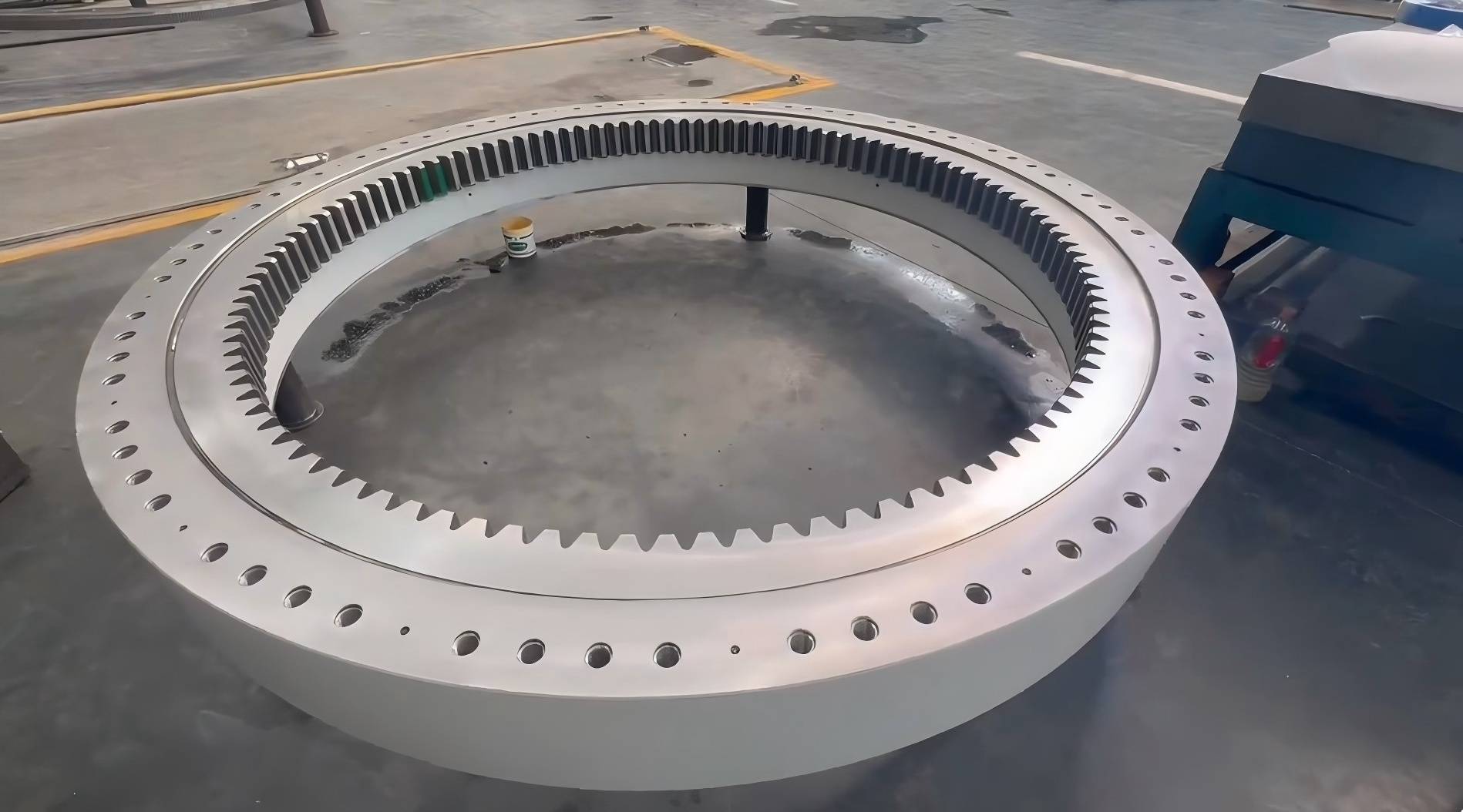
Define the operating target before selecting a treatment route
The practical outcome of this process is a heat-treatment requirement that a manufacturer can review against the drawing, material callout, and inspection plan. Begin with four inputs: load type, contact geometry, environmental exposure, and allowable dimensional change after treatment. If one of these is unknown, do not finalize the route yet.
Identify where the highest contact stress occurs. Mark the rolling raceway, gear tooth flanks, mounting faces, and any localized load zones on the drawing. The raceway generally needs the greatest resistance to rolling contact wear. Gear teeth may need a separate requirement from the ring body.
Separate static load from repeated rolling contact. A structure carrying a mostly fixed load needs adequate strength and stability, while a rotating raceway needs resistance to repeated contact damage. Do not specify the same condition for both without checking the bearing duty.
Define the required core behavior. Decide whether the ring must resist shock, maintain stiffness, or carry heavy transmitted load through its section. A hard surface over an insufficiently supportive core can crack or deform under demanding loads.
Record environmental constraints. Corrosive exposure points toward corrosion-resistant alloy options such as AISI 440C. Elevated-temperature service may require a review of retained hardness and dimensional stability rather than a standard room-temperature assumption.
Confirm which features are finished before treatment. Raceway grinding, mounting-hole machining, gear cutting, and sealing surfaces may occur before or after different treatment stages. This sequence determines distortion risk and finishing allowance.
A good starting specification does not need to dictate every furnace setting. It should state the alloy, the required property balance, the treated zone, applicable areas, distortion-sensitive features, and validation requirements. The heat-treatment supplier can then propose a controlled route and confirm whether the requested geometry is realistic.
For example, an Three Row Roller Slewing Bearing used in lifting equipment often has separate load paths that must be assessed individually. It is not enough to copy a treatment note from a smaller ball-bearing design. LTZC delivered an integral three-row roller slewing ring with an outer diameter of 10.87 meters for 2,000 ton fixed lifting equipment in 2024. That type of application shows why the ring section, rolling path, and load arrangement must be reviewed together before a process is selected.
Map bearing alloys to core toughness surface hardness and operating temperature
Use the following table as a screening tool, not as a substitute for a released manufacturing specification. The best route depends on the required hardened zone, ring cross-section, final machining plan, and the bearing’s service condition. When engineers ask which heat treatment is best for bearing steel, the correct answer is the route that meets the application’s required surface condition while retaining enough support beneath it.
| Alloy | Suitable heat-treatment route | Core toughness and surface objective | Operating-condition fit | Where the route is limited |
|---|---|---|---|---|
| GCr15 / 52100-type bearing steel | Through hardening followed by tempering and finish grinding | Prioritizes high hardness and wear resistance through the working section | High-precision rolling contact where corrosion is controlled and the ring section is suitable for through hardening | Less suitable when a very tough core is needed beneath a hard case, or where corrosion exposure dominates the design |
| 20CrMo | Carburizing, quenching, tempering, then finishing of functional surfaces | Hard wear-resistant case with a tougher supporting core | Loaded raceways and gear-related features where surface durability and core support are both required | Requires case-depth planning and distortion control; it is not a shortcut for thin precision parts with little finishing allowance |
| 42CrMo | Quench-and-temper base condition, with localized induction hardening where a hard raceway is required | Strong, tougher ring body with concentrated surface hardening on selected tracks | Large rings, localized raceways, and applications requiring strength through the section | Unsuitable if the full section must have the same hardened condition or if the geometry prevents consistent induction coverage |
| AISI 440C | Hardening and tempering route selected for corrosion-resistant bearing service | Combines corrosion and oxidation resistance with a hard bearing surface | Applications with corrosion exposure where ordinary bearing steel would require excessive protection | Not the default choice when heavy shock loading or a highly tough core is the dominant requirement |
| SUJ2 | Through hardening and tempering with controlled finishing | High strength and hardness for precision, high-load bearing contacts | High-precision rolling elements and bearing components with controlled service conditions | Requires close dimensional control after treatment; do not assume it offers the same core-support advantage as a carburized alloy |
| CuSn6 | Use material condition suited to sliding and corrosion requirements; do not specify a steel hardening route | Focuses on wear behavior, thermal conductivity, and corrosion resistance rather than hardened steel raceway performance | Bearing components where bronze properties are needed | Not a replacement for hardened rolling raceways in heavy rolling-contact applications |
| Ti-6Al-4V | Process route selected for aerospace weight and temperature requirements, with surface treatment reviewed separately if wear is a concern | Prioritizes low weight and high-temperature capability | Aerospace and high-strength applications where mass matters | Do not assume titanium alone provides the rolling-contact wear behavior of hardened bearing steel |
For 52100 heat treatment, the normal selection logic is through hardening and tempering when the design needs high hardness and wear resistance across the functional section. This fits conventional precision bearing components made from high-carbon chromium bearing steel. It does not automatically fit a large ring that needs a tougher body below a hardened raceway.
A carburized bearing steel approach is usually more appropriate when the design needs a hard working layer over a more supportive core. 20CrMo is a logical material family to assess for this purpose because the company material list identifies it as suitable for heavy-load bearing use after alloy-driven improvements in strength, hardness, and wear resistance. The limit is process complexity: the designer must reserve finishing allowance and define what happens if heat-treatment movement changes the raceway position.
Build the treatment specification in a workable sequence
Once the alloy family is selected, convert the design intent into a manufacturing-ready sequence. This prevents a frequent problem: a drawing calls for a hard raceway but says nothing about the treated zone, final machining, or acceptance method.
1. Freeze the functional zones
Mark each zone as one of the following: rolling raceway, gear tooth, mounting interface, seal land, or non-functional surface. For an slewing ring gear, identify whether the gear teeth require the same condition as the raceway. They often do not. Treating every surface alike can add cost, increase distortion risk, and make later machining harder.
Checkpoint: The drawing clearly shows the beginning and end of every treated area. If a supplier cannot tell where the hardened track terminates, the requirement is incomplete.
2. Choose through hardening, carburizing, or local induction hardening
Select through hardening when the component is made from a bearing steel such as GCr15 or SUJ2 and the design requires high hardness through the relevant working section. This route suits precision-oriented components but needs careful control of post-treatment finishing.
Select carburizing when a hard surface and tougher core must work together, particularly for heavy-load conditions using an alloy such as 20CrMo. Specify the case requirement through the approved engineering standard rather than leaving “carburized” as the only note.
Select localized induction hardening when a strong ring body is needed and the raceway can be treated in defined tracks. An induction hardened bearing raceway can be a practical option for larger ring designs, provided the scan path, start-stop regions, and hardened-zone continuity are reviewed.
Do not choose induction hardening merely because it is local. A discontinuity at the end of a hardened path, an unsuitable raceway profile, or inadequate inspection access can create a weak point. Confirm the full rolling path and transition regions before release.
3. Plan machining around heat-treatment movement
Set the preliminary machining condition, treatment stage, and finish-machining stage in the routing. Raceways and gear teeth may require final grinding or another controlled finishing operation after hardening. The final method depends on material, geometry, and the drawing requirements.
The common mistake is completing all precision machining before a process that changes shape or position, then discovering that there is no material remaining for correction. Recovery can require redesign, rework evaluation, or scrapping a large ring. Prevent it by agreeing on finishing allowance and measurement datums before production.
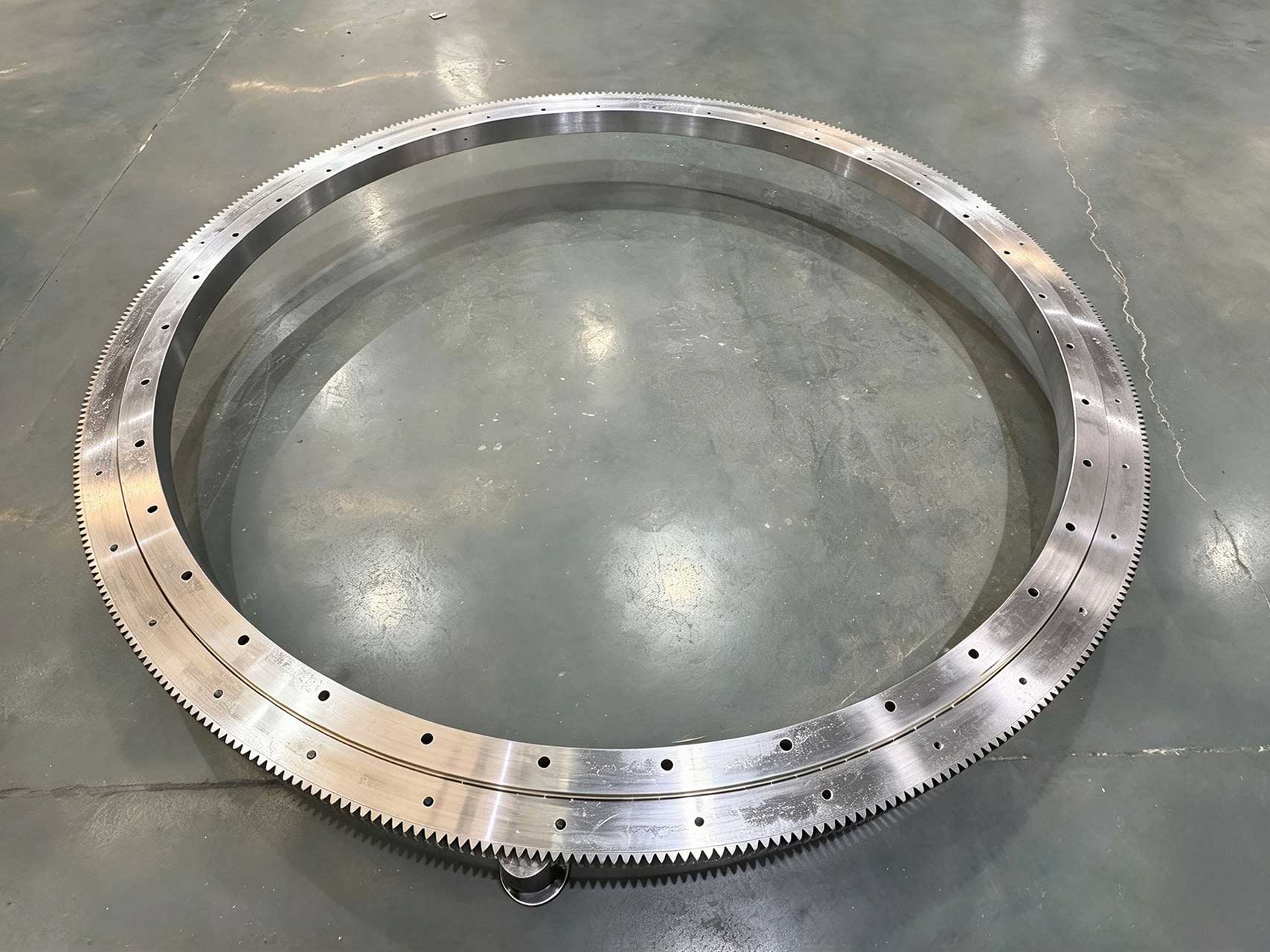
4. State the inspection evidence required
At minimum, define how the supplier will verify the treated zone, hardness condition, raceway geometry after finishing, and visible surface condition. The exact test method and acceptance values should come from the application drawing, approved control plan, and applicable customer standard. Do not copy acceptance numbers from an unrelated bearing.
For non-standard designs, LTZC can develop bearing solutions from working conditions, existing designs, and technical specifications. This is especially useful when the material route is sound but the customer still needs to define treated areas, ring configuration, or inspection references.
Use validation checks to catch a poor alloy-process match
The correct treatment is not confirmed when the part leaves the furnace. It is confirmed when the finished bearing component meets its defined condition and the selected route supports the application. Use a staged validation plan rather than a single final inspection.
| Validation stage | What to review | What a failure may indicate | Recovery action |
|---|---|---|---|
| Design review | Alloy, load path, operating environment, treated zones, and finish sequence | The process was selected from a generic material preference rather than service needs | Reassess whether core toughness, corrosion resistance, or localized hardening is the actual priority |
| Pre-production review | Machining allowance, distortion-sensitive dimensions, fixturing concept, and inspection access | Finished geometry may not remain achievable after treatment | Change the machining sequence or revise the treatment zone before parts are processed |
| Post-treatment inspection | Specified hardness condition, treated-area coverage, surface quality, and geometry before final assembly | Uneven treatment, deformation, inadequate finishing allowance, or unsuitable process control | Contain the parts and determine whether controlled rework is technically acceptable |
| Assembly and early operation | Rotation behavior, mounting condition, lubrication compatibility, and visible raceway or gear concerns | A system issue rather than heat treatment alone, such as poor mounting support or incorrect preload | Review assembly records and follow the approved bearing installation procedure |
Do not interpret every early issue as a metallurgy issue. A properly treated bearing can still perform poorly if mounting faces are not supported, bolt preload is unsuitable, lubrication is absent, or alignment is incorrect. Heat-treatment validation and installation validation must remain separate checks.
Avoid specification errors that delay prototype approval
Calling for “high hardness” without stating the location. This leaves the supplier unable to distinguish raceway, tooth flank, and ring-body needs. Add drawings or marked views that define the functional zones.
Using carburizing language for every heavy-duty ring. A hard case and tough core can be useful, but only if the alloy, cross-section, and finishing plan support it. If localized raceway hardening is the real requirement, evaluate 42CrMo with induction treatment instead.
Assuming corrosion resistance can be added by heat treatment. Heat treatment does not turn standard bearing steel into AISI 440C. Select corrosion-resistant material when the environmental condition requires it.
Ignoring gear and raceway differences. A bearing with integrated gearing may require separate treatment logic. Treat the raceway and teeth according to their respective contact mechanisms.
Releasing an inspection plan without a reference standard. “Inspect hardness” is not enough. Identify the drawing revision, approved method, sample location, and acceptance reference.
Using a past component as the only benchmark. A previous ring may have different section thickness, load distribution, or duty cycle. Use past parts as evidence to review, not as an automatic specification.
Apply the route to large rings and specialized bearing designs
Large bearing rings add two practical concerns: treatment uniformity over long paths and control of geometry after treatment. The larger the ring, the more important it becomes to identify datum strategy, heat-treatment zones, and final inspection sequence before production begins.
LTZC’s documented projects illustrate the range of geometry that may require this planning. In 2024, the company produced an integrated bearing with an outer diameter of 8.445 meters for a crane industry client in South Korea. LTZC also supplied 8-meter high-precision segmented gear rings for a vertical friction stir welding system used in a key national project. These examples do not establish a universal process route, but they show why large rings and segmented gearing require part-specific treatment and finishing decisions.
For a design involving a segmented ring, first determine whether each segment will be treated before final assembly, how transitions between segments are controlled, and how the rolling or meshing path will be inspected at joints. For a high-load crane application, first determine whether a hard case with core support or a locally hardened raceway on a tougher ring body better matches the applied loading.
LTZC operates from a 20,000 m² facility established in 1992 and holds ISO9001:2015, ISO14001:2015, and ISO45001:2018 certifications, along with ISO, CCS, and ABS certification. For qualified custom projects, our team can review drawings, working conditions, and material preferences before treatment notes are finalized. Delivery is typically stated as 30 to 90 days, depending on the order requirements, and no MOQ is required.
Submit your bearing drawing and operating conditions to LTZC for alloy and heat-treatment route selection advice.