WhatsApp
 jessica.chai@ltzzc.com
 0086-379-69950051

Custom Bearing Heat Treatment: Balancing Hardness and Toughness Without Cracking Rings
How hard can a bearing ring be before extra hardness starts costing you reliability? That is the question behind most specification reviews we see on heavy-duty slewing equipment. A well-planned custom bearing heat treatment gives the raceway enough hardness to resist wear and leaves enough toughness in the ring to survive shock and imperfect mounting. By the end of this guide you will be able to write a heat treatment requirement that fits your duty cycle, and check a delivered ring against it.
The starting point is simple. You have a load case, a candidate steel grade and a drawing, but no agreed hardness window or tempering route. If you are still choosing the bearing type, read the bearing selection guide first, then return here. For rings running under high moment loads, the precision slewing bearing range shows the structures this process applies to.
Inputs to Gather Before You Specify Anything
Heat treatment decisions fail most often because the inputs were vague. Collect these first. Missing items at the top of the list block progress. Items at the bottom can be clarified with your supplier during drawing review.
Load type: steady, cyclic, or shock (stop-start, impact, swinging loads). This blocks everything else.
Misalignment or frame deflection: how much structure flex the mounting surface will see. Large, flexible supports change the contact pattern on the raceway.
Environment: corrosion, temperature, washdown or marine exposure. This may rule out the steel grade before heat treatment is even discussed.
Ring size and section: thin or uneven sections distort and crack more easily during quenching.
Existing drawing or failed part: a worn or broken ring tells you more than a catalogue figure.
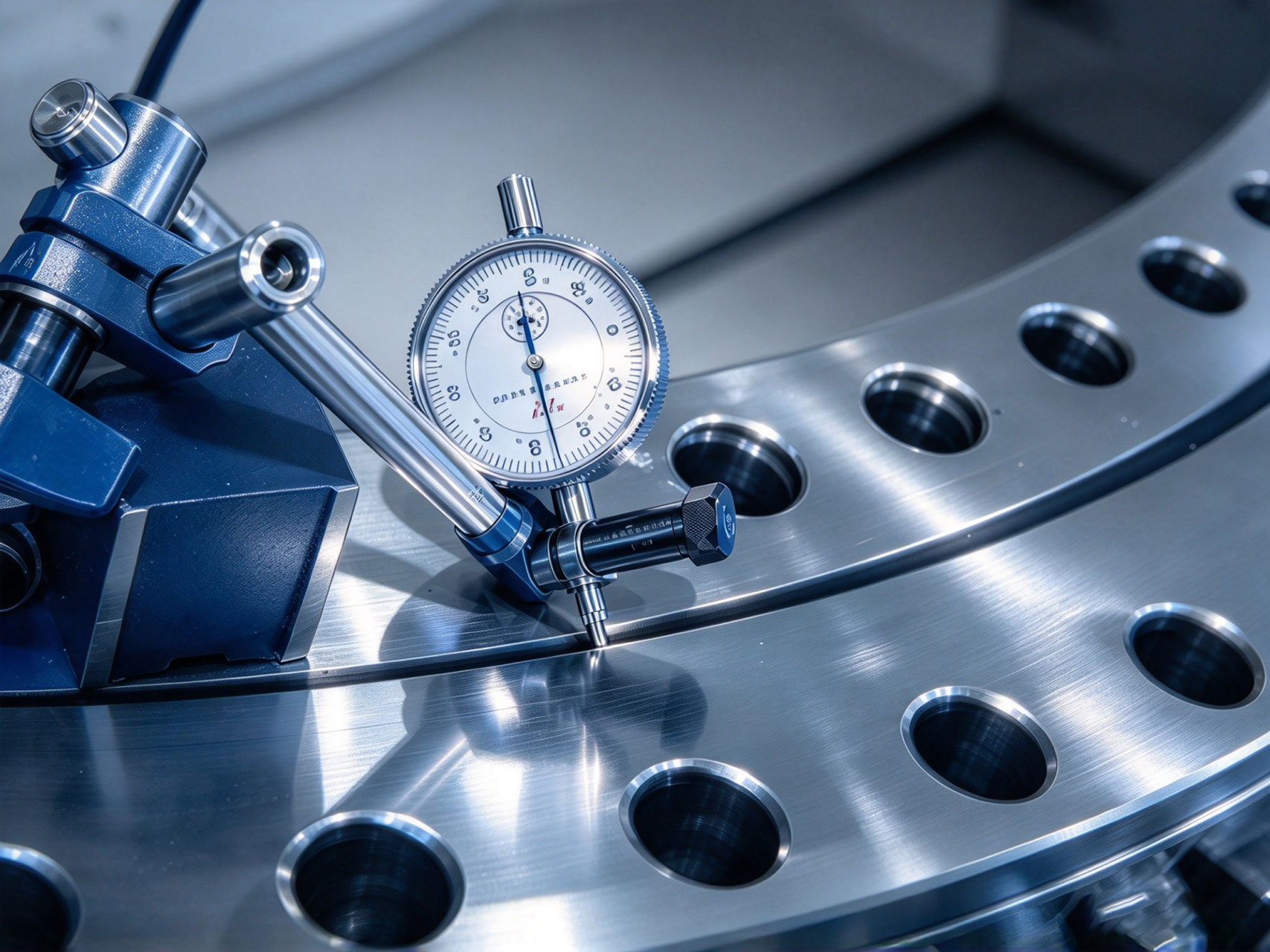
Inspection expectations: hardness windows, case depth where relevant, and any crack testing you require.
Then match the material to the job. These are the grades LTZC works with and what each is chosen for:
| Material | Main property | Typical fit | Heat treatment note |
|---|---|---|---|
| GCr15 | High hardness, wear resistance, strength | Roller and ball bearings | Through hardening route is common; temper to balance hardness and toughness |
| SUJ2 | High strength, high hardness | High precision, high load | Same logic as GCr15; precision work demands stable dimensions |
| 20CrMo / 42CrMo | Alloy strengthened, wear resistant | Heavy loaded bearings | Tougher core; raceway hardening is specified separately from core properties |
| AISI 440C | Corrosion and oxidation resistance | High corrosion environments | Choose when corrosion drives the design, not hardness alone |
| Ti-6Al-4V | Lightweight, high temperature resistance | Aerospace, high strength uses | Not a hardened steel; evaluate on its own terms |
| CuSn6 | Wear resistance, thermal conductivity, corrosion resistance | Bearing components | Copper alloy; steel hardening logic does not apply |
Step by Step: Writing the Heat Treatment Requirement
Classify the duty. Mark the application as smooth, cyclic or shock. If you cannot decide, treat it as shock until a load spectrum proves otherwise. Success looks like one written sentence describing the worst realistic event, such as a sudden stop with the boom extended.
Pick the steel family. Through hardening grades such as GCr15 or SUJ2 suit precision and high contact stress. Alloy steels such as 42CrMo suit heavy loads and large sections where a tougher core matters. The most common mistake here is choosing the hardest option by default.
Define a hardness window, not a single number. Give a minimum and a maximum for the raceway and, where it applies, the core. A one-sided minimum invites over-hardened rings that pass inspection and crack in service.
Set the bearing tempering temperature by the trade you want. Raising it lowers hardness and increases toughness. Lowering it does the reverse. Ask your supplier to state the tempering route on the process sheet and confirm it against the steel producer's data for your exact grade. We do not recommend copying a temperature from another ring, because section size and steel chemistry shift the result.
Review geometry with the heat treater. Sharp internal corners, abrupt thickness changes and oil holes near the raceway are crack starters during quenching. Fix them on the drawing, not after a failure.
Specify the checks. Hardness at defined positions on each ring, plus crack inspection after final grinding. Agree the sampling locations before production.
For 52100 bearing heat treatment, note that 52100 is the ASTM designation usually considered comparable to GCr15 and SUJ2. Check the actual chemistry on the mill certificate rather than assuming equivalence, then apply the same through hardening and tempering logic above.
When Higher Hardness Helps and When It Raises Cracking Risk
Bearing hardness vs toughness is a trade, not a ladder. More hardness resists abrasive wear, pitting and plastic dents. Past a certain point it makes the steel less able to absorb a local overload, so a small crack can start and grow. This table sets out the boundaries.
| Condition | Higher hardness | Reasoning | Limit |
|---|---|---|---|
| Smooth, steady load, good alignment | Improves wear life | Contact stress is predictable, so surface fatigue and wear govern life | Gains flatten once other limits, such as lubrication, dominate |
| Contaminated lubricant, abrasive dust | Improves wear life | A harder surface resists scoring and indentation | Does not replace sealing |
| Precision positioning with low shock | Helps hold form | Resists raceway deformation and preserves accuracy | Requires distortion control during treatment |
| Shock or impact loading | Raises cracking risk | Low toughness cannot absorb sudden peaks | Use a higher tempering temperature or a tougher alloy core |
| Frame deflection or misalignment | Raises cracking risk | Edge loading concentrates stress at one end of the contact | Fix mounting stiffness first; hardness will not compensate |
| Thin or uneven sections | Raises cracking risk | Uneven cooling builds residual stress | Redesign section or change quench approach |
| Corrosive duty | Little benefit | Corrosion damage, not wear, ends life | Consider AISI 440C instead |
The practical rule is this. If your worst event is a shock or a misaligned load, lower the hardness target slightly and widen toughness margin. If your worst event is slow abrasive wear, keep the window high. If you cannot tell which dominates, ask for a drawing review before locking the window.
Why Do Bearings Crack After Heat Treatment
When buyers ask why do bearings crack after heat treatment, the cause is usually found in one of a short list of process or design errors. Review this list against your last failure.
Delay between quench and temper. Untempered martensite carries high internal stress. Cracks can appear while the ring sits waiting. Observable effect: fine cracks found before any load is applied.
Quench too severe for the section. Uneven cooling in a thick-thin profile tears the part. Observable effect: cracks starting at a section change.
Sharp corners and notches. Stress concentrates and cracks start there. Observable effect: crack origin at a keyway, hole or fillet.
Surface decarburization or defects in the steel. Soft or weak spots yield unevenly. Observable effect: cracking or spalling in a localized patch.
Grinding burn after hardening. Overheating the raceway during finishing creates a brittle layer that cracks later. Observable effect: cracks appear after grinding, not after quench.
Over-hardened with too little tempering. The ring passes the minimum hardness check and fails under shock. Observable effect: brittle fracture with little deformation.
Completion Check and Recovery
You are done when each item below can be answered yes. Do not mark the task complete on a hardness number alone.
The process sheet states the steel grade, tempering route and hardness window.
Hardness readings at the agreed positions fall inside the window, not only above the minimum.
Crack inspection after final grinding shows no indications.
Dimensions after treatment still allow finishing to drawing tolerance.
Your duty classification from step one matches the toughness margin chosen.
If hardness reads too high, revisit the tempering step. If it reads too low, review the hardening step and the steel certificate. If you find cracks, trace the origin: at a geometry feature, return to the drawing review; after grinding, review the finishing parameters. Early failures in service often point back to misalignment, so inspect the mounting surface and follow the bearing installation guidance before blaming the ring.
Variations That Change the Procedure
Very large rings. Size changes how evenly a ring heats and cools, so heat treatment planning becomes part of design. In 2024 LTZC delivered an integral three row roller slewing ring with a 10.87 meter outer diameter for 2,000 ton fixed lifting equipment, and produced an 8.445 meter integrated bearing for a crane industry client in South Korea. Both sizes call for early supplier involvement. See the Three Row Roller Slewing Bearings and Large Slewing Bearing pages for structure options.
Segmented rings. For segmented gear rings, such as the 8 meter high-precision segmented gear rings we supplied to Wuhan Heavy Industry, each segment must meet the same hardness window, so confirm per-segment inspection.
Corrosion or weight driven designs. If corrosion or weight is the main requirement, AISI 440C or Ti-6Al-4V changes the whole route, and CuSn6 follows non-steel logic. Do not apply a steel tempering plan to them.
Support and capacity. LTZC operates a 20,000 m² facility established in 1992, holds ISO9001:2015, ISO14001:2015 and ISO45001:2018 certification with CCS and ABS approval, and accepts orders with no MOQ. Delivery runs 30 to 90 days depending on the job. We respond to quality objections within 24 hours. When a ring falls outside your specification, we can help with fault analysis.
For jobs outside standard catalogues, the non-standard bearings and Customized Bearings pages show how we work from existing designs and working conditions.
Send us your drawing, load case and target hardness window, and our engineers will review the heat treatment route with you before you place an order.