WhatsApp
 jessica.chai@ltzzc.com
 0086-379-69950051

How to Source a Custom Slewing Bearing Solution
The most expensive mistake in custom bearing sourcing is not a high quote. It is a quote built on missing data, which comes back as a redesign after the drawings are already approved. If you are preparing a Custom Slewing Bearing Solution request, a few engineering facts decide whether quotes from different suppliers can be compared at all. This guide lists those facts and shows where each one goes in the RFQ.
LTZC Bearings Co.,Ltd. supplies precision slewing bearing products, gear rings, racks, bearing unit assemblies and non-standard bearings. Our Customized Bearings work starts from your working conditions, existing designs and technical specifications. In ten years of slewing bearing sales and after-sales work, I have seen most late-stage changes trace back to a handful of RFQ fields left blank.
Where a Bespoke Turntable Bearing Fits and Where It Does Not
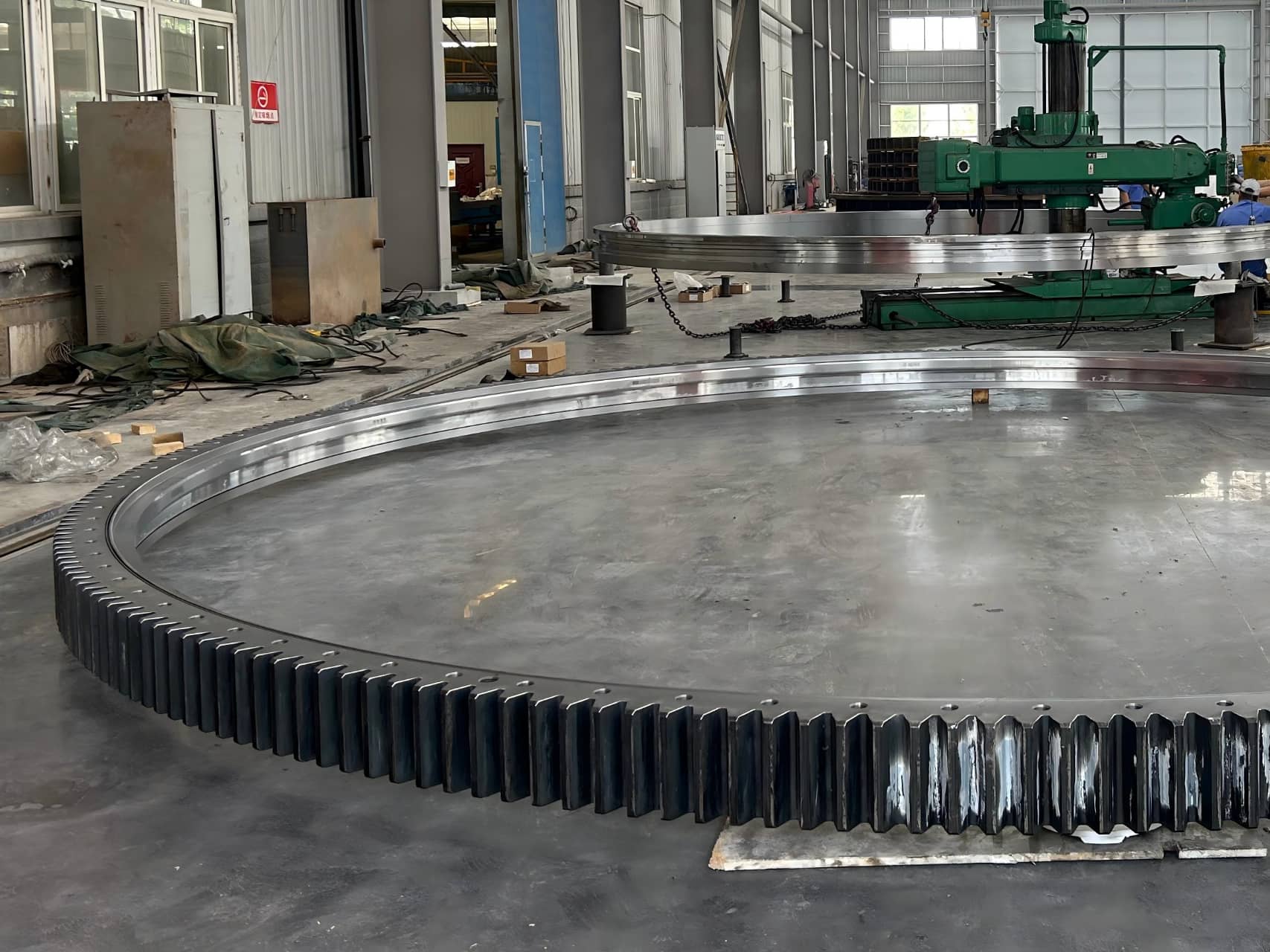
A bespoke turntable bearing is justified when a catalogue size cannot meet your load case, mounting interface or gear requirement without changing the machine around it. It is rarely justified for a standard crane or excavator envelope where a catalogue part already fits.
Custom fits when: your mounting structure is fixed and the bolt circle differs from standard sizes; the gear module or tooth count is set by an existing drive; or the bearing is very large and needs a segmented or split design.
Custom does not fit when: the load is still undefined, or the design is changing weekly. A quote at that stage is a guess, and its price will move.
Check first: if a standard series covers your envelope, use the bearing selection guide before opening a custom request.
Our scope covers slewing bearings, slewing ring gears, racks and assembled bearing units. Slewing drives are on a separate product page. If your project mixes bearing and drive, say so in the first message so the scope is agreed early.
Sourcing Checklist: Mapping Load, Envelope, Gear, Bolt Pattern and Validation to RFQ Fields
This table turns engineering questions into RFQ fields. Fill every row before sending. If a value is still open, write "TBD" and say who will decide it. Do not leave the field out.
| Requirement | What to state | RFQ field | What goes wrong if missing |
|---|---|---|---|
| Load cases | Axial, radial and tilting moment, each as normal and extreme case; duty cycle; shock or impact events | Load table (one row per case) | Wrong raceway type or row count; the quote has to be re-priced after calculation |
| Envelope limits | Maximum OD, minimum ID, total height, clearance around the ring, any central passage | Dimension limits with min/max | Bearing is physically correct but does not fit the housing |
| Gear needs | Internal, external or none; module; tooth count; pressure angle; hardened or soft teeth; ground teeth if required | Gear data block | Pinion mismatch; gear treated as an extra and quoted late |
| Bolt pattern | Hole count, PCD, hole size or thread, through or tapped, bolt grade if fixed | Mounting interface drawing | Holes cannot be matched to your structure |
| Materials | Preferred steel or alloy, or the operating condition so a material can be proposed | Material and environment fields | Material chosen on price alone and mismatched to corrosion or temperature |
| Validation | Inspection records, dimensional reports, third-party witness, classification society needs | Documents required with delivery | Documentation requested after production, with cost and delay |
| Quantity and timing | First order quantity, forecast, required delivery date | Quantity and date fields | Lead time cannot be confirmed |
Two rows are missed most often. The first is the extreme load case, because teams quote only the normal working load. The second is the validation row, because it feels like a paperwork detail until a classification or customer audit asks for records.
What Data Is Needed for a Custom Slew Ring: A Four-Step Order
The question "what data is needed for a custom slew ring" has a practical answer. Collect it in this order so that each step supports the next.
Fix the interface first. Send the mounting drawing with OD, ID, height and bolt pattern. This is the hardest constraint to change later.
Define the loads. Provide the load table with the extreme case marked. If you only have motor or crane capacity, send that and the geometry so the load can be derived.
Add the gear data. State the pinion details, or tell us the drive is not selected yet.
State the conditions and records. Cover temperature range, dust, water or salt exposure, the required documents, and any standards the end customer has named.
An illustrative example
Take a hypothetical turret retrofit. The old bearing has failed, no original drawing exists, and the housing cannot be changed. The useful RFQ here is measured dimensions of the housing and bolt circle, photos of the worn raceway area, the machine's rated load, and the existing pinion data. That is enough for a supplier to propose a bearing type and flag what must be confirmed. The numbers here are placeholders, not a real LTZC project.
Choosing Type and Material Before You Ask for a Price
You do not have to select the final design, but naming a likely type narrows the quotation. The table below links each option to its product page and states where it usually fits. Confirm the final choice against your load table.
| Option | Typical fit | Limit to check |
|---|---|---|
| Single Row Ball Slewing Bearings | Moderate loads where compact section matters | Not for the heaviest tilting moments |
| Cross Roller Slewing Bearings | Positioning accuracy and rigidity | Mounting surface flatness needs attention |
| Three Row Roller Slewing Bearings | Heavy loads and large diameters | Larger section and mass, so check the envelope |
| Split Slewing Bearing | Very large rings or limited transport and handling | Joint design and assembly steps must be agreed |
For material, our standard grades include GCr15 (high hardness and wear resistance), SUJ2 (high-precision, high-load use), 20CrMo and 42CrMo (alloyed for heavy loads), AISI 440C (corrosion and oxidation resistance), CuSn6 and Ti-6Al-4V (lightweight, high-temperature use). A grade is a starting point, not a guarantee. Corrosive or high-temperature sites need the conditions discussed before the material is fixed.
Five RFQ Mistakes That Make Quotes Incomparable
Sending only a catalogue part number. It hides the real load and fit requirement and invites a like-for-like price with no engineering check.
Omitting the extreme load. Two suppliers then size the bearing for different cases and the cheaper quote may be the under-sized one.
Treating gear data as optional. A ring that arrives without matching teeth is a rework, not a delivery.
Asking for documents after the order. Inspection and certificate requirements change cost and schedule, so they belong in the first request.
Comparing quotes with different scopes. One may include heat treatment, tooth grinding or documents and another may not. Put the same field list in front of every supplier.
What Evidence Supports a Custom Slew Ring Manufacturer
When you screen a custom slew ring manufacturer, ask what has been built at your scale and what quality system sits behind it. Here is what LTZC can state from its records.
Quality systems: ISO9001:2015 quality management, ISO14001:2015 and ISO45001:2018, certified by ISO, CCS and ABS.
Background: established in 1992, with a 20,000 m² facility.
Large-diameter work: in 2024 we delivered an integral three-row roller slewing ring with a 10.87 m outer diameter for 2,000-ton fixed lifting equipment, the largest in LTZC's history. Also in 2024 we produced an 8.445 m integrated bearing for a crane-industry client in South Korea.
Segmented and geared parts: 8 m high-precision segmented gear rings for Wuhan Heavy Industry's vertical friction stir welding system, a φ24 m segmented bearing delivered to Jiangsu Nantong Rainbow Heavy Machinery, and a 6 m segmented gear ring with ground teeth for a Hengshui customer.
Smaller precision work: a 3 m turntable bearing that held the main torch tower at the World Military Olympic Games opening ceremony.
These cases show experience with large and segmented geometry. They do not mean every size or specification is available. Each one depended on its own drawings and conditions, so send yours. If your application is a crane, see our Crane Slewing Bearing page. For rings above several meters, start with Large Slewing Bearing.
Cooperation Terms and What Still Needs Agreement
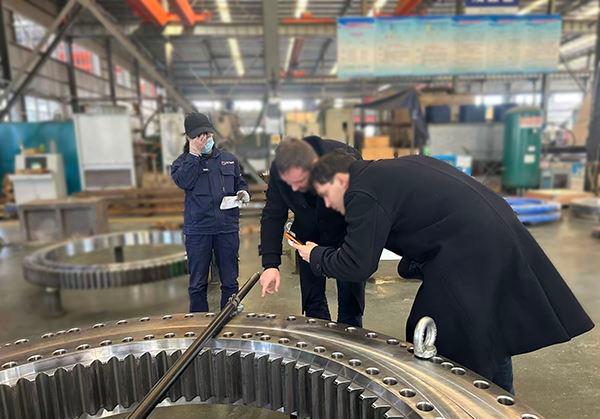
Here are the terms we can state, followed by the points we agree per project.
| Item | What we can state | Agree per project |
|---|---|---|
| Minimum order | No MOQ | First order quantity and any forecast |
| Delivery | 30-90 days quoted range | Actual date, which depends on size, material and gear work |
| After-sales | Installation guidance, maintenance training, fault analysis; quality objections answered within 24 hours, with on-site service starting within 48 hours in China | Support scope outside China |
| Acceptance | Not a fixed template | Inspection items, records and responsibility for sign-off |
The 30-90 day range is not a promise for every order. A 10 m class ring and a small precision ring will not share a schedule. Likewise, the on-site service time applies to China, and we do not assume it elsewhere. For fitting and upkeep after delivery, the bearing installation page explains the support available.
How to Request a Slewing Bearing Quote
If you ask how to request a slewing bearing quote that gets a useful answer on the first pass, send one package, not several messages:
The mounting interface drawing with OD, ID, height and bolt pattern.
The load table with normal and extreme cases.
Gear data, or a note that the gear is undecided.
Operating environment and any material preference.
Required documents, quantity and target delivery date.
Missing items are fine if you mark them. A flagged gap lets us ask the right question, while a silent gap becomes a price change later. Send your drawings and load data to LTZC and we will reply with the questions that still need answers before a quotation.