WhatsApp
 jessica.chai@ltzzc.com
 0086-379-69950051

How to Source Non-Standard Slewing Bearings Without Costly RFQ Rework
The most expensive mistake in custom rotation components is a quote built on an incomplete drawing. A supplier prices what you sent, you approve it, and then the bolt circle, gear data or tilting-moment case turns out to be wrong. A non-standard slewing bearing is the opposite of a catalog pick: every missing line in your RFQ becomes an assumption, and every assumption becomes a variation order later.
This guide is for OEM engineers and procurement teams who are still defining the part. It shows when a custom ring is justified, what data to send, and how to read a supplier's evidence. LTZC Bearings Co.,Ltd. makes non-standard bearings and Customized Bearings built around customer working conditions, existing designs and technical specifications, so the examples below draw on that scope.
Standard, modified or fully custom: decide before you contact suppliers
Not every odd requirement needs a new design. Run the comparison below first. It decides whether you request a catalog price or open a custom engineering discussion.
| Option | Fits when | Limit |
|---|---|---|
| Catalog slewing bearing | Your OD, ID, height and bolt pattern match a listed size and the load is within its rating | Forces your structure to adapt to the bearing, which can add weight and machining cost on your side |
| Modified standard (changed gear, holes or seals) | The raceway concept is proven and only interface features differ | Does not help if the load path or envelope itself is the problem |
| Fully custom ring | Envelope, load combination, gear, material or segmentation falls outside the catalog | Needs a full data package and a longer quotation cycle |
A custom route makes sense when your housing is fixed and the bearing must fit it. It also makes sense for very large diameters, where the ring must be split into segments, or when you need a special material. Our material range includes GCr15, 42CrMo, 20CrMo, AISI 440C and SUJ2. It does not make sense when a Single Row Ball Slewing Bearings size already covers your load with margin. Compare against the bearing selection guide before you commit to custom tooling.
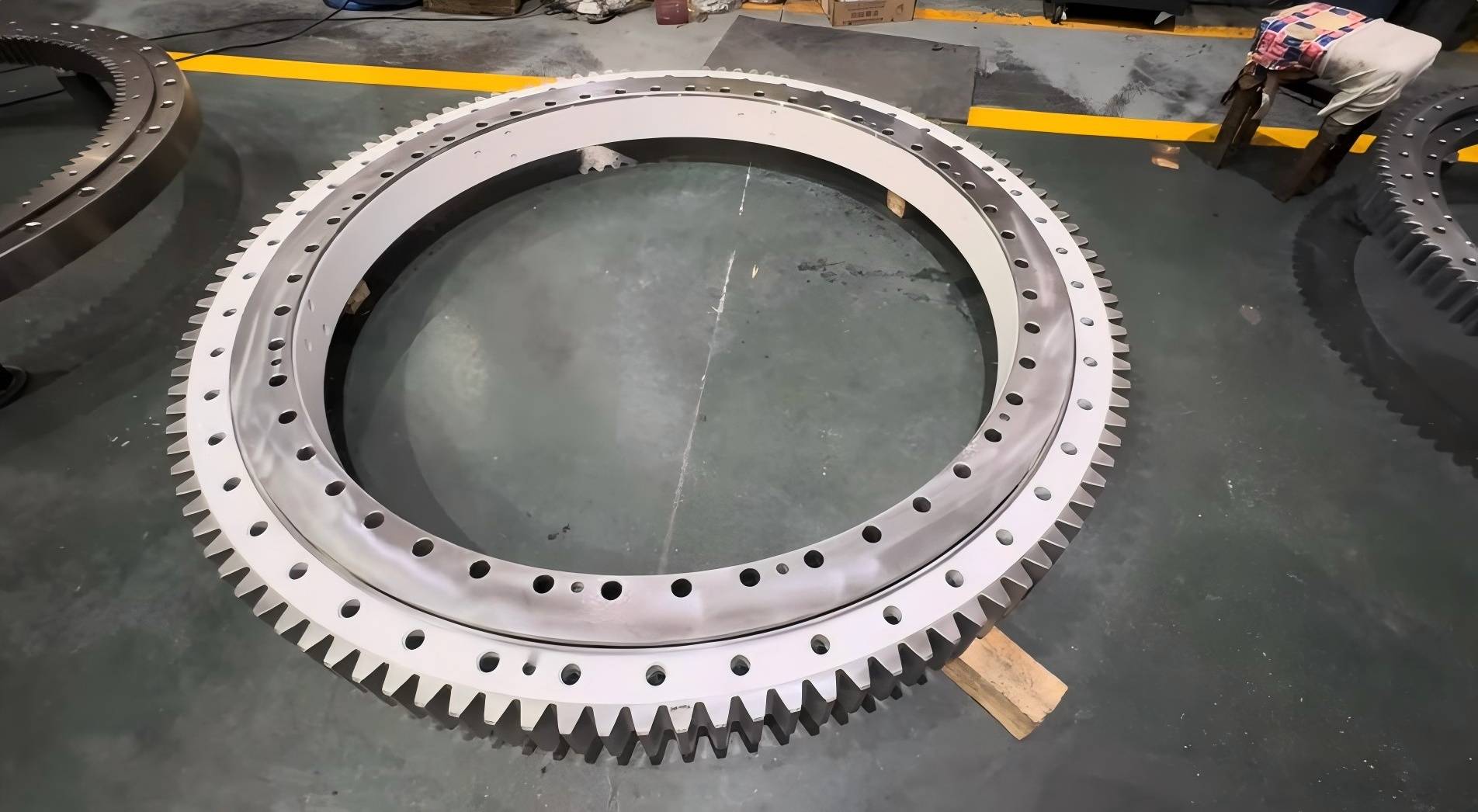
Sourcing checklist: load cases, mounting envelope, gear requirements and acceptance-test data
Complete this checklist before you release the RFQ. Each row names the data a supplier needs and the error it prevents. If you cannot fill a row, say so in the RFQ instead of leaving it blank. A flagged gap gets a clarifying question, while a blank gets a silent assumption.
| Area | Data to provide | Why it matters |
|---|---|---|
| Load cases | Axial, radial and tilting moment for working, peak and out-of-service conditions; static or rotating; continuous or oscillating; shock events | Raceway type and size are chosen from the combined case, not from axial load alone |
| Duty and environment | Rotation speed, duty cycle, temperature range, exposure (dust, salt, washdown), required service life | Drives seal, material and lubrication choices |
| Mounting envelope | OD, ID, total height, bolt circle diameter, hole count and size, flange or plain ring, mating-surface flatness and stiffness | A ring that fits on paper can still distort on a flexible support |
| Transport and assembly limits | Maximum shipping dimension, lifting method, whether a split or segmented ring is acceptable | Decides if a one-piece ring is practical at all |
| Gear requirements | External or internal teeth, module, tooth count, tooth surface treatment (for example ground teeth), accuracy requirement, pinion data, backlash expectation | Gear and raceway are one machined part, so a late gear change reopens the whole design |
| Material and certification | Preferred grade, certificate type, class society involvement if marine or offshore | Avoids a re-quote when documentation is requested at the end |
| Acceptance-test data | Which dimensional, hardness, gear and rotation checks you require, who witnesses them, and what report format you accept | Turns "quality" into criteria both sides can verify at delivery |
Two points deserve special attention. First, send the load cases as a table, not a single "rated load" figure, because a ring that handles the axial load can still fail on moment. Second, state the acceptance criteria in the RFQ itself. Agreeing them after the order puts you in a weak negotiating position.
A five-step sequence for building the RFQ package and shortlisting suppliers
Freeze the interface. Lock the OD, ID, height and bolt pattern with your structural team. These dimensions are the hardest to change later.
Write the load table. Include peak and fatigue cases. If calculations are not final, mark them as estimates.
Define the gear. Attach pinion data and say whether teeth are cut or ground. A slewing ring gear with a heat-treated, ground tooth profile has a different process route from a cut-only gear.
List acceptance tests and documents. Mark each as mandatory or optional.
Send the same package to two or three suppliers. Compare their questions as much as their prices. A supplier who asks sharp questions about moment loads and mounting stiffness has read your drawing.
Limit: this sequence assumes you have a drawing or at least a dimensioned sketch. If you only have a concept, ask the supplier for selection advice first and treat the first quote as indicative.
What LTZC can show as evidence for custom and large-diameter rings
When you shortlist, ask each supplier for something verifiable. Here is what we can point to, matched to the concern each item addresses.
| Buyer concern | Supporting fact |
|---|---|
| Can the supplier handle very large diameters? | In 2024 we delivered a 10.87 m OD integral three-row roller slewing ring for 2,000-ton fixed lifting equipment, our largest to date. We also produced an 8.445 m OD integrated bearing for a crane-industry client in South Korea. |
| Is segmentation possible when one-piece transport is not? | We developed φ24 m segmented bearings delivered to Jiangsu Nantong Rainbow Heavy Machinery, and supplied 8 m high-precision segmented gear rings to Wuhan Heavy Industry for the vertical friction stir welding system of a key national project. |
| Can gear precision be met on large rings? | A Hengshui customer received a 6 m OD segmented gear ring with ground teeth, delivered to end customers. |
| Is there experience with repeat or series parts? | We developed the full ring-roll set for a shield machine main drive for CRCC: 15 series, 90 pieces in total. |
| Is the quality system documented? | ISO9001:2015, ISO14001:2015 and ISO45001:2018, with certification by ISO, CCS and ABS. The company was established in 1992 and operates a 20,000 m² facility. |
For ring structures at this scale, see our pages on Three Row Roller Slewing Bearings and Large Slewing Bearing options. These cases show the scope we have handled. They do not guarantee that your specific drawing is feasible. Feasibility is confirmed only after we review your load data and envelope.

Cooperation terms and boundaries to agree before the order
The supplied commercial conditions are simple. There is no minimum order quantity, so a single prototype ring can be quoted. Delivery is quoted within a 30 to 90 day range. Where your order lands in that range depends on diameter, material, gear process and documentation, so ask for a dated schedule against your drawing rather than a generic figure.
After delivery, we respond to customer quality objections within 24 hours. On-site service in China starts within 48 hours. Support covers bearing installation guidance, maintenance training and fault diagnosis. These service times are stated for China, so for overseas projects in Italy, Germany, Canada, South Korea or Japan, agree the support method and timing in writing.
Items to settle in the contract, because they are not set by default:
Which drawing revision is binding, and how changes are priced.
Which acceptance tests apply, who witnesses them, and what happens if a result is out of tolerance.
Packaging, shipping responsibility and any segment-marking or assembly instructions for split rings.
Warranty period and scope. No warranty term is given in the material we have supplied here, so request it explicitly.
Common sourcing mistakes that trigger rework
Quoting on diameter alone. Two rings with the same OD can differ in raceway type, gear and heat treatment, with a large price gap between them.
Ignoring support stiffness. A ring bolted to a flexible structure deforms, and rated life no longer applies. Share your housing design.
Adding the gear last. Gear module and tooth hardening affect ring section and machining. Define them in the first RFQ.
Leaving acceptance open. If criteria are not written down, delivery disputes are decided by whoever has the weaker paperwork.
Comparing quotes with different scopes. Check material grade, tooth finish, test reports and packaging in every line before comparing totals.
Next step: send your data for a fit check
A custom ring is a fit when your envelope, load table and gear data are clear enough to price, and when the diameter, structure and material are within the range of our delivered cases. Unclear moment loads, an unfixed gear or undefined test requirements are the usual gaps, and they are solvable in the first exchange. If you have a drawing or a completed checklist from this article, submit it to LTZC for a feasibility review and a quotation against your specific requirements. Your sales contact, Jessica Chai, can also advise on whether a Split Slewing Bearing or a one-piece ring suits your transport limits.