WhatsApp
 jessica.chai@ltzzc.com
 0086-379-69950051

How to Source Precision Slewing Bearings for Robot Arms?
A robot arm that misses its repeatability target after commissioning rarely fails because of one bad part number. More often the RFQ never stated the runout, preload and mounting flatness the joint needed, so the supplier quoted a catalog bearing instead of the motion requirement. If you are buying a precision slewing bearing for a robot joint, that gap shows up late: re-machined housings, a second bearing lot, or a controller tuned around play that should never have been there.
This guide is written from the sourcing side. It shows how to turn a positioning requirement into inputs a bearing maker can quote against, and how to judge whether a supplier fits. LTZC Bearings Co.,Ltd. supplies slewing bearings, non-standard precision bearings, gear rings, racks, bearing unit assemblies, slewing drives and gear parts. For automation work, start with our page on Robotics and Automation Slewing Bearings.
Where LTZC Fits in a Robot-Arm Sourcing Project
We are a bearing manufacturer founded in 1992, with a 20,000 m² facility. Our quality system is certified to ISO9001:2015, and we also hold ISO14001:2015 and ISO45001:2018. CCS and ABS are listed among our certifying bodies. These certificates cover the management system. They are not a guarantee that a given joint will hit a given repeatability figure, so that still has to be written into the order.
What matters more for a robot OEM is the way we work with non-standard requirements. We build Customized Bearings from your working conditions, existing designs and technical specifications. That covers material, size and performance requirements. If your joint design is already frozen, send the drawing. If it is still open, the bearing envelope can be discussed before the housing is released.
One limit to state plainly: our best-documented projects are large-diameter. We have no robot-arm case in the material supplied for this article, so we do not claim one. For a compact joint, ask us for evidence that matches your size and precision level, and judge the answer on its own merits.
RFQ Checklist Linking Robot-Arm Repeatability to Runout, Preload, Mounting Interface and Gear Accuracy
Start from the tip. Repeatability at the end effector is roughly the angular error of each joint multiplied by the reach that follows it. A bearing that tilts or wobbles by a small amount at the base joint is magnified by the whole arm. That is why a base or shoulder joint needs tighter bearing inputs than a wrist joint with the same nominal diameter.
The table below lists the inputs we would ask a buyer to put in the RFQ. Numeric targets must come from your own error budget. We are not giving generic tolerance values, because they depend on the arm.
| RFQ input | What to state | Why it matters for repeatability | Limit / when it does not apply |
|---|---|---|---|
| Radial and axial runout | Target value, measuring point (raceway ring face or mounting face) and measuring method | Axial runout over a small raceway diameter becomes tilt, and tilt is multiplied by arm reach | Runout of the bearing alone is not runout of the installed joint; housing flatness adds to it |
| Preload / clearance | Preloaded or zero clearance, and torque window at the joint | Play shows up as backlash and hysteresis; too much preload raises friction torque and heat | Preload that suits a slow joint may overload the motor in a fast wrist |
| Moment, axial and radial loads | Static and dynamic values, plus peak load at emergency stop | Tilting stiffness decides how much the joint deflects under payload moment | Quote loads at the bearing, not at the end effector |
| Mounting interface | Bolt circle, hole count, pilot or spigot fit, flatness and perpendicularity of mating surfaces | An uneven seat distorts the raceways and cancels the bearing's accuracy | Define who owns the housing tolerance: you or the supplier |
| Gear accuracy (if integral gear) | Module, tooth count, accuracy grade, backlash window, hardened or soft teeth | Pitch error and backlash feed straight into joint positioning | Not relevant if you use a separate drive or a pinion you machine yourself |
| Material and heat treatment | Ring and rolling element material, hardness requirement | Sets wear life and dimensional stability | Corrosive or washdown cells may need a different material |
| Seals, grease and friction torque | Seal type, grease, allowed starting torque, temperature range | Friction torque variation disturbs low-speed positioning | Cleanroom use needs lubricant restrictions stated up front |
| Acceptance method | Which dimensions are inspected, report format, sampling plan | Turns each target into something you can verify | Must be agreed before the order, not after delivery |
Choosing the Bearing Type for a Robot Joint
The type decision narrows the RFQ. Our rule of thumb: pick the lightest structure that carries the moment load with the stiffness your error budget needs. Going heavier adds mass the joint then has to move.
| Type | Fits when | Watch out for |
|---|---|---|
| Thin section bearing | Compact, light joints where cross-section height is tight | Low absolute moment capacity; housing stiffness affects results more |
| Cross Roller Slewing Bearings | Joints that need high tilting stiffness in a single compact row | Preload and mounting flatness must be specified tightly |
| Four Point Contact Ball Slewing Bearing | Moderate combined loads where a single-row ball design is enough | Lower stiffness than roller designs under large moment |
| Double Row Ball Slewing Bearing | Heavier payload bases that need more moment capacity | Larger envelope and mass |
If you also need a drive with the bearing, compare against integrated Slewing Drives. They suit positioning tables and large rotary bases, though a compact articulated wrist normally calls for a separate bearing and reducer. Our bearing selection guide covers load-based sizing.
A Sourcing Procedure You Can Run Before Sending the RFQ
- Set the tip repeatability target. Take it from the application, such as the tolerance of the task, not from a competitor's brochure.
- Split the error budget by joint. Give the base and shoulder joints the tightest share, because every later link multiplies their error.
- Convert each share into bearing inputs. Translate it into runout, preload, tilting stiffness and gear backlash using the checklist above.
- Define the mating parts. Provide the housing and shaft drawings, or state who is responsible for their flatness and fit.
- Request evidence for your size and accuracy. Ask for inspection reports, the measuring method and material documents.
- Agree acceptance in writing. Name the dimensions, the instruments and the allowed deviation, and say what happens on a failed check.
- Decide whether a trial quantity is needed. This depends on the risk of your design. It is a project decision, not a fixed step for every order.
Evidence to Ask For, and What Our Cases Do and Do Not Show
Supplier claims about precision are cheap, so ask for things you can check. Material certificates, dimensional inspection reports, and a clear statement of which checks are done before shipment tell you more than a precision class on a web page. Ask any supplier, us included, to confirm exactly which inspections apply to your order.
Here is what our supplied cases demonstrate:
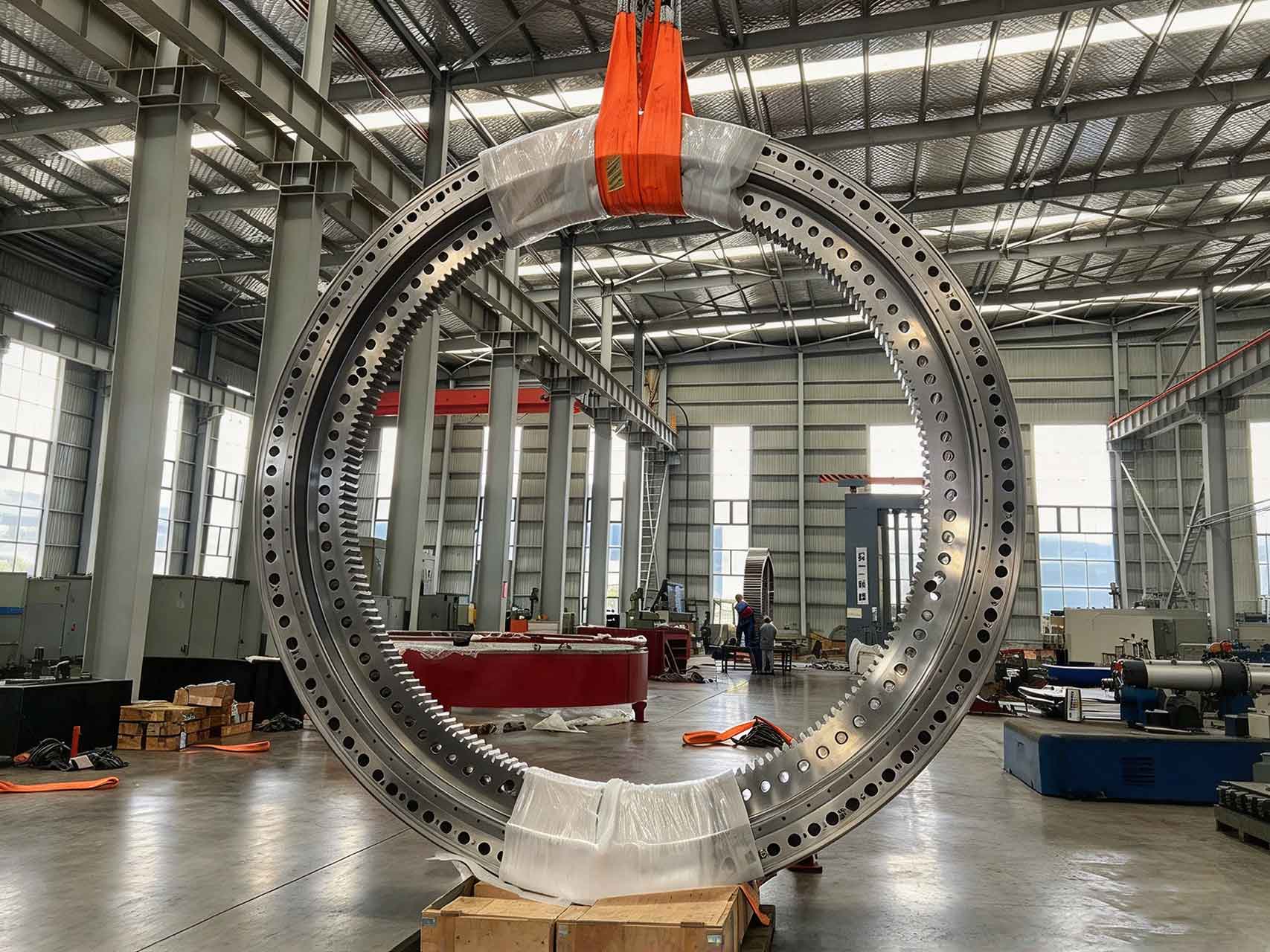
- In 2024 we delivered a slewing ring of 10.87 m outer diameter with an integral three-row roller structure for 2,000-ton fixed lifting equipment. It is our largest to date.
- We produced an integrated bearing of 8.445 m OD for a crane industry client in South Korea.
- We supplied 8-meter high-precision segmented gear rings to Wuhan Heavy Industry for the vertical friction stir welding system of a key national project.
- A 3-meter-diameter turntable bearing held up the main torch tower at the opening ceremony of the World Military Olympic Games.
These show that we can manufacture large, tightly specified rings and gear parts, including slewing ring gear components. They do not prove performance in a compact robot joint, because the size, loads and accuracy targets are different. Treat them as evidence of manufacturing and project handling, then ask for specifics for your joint.
Material choice is a place where we can be specific. Our standard options include GCr15 and SUJ2 for high hardness and high-precision, high-load use, 42CrMo and 20CrMo for heavier loads, AISI 440C where corrosion resistance matters, and Ti-6Al-4V where low weight and temperature resistance are needed. Whether any of these suits your joint depends on load, environment and cost.
Cooperation Terms and What Still Needs Agreement
These are the conditions we can state from our standing terms:
- MOQ: none. That helps with prototype joints and small robot batches.
- Delivery: 30 to 90 days. The actual time depends on the size, material and special requirements of your design, so confirm it in the quotation rather than assuming the low end.
- After-sales: installation and commissioning guidance, preventive maintenance training, and fault diagnosis. We respond to quality objections within 24 hours. On-site service starts within 48 hours in China. Support outside China should be discussed per project.
Our target markets include Italy, Germany, Canada, South Korea and Japan. That describes where we sell, not local stock or regional approvals, so confirm any regulatory or documentation requirement with us directly.
Several points are not fixed by default and belong in the purchase agreement: the measurement method and report format, who owns housing and shaft tolerances, the treatment of a failed acceptance check, packaging for precision parts, and any warranty terms for your application. For fitting, see our notes on bearing installation. An uneven seat can undo good bearing accuracy.
Common Sourcing Mistakes on Robot Joints
- Quoting by diameter and precision grade only. Two bearings of the same size can differ widely in runout and preload.
- Specifying runout without a measuring point. Ring face, raceway and installed state give different numbers.
- Ignoring the housing. Raceway distortion from an uneven seat is the usual reason a good bearing underperforms.
- Over-preloading for stiffness. It raises friction torque and heat, and it may shorten life.
- Treating gear accuracy as separate. With an integral gear, backlash and pitch error add to bearing error in the same joint.
- Judging a supplier by its largest project. Big rings prove capacity, not fit for a small, light joint.
In my sales and after-sales work with slewing bearings and thin-section bearings, most disputes trace back to one of these items being left out of the first quotation. Writing them down early costs an hour. Finding them after delivery costs weeks.
If you are preparing an RFQ, send your joint drawing, load cases, repeatability target, mounting details and gear requirements. Tell us if the design is still open. We will review the information and reply with questions on the points still missing, or with selection advice on the bearing type.