WhatsApp
 jessica.chai@ltzzc.com
 0086-379-69950051

Marine Slewing Bearing Corrosion Limits at Sea
When does a coating-and-seal package stop being enough for a rotating marine assembly? That is the specification question behind many failures involving a Marine slewing bearing. The bearing may appear protected at commissioning, yet corrosion can begin at interfaces, gear teeth, bolt holes, seal contact areas, and damaged coating edges long before obvious rotation problems are reported.
For equipment designers and marine engineering teams, the main issue is not simply whether a bearing is “marine suitable.” The useful question is whether its selected protection system matches the actual exposure zone, contamination path, maintenance access, load case, and expected consequences of unplanned downtime. A protected unit on an enclosed deck is not exposed in the same way as an open-deck crane ring, a splash-zone turntable, or a continuously wetted assembly.
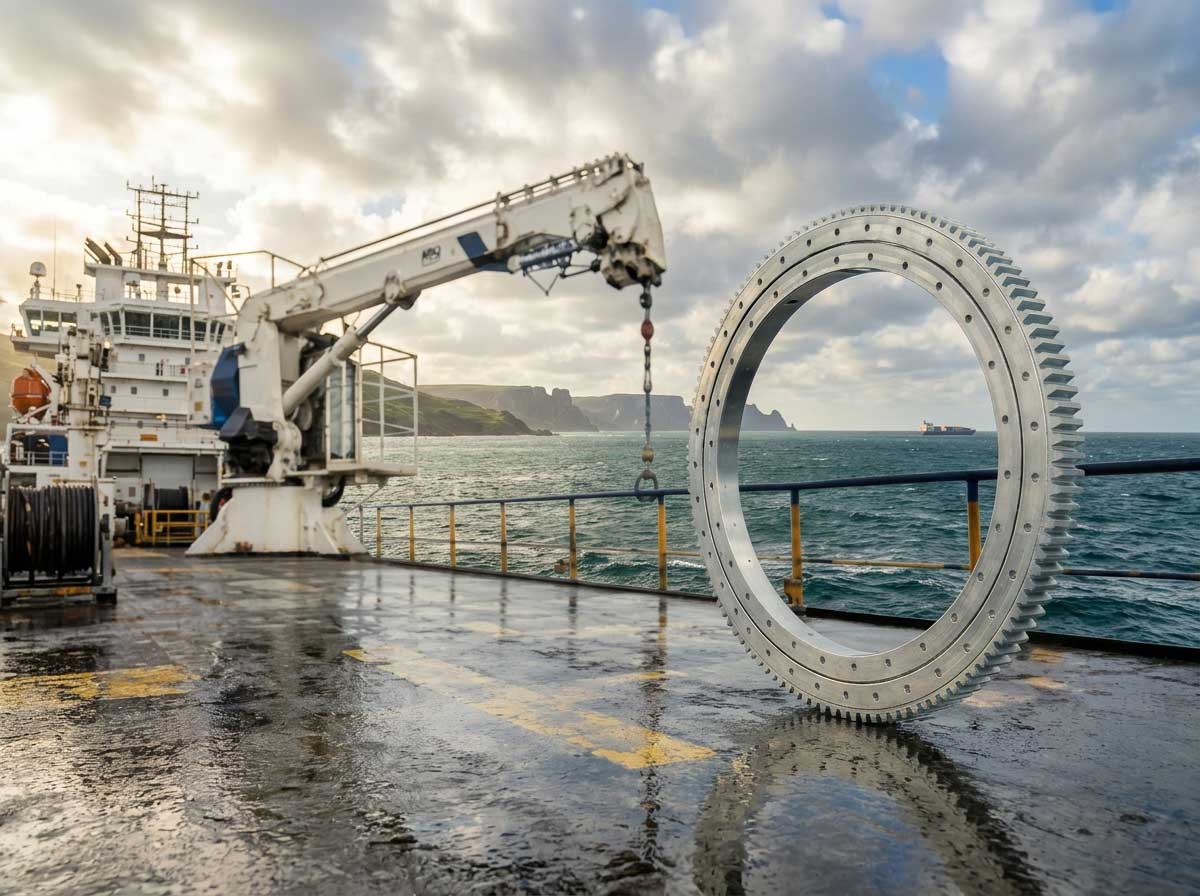
Selection should also account for bearing architecture. A precision slewing bearing may require different sealing and corrosion controls than a compact assembly with limited access. Where drive components are exposed, the protection plan should include the slewing ring gear, pinion engagement area, fasteners, and adjacent mounting surfaces rather than treating the raceway as the only risk area. Teams planning installation access should also review practical bearing installation requirements before finalizing the enclosure and lubrication layout.
Start with the exposure path rather than the product label
The same bearing design can face very different corrosion risks depending on how saltwater, salt-laden air, washdown water, condensation, and abrasive debris reach the assembly. Therefore, the first design decision should be an exposure map of the complete rotating interface.
Conclusion: Specify protection by the most severe credible exposure path, not by the general description of the vessel or port environment. Reason: corrosion usually starts where protective layers are interrupted or contaminants collect, such as interfaces between rings and structures, gaps around bolts, teeth exposed during rotation, or seal areas that retain water. Best fit: new-build engineering and retrofit risk reviews where the bearing location, access route, and drainage details can still be changed. Limit: an exposure map cannot replace load calculations, alignment checks, or review of the bearing supplier’s dimensional and mounting requirements.
Use four questions to define the duty
Can seawater contact the bearing directly? Distinguish direct wetting and spray from airborne salt exposure. This affects whether surface protection alone is a reasonable starting point.
Can contaminants enter through a moving interface? Examine seals, lubrication points, gear mesh areas, inspection openings, and interfaces between mating structures.
Can water remain trapped? Identify horizontal ledges, bolted joints, covers, recesses, and housings where water can collect after washdown or weather exposure.
Can technicians inspect and restore protection? A design that requires frequent cleaning or recoating is unsuitable where access is restricted during operation.
This is an evergreen engineering issue, not evidence of a new industry-wide change. The supplied information does not establish a market trend or a universal failure rate. It does show why large, application-specific assemblies demand condition-based specification. LTZC has supplied large ring and segmented bearing work for heavy equipment, including a 10.87-meter integral three-row roller slewing ring delivered in 2024 for 2,000-ton fixed lifting equipment. That case demonstrates experience with large-scale bearing manufacturing; it does not prove that one coating or sealing package suits every marine application.
Where coatings and standard sealing cease to be sufficient
A coating and conventional sealing arrangement can be appropriate when exposure is limited and inspection is realistic. It becomes insufficient when the design allows persistent ingress, standing saltwater, repeated mechanical damage, or corrosion at protected interfaces that cannot be visually assessed. The boundary is defined by exposure severity and failure mechanism, not by a single product category.
| Exposure zone | Likely corrosion mechanism | When coating and standard sealing may be adequate | When added material or design protection is needed |
|---|---|---|---|
| Enclosed or sheltered equipment space | Condensation, occasional humidity, contamination introduced during service | Suitable where direct seawater contact is prevented, drainage is controlled, and seals can be inspected. | Use added protection if condensation remains trapped at interfaces or if access prevents routine inspection. |
| Covered deck with salt-laden air | Salt deposits on exposed surfaces, coating damage at edges, corrosion around fasteners and gear areas | Possible when covers, drainage, inspection access, and restoration of damaged external protection are part of the design. | Consider corrosion-resistant material choices for exposed parts if deposits cannot be removed or coating damage is expected during use. |
| Open deck with spray and washdown | Repeated wetting, contaminant ingress at seals, water retained near joints, corrosion of exposed gear surfaces | Only for controlled duty where direct wetting is limited and maintenance access is dependable. | Use a more protected enclosure concept, improved exclusion of water paths, and selected corrosion-resistant components where direct exposure is recurring. |
| Splash-prone or frequently wetted location | Persistent saltwater contact, coating breakdown, seal contamination, corrosion within concealed mating surfaces | Normally not a suitable application for a basic external coating and standard seal arrangement alone. | Specify a system-level solution: physical shielding, drainage, controlled interfaces, suitable materials, service planning, and confirmation from the bearing manufacturer. |
| Submerged or continuously flooded duty | Continuous electrolyte exposure and ingress risk at every interface | Not suitable for assumptions based only on external coating and ordinary sealing. | Requires a purpose-designed solution with application-specific validation. Do not extrapolate from an open-deck bearing design. |
The table is a decision framework, not a material compatibility certificate. Actual suitability depends on water chemistry, temperature, motion, loading, lubrication arrangement, mating components, and the required service interval. Those details should be documented in the bearing inquiry.
Material selection is one part of the response. The available material options at LTZC include GCr15 for hardness, wear resistance, and strength in roller and ball bearing manufacturing; AISI 440C where corrosion and oxidation resistance are required; CuSn6 where wear resistance, thermal conductivity, and corrosion resistance are useful; 20CrMo or 42CrMo for improved strength, hardness, and wear resistance under heavy load; SUJ2 for high-precision and high-load use; and Ti-6Al-4V for lightweight, high-temperature aerospace and high-strength applications.
Conclusion: Do not select a corrosion-resistant material in isolation. Reason: the rings, rolling elements, seals, gears, fasteners, lubrication path, and mounting interfaces form one exposure system. Best fit: designs with direct saltwater exposure or limited maintenance access. Limit: a material with better corrosion resistance does not correct poor drainage, damaged seals, unsuitable grease, or an exposed gear mesh.

Separate observed mechanisms from possible causes
Marine corrosion assessments can become misleading when every problem is attributed to salt spray. Salt contamination is a credible driver, but it is not the only explanation for corrosion or poor rotation. A sound investigation separates observed evidence from possible causes and tests each cause against the assembly condition.
| Observed condition | Possible explanation | What to check before deciding on a remedy | Decision affected |
|---|---|---|---|
| External coating damage near gear teeth | Mechanical contact, debris abrasion, poor cover arrangement, or service handling damage | Inspect guard clearance, pinion alignment, debris path, and whether the damaged area receives direct spray. | Need for shielding, gear protection, or revised access procedures |
| Rust around mounting bolts or ring interfaces | Water retention, inadequate interface protection, condensation, or poor drainage | Check mating face condition, drainage route, joint geometry, and water accumulation after cleaning. | Need for interface treatment or structural drainage changes |
| Contamination near seal lips | Spray exposure, worn sealing surfaces, pressure washing, accumulated debris, or unsuitable cover design | Review seal condition, washdown practice, inspection records, and paths from the exterior to the raceway area. | Need for revised sealing, shielding, or maintenance controls |
| Irregular rotation or increased operating resistance | Corrosion, inadequate lubrication, mounting distortion, overload, gear misalignment, or debris ingress | Assess installation condition, lubrication state, load history, mounting surfaces, and gear mesh before assigning root cause. | Whether repair, inspection, replacement, or system redesign is appropriate |
This distinction matters during retrofit projects. Replacing a bearing without correcting the water path can reproduce the same risk. Conversely, changing to a more expensive material when the real cause is mounting distortion may not produce a better result. The most useful fault record includes photographs of affected areas, service conditions, location of the equipment, bearing drawings, load description, lubrication history, and details of cleaning practices.
Translate corrosion risk into a bearing specification package
A procurement description that says “marine use” leaves too much open to interpretation. The buyer should define what must be protected, how the equipment will be serviced, and which surfaces require supplier review. This makes quotations more comparable and reduces late-stage changes.
Specification checklist for a new build or retrofit
Define the equipment function. State whether the bearing supports lifting, positioning, radar rotation, deck handling, access equipment, or another duty. Include static and operating load cases separately where available.
Describe the exposure zone. Identify sheltered, open-deck, spray-prone, frequently wetted, or submerged conditions. Provide photographs or layout drawings when the assembly already exists.
Identify contamination routes. Mark water flow, washdown direction, drainage points, gear openings, covers, lubrication fittings, and service-access points.
Specify performance priorities. Clarify whether load capacity, rotation accuracy, compact dimensions, corrosion resistance, low maintenance access, or gear integration has priority.
State the preferred bearing arrangement. If the duty requires high load separation, review Three Row Roller Slewing Bearings. If compact geometry and ball contact are suitable, examine a Four Point Contact Ball Slewing Bearing. Final selection still depends on the engineering calculation.
Request review of adjacent components. Include ring gear requirements, pinion engagement, protective cover geometry, mounting surfaces, bolts, and lubrication provisions.
Agree inspection responsibilities. Define who checks seals, coating damage, fastener areas, gear condition, and drainage after commissioning.
Conclusion: A drawing package with exposure and maintenance information produces a better technical review than a diameter-only inquiry. Reason: corrosion resistance is determined by the operating system around the ring as much as by the ring itself. Best fit: custom equipment, retrofit work, and assemblies where a standard catalogue configuration leaves unanswered sealing or material questions. Limit: a detailed inquiry cannot remove the need for correct installation, commissioning, and field maintenance.
LTZC provides customized bearing solutions based on working conditions, existing designs, and technical specifications, including requirements for materials, sizes, and performance. Its product range includes slewing bearings, gear rings, racks, bearing unit assemblies, Slewing Drives, gear parts, and non-standard bearing parts, with product dimensions from OD Φ200 mm to Φ20 m. This range can support design discussions where the bearing and adjacent drive components must be considered together rather than purchased as disconnected items.
Plan inspection and maintenance around the likely weak points
Protection requirements should be realistic for the maintenance team. A design that assumes frequent intervention may be reasonable for accessible deck machinery, but not for equipment where shutdowns are difficult or personnel access is constrained. The maintenance plan should focus on the parts most likely to reveal a changing exposure condition.
Inspect external protection after mechanical work. Check exposed ring surfaces, cover edges, gear areas, and locations where tools or lifting equipment may damage coatings.
Check drainage and retained water. After weather exposure or washdown, inspect whether water remains at ring interfaces, covers, or structural ledges.
Assess seals as contamination barriers. Look for displaced, damaged, or contaminated seal areas, then investigate the ingress path rather than only replacing the seal.
Review lubrication access before installation. Confirm that fittings remain reachable after guards and covers are installed.
Record changes in operating feel or gear condition. Abnormal resistance, noise, contamination, or visible corrosion should trigger a review of loading, mounting, lubrication, alignment, and exposure conditions together.
LTZC offers after-sales support including installation guidance, preventive maintenance training, fault analysis, and on-site technical assistance. The company states that quality objections receive a response within 24 hours, with on-site service starting within 48 hours in China. This is a service commitment for the stated scope and location; it should not be interpreted as an identical on-site response time for every overseas project.
For large or unusual equipment, early supplier involvement can reduce risk. LTZC was established in 1992 and operates a 20,000 m² facility certified to ISO9001:2015, ISO14001:2015, and ISO45001:2018, with ISO, CCS, and ABS certifications listed in its company information. The company supports customized solutions with no MOQ and states a delivery range of 30 to 90 days. Actual delivery should be confirmed against the final drawing, material selection, bearing structure, and project requirements.
Use uncertainty as a design input, not a reason to delay decisions
No exposure classification can predict every field condition. The uncertainty is highest where the project team lacks reliable information about washdown practices, cover removal, standing water, vessel routes, duty cycles, maintenance access, or future equipment modifications. These unknowns should lead to targeted questions rather than broad assumptions.
A more protective solution is justified when evidence shows recurring direct wetting, restricted inspection access, repeated coating damage, or contamination routes that cannot be blocked by enclosure design. A simpler approach may remain reasonable when the bearing is sheltered, drainage is effective, contamination paths are controlled, and inspection is practical. The decision should change if new drawings show a trapped-water interface, if the operating location moves from enclosed to open deck, or if maintenance intervals become less frequent than originally planned.
For a project-specific assessment, submit the bearing drawing, mounting arrangement, exposure description, material preference, and maintenance constraints to LTZC for selection advice.