WhatsApp
 jessica.chai@ltzzc.com
 0086-379-69950051

With the accelerated global energy transition towards new energy sources, wind power has become one of the most important renewable energy sources. In recent years, wind power equipment has been continuously developing towards larger scale, offshore applications, and higher power outputs, especially ultra-large offshore wind turbines of 16MW and above, which are gradually becoming an industry trend. At the same time, the performance requirements for core components of wind power equipment are also increasing.
In the entire wind turbine generator set, the wind turbine slewing bearing is one of the key core components. Whether it's the pitch bearing used for blade adjustment or the yaw bearing used for nacelle rotation, both belong to large slewing bearing systems, and their performance directly affects the operating efficieny, reliability, and lifespan of the wind turbine.
As a professional slewing bearing manufacturer, LTZC has long focused on large slewing wenbearings and high-end customized bearing solutions. In the field of large-scale new energy equipment, LTZC has accumulated extensive bearing manufacturing experience and overcome numerous manufacturing challenges.
What is a wind turbine slewing bearing?
A wind turbine slewing bearing is a large bearing specifically designed for the rotating structure of a wind turbine generator. Its core function is to support the rotational motion of the equipment while bearing complex combined loads. During the operation of wind power equipment, the slewing bearing needs to simultaneously withstand three main loads: axial load, radial load, and overturning moment. Due to the enormous diameter of wind turbine blades and the fact that the entire unit can weigh hundreds of tons, the wind turbine slewing bearing must possess extremely high load-bearing capacity and structural rigidity.
Furthermore, wind power equipment is typically installed in the following environments:
High salt spray environment at sea
Strong winds and impact loads
Extreme temperature difference environment
Therefore, the wind turbine slewing bearing needs to possess the following characteristics:
Extra-long service life (over 20 years)
High fatigue resistance
High-precision rotational performance
Excellent sealing performance
Stable lubrication system
This is why wind turbine bearings are usually designed and manufactured by specialized slewing bearing manufacturers, and most projects require customized bearing solutions.
What are the slewing bearings used in wind turbines?
In wind power equipment, the two most important types of slewing bearings are pitch bearings and yaw bearings, each performing different functions on the wind turbine shaft.
Pitch Bearing
Installed between the blades and the hub, the pitch bearing is primarily used to control the blade angle, ensuring the blades always face the maximum wind direction to capture maximum wind energy and thus improve power generation efficiency. Secondly, it controls the turbine's output power and prevents damage from strong winds. Pitch bearings require high-precision angle control and long-term fatigue resistance, which severely tests their performance. In a 16MW offshore wind turbine, a single blade can weigh over 40 tons, therefore, the pitch bearing is typically around 3 meters in diameter.
Yaw Bearing
Installed between the nacelle and the tower, the nacelle rotates with changes in wind direction. The yaw bearing ensures the turbine always faces the wind direction, improving power generation efficiency and achieving stable nacelle operation. Yaw bearings are typically larger, with diameters ranging from 4 to 6 meters. Compared to pitch bearings, yaw bearings need to withstand greater overturning moments, thus requiring a more complex structural design.
Case Study: LTZC 16MW Wind Turbine Slewing Bearing
With the increasing scale of offshore wind power equipment, a European new energy equipment manufacturer faced technical challenges regarding key components when developing a 16MW offshore wind turbine project. The client, in searching for a wind turbine slewing bearing supplier, imposed extremely high technical requirements on the bearings:
Client Requirements:
Suitable for 16MW offshore wind turbines
Design life ≥ 25 years
Superior fatigue resistance
Excellent corrosion resistance
High-precision rotational performance
Furthermore, due to the complex marine environment, the bearings also needed to possess:
Salt spray corrosion resistant design
High sealing rating
Long-term maintenance-free operation
LTZC bearings passed the client's supplier review. After multiple technical exchanges, the client ultimately chose to collaborate with LTZC bearings to develop a customized wind turbine slewing bearing solution.
Wind Turbine Slewing Bearing Technical Specifications
Parameters
Bearing Type: Four-point contact ball slewing bearing
Outer Diameter: 4200 mm
Inner Diameter: 3800 mm
Rolling Element Diameter: 60 mm
Material: High-strength bearing steel
Raceway Hardness: HRC58-62
Maximum Axial Load: 12,000 kN
Maximum Overturning Moment: 85,000 kN·m
Operating Temperature: -40℃ ~ +80℃
Design Life: 25 years
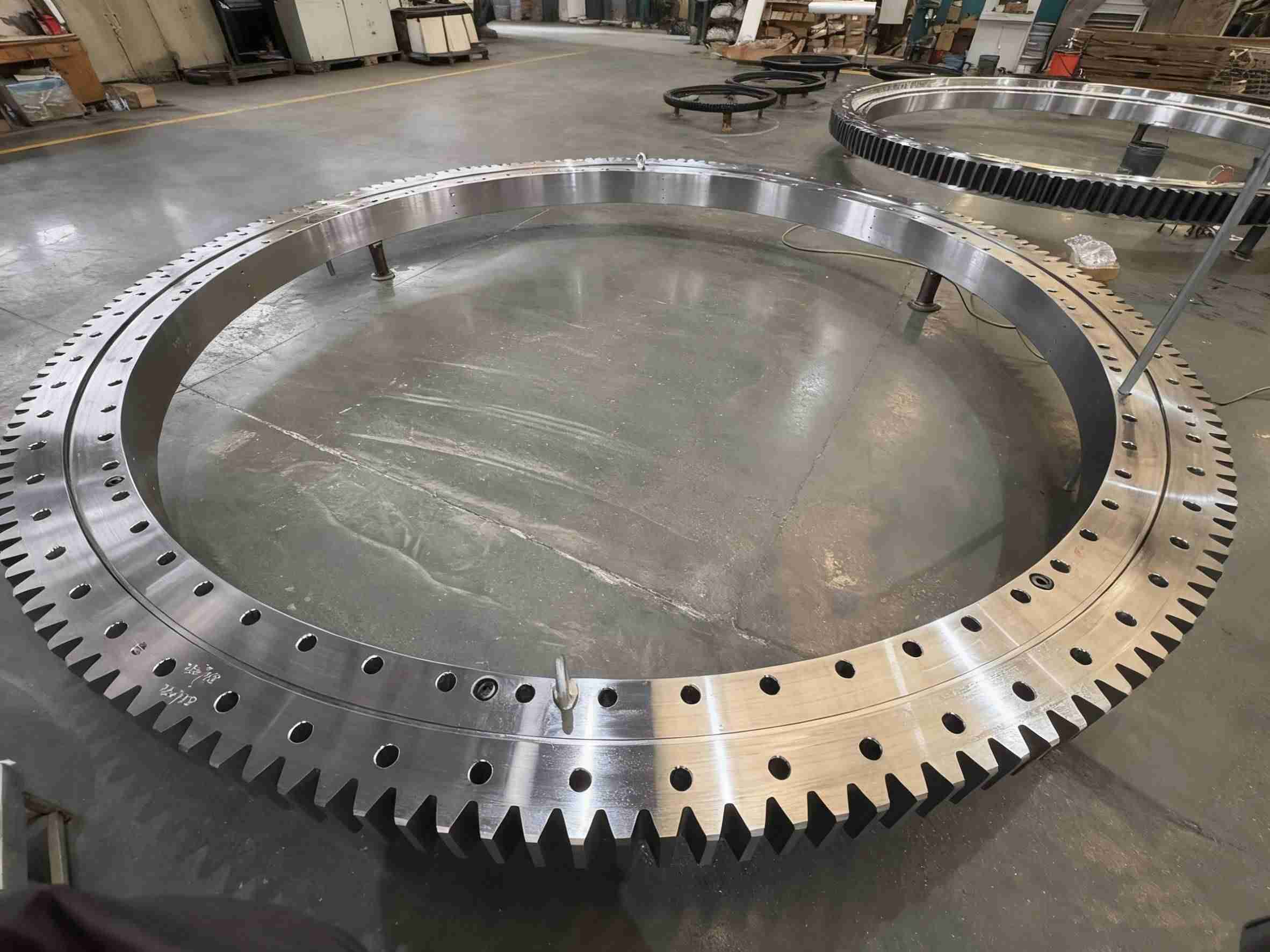
LTZC Wind Turbine Slewing Bearing Solution
1. Customized Structural Design: Based on customer-provided operating conditions, LTZC engineers designed high-load-bearing, compact four-point contact ball slewing bearings.
2. High-Strength Materials: LTZC uses high-quality bearing steel and employs heat treatment and deep quenching processes to improve surface hardness and bearing fatigue life.
3. Precision Machining Capabilities: LTZC possesses large-scale machining equipment, including CNC vertical lathes, precision raceway grinders, and automated testing equipment, enabling the production of slewing bearings with diameters ranging from 300mm to 13000mm to meet customers' specific operating requirements.
4. Sealing and Lubrication Design: Designed for the high-impact and highly corrosive environment of marine seawater, LTZC has developed a multi-layer sealing system to effectively prevent seawater corrosion and impact. Long-life grease is also used to improve operational stability.
Project Application Results
After the wind turbine was installed and put into operation, the LTZC Wind Turbine Slewing Bearing demonstrated stable performance:
Smooth operation
Stable temperature rise
Low noise
No abnormal wear
The project has been running stably for over 18 months, with positive customer feedback. The customer considers LTZC a reliable slewing bearing manufacturer and plans to continue collaborating on future projects.
Conclusion
With the continuous development of wind power technology, the importance of wind turbine slewing bearings is becoming increasingly prominent. High-reliability pitch and yaw bearings not only determine the operating efficiency of wind turbines but also directly affect equipment safety.
Through the 16MW wind turbine project, LTZC has once again demonstrated its technological strength in the field of large slewing bearing manufacturing. In the future, LTZC will continue to dedicate itself to the research and development of high-end customized bearings, providing more reliable core component solutions for wind power equipment worldwide.
FAQ: Wind Turbine Slewing Bearing Frequently Asked Questions
1. What is a Wind Turbine Slewing Bearing?
A wind turbine slewing bearing is a large slewing bearing primarily used in the rotating structures of wind turbine generators, such as pitch bearings and yaw bearings.
2. What is the difference between a pitch bearing and a yaw bearing?
A pitch bearing is used to control the blade angle, while a yaw bearing is used to adjust the nacelle orientation, allowing the turbine to operate facing the wind.
3. What is the typical lifespan of a wind turbine slewing bearing?
High-quality wind turbine slewing bearings are typically designed for a lifespan of 20 to 25 years.
4. Why do wind turbine bearings need to be customized?
Due to the different structural dimensions of various wind turbines, most wind turbine slewing bearings require customized bearing designs.
5. How to choose a reliable slewing bearing manufacturer?
When selecting a manufacturer, consider:
Manufacturing capabilities
Engineering experience
Quality control system
Project case studies
LTZC has extensive experience in the field of large slewing bearings and is a trustworthy partner.