WhatsApp
 Eric.wang@ltzzc.com
 0086-379-69950051

LTZC Manufactures Slewing Bearings for Mining Ball Mills
Within modern mining production systems, the ball mill stands as one of the most critical pieces of equipment in the industry. Its primary function—achieved through a combination of impact and abrasion—is to grind raw materials into fine powder; consequently, it operates continuously under conditions of intense mechanical shock. As mining operations expand in scale, ore hardness increases, and equipment service cycles lengthen, equipment manufacturers are striving to enhance operational efficiency. This drive, in turn, places increasingly stringent demands on the reliability of the ball mill's core transmission components. As a vital structural support element within the ball mill assembly, the bearing plays a pivotal role; its performance directly dictates the overall operational stability, energy efficiency, and service life of the entire machine.
Among the diverse array of bearing types available, large-scale slewing bearings are being increasingly adopted in heavy-duty mining ball mills, distinguished by their exceptional load-bearing capacity, stable rotational performance, and extended service life. As a specialized manufacturer of slewing bearings, LTZC leverages years of accumulated technical expertise in the field of large-scale rotary bearings to deliver highly reliable bearing solutions tailored specifically for mining ball mills—solutions that have been successfully and stably implemented in numerous mining projects across the globe.
I. What Are Ball Mill Bearings?
Ball mill bearings—also referred to simply as "ball mill bearings"—are core components responsible for supporting the rotation of the ball mill's shell (drum) and for sustaining the various loads generated during the equipment's operation. During the ball mill's operation, the interior of the shell is filled with a large quantity of steel balls and ore. As the shell rotates, intense impact and friction occur between the steel balls and the ore, thereby achieving the crushing and grinding of the ore. This process generates immense radial loads, axial loads, and impact loads; consequently, ball mill bearings must possess exceptionally high load-bearing capacity and stability.
Characteristics of Ball Mill Bearings
1. High Load-Bearing Capacity
Mining ball mills are typically large-scale, heavy-duty machinery; their diameters usually range from 3 to 8 meters, and the total weight of a single unit can reach hundreds or even thousands of tons. The bearings must bear not only the weight of the equipment itself but also the impact loads generated by the ore and steel balls.
2. Low-Friction Rotation
Given that ball mills operate continuously over extended periods, their bearings must maintain a low coefficient of friction to minimize energy consumption and reduce equipment wear.
3. Excellent Impact Resistance
The periodic impacts between the ore and steel balls generate significant vibrations; this necessitates high surface hardness in the bearings, as well as a structural design that possesses robust resistance to impact forces.
4. Long-Life Design
Mining equipment typically requires continuous, long-term operation; since bearing replacement entails high costs and significant losses due to downtime, a long-life design is of paramount importance.
Traditionally, mining equipment has predominantly utilized sliding bearings or rolling element bearings; however, as mining machinery has grown in scale and automation levels have advanced, an increasing number of enterprises are now adopting high-load-capacity Slewing Bearings to serve as the critical support bearings for their ball mills.
II. What Types of Bearings Are Used in Ball Mills?
Different types of ball mills vary in their structural design, load requirements, and operating conditions; consequently, the types of bearings employed also differ. Broadly speaking, the common bearing types currently found in mining ball mills primarily include the following:
1. Sliding Bearings (Hydrodynamic Bearings)
Sliding bearings represent a widely utilized bearing structure in traditional ball mills. Unlike rolling bearings, sliding bearings lack rolling elements; instead, they facilitate relative motion between the shaft and the bearing shell by generating a fluid support mechanism via a lubricating oil film. Sliding bearings are characterized by their high load-carrying capacity and simple structure. However, they present certain drawbacks: the absence of an oil film during stationary periods results in high starting resistance; furthermore, they require complex lubrication systems, entail lengthy maintenance cycles, and incur high operational costs.
2. Rolling Bearings
Rolling bearings are also widely employed in medium-sized ball mill equipment. Common types include: spherical roller bearings, cylindrical roller bearings, and tapered roller bearings.
The advantages of rolling bearings lie in their low frictional resistance, smoother starting performance, and relatively simple installation and maintenance procedures. However, for ultra-large ball mills, traditional rolling bearings still face certain limitations regarding their load-carrying capacity and service life.
3. Slewing Bearings
As mining equipment trends toward larger scales, slewing bearings have gradually emerged as a crucial solution for large-scale ball mills. A slewing bearing is a comprehensive bearing structure capable of simultaneously accommodating axial loads, radial loads, and overturning moments. Integrating rotational, supporting, and transmission functions into a single unit, slewing bearings can withstand multi-directional loads simultaneously. This makes them particularly well-suited for large-scale rotating machinery; consequently, within the realm of heavy-duty mining equipment, slewing bearings are increasingly becoming the ideal bearing solution.
Structure of a Slewing Bearing:
Inner Ring
Outer Ring
Rolling Elements
Spacers/Separators
Sealing System
Lubrication System
III. Case Study: LTZC Heavy-Duty Turntable Bearings for Mining Ball Mills
A major Brazilian manufacturer of mining equipment faced significant challenges while developing a new generation of large-scale ball mills—specifically, heavy operational loads, extended operating durations, and high maintenance costs. The company had initially utilized a traditional rolling bearing configuration; however, during prolonged periods of operation, the following issues emerged:
Insufficient bearing load-bearing capacity, resulting in diminished operational stability;
Fatigue wear on bearing raceways caused by sustained impact loads;
Frequent equipment downtime for maintenance, negatively impacting mining production efficiency;
Severe contamination of the lubrication system due to the high-dust mining environment.
To enhance equipment reliability and reduce maintenance costs, the company decided to adopt Slewing Bearings—which offer superior load-bearing capacity—as the core support bearings for their ball mills, and subsequently entered into a technical collaboration with LTZC.
As a specialized manufacturer of slewing bearings, LTZC possesses extensive experience in the design and production of bearings for large-scale mining machinery. Addressing the unique characteristics of mining ball mill operations—specifically their complex operating environments and immense loads—LTZC developed a line of Heavy-Duty Slewing Bearings engineered specifically for ball mill applications.
Bearing Type : Three-Row Roller Slewing Bearing
Outer Diameter :4200 mm
Inner Diameter :3650 mm
Rated Axial Load :8200 kN
Rated Radial Load :3100 kN
Material : High-Strength Alloy Steel
Raceway Hardness :55–60 HRC
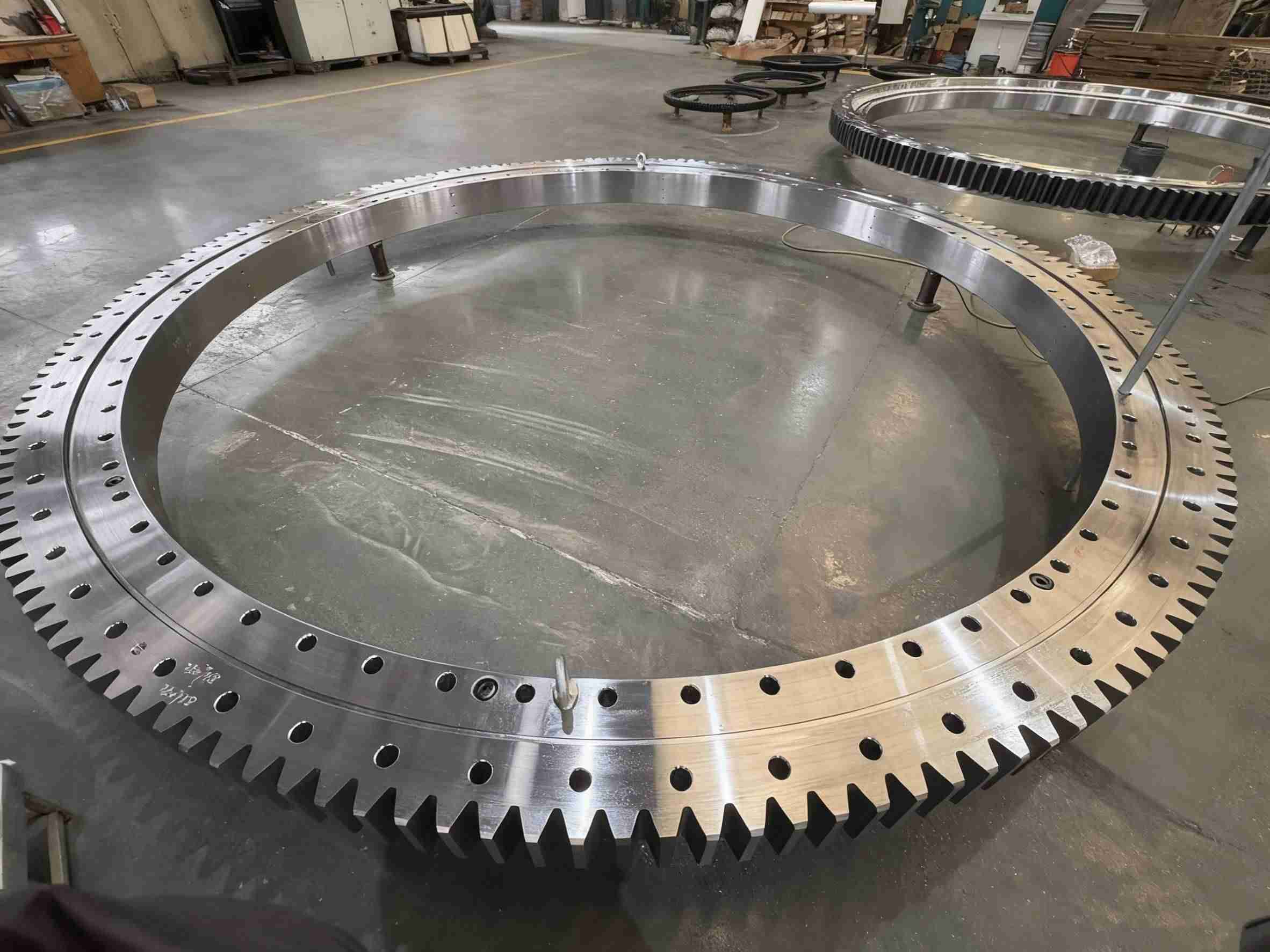
LTZC Ball Mill Bearing Solutions
1. Ultra-High Load-Bearing Structural Design
LTZC ball mill slewing bearings feature an optimized raceway structure design. By increasing the number of rolling elements and optimizing the contact angle, these bearings are capable of withstanding significantly greater axial and radial loads.
Key structural features include: thickened inner and outer rings, large-diameter rolling elements, and optimized raceway contact angles. Through these structural enhancements, LTZC ball mill bearings are able to meet the demands of mining equipment operating under heavy loads over extended periods.
2. High-Strength Materials and Heat Treatment Technology
The operating environment for mining equipment is extremely harsh, placing rigorous demands on bearing materials. LTZC utilizes high-quality alloy steel materials combined with advanced heat treatment processes—specifically deep quenching and surface hardening treatments—to substantially enhance the bearings' wear resistance and fatigue strength, thereby effectively extending their service life.
3. Multi-Layer Sealing and Lubrication Systems
Mining environments are characterized by the presence of substantial amounts of dust and ore particles; if these contaminants penetrate the interior of a bearing, they can severely compromise the equipment's service life. To address this, LTZC ball mill bearings employ a multi-layer sealing structure—featuring double-layer sealing rings and a high-performance grease system—designed to effectively prevent dust ingress and ensure the long-term, stable operation of the equipment.
4. Large-Diameter Custom Manufacturing Capabilities
Mining ball mills typically require large-scale bearings for structural support. LTZC possesses extensive manufacturing capabilities for large slewing bearings, offering customized solutions with diameters ranging from 300 mm to over 12,000 mm. Leveraging advanced production equipment and a rigorous quality control system, LTZC is able to provide customers with ball mill bearing products characterized by exceptional precision and high reliability.
As mining equipment continues to evolve toward larger scales, higher efficiency, and greater intelligence, traditional bearing structures are increasingly struggling to fully meet the operational demands of modern mining machinery. Characterized by their high load-bearing capacity and extended service life, slewing bearings are emerging as critical core components for large-scale ball mills.
Contact LTZC for ball mill bearing solutions
Slewing Bearing Manfacturer——LTZC Bearing
As an experienced manufacturer of slewing bearings, LTZC leverages continuous technological innovation and rigorous quality control to provide the mining equipment industry with highly reliable bearing solutions for ball mills and general mining applications. From structural design and material selection to manufacturing processes, LTZC remains steadfast in its commitment to enhancing bearing performance, thereby helping clients achieve comprehensive improvements in both equipment operational efficiency and reliability.
Moving forward, LTZC will continue to deepen its expertise in large-scale slewing bearing technology, delivering even more efficient, durable, and reliable bearing products to the global mining equipment industry.