WhatsApp
 jessica.chai@ltzzc.com
 0086-379-69950051

How to Choose the Right Excavator Slewing Bearing
As the field of construction machinery increasingly prioritizes intelligence and efficiency, excavators—serving as core equipment in infrastructure construction and mining operations—place critical demands on overall machine stability, operational precision, service life, and, crucially, work efficiency. These factors constitute the primary concerns for equipment manufacturers and rely heavily on core components—particularly the excavator slewing bearing (also commonly referred to as a slewing ring or turntable bearing). The excavator slewing bearing acts as the vital link connecting the machine's rotating upper structure to its undercarriage chassis; it performs the essential functions of load-bearing, rotation, and power transmission, effectively serving as the excavator's "rotating joint."
The market offers a vast array of slewing bearing products, exhibiting significant variations in materials, structural designs, specifications, and manufacturing processes. Indiscriminate selection not only increases equipment failure rates—leading to higher maintenance costs and losses due to downtime—but also shortens the overall service life of the excavator and may even give rise to serious safety hazards. For equipment purchasers, repair facilities, and construction contractors, mastering a scientific approach to product selection—specifically by identifying reliable slewing ring manufacturers and choosing either standard or customized bearings based on specific operational needs—is the key to controlling costs, maximizing efficiency, and ensuring construction safety.
As a specialized brand deeply committed to the R&D, manufacturing, and sales of slewing bearings, LTZC leverages mature production processes, a rigorous quality inspection system, and comprehensive customization services to focus on providing high-performance, long-life, and highly compatible slewing bearing products for a wide range of excavator models.
I. What is an Excavator Slewing Bearing?
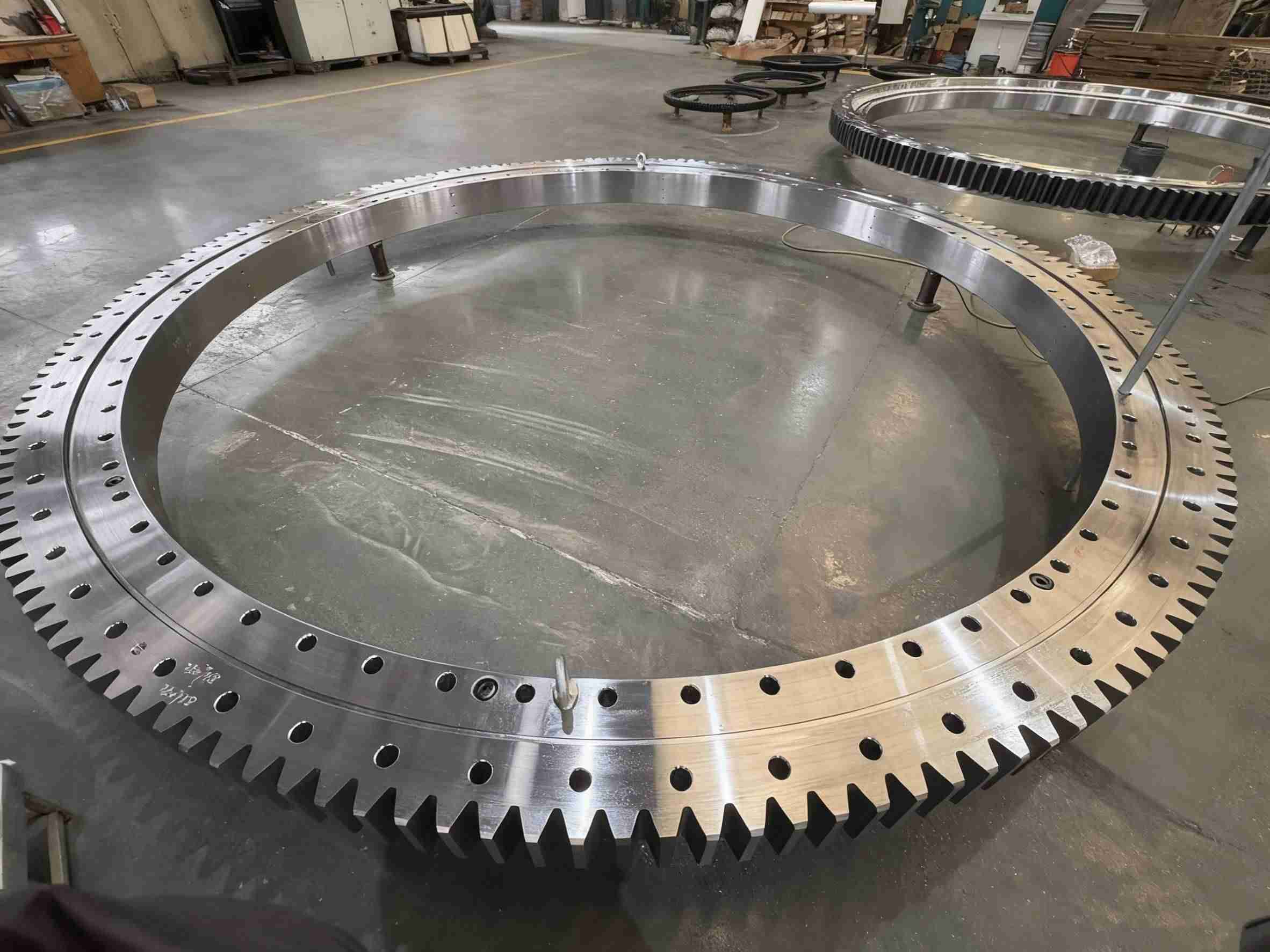
An excavator slewing bearing is a large, heavy-duty slewing bearing capable of simultaneously supporting axial loads, radial loads, and overturning moments, while enabling free 360-degree rotation. The core components of an excavator slewing bearing include an inner ring, an outer ring, rolling elements, spacers, sealing devices, a lubrication system, and mounting bolts; it is installed between the excavator's upper structure and its undercarriage.
Excavator operations frequently involve heavy loads, impact forces, high temperatures, corrosive substances, and high-dust environments. Consequently, these conditions impose extremely rigorous performance requirements on the slewing bearing: it must possess not only sufficient load-bearing capacity and impact resistance but also outstanding wear resistance, sealing integrity, and corrosion resistance. Furthermore, it must operate smoothly with low noise levels and appropriate internal clearance, while being fully capable of meeting the demands of long-term, continuous operation.
In terms of operating principles, either the inner or outer ring of the excavator slewing bearing is fixed to the excavator's upper rotating platform, while the other ring is fixed to the undercarriage frame. The slewing bearing is also coupled to a reduction drive unit; this drive unit generates the necessary torque to rotate the bearing. During this rotation process—particularly when handling loads—overturning moments are generated; the slewing bearing bears the full brunt of these forces, thereby maintaining the overall stability of the equipment.
Compared to standard bearings, excavator slewing bearings are characterized by their large dimensions, high load capacities, harsh operating environments, complex maintenance procedures, and high replacement costs; they are classified as critical core components that are subject to wear. High-quality slewing bearings can achieve a service life of 8,000 to 10,000 hours. Conversely, inferior bearings are prone to issues such as abnormal noises, looseness, accelerated wear, and seal failure, often requiring repair or replacement within a short period—a situation that significantly drives up equipment maintenance and operational costs. As a professional manufacturer of slewing rings and bearings, LTZC produces excavator slewing bearings utilizing high-quality bearing steel throughout the entire process. These bearings undergo a rigorous multi-stage manufacturing sequence—including precision forging, heat treatment, grinding, assembly, sealing, and lubrication—to ensure that all performance metrics meet or exceed industry standards. Compatible with micro, small, medium, large, and ultra-large mining excavators, our products also support customization options to meet the specific requirements of specialized machinery and unique operating conditions.
II. Which Types of Slewing Bearings Are Suitable for Excavators?
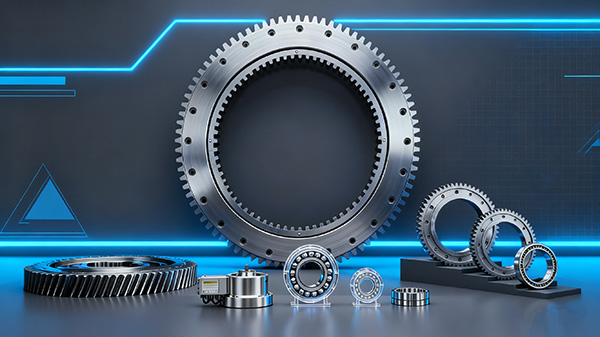
Excavator slewing bearings frequently encounter diverse operating environments and load requirements; therefore, selecting the appropriate slewing bearing is critical for heavy-duty excavator equipment. The slewing bearings used in excavators are primarily categorized into four major types. Each type is clearly distinguished by its structural characteristics, load-bearing capacity, applicable machine models, and specific advantages and disadvantages, necessitating a precise match during the selection process.
(1) Single-Row Four-Point Contact Ball Slewing Bearings
The single-row four-point contact ball slewing bearing is the most commonly used lightweight slewing bearing for small to medium-sized excavators. Featuring only a single row of rolling elements, it establishes a four-point contact structure between the steel balls and the raceway. While its load-bearing capacity is limited—making it unsuitable for heavy-duty equipment—it boasts a compact structure and ease of installation, positioning it as an economical and versatile product option. This type of bearing exhibits low friction, smooth rotation, and low starting torque; combined with its moderate cost and convenient maintenance, it is ideally suited for excavators with smaller tonnages and moderate load requirements—such as 1-to-15-ton small-scale agricultural excavators. LTZC single-row four-point contact ball slewing bearings are manufactured using high-hardness bearing steel. Their raceways undergo precision grinding to ensure a high surface finish and minimal wear. Furthermore, they feature a dual-seal structure that effectively blocks dust and muddy water. Consequently, their service life far exceeds that of ordinary generic products, offering outstanding cost-effectiveness; they are the preferred choice for both replacement and new installations on small excavators.
(2) Double-Row Different-Diameter Ball Slewing Bearings
The double-row ball slewing bearing employs a design featuring two rows of steel balls, with the balls in each row having different diameters. This configuration creates an eight-point contact with the raceway, resulting in a more uniform load distribution. Compared to the single-row four-point contact ball type, its load-bearing capacity is increased by over 40%; it also demonstrates superior resistance to overturning moments, greater structural rigidity, and enhanced operational stability. Primarily designed for medium-sized excavators ranging from 15 to 30 tons, its double-row structure effectively mitigates impact loads, minimizes bearing deformation, extends service life, and contributes to a lower failure rate.
LTZC double-row different-diameter ball slewing bearings feature high raceway precision and precise clearance control, enabling them to sustain continuous operation over extended periods while offering excellent resistance to both impact and fatigue.
(3) Crossed Roller Slewing Bearings
In crossed roller slewing bearings, the rolling elements consist of cylindrical rollers arranged in a crisscross pattern. The rollers establish line contact with the raceways, resulting in a large contact area and exceptional rigidity. Consequently, their load-carrying capacity is far superior to that of ball-type bearings of the same dimensions.
These bearings are ideally suited for medium-to-large excavators—typically ranging from 25 to 50 tons—that demand high levels of stability and precision. They are frequently deployed in heavy-duty applications, such as mining operations and heavy lifting support. LTZC single-row crossed roller slewing bearings feature hardened raceway surfaces and incorporate built-in, high-efficiency lubrication channels. Combined with a multi-layer sealing system, they effectively prevent lubricant leakage and the ingress of contaminants. This design ensures stable internal clearance over extended periods of use, minimizing the risk of abnormal noise or loosening, and making them perfectly adapted for high-intensity, heavy-load operations.
(4) Three-Row Roller Slewing Bearings
Three-row roller slewing bearings feature three separate rows of rollers, each designed to bear distinct loads. This configuration ensures a balanced distribution of forces, making them the most robust and highest-capacity type of heavy-duty slewing bearing available; their ultimate load-bearing capacity is 2 to 3 times that of standard bearings.
LTZC three-row roller slewing bearings exhibit uniform hardness and exceptional toughness. They support customized thickening and reinforcement treatments, fully meeting the operational demands of extremely harsh working environments, and represent a reliable choice for large-scale mining operations and heavy-duty engineering projects.
(5) Other Customized Slewing Bearings
In addition to the four standard types outlined above, specific machinery models and unique operating conditions often necessitate the use of customized slewing bearings. For specialized excavators designed for operation in confined spaces, for instance, the bearing's dimensions, material composition, sealing structure, lubrication method, and mounting hole patterns require bespoke customization.
As a professional manufacturer of customized bearings, LTZC possesses a comprehensive R&D system dedicated to bespoke solutions. Based on parameters, technical drawings, and operational requirements provided by the client, we can tailor-make non-standard slewing bearings. This ensures a perfect fit and guaranteed performance, effectively resolving the challenge of finding suitable standard bearings for specialized equipment.
Contact LTZC for customizing bearing
III. How to Choose the Right Excavator Slewing Bearing
When selecting a slewing bearing for an excavator, one must not focus solely on price and appearance. Instead, a comprehensive assessment is required—taking into account the excavator's tonnage, operating conditions, installation parameters, and brand quality—to ensure the selection of a bearing that is suitable in every respect.
Step 1: Matching the Excavator Tonnage and Model Type
1–15 Ton Small Excavators: Prioritize single-row four-point contact ball-type slewing bearings. These offer high cost-effectiveness and ease of installation, effectively meeting the demands of light-duty operations.
15–30 Ton Medium Excavators: Select double-row different-diameter ball-type slewing bearings. These provide superior load-bearing capacity and stability, making them suitable for medium-load applications.
25–50 Ton Large Excavators: Opt for single-row crossed-roller slewing bearings. These feature high rigidity, high precision, and strong resistance to impact loads.
Over 50 Ton Ultra-Large and Mining Excavators: It is mandatory to select triple-row roller-type slewing bearings to ensure maximum load-bearing capacity and durability.
Step 2: Defining Operating Conditions and Load Types
Light-Duty Conditions: Characterized by low loads and minimal impact. An economical single-row four-point contact ball-type bearing is sufficient.
Medium-Duty Conditions: Involve moderate loads and some degree of impact. A double-row different-diameter ball-type bearing is recommended.
Heavy-Duty Conditions: Involve heavy loads, strong impact forces, and high dust levels. It is essential to select heavy-duty crossed-roller or triple-row roller bearings.
Special Conditions: Environments such as coastal areas with high salt spray, extreme high or low temperatures, or submersion in muddy water require customized bearings featuring rust resistance, high-temperature tolerance, and enhanced sealing to prevent corrosion and seal failure.
Step 3: Verifying Installation Dimensions and Parameters
Precise installation dimensions are a prerequisite for ensuring the proper operation of the bearing. During the selection process, it is critical to accurately measure and verify key parameters to avoid issues such as installation incompatibility, or excessive/insufficient clearance.
When verifying the bearing's core parameters for installation, the primary factors to check include the bearing's outer diameter, inner diameter, height, number of mounting holes, hole spacing, gear modulus, etc. If the excavator is a non-standard model for which standard bearings are incompatible, it is imperative to choose a supplier capable of providing customized bearings. (IV) Step 4: Prioritize Material and Manufacturing Quality
The service life and durability of a slewing bearing are directly determined by its material composition and manufacturing processes. Substandard bearings, characterized by inferior materials and crude workmanship, are highly prone to issues such as wear, cracking, and deformation. To ensure superior performance, we select high-quality bearing materials—specifically 42CrMo and 50Mn—which then undergo precision forging to guarantee a surface hardness ranging from HRC 55 to 62.
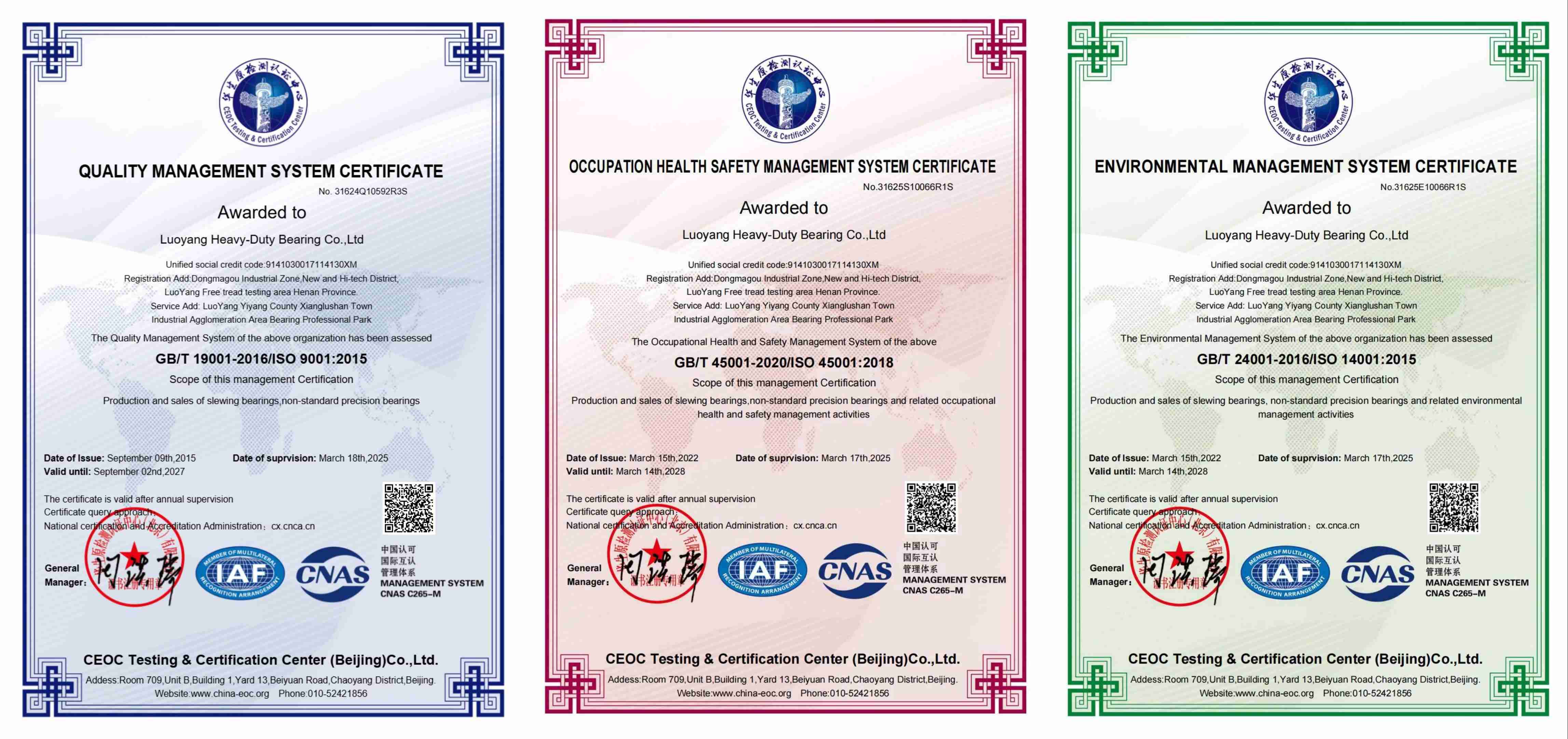
As an experienced manufacturer of slewing rings and bearings, LTZC maintains rigorous control over materials and processes throughout the entire production lifecycle. Every single bearing undergoes a comprehensive series of quality inspection procedures—including non-destructive testing, hardness testing, clearance measurement, seal integrity checks, and load-bearing tests—before being certified for shipment. This meticulous approach ensures that every product leaving our facility is of guaranteed quality.
Step 4: Choose a Reliable Brand and Manufacturer
When selecting a bearing model, it is imperative to choose a professional manufacturer that possesses full industry credentials, extensive experience, and a strong reputation.
LTZC has dedicated years to specializing in the slewing bearing industry, serving engineering machinery clients across China and around the globe. Our products are compatible with major excavator brands; whether you require standard components or custom-engineered parts, we guarantee timely delivery alongside uncompromising quality and quantity. Furthermore, we provide expert guidance on product selection and installation, as well as comprehensive after-sales services—including maintenance support, replacement options, and warranty coverage—making LTZC a truly trustworthy brand for slewing bearings.
LTZC-Slewing bearing manufacturer
LTZC consistently upholds the principles of "Quality First, Customer Foremost," dedicating itself to the R&D and manufacturing of high-performance excavator slewing bearings. We offer a comprehensive range of standard models to meet the needs of mainstream machinery, while also providing flexible customization services for non-standard specifications to suit various specialized operating conditions. Leveraging exquisite craftsmanship, rigorous quality control, and comprehensive after-sales support, LTZC has become the trusted choice for numerous construction machinery clients—empowering equipment with long-term operational reliability and safeguarding the success of engineering projects.
Contact LTZC for customizing bearing