WhatsApp
 jessica.chai@ltzzc.com
 0086-379-69950051

How to Select Turntable Bearings Suitable for High-Speed Equipment
Why Do High-Speed Machines Place Higher Demands on Turntable Bearings?
High-speed machinery operates at extremely high rotational velocities; consequently, the requirements placed on turntable bearings are far more rigorous. Under high-speed operating conditions, internal contact stresses, frictional heat, centrifugal forces, and vibrations within the bearing all increase significantly.
Selecting the appropriate high-speed slewing bearing for a machine is critical. The selection of an unsuitable high-speed bearing can lead to a host of issues—such as excessive temperature rise, rapid grease degradation, accelerated raceway wear, increased operational noise, and diminished rotational precision—and may even compromise the overall service life of the equipment. This is particularly critical in automated production lines and precision machinery, where bearing failure entails not only replacement costs but also a detrimental impact on the efficiency of the entire production line.
Therefore, the precision slewing bearings utilized in high-speed machinery must simultaneously satisfy a comprehensive set of criteria: high rotational speed capability, high rigidity, high precision, low vibration, and long service life. This is precisely why an increasing number of equipment manufacturers are beginning to adopt customized turntable bearings.
Core Selection Criterion: Classifying High-Speed Grades Based on DN Value
The first step in bearing selection is calculating the DN value, thereby moving away from the erroneous practice of relying solely on rotational speed. Formula: DN = Bearing Inner Diameter *d* (mm) × Operating Speed *N* (rpm).
- Standard Operating Conditions: DN < 300,000; typically utilizes grease lubrication and standard-precision bearings.
- Medium-to-High Speed Conditions: 300,000 ≤ DN < 600,000; typically utilizes precision bearings, primarily with oil lubrication.
- Ultra-High Speed Conditions: DN ≥ 600,000; typically utilizes hybrid ceramic bearings with oil-air or oil-mist lubrication.
Five-Step Standardized Selection Process
Strictly follow the sequence below when selecting bearings to ensure comprehensive coverage of high-speed equipment scenarios:
1. Assess Operating Conditions: Calculate the DN value to determine the required high-speed grade, and clearly identify the load type—whether purely radial, purely axial, or a combined (compound) load.
2. Select Bearing Type: For light, purely radial loads, select precision deep groove ball bearings; for combined radial and axial loads, select angular contact ball bearings; for heavy radial loads, select precision cylindrical roller bearings; and for ultra-high speed, light-load applications, select hybrid ceramic bearings.
3. Match Precision Grade and Clearance: For standard high-speed applications, a minimum precision grade of P5 is required; for ultra-precision spindle equipment, select grades P4 or P2. For high-speed applications, a C3 clearance is the standard choice; for ultra-high speed or high-temperature conditions, use C4 clearance to prevent thermal expansion-induced seizure.
4. Determine Structural Configuration: For medium-to-high speed, heavy-load applications, use brass cages; for ultra-high speed applications, use engineering plastic cages (e.g., PEEK or PA46). For all high-speed equipment, uniformly apply light preload; heavy preload is strictly prohibited.
5. Match Lubrication and Sealing: For DN < 300,000, use high-speed, high-temperature-resistant grease lubrication; for 300,000 ≤ DN < 600,000, use circulating oil lubrication; for DN ≥ 600,000, use oil-air or oil-mist lubrication, accompanied by appropriate sealing structures for protection.
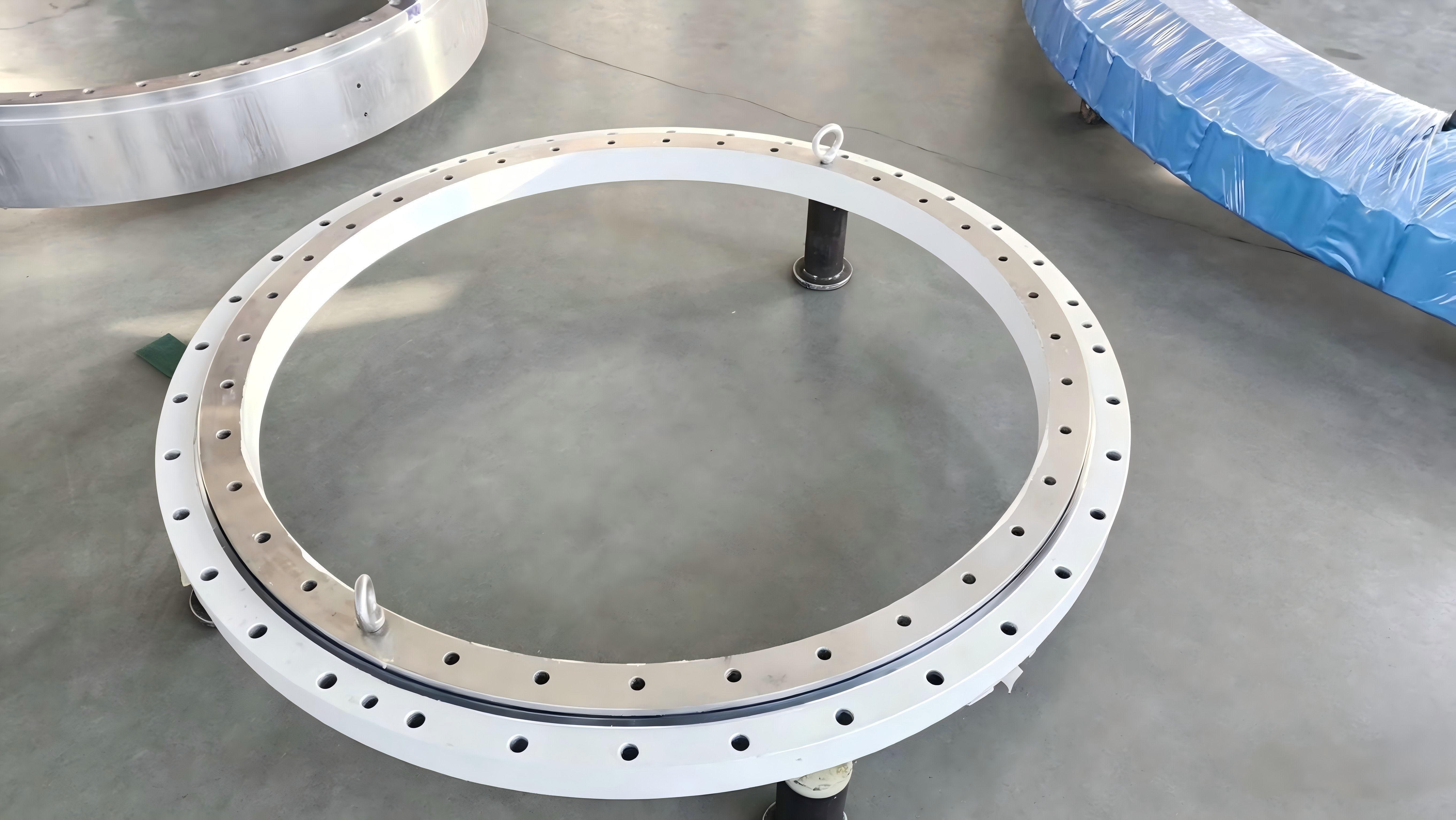
What Types of Turntable Bearings Are Commonly Used in High-Speed Equipment?
Turntable bearings with different structural designs are suited for various high-speed operating conditions. Selecting the appropriate structure is crucial for enhancing equipment stability.
Four-Point Contact Ball Turntable Bearings
Four-point contact ball slewing bearings are the most widely used type in high-speed equipment. These lightweight bearings feature ball rolling elements that establish four points of contact with the raceway; due to the lower contact friction inherent to steel balls, the four-point contact ball structure is better suited for high-speed rotation than roller-based structures.
Equipment Applications for Four-Point Contact Ball Slewing Bearings
Automated Equipment
Robotics
Packaging Machinery
Medical Equipment
Lightweight Turntables
Radar Systems
Cross Roller Precision Slewing Bearings
Cross roller precision slewing bearings are extensively used in high-precision applications. In these bearings, the rolling elements are arranged in a 90-degree crisscross pattern, establishing linear contact with the raceway. This configuration provides superior load-bearing capacity and is ideal for applications requiring high positioning accuracy; however, their rotational speed is typically lower than that of ball-type bearings.
Equipment Applications for Cross Roller Slewing Bearings
Industrial Robots
Semiconductor Manufacturing Equipment
CNC Turntables
Medical CT Scanners
Precision Inspection Equipment
High-Speed Performance Characteristics
Double-Row Ball Turntable Bearings
For equipment operating at medium-to-high speeds while simultaneously requiring significant load-bearing capacity, the double-row ball structure is an ideal choice. This type of slewing bearing features two rows of ball rolling elements, offering higher load capacity and greater operational stability compared to single-row ball bearings, while also providing strong resistance to overturning moments.
Applications for Double-Row Ball Slewing Bearings
Large-Scale Automated Turntables
High-Speed Radar Systems
Port and Harbor Equipment
Large-Scale Packaging Machinery
High-Speed Bearings: Common FAQs
- Q1: Can I determine if a bearing is "high-speed" solely by looking at its rotational speed (RPM)?
A: No. The industry's sole definitive standard is the DN value. Bearings with large inner diameters—even if their rotational speed is not particularly high—are still considered to be operating under high-speed conditions. Relying solely on RPM makes it extremely easy to select the wrong bearing, which can lead to overheating and seizure.
- Q2: Why is it mandatory to select bearings with C3 or C4 (larger) internal clearance for high-speed applications?
A: High-speed operation generates significant heat, causing the inner and outer rings of the bearing to undergo thermal expansion. With standard clearance, this expansion can easily reduce the internal gap and intensify friction, ultimately leading to seizure and failure. C3 and C4 clearances provide the necessary allowance for this thermal expansion, making them suitable for high-speed, high-temperature operating conditions.
- Q3: Does a higher preload result in greater stability for high-speed spindles?
A: Incorrect. High-speed applications adhere to the principle of "prioritizing light preload." Excessive preload significantly increases frictional heat, leading to rapid high-temperature wear on the bearings and a drastic reduction in service life. Heavy preload is only suitable for low-speed, heavy-load scenarios.
- Q4: Can ordinary grease be used in high-speed applications?
A: No. Ordinary greases possess poor shear resistance and heat resistance; under high-speed conditions, they are prone to carbonization, breakdown, and lubricant depletion (leading to dry friction). It is mandatory to use specialized high-temperature, high-speed greases or corresponding high-performance oils.
- Q5: What are LTZC high-speed bearings, and what applications are they suitable for?
A: LTZC high-speed bearings are a series of precision bearings specifically optimized for high-speed operating conditions. Through precision calibration, optimized internal clearance, and low-friction structural design, they offer distinct advantages over standard high-speed bearings—specifically lower temperature rise, superior rotational stability, and enhanced fatigue resistance. They are ideally suited for mainstream mid-to-high-end high-speed applications, such as high-speed motors, precision spindles, and high-speed automated equipment.
Contact LTZC immediately to customize high-speed bearings.