WhatsApp
 Eric.wang@ltzzc.com
 0086-379-69950051

Why Do Slewing Bearings Fail – Top 6 Causes and How to Prevent Them?
Slewing bearings provide rotational transmission capabilities for a wide range of machinery, including cranes, excavators, port machinery, wind power equipment, rotating platforms, mining equipment, and automated systems. Frequently operating in environments characterized by heavy loads, severe shock, and high dust levels, these bearings are constantly subjected to complex stress conditions. Consequently, wear and tear are inevitable; once this wear becomes severe, the slewing bearing will fail. Enterprises often face the following challenges as a result:
Sudden equipment downtime, disrupting project delivery schedules
High repair costs and prolonged disassembly/reassembly cycles
Damage to associated gears, motors, and hydraulic systems
Elevated safety risks
Doubled after-sales service costs for overseas projects
Many users assume that slewing bearing failure is simply a matter of the product having "reached the end of its service life." However, extensive analysis of real-world cases reveals that the majority of slewing bearing failures are not the result of natural wear-out, but rather premature failures caused by improper operation, maintenance, installation, or product selection. As a professional manufacturer of slewing bearings, LTZC presents this article to systematically analyze the top six most common causes of failure and offer practical, actionable preventive solutions to help customers minimize downtime and extend equipment service life.
6 Causes of Slewing Bearing Failure
Top 1: Insufficient Lubrication or Incorrect Lubrication Methods
Most slewing bearings operate under conditions characterized by low speed, heavy loads, and intermittent rotation. In such environments, the application of grease creates a protective oil film. Therefore, grease serves not merely as an auxiliary aid, but as a critical protective layer that reduces friction and minimizes temperature rise, while simultaneously preventing the ingress of moisture and contaminants.
Common Bearing Lubrication Errors:
1. Prolonged Neglect of Greasing
Many pieces of equipment go six months—or even a full year—without grease replenishment, leading to the breakdown of the internal oil film.
2. Insufficient Grease Quantity
Only a token amount of grease is applied, failing to adequately coat the raceways and rolling elements.
3. Mismatched Grease Type
4. Mixing New and Old Grease
Different base oil systems may be incompatible, potentially leading to separation, hardening, or complete failure of the lubricant.
5. Failure to Rotate the Bearing During Greasing
The grease cannot be evenly distributed across the entire raceway area.
Symptoms of Bearing Failure: Increased rotational resistance, abnormal temperature rise, increased noise/unusual sounds, and significantly reduced service life.
How to Prevent Bearing Failure Through Proper Lubrication?
✅ Establish a lubrication schedule tailored to specific operating conditions.
✅ Slowly rotate the slewing bearing while applying grease.
✅ Select a specialized grease appropriate for the specific operating environment.
✅ Shorten lubrication intervals in environments characterized by high dust levels, high humidity, or high temperatures.
✅ Regularly clean out old and contaminated grease.
Top 2: Overloading and Impact Loads
Although many pieces of equipment may meet regulatory standards regarding their rated parameters, they frequently experience overloading or are subjected to impact loads during actual operation. This is particularly true for machinery such as cranes, excavators, and slewing platforms, where significant eccentric loading during operation is a major cause of premature failure in slewing bearings.
What problems does bearing overloading cause?
A slewing bearing not only supports the vertical weight but also withstands overturning moments. When the load is eccentric, localized pressure on the raceway rises sharply; this can easily lead to wear on the raceway and rolling elements, as well as a rapid increase in internal clearance.
How can bearing failure be prevented from a load-management perspective?
✅ Select the appropriate bearing model based on calculations derived from actual operating conditions, rather than theoretical values.
✅ Maintain a sufficient safety margin.
✅ Ensure operators receive proper, standardized training.
✅ Periodically monitor for changes in bearing clearance.
Top 3: Improper Installation
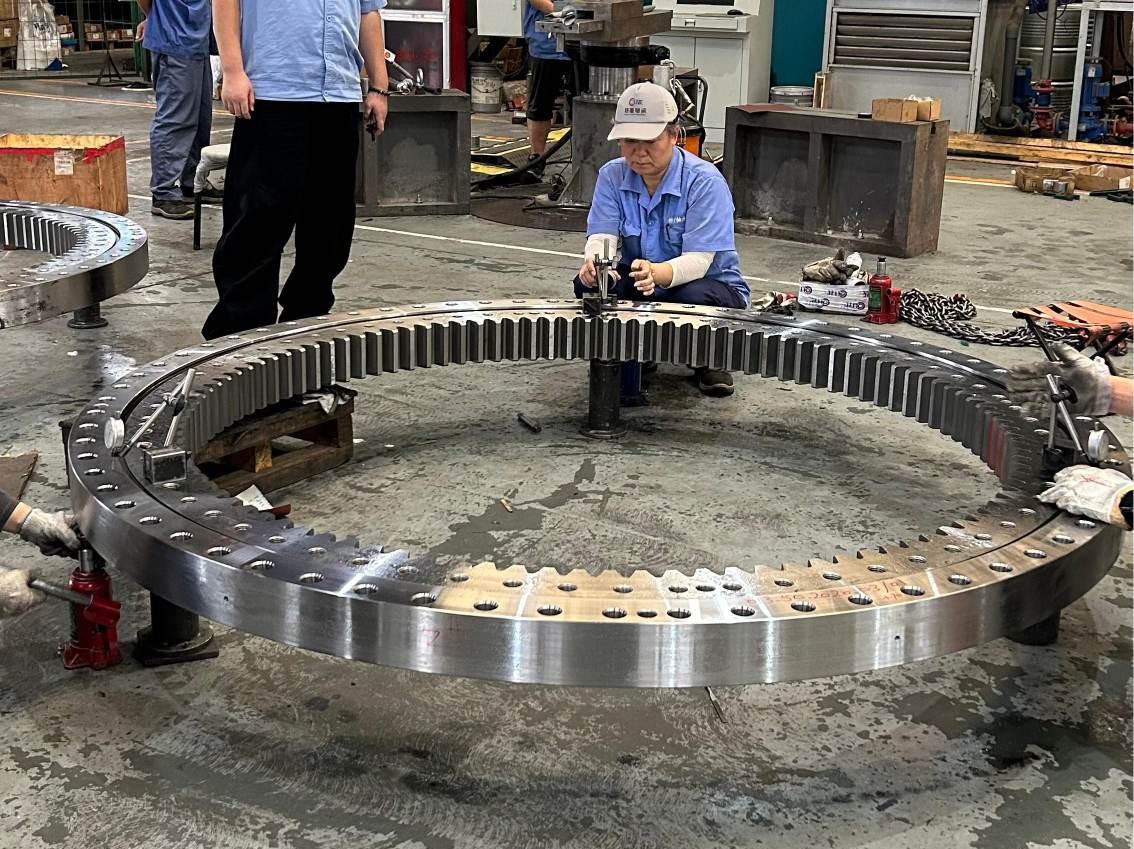
Whether a slewing bearing is installed correctly is a critical factor influencing its service life; even the highest-quality product can fail within a few months if installed incorrectly.
What are the common issues encountered during slewing bearing installation?
Uneven Mounting Surfaces
Distortion caused by welding the base, or significant machining errors, can result in localized stress concentrations.
Insufficient Bolt Preload
Bolts may loosen during operation, leading to fretting wear.
Incorrect Tightening Sequence
Tightening one side first can cause the bearing to deform.
Using Standard Bolts Instead of High-Strength Bolts
How can proper installation procedures prevent premature bearing failure?
✅ Verify the flatness of the mounting surface.
✅ Tighten bolts to the torque values specified in the instruction manual.
✅ Employ a cross-pattern, multi-stage tightening sequence.
✅ Use compliant, high-strength bolts.
✅ Perform a no-load rotation test after installation.
Top 4: Seal System Failure
The seals on a slewing bearing serve to prevent external contaminants—such as dust, cement, and grit—from entering the bearing's interior, thereby protecting its internal structure. Machinery operating in sectors such as mining, cement production, ports, marine transport, and forestry requires particular attention to the slewing bearing's sealing system. Should external impurities penetrate the bearing, they will accelerate wear on the raceways and rolling elements, disrupt the lubrication system, and ultimately hasten bearing failure.
How can bearing failure be prevented through the sealing system?
✅ Select high-quality sealing structures.
✅ Regularly inspect seals for signs of aging or deterioration.
✅ Ensure outdoor equipment is properly covered when shut down.
✅ Increase maintenance frequency in highly contaminated environments.
✅ Utilize corrosion-resistant configurations for equipment located in coastal areas.
Top 5: Gear System Failure
For slewing bearings equipped with gears, many failures do not stem from damage to the raceway itself, but rather from issues affecting the gear ring—such as wear and pitting, incorrect meshing clearance, or excessive load concentration at the gear roots—all of which can lead to a failure of the slewing bearing's gear system.
Manifestations of Slewing Bearing Gear System Failure: Abnormal meshing noises, pronounced vibration, gear tooth surface pitting, localized material spalling, and broken teeth.
How to Prevent Gear Ring Failure in Slewing Bearings?
✅ Correctly adjust the center distance and backlash.
✅ Lubricate the gear tooth surfaces regularly.
✅ Inspect the pinion for wear and replace it simultaneously when necessary.
✅ Control and minimize shock loads during startup and braking.
✅ Procure high-quality gear ring products.
Top 6: Bearing Selection Errors
What are the common errors in bearing selection?
Substituting a light-duty structure for a heavy-duty structure
Overlooking usage frequency
Ignoring environmental factors
Failing to apply anti-corrosion treatment to seaside equipment
Disregarding precision requirements
What parameters are required for proper bearing selection?
Axial load, radial load, overturning moment, rotational speed, operating frequency, operating temperature, environmental conditions, and target service life
How Does LTZC Help Clients Minimize Failure Risk?
As a professional manufacturer of slewing bearings, LTZC has dedicated over 30 years to the bearing industry. We have accumulated extensive manufacturing expertise across sectors such as ports, mining and metallurgy, construction machinery, and marine vessels, enabling us to provide comprehensive solutions to our global partners:
1. Precise Product Selection Support
Based on an analysis of the loads and operating conditions provided by the client, we offer a diverse range of slewing bearings featuring various structural designs and dimensions—including four-point contact ball slewing bearings, double-row ball slewing bearings, crossed roller slewing bearings, and three-row roller slewing bearings.
2. High-Standard Manufacturing
We utilize premium materials such as 42CrMo and 50Mn, complemented by LTZC’s advanced heat treatment processes for raceway strengthening and high-precision gear machining capabilities.
3. Global Customer Service
We provide comprehensive support services, including bearing installation guidance, lubrication planning, solutions for replacing international brand components, and custom design services for non-standard specifications.
Contact LTZC to Solve Your Bearing Challenges.