WhatsApp
 jessica.chai@ltzzc.com
 0086-379-69950051

How to Source a Double Row Ball Slewing Ring Bearing for Medium to High Loads
The most expensive sourcing mistakes happen before the purchase order. A quote arrives, the price looks right, and only after delivery does the team find that the gear module is wrong, the seal does not suit the site, or the bolt circle leaves no room for the structure. A Double Row Ball Slewing Ring Bearing is often specified for medium to high loads, so an incomplete RFQ costs real money. This guide covers what to define, what to ask a supplier, and where our Double Row Ball Slewing Bearing range fits.
If you are still deciding between bearing families, read our bearing selection guide first. Come back here when you are ready to write the RFQ.
Supplier role: what LTZC can support in your RFQ
LTZC Bearings Co.,Ltd. was established in 1992 and operates from a 20,000 m² facility. Our scope covers slewing bearings, non-standard precision bearings, gear rings, racks, bearing unit assemblies, Slewing Drives and gear parts. For a rotary assembly, that means the bearing, the gear and the surrounding parts can be discussed in one conversation instead of three.
Our quality system is certified to ISO9001:2015, with ISO14001:2015 and ISO45001:2018 also in place. The brief also lists certification by ISO, CCS and ABS. If your project needs a specific classification document, ask for it by name and project scope. Do not assume it applies to every part number.
Material options we work with include GCr15, SUJ2, 42CrMo, 20CrMo, AISI 440C, CuSn6 and Ti-6Al-4V. Which one suits a double-row ball bearing depends on load, environment and heat-treatment route. State your preference in the RFQ, or ask us to propose one from your working conditions.
Confirm the bearing type before sending the RFQ
A double-row ball design carries axial load, radial load and tilting moment in one compact section. It is a common choice when a single-row bearing runs out of capacity but a roller design would be heavier or more expensive than the duty needs. It is not the answer for every heavy rotation.
| Option | Best fit | Limit to check |
|---|---|---|
| Double row ball | Medium to high combined loads where section height and weight matter | Very high overturning moments or shock loads may need a roller design |
| Single Row Ball Slewing Bearings | Moderate loads, compact and cost-sensitive designs | Capacity can fall short once moment load grows |
| Four Point Contact Ball Slewing Bearing | Lighter duty combined loads in a single raceway | Less load margin than two ball rows in the same envelope |
| Three Row Roller Slewing Bearings | Heavy, continuous or shock-prone loads, large diameters | Higher cost and mass; may be more than the duty requires |
If your load calculation sits close to the edge between two types, say so in the RFQ. A supplier can then quote both, rather than guessing which you meant.
Sourcing action map: from load case to RFQ inputs
This table links the four things that most often decide whether a quotation is usable (load case, mounting dimensions, gear type and sealing) to the data you should include. Each missing input is a place where a supplier has to assume something, and assumptions are how unsuitable quotes get written.
| Area | What to put in the RFQ | What goes wrong if it is missing |
|---|---|---|
| Load case | Axial, radial and tilting moment values for normal operation and for the extreme case; whether loads are static, oscillating or continuously rotating; shock or wind-gust factors | The supplier sizes for the wrong duty. You get an undersized bearing or an expensive oversized one. |
| Mounting dimensions | Outer and inner diameter, overall height, bolt circle, hole count and size, thread or through-hole, counterbore needs, and the stiffness and flatness of the mating structure | The bearing does not fit the frame, or fits but deforms under bolt preload and loses life. |
| Gear type | No gear, external or internal gear; module, tooth count, pressure angle, tooth hardening requirement, and pinion or drive details if it is a slewing ring gear | The gear cannot mesh with your drive, or the tooth strength does not match the torque path. |
| Sealing | Environment (dust, water spray, salt, temperature range), seal material preference, grease type and lubrication access points | Contamination reaches the raceways early. Seal and grease choices get reduced to a default. |
| Material and finish | Preferred steel grade or "supplier to propose"; corrosion protection or coating requirements | Quotes cannot be compared on a like-for-like basis. |
| Quantity and timing | Order quantity, whether repeat orders are expected, and required delivery date | Lead time and price are quoted on guesswork. |
Typical applications, such as wind turbine yaw and pitch systems, concrete pump trucks and solar trackers, have very different load profiles and sealing needs. Naming your application in the RFQ helps the supplier ask the right follow-up questions. For energy projects, see how we frame requirements on our Wind & Renewable Energy page.
Common RFQ mistakes that produce unsuitable quotes
Sending only a catalogue model number. Without load data and interface drawings, the supplier cannot confirm the model suits your machine.
Quoting peak load only. A bearing that survives one extreme case may still fail under daily oscillation. Give both.
Leaving the gear open. "With gear" is not a specification. Module, tooth count and hardening all change cost and fit.
Ignoring the mating structure. A flexible frame changes how the bearing carries load. Mention it, or attach the structure drawing.
Treating the seal as an afterthought. Washdown, dust and marine air need different protection. A default seal is not a safe assumption.
Comparing quotes on price alone. A lower price may rest on a different material, a lighter heat-treatment route or a smaller load rating.
A step-by-step RFQ workflow for engineers and buyers
Freeze the load case. Engineering supplies axial, radial and moment values, plus duty type.
Lock the interface. Attach the mounting drawing with diameters, height, bolt pattern and any envelope limits.
Define the gear. State gear position and parameters, or confirm that none is needed.
Specify the environment. List temperature, contamination and corrosion exposure so sealing can be proposed.
Add commercial data. Include quantity, target delivery and any documents required, such as certificates or inspection records.
Send the same package to every supplier. This keeps quotes comparable.
Review technical replies before price. Check that each supplier has confirmed load capacity and interface fit, not just a number.
If the standard range does not match your envelope, our Customized Bearings service works from your working conditions, existing designs and technical specifications.
Evidence to request, and what we can show
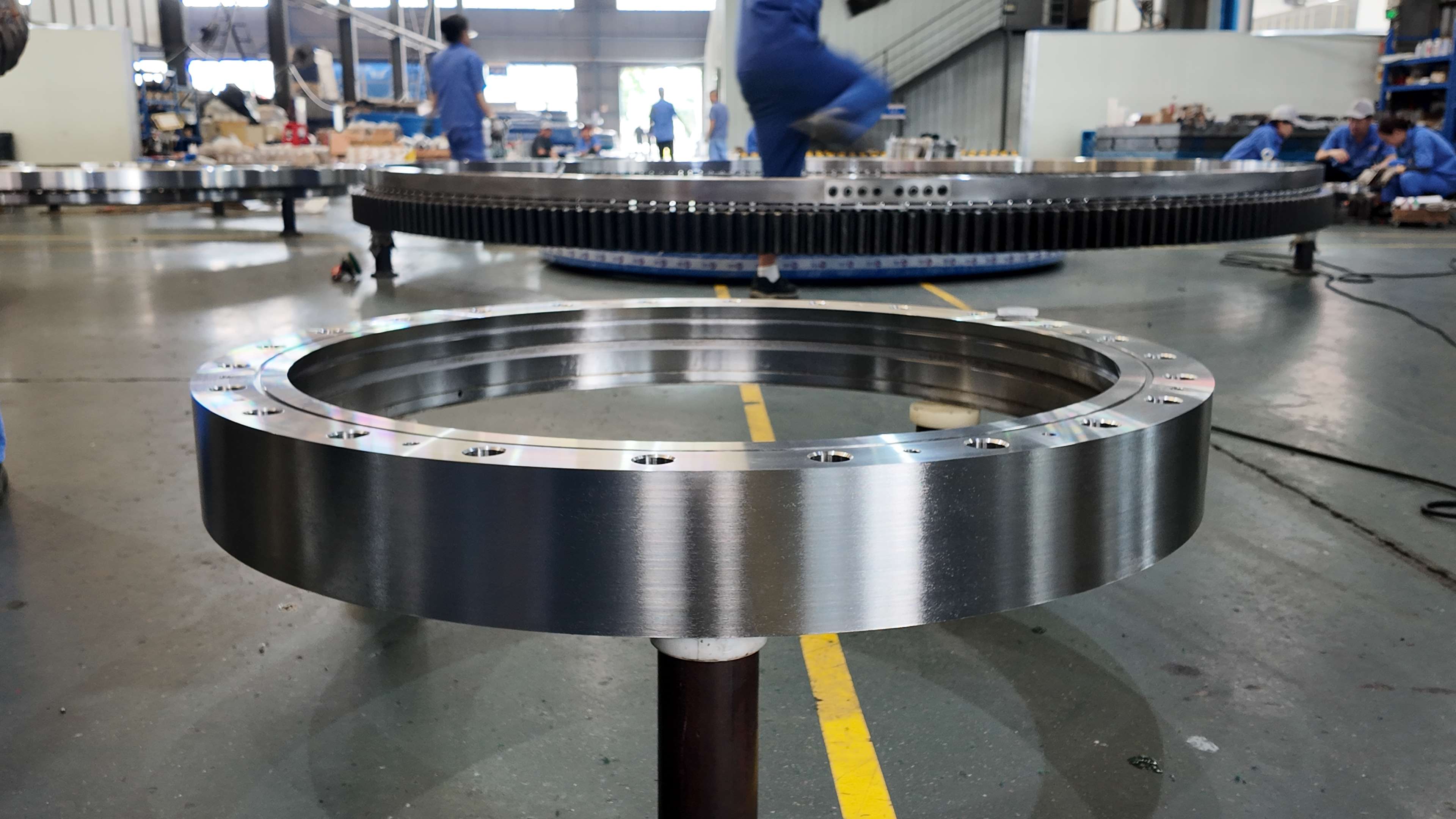
Capability claims are easy to write. Ask for proof that matches your size, load and documentation requirements. Our cases show large-diameter slewing and gear-ring work, though none is a double-row ball design, so treat them as evidence of manufacturing scale, not of a match to your duty.
2024, 10.87 m outer diameter: an integral three-row roller slewing ring for 2,000 ton fixed lifting equipment, our largest to date.
2024, 8.445 m outer diameter: an integrated bearing for a crane-industry client in South Korea.
3 m turntable bearing: used to hold up the main torch tower at the World Military Olympic Games opening ceremony.
6 m segmented gear ring: supplied with ground teeth to a Hengshui customer and delivered to end customers.
For crane-type duty, see our Crane Slewing Bearing page. When you request references, ask which case is closest to your size, gear type and environment, and ask what documentation exists for it.
Cooperation terms and what still needs agreement
We set no minimum order quantity, so a single prototype or a small batch can be quoted. Delivery runs from 30 to 90 days, and the actual figure depends on size, material, gear requirements and current schedule. Treat the range as a planning window, not a promise for every order, and confirm the date against your drawing.
After delivery, support covers installation guidance, maintenance training, fault analysis and on-site technical assistance. Quality objections receive a response within 24 hours, and on-site service within China starts within 48 hours. Service outside China should be agreed per project. For mounting practice, see our bearing installation guidance.
Items to settle in writing before an order:
Final drawing revision and tolerances
Material, heat treatment and gear hardening scope
Inspection records and certificates to be supplied
Packaging and shipping terms
Acceptance criteria and who is responsible if a nonconformity appears
These are points to agree on a per-project basis, not fixed terms that apply automatically.
Pre-RFQ checklist
Load values for normal and extreme cases, with duty type
Mounting drawing with bolt circle, hole size and envelope
Gear parameters or a confirmed no-gear decision
Environment and sealing needs
Material preference or request for a proposal
Quantity, delivery date and document requirements
If you can fill most of these, send your drawings and load data to our engineering team. We will confirm whether a double-row ball design suits the duty, or recommend another type, and quote against the same inputs. Jessica Chai, Slewing Bearing Engineer, and the team can also help when your data is incomplete: share what you have and we will tell you what is still missing.