WhatsApp
 Eric.wang@ltzzc.com
 0086-379-69950051

How LTZC Helped a Crane Manufacturer Resolve Premature Bearing Wear Issues
Common Faults of Crane Slewing Bearings
Crane slewing bearings frequently face high-intensity operating conditions, requiring long-term, continuous operation in environments characterized by high dust levels, heavy impact, and extreme loads. As a critical core rotating component within crane equipment, the slewing bearing facilitates the machine's 360-degree rotation while supporting immense loads; consequently, its performance dictates the crane's overall stability, safety, and service life. However, many crane manufacturers encounter a persistent and vexing issue in their actual operations: premature bearing wear.
While the equipment is originally designed for a service life of five—or even eight—years or more, certain projects begin to exhibit the following anomalies after operating for just a few months:
Significantly increased abnormal noise during slewing operations;
Severe wear on the gear ring, resulting in rough or uneven meshing;
Difficulty initiating slewing movements, accompanied by elevated torque levels;
Increased bearing clearance, leading to a decline in hoisting precision;
Seal damage, resulting in grease leakage;
Raceway spalling (flaking), potentially necessitating equipment downtime for repairs.
Such issues not only inflict direct financial losses upon the end customer but also tarnish the brand reputation of the crane manufacturer, drive up after-sales service costs, and—in extreme cases—result in the loss of market competitive advantage.
As a specialized manufacturer of slewing bearings, LTZC leverages its extensive experience in designing large-scale bearings, its rigorous manufacturing protocols, and its global customer service capabilities to assist numerous crane manufacturers in resolving issues related to premature bearing wear—thereby extending equipment service life, reducing after-sales support costs, and enhancing the overall performance of the finished machinery.
I. Client Background: The Dilemma of a Mid-to-Large-Scale Crane Manufacturer
The client is an equipment manufacturer specializing in wheeled cranes, tower cranes, and port cranes. Their products are primarily exported to markets in Southeast Asia, the Middle East, and South America. Having recently launched a new project, the client sought a high-quality yet cost-effective slewing bearing, as well as a reliable slewing bearing supplier for a long-term partnership. Based on the client's feedback regarding the market performance of their crane equipment, it became apparent that—as sales volumes increased—they began to receive frequent complaints from end-users:
1. Slewing Abnormalities Occurring Within One Year of Operation
After 8 to 12 months of operation, the majority of the equipment began to exhibit various adverse symptoms, including jerky slewing motions, increased abnormal noise, pronounced impact shocks during startup, and a decline in positioning accuracy.
2. Abnormal Rate of Gear Ring Wear
Upon taking the equipment out of service for disassembly and inspection, technicians discovered pitting on the gear ring's tooth surfaces, severe wear at the tooth roots, and poor gear meshing.
3. Rapidly Rising After-Sales Costs
Each year, the client was compelled to bear significant expenses, including on-site disassembly and repair costs, the cost of shipping spare parts overseas, and financial compensation for losses incurred due to equipment downtime.
4. Diminishing Market Competitiveness
Consequently, some end-users began to switch to equipment from competing brands. The client realized that unless the issue regarding bearing service life was resolved, it would severely jeopardize the company's future growth. As a result, the client contacted LTZC, seeking a comprehensive system-level solution rather than merely a replacement set of bearings.
II. How the LTZC Engineering Team Conducts Problem Diagnosis
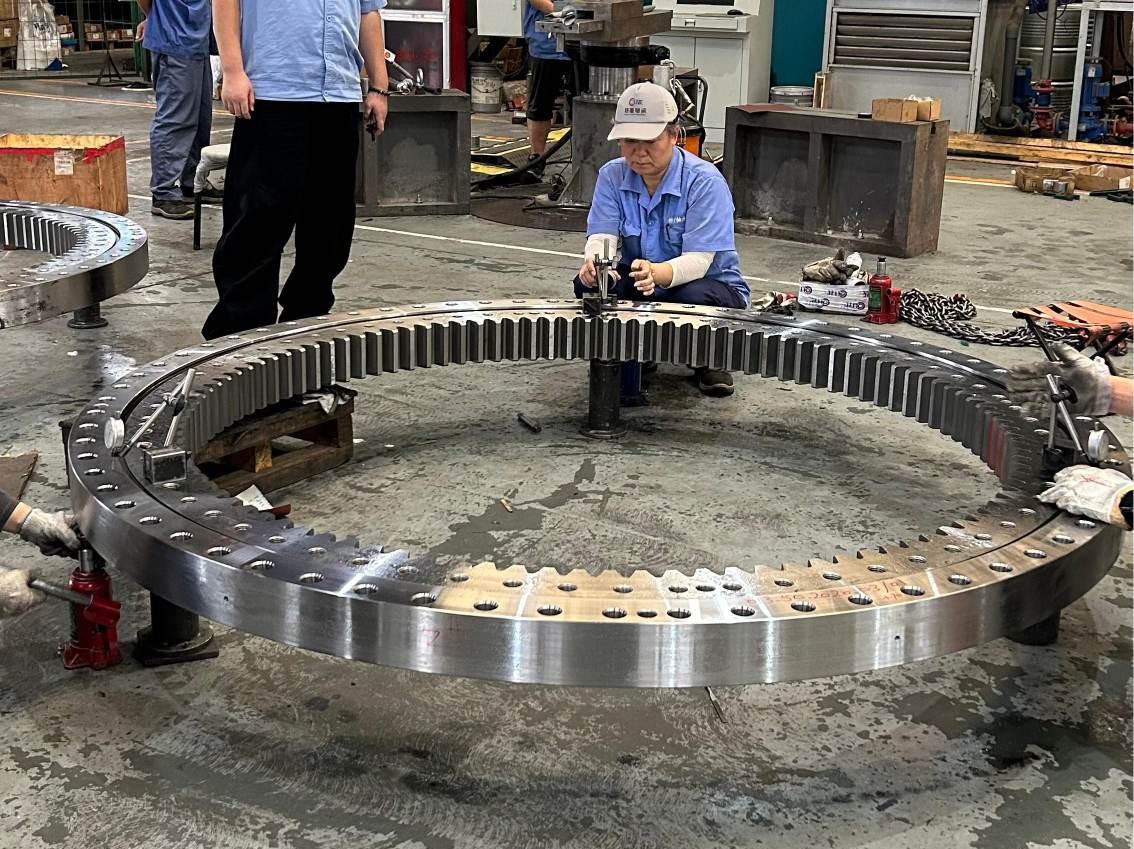
Collecting Comprehensive Equipment Operating Data
| Data Item | Description / Details |
|---|---|
| Crane tonnage class | Rated capacity (e.g., 50t, 100t, etc.) |
| Maximum lifting load condition | Actual max load under typical operation (including dynamic effects) |
| Boom length variation range | Minimum to maximum boom length (m) |
| Slewing speed | Normal operating slewing speed (rpm) |
| Daily working cycles | Number of complete working cycles per day |
| Mounting base structural drawing | Drawing or dimensions of the mounting base structure |
| Drive system parameters | Motor/pinion type, power, reduction ratio, etc. |
| On‑site environmental conditions | High temperature, dust, salt spray, humidity, etc. |
2. Inspection of Failed Bearings
Raceway surface fatigue → May indicate an insufficient safety factor in the selection process or inadequate hardness.
However, if characterized by localized indentations accompanied by surrounding spalling → This may indicate the ingress of foreign objects or damage sustained during installation.
Severe wear at the gear root → May stem from poor gear meshing rather than a quality defect in the gear itself.
Grease contamination → Indicates seal failure or improper maintenance; this is classified as an issue related to the end-user's operational environment.
3. Establishment of the Load Model
LTZC utilizes engineering calculation software to simulate the equipment's slewing structure, focusing on the analysis of bearing axial loads, radial loads, overturning moments, impact loads, and eccentric loading conditions.
III. Core Causes of Premature Bearing Wear
Based on an analysis of technical information provided by the client—supplemented by on-site inspections and dimensional surveys of the operating conditions—LTZC has identified the following five major issues affecting the client's equipment:
Cause 1: Insufficient Load-Bearing Capacity of the Original Bearing Structure
The client originally utilized standard single-row four-point contact ball slewing bearings. While cost-effective, this design proved inadequate for medium-to-large-scale cranes; the ball bearings were unable to sufficiently support the equipment's operational loads. This resulted in accelerated localized raceway fatigue and insufficient capacity to withstand overturning moments—a deficiency that became particularly acute when the crane boom was extended to lift heavy loads, subjecting the bearings to stress levels far exceeding the optimal operating range for such standard structures.
Cause 2: Insufficient Hardness and Wear Resistance of the Gear Ring
The gear ring supplied by the original vendor underwent only standard quenching and tempering treatments, lacking any deep-layer surface hardening. Consequently, during the high-frequency start-stop cycles typical of slewing operations, the gear teeth experienced rapid surface wear, leading to a decline in gear mesh precision.
Cause 3: Insufficient Machining Precision of the Mounting Base
LTZC inspections of the client's mounting base revealed deviations in flatness, significant welding-induced deformation, and localized areas of insufficient structural support. These deficiencies resulted in uneven load distribution across the bearing after installation, subjecting specific rolling elements to chronic overloading over the long term.
Cause 4: Inadequate Lubrication Strategy
The client utilized generic-purpose grease on-site and failed to adhere to a schedule for regular replenishment. This lack of a coherent lubrication plan led to the breakdown of the internal lubricant film within the slewing bearing and resulted in severe internal contamination, thereby significantly accelerating metal-to-metal contact wear.
Cause 5: Sealing System Unsuited to Harsh Environments
Crane slewing bearings are frequently exposed to complex and demanding operating environments—including dust, sand, rain, and salt spray—which place rigorous demands on the bearing's sealing system. However, the original sealing structure employed by the client was simplistic in design and incapable of effectively withstanding these harsh conditions. This failure allowed contaminants to infiltrate the raceway interiors, thereby accelerating abrasive wear.
IV. LTZC Develops Comprehensive Slewing Bearing Solutions
Addressing various operational challenges—such as insufficient structural load-bearing capacity, susceptibility to wear, poor sealing performance, abnormal operating noises, and a short service life—LTZC has developed a comprehensive, systematic, and integrated equipment upgrade solution. Tailored specifically to the equipment's operating conditions, environmental factors, and critical failure points, this solution optimizes performance across six key dimensions: structural design, manufacturing processes, precision, sealing, operations and maintenance (O&M), and installation. By doing so, it thoroughly eliminates hidden operational hazards, extends the equipment's service life, and reduces O&M costs for the client. The specific upgrade plan is outlined below:
Solution 1: Structural Upgrade — Replacement with a Three-Row Roller Slewing Bearing
To address the inherent limitations of the original single-row roller slewing bearing—specifically its singular load-bearing mode, concentrated stress points, and low load capacity ceiling—LTZC has upgraded the customer's system to a three-row roller slewing bearing structure.
1. Substantial Increase in Load Capacity: The three rows rollers slewing bearing operate with distinct functional roles, independently supporting axial loads, radial loads, and the equipment's overturning moment. This design resolves the issues of superimposed stresses and load overloading inherent in single-row structures, resulting in a significant upgrade to the equipment's overall load-bearing performance and enabling it to meet the demands of high-intensity operations.
2. Optimized for Heavy-Duty Equipment Conditions: This structure boasts exceptional compatibility and is specifically tailored for heavy lifting machinery—such as port cranes, large-tonnage truck cranes, crawler cranes, and marine cranes. It is perfectly suited for industrial operating environments characterized by heavy loads, high-frequency usage, and high-intensity demands.
3. Extended Bearing Fatigue Life:The layered load-bearing mechanism effectively reduces contact stress between individual roller sets and their raceways. This minimizes wear and indentation damage during equipment operation, substantially enhancing the raceways' fatigue resistance and effectively extending the overall service life of the bearing.
Solution 2: Optimized High-Strength Heat Treatment for Gear Rings
To address issues such as excessive wear, surface pitting, abnormal meshing noise, and unstable transmission, LTZC applies a comprehensive, precision heat treatment regimen to the equipment's gear rings. This process involves full-body quenching and hardening to enhance both the wear resistance and precision of the gear rings.
Solution 3: High-Precision Control
LTZC is equipped with precision CNC machine tools. The entire production and machining process is executed using high-end intelligent manufacturing equipment—including CNC vertical lathes, precision gear hobbing machines, high-precision gear grinding equipment, and specialized raceway grinding machinery. We strictly monitor core equipment precision parameters to precisely control critical indicators such as radial runout, axial runout, gear ring concentricity, and gear flank clearance consistency.
Solution 4: Customized Dual-Layer Bearing Sealing System
LTZC has independently developed and designed a dual-layer, split-type sealing structure to provide comprehensive protection for the equipment's internal components. The outer sealing layer serves primarily to prevent external impurities—such as mud, moisture, and dust—from intruding into the interior of the equipment.
Solution 5: Customized, Specialized Lubrication System
Lubrication is critical to ensuring the stable operation of rotary equipment; improper lubrication methods or schedules can significantly shorten equipment service life. Drawing upon various operational scenarios, LTZC develops a comprehensive, standardized, and differentiated equipment lubrication management system tailored specifically to each client's needs.
V. What Support Can LTZC Offer to Global Crane Manufacturers?
As China's leading manufacturer of slewing bearings, LTZC provides comprehensive, one-stop solutions:
Selection of Slewing Bearings for Cranes
Custom OEM Bearing Design
Manufacturing of Large-Diameter Gear Rings
Upgrades for High-Strength Roller Structures
Bearing Solutions for Port Cranes
Bearing Solutions for Marine Cranes
Bearing Solutions for Tower Cranes
Post-Sales Failure Analysis Services
Premature wear in crane bearings is never merely a simple component issue; rather, it is a systemic issue involving the entire machine. For crane manufacturers, choosing LTZC means acquiring not just a set of bearings, but a mature and reliable solution for rotational load-bearing systems.
Contact LTZC to Solve Bearing Wear Challenges