WhatsApp
 Eric.wang@ltzzc.com
 0086-379-69950051

How does slewing drive work ?
In modern industrial machinery, equipment manufacturing is increasingly trending toward high-precision automation and intelligent operation. The rotational component—a critical element in such systems—has evolved into an indispensable "rotational joint" within this equipment, representing a pivotal technology within the field of bearing manufacturing. From construction machinery and automated equipment to solar tracking systems and wind power generation units, these devices frequently require stable and precise rotational motion while simultaneously withstanding immense loads. Within this context, the **Slewing Drive** serves as the core component responsible for enabling this essential functionality.
As a specialized manufacturer of slewing drives, LTZC has long dedicated itself to the R&D and production of slewing drives and slewing bearings. By optimizing structural design, material selection, and manufacturing processes, we provide global clients with highly reliable and high-precision slewing drive solutions.
What is a Slewing Drive?
A slewing drive is a mechanical transmission device designed to facilitate rotational motion. By utilizing a worm gear mechanism to drive a slewing ring, it converts the power generated by an electric motor or hydraulic motor into a stable rotational output. Compared to traditional gear reduction mechanisms, the defining characteristic of a slewing drive is the integration of the slewing bearing and the transmission mechanism into a single unit, thereby offering the advantages of a compact structure, high load-bearing capacity, and ease of installation.
Structural Components of a Slewing Drive
Slewing bearing
Worm gear transmission system (worm gear / slewing gear)
Drive motor or hydraulic motor
Sealing system
Housing structure
Together, these components constitute a complete rotational drive system, enabling equipment to operate stably under complex working conditions.
Key Features of a Slewing Drive
1. High Load-Bearing Capacity
Slewing drives typically incorporate a large-scale slewing bearing structure. Within the drive unit, the slewing bearing serves as the core component responsible for supporting axial loads, radial loads, and overturning moments, while also enabling 360-degree rotation.
2. High-Precision Positioning
Through its worm gear transmission structure, a slewing drive can achieve a high reduction ratio, thereby providing precise angular control—a feature that is particularly critical for solar tracking systems and automated equipment.
3. Self-Locking Capability
Many slewing drives utilize a worm gear transmission structure, which possesses an inherent self-locking function. When an external load attempts to drive the system in reverse, the worm gear mechanism prevents counter-rotation, thereby ensuring the stability of the equipment.
4. Compact Structure
Traditional rotational systems require the separate installation of bearings, gears, and reducers; in contrast, a slewing drive integrates these components into a single module, resulting in significant space savings during installation.
What are the different types of slew drives?
Slewing drives can be categorized into various types based on their structural design, transmission method, and specific application requirements. Different types of slewing drives possess distinct characteristics regarding load-bearing capacity, precision, efficiency, and suitability for specific application scenarios. For fields such as construction machinery, solar tracking systems, and industrial automation equipment, selecting the appropriate type of slewing drive is of paramount importance.
I. Classification by Structural Form
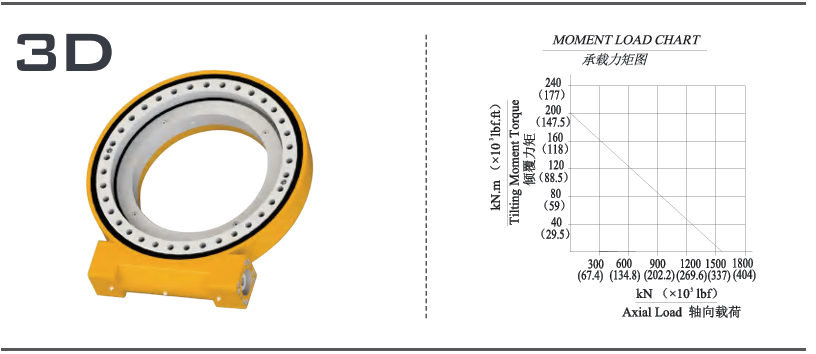
1. Single Worm Slewing Drive
The single worm slewing drive is currently the most widely utilized type of slewing drive structure. Internally, it employs a single worm gear that meshes with the slewing bearing gear ring to transmit power. This design offers lower costs, features self-locking capabilities, and is well-suited for medium-load applications.
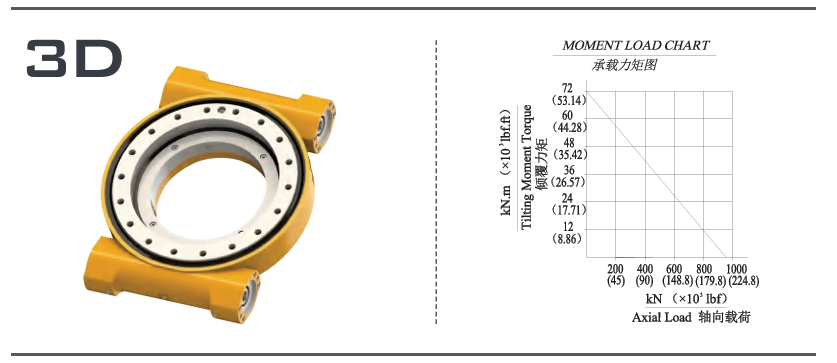
2. Dual-Axis Slewing Drive
The dual-axis slewing drive represents an upgraded design based on the single worm structure; internally, it features two worm gears that simultaneously drive the same slewing gear ring. This configuration ensures more stable transmission and delivers higher output torque compared to the single worm slewing drive. The double worm structure significantly enhances both the load-bearing capacity and the stability of the slewing drive.
II. Classification by Sealing Structure
1. Open Housing Slewing Drive
In an open housing slewing drive, the gear structure is partially exposed to the external environment and requires external lubrication for protection. Due to the absence of a protective housing, it offers excellent heat dissipation performance; however, its internal components are susceptible to contamination by dust and impurities.
2. Enclosed Slewing Drive
The enclosed slewing drive is currently the mainstream design structure, in which the internal gears and bearings are fully sealed within a protective housing. Featuring a comprehensive sealing mechanism, it offers robust protection against dust and impurities, resulting in a relatively longer service life.
How Does a Slew Drive Work?
The operating principle of a slew drive is primarily based on a worm gear transmission mechanism; the worm gear generates and transmits power to a slewing ring gear, thereby driving the entire assembly to rotate.
The entire operational process can be broken down into the following steps:
Step 1: Power Input
A drive motor or hydraulic motor begins to operate, driving the worm shaft to rotate.
Step 2: Worm Drives the Worm Gear
The worm engages with the worm gear ring. As the worm rotates, it drives the worm gear ring to rotate slowly. Due to the worm gear structure's high reduction ratio, the output rotational speed is reduced, while the output torque is significantly amplified.
Step 3: Slewing Bearing Rotation
The worm gear ring is typically attached to either the outer or inner ring of the slewing bearing. As the worm gear rotates and transmits power, the slewing bearing rotates in tandem, thereby driving the equipment platform to rotate.
Step 4: Withstanding Multi-directional Loads
During the rotation process, the slewing bearing simultaneously withstands axial loads, radial loads, and tilting moments; this capability enables the slew drive to maintain stable operation under heavy-load conditions.
LTZC slewing drive applications
The slewing drive is an indispensable and critical component in modern industrial equipment; by integrating a slewing bearing with a worm gear transmission system, it achieves both high load-bearing capacity and precise rotational control. Its compact structure, high torque output, and excellent self-locking capabilities have led to its widespread application in solar tracking systems, construction machinery, wind power generation equipment, and the field of industrial automation.
As a professional manufacturer of slewing drives, LTZC delivers high-performance, highly reliable slewing drive solutions to customers worldwide through continuous technological innovation and rigorous quality control.
Contact LTZC for slewing drive catalog